
Currency
 Plus what’s next for Gold?
When the euro arrived on the scene, it took over around 32% of global foreign exchange reserves from the USD, with the tacit approval of the U.S. This dropped the USD’s percentage of global reserves from 95% to around 63%. Since then [2000] its percentage of reserves dropped from 63% to 53% and now has risen back to 56%.
Arrival of the Euro
When the Euro arrived on the scene, gold continued to be held –with the exception of the amounts sold under the Washington Agreement and the Central Bank Gold Agreements—alongside the Yen, Sterling and the Swiss Franc.
The monetary system from the end of the World War has been firmly under the control of the U.S., with all other nations and their currencies dependent on the dollar’s proper functioning as the monetary system’s global foundation. The system functioned properly so long as the USD was managed as money measuring values across the world. Yes, the world had to accept the “exorbitant privilege” of the constant Trade Deficit, which worked well so long as the world’s economies, on balance, continued to grow, but the USD provided global liquidity and facilitated a globalization of world trade.
Unfortunately, the dollar and the Fed were beset by a major conflict of interests. On the one hand, the dollar had to be the stable base for the world’s monetary system; on the other hand, it had the task of coping with a U.S. economy and assist in maintaining stable prices and do all possible to assist in U.S. growth and low unemployment. These two tasks have become incompatible.
As this became clearer from the credit crunch in 2007 until now, confidence in the USD has declined.
Relationship of Currencies to the USD
The loss of confidence in the dollar is palpable, but as each attempt to find alternative currencies to the dollar was made, so the central banks of those currencies balked at the damage the ‘safe-haven’ treatment of their currencies caused to the int’l competitiveness. One by one, the exchange rates of ‘safe haven’ currencies was undermined by their central banks. First the Japanese Yen, then the Swiss Franc, were undermined as fleeing wealth sent their exchange rates through the roof. The net result was that other currencies showed themselves to be no more than branches on the ‘dollar tree’.
The net result has been that the entire currency system now shares in the loss of confidence in the dollar and carefully follows the course of cheapening the value of currencies alongside the dollar. This has left the dollar the sole global reserve currency once again, despite its increasingly threatening structural faults.
Loss of Confidence in the USD, then other Currencies
The fall in the percentages of the USD held as reserve assets from 63% in 1999 to 53% in 2012 precisely measured the loss of confidence in the dollar, as a currency, as attempts were made to flee to currency alternatives.
Short-term flights to other currencies still happen and will still happen as interest rate differentials remain tempting sources of profits. But the concept of ‘safe-haven’ currencies has gone. Once U.S. interest rates start to rise, we may well see a decimation of the liquidity levels. Nations with other currencies will suffer; nations with current account deficits will be the first victims of interest rate rises.
So why did the percentage of reserve portfolios move back to 56% in the second quarter of 2013?
This was an important change in the global monetary system.
Looking around after this change, it became clear that all currencies would follow the same course as the ‘Swissy’ and the Yen who are continually weakened by their central banks. With the bulk of the globe’s trade still transacted in the USD, no nation canafford to undermine its exports by allowing their currency to strengthen too much.
The same holds true of the Chinese Yuan at the moment and will do so until it can assist in carrying the mantle now being carried by the U.S. as the sole global reserve currency. The Yuan is close to becoming an alternative global reserve currency, a destination that the U.S. cannot change.
Confidence in the USD-based on Oil
Only oil producers whose balance of payments rests entirely on oil revenues, or nations who are self-sufficient in oil, can afford to allow their currencies to strengthen. This is because confidence in the dollar relies on being the currency in which oil is sold. If oil were prices in the globe’s main currencies, the exchange rate of the dollar would reflect it Balance of Payments. This would lead to a persistently declining exchange rate.
But even where an economy relies heavily on oil exports, if they have an export sector outside oil, they will force their exchange rates down or held steady against the dollar to protect those exports.
This emphasizes that the fundamental purpose of a currency is to assist in the int’l promotion of a nation. This implies that a currency is no longer a real store or measurer of value either locally of internationally.
So the dollar has returned, at the moment, to the foundation of currencies and the one that central banks will prefer to hold because it is the best of a bad bunch and the one on which the others rely.
Arrival of the Yuan
When we look forward we see the Yuan rising in importance as it becomes more and more convertible globally. Over time, expect more and more of China’s int’l transactions to be conducted in the Yuan and not via the dollar. This is a critical change as now the bulk of China’s transactions are done in the USD and then converted –by the People’s Bank of China—into Yuan. There is a date that only the gov’t of China knows, when it will make a change to that pattern.
There is a date somewhere in the near future, when China’s trade invoices are expressed in Yuan. This will necessitate the selling of local currencies directly for the Yuan to pay for imports. It is also likely that exporting countries to China are paid in Yuan and no longer in dollars. Expect the change will come about not precipitously but gradually so as to cause the least disruption to world trade. Once started, this process will not stop. The investor’s skill will be in knowing when that process impacts global trade overall.
To get this in perspective, China has well over $3 trillion in its reserves from trade as it grew steadily over the last 16 years. It’s now a vastly bigger economy and its int’l exposure on both the import and export fronts has grown alongside the expansion of reserves. If this need is changed into Yuan from the dollar, then the drop in the demand for the dollar globally will be precipitous! So it is not only the potential fall in the percentages of reserves in dollars, but the drop in the ongoing use of the dollar as a reserve currency. No nation will want a brutal change, and China will work with other nations to soften the blow much as it can.
Such a change is a pivotal change, particularly as there will be no interdependence between the Yuan and the dollar as we see between the euro and the dollar. China will not seek the interests of the U.S., and the U.S. has little concern for China’s interests.
You may think that at least China will continue to pay for its oil in dollars. Not so! Most of the oil deals China has organized can be switched into the Ruble or euro without strain, and some have already been agreed on that basis. Where there may be difficulty in doing so China will still have its vast $3+ trillion in dollars to use up so as to make the transition as smooth as possible. But eventually, China will have sufficient strength to dictate terms to all oil producers. They too may prefer to diversify out of the dollar then.
Not Gold vs. the USD, but Gold vs. all Currencies
We repeat that the overriding change that occurred since 2012 in asset allocation in reserves is that there has been a return to the dollar because that is the best of the worst among currencies, not because confidence has been restored back into the U.S. dollar. No currency is a safe-haven now.
How does that translate into an impact on gold?
What’s very clear is that if central banks feared for the prospects for the dollar up to 2012 they continue to do so now, because the situation has worsened for the dollar not improved. So where to go now?
Central banks and the entire banking system have disliked gold since the end of the Gold Standard because it prevented the devaluation of currencies without consequences. By removing gold from the monetary scene (except as a disjointed reserve asset) the consequences of devaluation have been removed, for a time. Eventually they will come back to haunt the monetary system, but so far, so good.Nevertheless, consequences are still on the way!
The first impact will hit when China forces a separation of U.S. fortunes from their own. The arrival of the Yuan as a reserve currency (almost on us) will mark the arrival of the first major consequence.
Once this happens, you will see the allocation of dollars in reserve portfolios drop again as the Yuan takes their place. The replacement of the dollar by the Yuan in reserve portfolios will go as fast as the use of the Yuan in global trade grows.
This makes sense of the World Gold Council’s statement we gave you last week,
“As more currencies are included in the reserve system, gold’s relationship with other currencies will likely evolve. It is likely that gold will retain its generally negative relationship with the US dollar, but it will also serve as a hedge againstall fiat currencies. As the monetary system evolves to make room for alternative reserve currencies, gold will have a growing prominence as a balancing mechanism against the risks inherent in fiat currencies.”
The global banking system will continue to fight against gold because of the limits it places on them, but a day is coming when confidence in fiat currencies will have fallen so low that they will reach out to gold for their very survival. As efforts to retain confidence and credibility in the current currency system start to sag, so gold will return to the global monetary system to ensure ongoing liquidity and facilitate the functioning of the current monetary system.
We emphasize that gold will not be brought back as alternative money, but in support of current paper, national money. We may be closer than we think to that point!
At that point, do not expect to see gold measuring by currencies. Gold will measure currencies.
Hold your gold in such a way that governments and banks can’t seize it!
Visit: www.stockbridgeMgMt.com And Enquire @ admin@StockbridgeMgMt.com
Get it First. Subscribe @
Legal Notice / Disclaimer
This document is not and should not be construed as an offer to sell or the solicitation of an offer to purchase or subscribe for any investment. Gold Forecaster – Global Watch / Julian D. W. Phillips / Peter Spina, have based this document on information obtained from sources it believes to be reliable but which it has not independently verified; Gold Forecaster – Global Watch / Julian D. W. Phillips / Peter Spina make no guarantee, representation or warranty and accepts no responsibility or liability as to its accuracy or completeness. Expressions of opinion are those of Gold Forecaster – Global Watch / Julian D. W. Phillips / Peter Spina only and are subject to change without notice. Gold Forecaster – Global Watch / Julian D. W. Phillips / Peter Spina assume no warranty, liability or guarantee for the current relevance, correctness or completeness of any information provided within this Report and will not be held liable for the consequence of reliance upon any opinion or statement contained herein or any omission. Furthermore, we assume no liability for any direct or indirect loss or damage or, in particular, for lost profit, which you may incur as a result of the use and existence of the information, provided within this Report.

Last week I penned an article titled, Gold Bear to End with a Bang. For those of you who prefer video, here is my analysis on video. I warn of the dangerous short-term downside potential in Gold that could mark the end to this bear market. Thus far, this analysis has been on track and has served to protect subscriber portfolios in recent days and weeks.
Sadly, this analysis did not sit too well with “Ranting” Andy Hoffman, marketing man and manipulation guru extraordinaire at precious metals dealer Miles Franklin. Rather than critique my analysis, he resorted to personal attacks in a lengthy rant. When someone attacks you personally, it’s probably because you are right. Moreover, he didn’t even read the entire article because he made numerous errors in reference to its content. Before I get to the larger point, let me correct some of his errors.
First of all, he assumes I’m implying that the gold stocks would not decline given a decline in the price of Gold. This is totally absurd. I noted: There is very strong support sitting right below the summer lows. Here is that same chart which shows the downside potential to that major support.
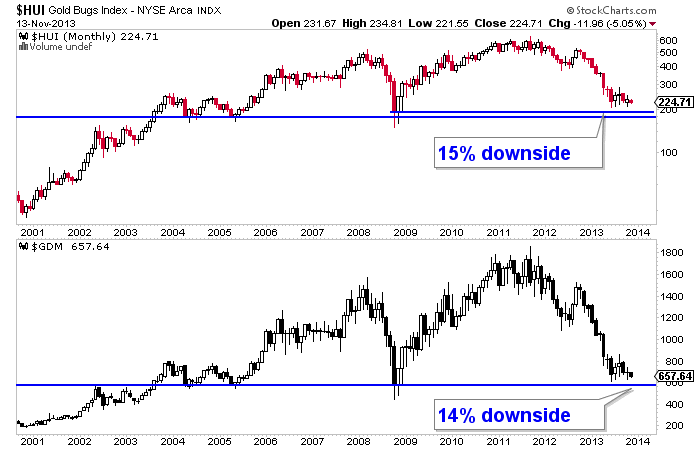
Secondly, he posted only one chart from my article while neglecting not only the other two important charts that show the pattern but also my conclusion. He compares my A-B-C labeling to the Aden Sisters’ pattern of which there is no relation whatsoever.
Third, he mocks the 1976 comparison which is quite foolish in my opinion. In a previous article I noted the several comparisons between today in 1976.
Instead of carefully reading the entire article and considering my analysis, he resorted to attacking me personally and professionally. He tried to denigrate me professionally by mocking my Chartered Market Technician designation and calling me a “two-bit” technician. If that were the case then how did I anticipate the June bottom and big rebound here and here or the top in commodities in 2011and the big decline in Silver in 2011? Surely I’ve made some bad calls but the reality is technical analysis works fine. It fails when the analyst has the wrong interpretation. And by the way, I’m one of only a few legitimately credentialed technical analysts in the gold community.
Furthermore, Hoffman claims that I don’t have my readers interests at heart and am leading them to slaughter. Are you serious? Its disgusting and disingenuous to claim that I don’t have my readers interest at heart. I’m alerting them about the potential for a serious decline. This guy was jamming Silver down people’s throats above $40/oz and he has the gall to call out someone else for making an honest prediction?
Hoffman goes on to mock newsletter writers as a group which I find ironic considering the only references Miles Franklin has (as to its credibility as a dealer) are newsletter writers! Also, according to its website, part of Miles Franklin’s philosophy is integrity. Yet, to attack someone personally and their professional credentials for no sound reason shows that its front man does not represent the company’s philosophy.
Honestly, it’s not surprising. Hoffman and the gold bug conspiracy loving charlatans have made a complete mockery of precious metals and the gold community. As the bear market has persisted these folks have shown no humility and become more fanatical in their already outlandish and ridiculous views.
The bigger the decline, the greater the manipulation they say while raising their already extreme future price targets. The more US equities outperform, the more grandiose the headlines become about the world ending and markets collapsing. Gold goes up, they are right. Gold goes down, they weren’t wrong. It was manipulation. How convenient for these guys. They never lose!
What is hilarious is this group has a double standard with technical analysis. Anytime I post an article with a really bullish chart pattern, the conspiracy brigade will quickly utilize it to its advantage. If my opinion is to the contrary, then they trot out the manipulated market line like a trained monkey.
Not once publicly or to subscribers have I ever blamed manipulation for my own mistakes and failures. It is a loser attitude and prevents growth as a trader or investor. Learning from mistakes is what makes you better in anything.
It’s absolutely pathetic how much Hoffman and his ilk use this excuse to cover up their failed forecasts and pumping of the metals at much higher prices. This whining about manipulation never made anyone one single cent. Do you ever hear money managers or fund managers blame their problems on manipulation? Does anyone actually believe a cartel is naked shorting mining stocks? “Honey I have to get to work early today, we really need to knock down the mining stocks.”
I stick by my forecast and am confident in its outcome. This sector is headed for trouble in the near term but it is likely to be the end of the bear market. There will be a huge and fantastic rebound. When I provide charts showing how much the metals and stocks can rebound, Hoffman and others are free to use them to promote their views. In the meantime, do yourself a favor and tune out the nonsense and anyone who isn’t going to help you make money. I’d be honored if you wanted to learn more about my premium service in which we focus on the gold and silver stocks which will outperform dramatically.
Jordan Roy-Byrne, CMT

Good morning, some fascinating reads to put your brains in gear:
• 10 reasons to be a bull in 2014, a bear by 2017 (MarketWatch)
What Is the Value of Stolen Art? (NY Times) see also Nazi Loot Heirs Look To Reclusive Hoarder to Recover Art (Bloomberg)
• Fracking Boom Gives Banks Mortgage Headaches (American Banker)
• How to be a New Keynesian and an Old Keynesian at the same time (Mainly Macro) see also Quantitative easing, not as we know it (Economist)
• ’The Worst 12-Month Stretch’ in the History of Pay TV (Atlantic)
• Iceland ain’t no Lehman: Paulson to Taconic Frozen in Iceland Bet Five Years After (Bloomberg)
• Why America Has a Mass Incarceration Problem, and Why Germany and the Netherlands Don’t (Atlantic Cities)
• Snapchat Went From Frat Boy Dream to Tech World Darling. But Will it Last? (LA Weekly)
• Crazy cool: New ‘active’ invisibility cloak design ‘drastically reduces’ visibility (Independent)
• 41 Century-Old Predictions for Our 21st Century Socialist Utopia (Gizmodo)

* Yellen’s Fed Chair nomination hearing in focus * U.S. to complete refunding with $16 bln 30-year bond sale * Fed to buy $2.75-$3.50 bln in medium-dated bonds By Richard Leong NEW YORK, Nov 14…….full article HERE

TORONTO, Nov 14 (Reuters) – Canada’s main stock index opened higher after Federal Reserve head nominee Janet Yellen’s indication of support for the U.S. central bank’s monetary stimulus program… … full article

-
I know Mike is a very solid investor and respect his opinions very much. So if he says pay attention to this or that - I will.
~ Dale G.
-
I've started managing my own investments so view Michael's site as a one-stop shop from which to get information and perspectives.
~ Dave E.
-
Michael offers easy reading, honest, common sense information that anyone can use in a practical manner.
~ der_al.
-
A sane voice in a scrambled investment world.
~ Ed R.
Inside Edge Pro Contributors

Greg Weldon

Josef Schachter

Tyler Bollhorn

Ryan Irvine

Paul Beattie

Martin Straith

Patrick Ceresna

Mark Leibovit

James Thorne

Victor Adair