
Mike's Content
 Michael’s Money Talks Show for Nov. 16th.
The Death of Government & our free lunch mentality is 1/2 of the equation. The other 1/2 is the rise of the Private Sector, New Technologies, Innovations & their impact on our lives. It also means change as last week BlockBuster closed its last 300 stores. In the meantime their are exploding companies & industries like Netflix, Facebook while we are on the brink of 3D Printing of Human Organs & food. More below:
{mp3}mtnov16lead2fp{/mp3}
The second hour of Money Talks begins with Michael interviewing Peter Grandich!! Though he never finished high school, Peter Grandich entered Wall Street in the mid-1980s with no formal education or training and within three years was appointed Vice President of Investment Strategy for a leading New York Stock Exchange member firm. He would go on to hold positions as a Market Strategist, portfolio manager for four hedgefunds and a mutual fund that bore his name. Now Peter comments on Markets soley for Money Talks and are we ever glad to have his perspective illustrated in this interview below.
{mp3}mtnov913hourfp{/mp3}

 U.S. stock market gauges racked up a sixth-straight weekly gain. The S&P 500 and Dow Jones Industrial Average again hit record closes today.
- This week Wal-Mart (WMT) reported third-quarter earnings slightly higher than analysts expected. The stock fell, though, because the company reduced its full-year profit forecast. In other words, Wal-Mart doesn’t expect a great holiday shopping season.
- Janet Yellen’s testimony signaled to Wall Street the Fed would not close the QE faucet just yet. That means a giant green light for equities.
- Moody’s downgraded senior debt ratings on four top bank holding companies including Goldman Sachs (GS) and JPMorgan Chase (JPM).
 Explaining its decision, Moody’s thinks the regulatory environment now indicates the banks are less-likely to receive government bailouts in a crisis — and leave bondholders with higher risk.
- Government-sponsored mortgage giants Fannie Mae and Freddie Mac surged after hedge funds disclosed new ownership stakes.
- Futures exchange operator CME Group (CME) said hackers breached its systems in July and compromised customer information.
- CME said there is no evidence the hackers influenced trading activity, but did not rule out the possibility.
- Microsoft is aiming the Xbox One at a broader market. It is primarily a gaming device, but the company is also pitching it as a primary living room device for watching movies, exercising with motion sensors, and video chatting with friends over Skype (which Microsoft owns).

 My “Peter Lynch Moment” Just Served a Huge Buy SignaL
Mutual fund superstar Peter Lynch used to say that individual investors had a big advantage over Wall Street. If you just keep your eyes and ears open, Lynch would write, you’re bound to see big profit opportunities long before the investment-banking boys in New York.
And the biggest opportunities are often right in your own neighborhood.
Lynch knew his business.
For months now, we’ve been talking about a “ground floor” investing opportunity – a whole new business that I believe could triple or more in the next few years.
Well, just the other night, as my lovely wife and I were strolling to a village restaurant near our home, I ran right into proof that this potential $6 billion industry has already grabbed a big handful of the all-important consumer market.
This was more than just validation: It tells me this market is evolving even faster than I projected – and says I may have underestimated the overall market potential.
And that’s not all…
….read the rest HERE (Ed Note: Be sure to read the last half of “Shaking Up Silicon Valley” )
Special Report: Why the Meltdown in Copper Prices this Week is Very Important for Precious Metals, and Possibly Equities Markets
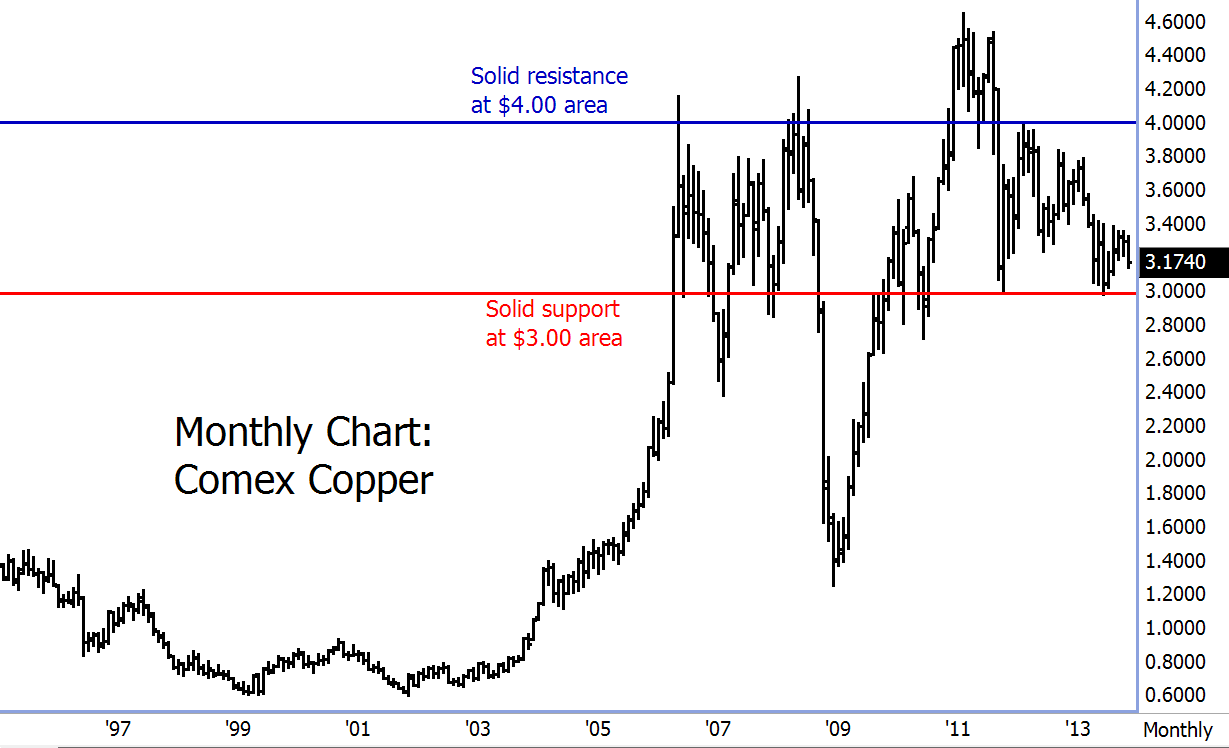
The technical breakdown in Comex copper futures this week is not only an ominous clue for the red metal, but it’s also a bearish signal for the entire raw commodity sector. December Comex copper futures prices this week dropped sharply and hit a three-month low. A bearish downside technical “breakout” occurred on the daily chart for the copper futures market, to suggest still more downside price pressure in the near term.
See on the monthly continuation chart for nearby Comex copper futures that prices have been trending lower for nearly three years and are on the verge of a downside breakout below key longer-term chart support at the $3.00 level.
Copper is a critical industrial metal used in construction worldwide. The fact copper prices dropped sharply this week is an early warning signal that construction activity worldwide could be flagging.
Indeed, history also shows copper market price moves can lead similar moves in the U.S. stock indexes. Along with the recent solid price downtrend in Nymex crude oil futures, the copper market meltdown this week suggests the raw commodity sector, in general, remains firmly controlled by the bears.
Importantly, the price action in copper and crude oil recently also corroborates the growing worries of worldwide deflationary price pressures.
Veteran commodity market watchers know that deflation is the archenemy of commodity markets.
Follow me on Twitter to immediately get the very latest market developments. If you are not on board, then you are not getting key analysis and perspective as fast or as often as you could! Follow me on Twitter to get my very timely intra-day and after-hours briefs on precious metals price action. The precious markets will remain very active. If you want market analysis fast, and in after-hours trading,then follow my up-to-the-second precious metals market perspective on Twitter. It’s free, too. My account is @jimwyckoff.
By Jim Wyckoff, contributing to Kitco News; jwyckoff@kitco.com
Successfully time one of these dramatic moves and you’ve created a big money making opportunity for yourself. Especially if you Shortsell the much quicker, more sudden & dramatic Bust moves. Then again if you are not a Shortseller, avoiding a Bust will at least save you a lot of capital as so many found out in 2008 when Blue chip Exxon lost 58% in 5 months, Microsoft 45% & Boeing fell from $88 to $30 – Money Talks Editor
More insights into long-wave theory…
– Readers don their K-wave caps and weigh in on this long-wave business…
– Why a 60-year-long wave theory should matter to you…
– Plus, Wayne Mulligan on how you can cut Wall Street out of your investments… the promise that crowdfunding offers investors.
“I agree with Mr. Rothbard’s opinion that government interference in the markets causes the boom and bust cycles,” writes one reader.
“But I also agree with the Elliott Wave and socionomics theories that market changes result from sentiments motivated by the thinking and mood changes of the masses (often unconscious), resulting in periods of economic change, booms, busts, wars, depressions, music, clothing styles, movies, etc.”
Hrmm… good point. Each theory definitely brings something to the table. Picking out when to apply each is the tricky part.
“OK, here’s my take on the K cycles,” writes a second reader, though we’re forced to trim her message down to fit our scarce space.
“First,” she explains, “maybe humans just need to go in cycles, and maybe it just takes about 60 years (plus or minus) for us to do it. After all, stock markets, economies, currency issues and interest rates are all human-generated (apes don’t bother with these things).
“Second, I think interest rates follow the K cycles pretty closely — give or take a bit for a hellbent Fed trying to ‘control’ interest rates. The last year or so would seem to indicate the Fed really can’t control interest rates as they would like us to believe. Time will tell for sure. But if interest rates do follow the K-wave, then there is reason for concern, as rising rates will certainly trounce the stock market and economy and seriously reduce the gummit’s disposable income (if it isn’t already).
“The K cycle does seem to match with recent history, so I suspect, against Rothbard’s suggestion, that there is some merit there. As you know, however, cycles work great until they don’t.”
 “There may be a grain of truth in Rothbard’s words,” writes a third reader, “that soothsayers merely adjust their predictions to fit the facts. However, as a trader, I see waves (cycles) daily.
“Traders use such arcane technical analysis tools as RSI, MACD, stochastics, Elliott Waves, Bollinger Bands et al., and these are used to predict a change from positive to negative and vice versa.
“As these waves coincide, inevitably, they push the markets higher or lower in the direction of coincidence (i.e., the one-minute coincides with the five-minute, which coincides with the 15-minute — you get the idea). Whenever you get a series of coincidences, the bigger the push, the more waves coincide, the more in one direction or another the markets will move. Like the waves on the ocean, driven by the winds. However, these business waves are driven by us…”
Heh. We try to leave the “arcane” technical analysis to our friend at theRude Awakening, Greg Guenthner. As for the Kondratiev wave theory, the basic premise seems reasonable enough to us.
Over periods of time, technological advances make people more productive. Business picks up. As people become more confident… their enthusiasm grows to a point where they start to give credence to business ideas and investments that make no sense. We suspect a politician or central bank is somewhere in the mix, too.
People start to take on too much debt. They pay ridiculous prices for certain assets because they either are too wrapped up in the market to realize their true value, or they’re hoping someone else is a greater fool. Eventually, at some point, someone stops for a second and asks what the hell is going on… and the fantasy is brought to a standstill, and then is shattered altogether. Phew…
 And if all of that happens in 60 years or so… well, we guess you can call it a K-wave. But really, we’d feel more comfortable calling it with the benefit of hindsight.
Conveniently, as we write this to you, two reader messages plopped into our mailbag.
“Just who could use a long, irregular 60-year cycle?” one of the readers asks. “Isn’t a four-year cycle tough enough for most people?”
“While I agree with the wave theory,” writes the other reader, “I have to admit I agree with the statement that ‘markets can remain irrational longer than I can remain solvent.’ Since I have only 30 years, at best, years left, what should I do to insure I can take care of myself over this period?”
Glad you asked. Just what is the whole point of this discussion? Sixty years is a lifetime for some people… if they’re fortunate. What good is the long run? That’s when we’re all dead, you might be thinking.
Well, not everyone! Your editor has big plans 60 years from now! Besides, what if we’re on the cusp of a new cycle? What new innovations could we see in the near term? How would they change the way we live? Is this just a pipe dream? Has this abstract 60-year K-wave stuff driven us completely unbalanced and stark raving mad?!
Well, we hate to do this to you…. but you’ll have to tune in next week to find out. Today is Friday. Who wants to go down a rabbit hole as the weekend stares them in the face? Nobody, that’s who.
(OK… fine. If you’re really dying to talk about K-waves, we won’t leave you out in the cold. You can reach us here: peter@dailyreckoning.com.)
In the meantime, we’ll leave you in the hands of Wayne Mulligan. In today’s episode, he explains a new investment opportunity that is going to come into its own in the coming months. We’re very excited about it.
Then, in today’s DR PRO, Ryan O’Connor cuts Twitter down to size… and explains why one play he’s recommended (already up 31% to date) is still a buy. If you haven’t upgraded yet, you’re missing out on Ryan’s market-crushing picks. Why don’t you click here to upgrade, already!


-
I know Mike is a very solid investor and respect his opinions very much. So if he says pay attention to this or that - I will.
~ Dale G.
-
I've started managing my own investments so view Michael's site as a one-stop shop from which to get information and perspectives.
~ Dave E.
-
Michael offers easy reading, honest, common sense information that anyone can use in a practical manner.
~ der_al.
-
A sane voice in a scrambled investment world.
~ Ed R.
Inside Edge Pro Contributors

Greg Weldon

Josef Schachter

Tyler Bollhorn

Ryan Irvine

Paul Beattie

Martin Straith

Patrick Ceresna

Mark Leibovit

James Thorne

Victor Adair