
Energy & Commodities
Short-seller Jim Chanos said on Tuesday that shares of international oil majors like Exxon Mobil Corp increasingly look like a value trap for investors as cash flows decline and return on capital slides.
His comments at the Reuters Global Investment Outlook Summit in New York came a week after Warren Buffett disclosed a large position in Exxon, the world’s largest publicly traded oil company.
Chanos said his Kynikos Associates fund was bearish on both national oil companies and the integrated majors.
“The costs of finding this stuff (oil) has gone through the roof,” Chanos said. “The economics are clearly deteriorating.”
“It isn’t the same cash flow generating business it used to be.”
….read more HERE


Yes. It is strangely a bell curve. Hyperinflation takes place in new governments because they have nothing and can only print. In a mature government, interest rates can rise (1) booming economy with rising demand, or (2) a collapsing economy where nobody is willing to but their paper so they are forced to pay higher rates due to the collapse in confidence. The former is normally aligned with a rising currency whereas the latter is associated with a collapsing currency. Every fundamental has two sides depending upon the capital flows.
This illustration shows it is really a bell curve. At some point rates take off as the economy turns down because confidence collapses.

 ….Gold Vulnerable
Today’s AM fix was USD 1,272.25, EUR 942.13 and GBP 790.12 per ounce. Yesterday’s AM fix was USD 1,283.50, EUR 950.04 and GBP 797.01 per ounce.
Gold fell $14.10 or 1.09% yesterday, closing at $1,273.70/oz. Silver slid $0.34 or 1.64% closing at $20.41/oz. Platinum dropped $30.50 or 2.1% to $1,406.99/oz, while palladium fell $15.47 or 2.1% to $714.83/oz.
Gold remains under pressure after the losses incurred yesterday. Gold has failed to rally despite Janet Yellen, the Federal Reserve’s chief in waiting, indicating she would continue the U.S. central bank’s ultra-easy monetary policy.
….read more HERE
In our previous essay, we examined one of the most interesting relationships in the crude oil market – the one between oil stocks and other stocks, to find out if there’s something else on the horizon that could drive oil stocks higher or lower in the near future. Back then, we wrote that there were periods of time when the S&P 500 Index was stronger than the oil stock index and that such divergences had triggered declines in both indices before.
Since that essay was published, we’ve seen similar price action. In the previous week, the S&P500 index broke above the previous high and hit a fresh all-time high. Meanwhile, although the XOI moved higher, the move ended slightly below the 2013 high.
Nevertheless, on Monday we saw further improvement and both indices hit their new 2013 highs. However, after that they declined. Will we see further deterioration? Before we try to answer this question, we’ll examine the NYSE Arca Oil Index (XOI) to find out what the current outlook for oil stocks is.
Let’s start with a look at the monthly chart of the oil stock index (charts courtesy by http://stockcharts.com).
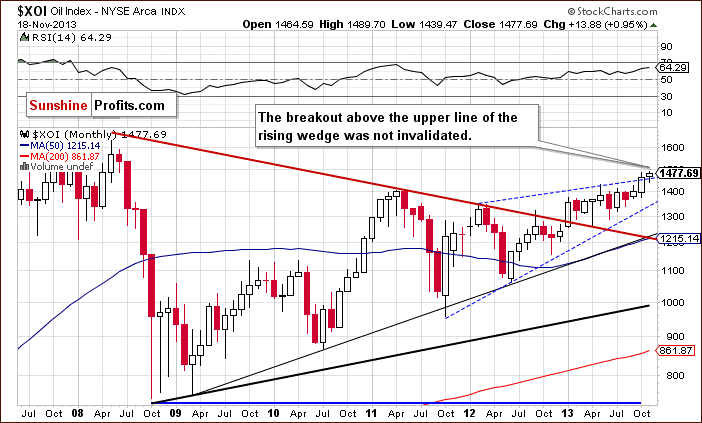
On the above chart, we see that the situation has improved recently and the XOI still remains above the upper line of the rising wedge.
Quoting our essay on oil stocks and crude oil from Oct. 30, 2013:
The breakout, however, is not yet confirmed. (…) in this area there’s a very important Fibonacci retracement level – 78.6% (close to 1,467) based on the entire May-October 2008 decline, which may slow the rally. However, if the buyers don’t give up and manage to push the oil stock index above this resistance, we will likely see further growth.
Looking at the above chart, we see that the breakout above the 78.6% retracement level encouraged buyers to act and resulted in a new 2013 high at 1,489. From this point of view, the situation is very bullish.
To see the current situation more clearly, let’s zoom in on our picture and move on to the weekly chart.
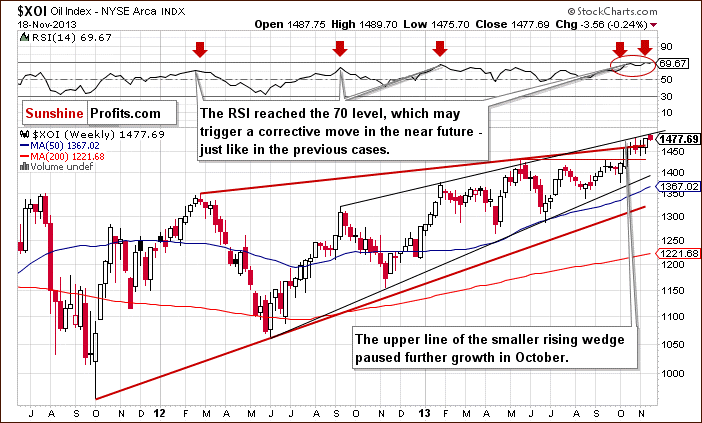
Looking at the above chart, we see that the oil stock index bounced off the bottom of the recent corrective move in the previous week, which resulted in a sharp pullback. With this upward move, the XOI came back to slightly below the October high. On Monday, we saw further improvement and the oil stock index climbed to a fresh 2013 high at 1,489.
In spite of this growth, the breakout above the previous high is not confirmed.
Please note that the upper line of the smaller rising wedge (marked with the black line), which successfully stopped growth at the end of October, is still in play. As you can see on the weekly chart, the XOI remains below this line,
which serves as resistance (currently around 1,495). Additionally, the RSI moved above the 70 level, which may trigger a corrective move in the near future – similarly to what we saw in the previous months.
Nevertheless, from the technical point of view, the medium-term uptrend is not threatened at the moment, and the situation remains bullish.
Now, let’s turn to the daily chart.
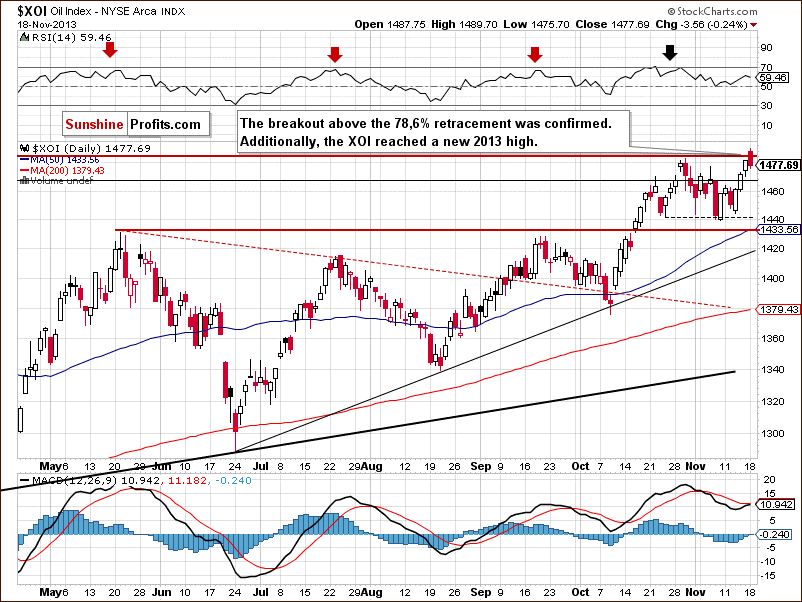
Looking at the above chart, we see that the oil stock index didn’t manage to break above the 78.6% retracement at the beginning of the previous week, which resulted in a decline in the following days. As you see on the daily chart, this downward move took the XOI to slightly above the bottom of the recent corrective move. On Wednesday, this support level encouraged buyers to act, which resulted in a pullback. In this way, the oil stock index broke above the 78.6% Fibonacci retracement level and almost reached the 2013 high on Friday.
On Monday, we saw further improvement, and the XOI hit a new annual high at 1,489. However, after this positive event, we saw a correction which pushed the oil stock index slightly below the previously-broken high. In spite
of this drop, the breakout above the 78.6% retracement level was confirmed, which is a strong bullish sign.
Summing up, from the long-, medium- and short-term perspectives, the outlook for oil stocks remains bullish and the uptrend is not threatened at the moment. However, taking into account the combination of a strong resistance level (the upper line of the rising wedge) and the position of the RSI, we should keep an eye on the oil stock index because the sellers may lock profits and trigger another correction in the coming days.
Thank you.
Nadia Simmons
Sunshine Profits‘ Crude Oil Expert

The Organization for Economic Cooperation and Development cut its global growth forecasts for this year and next as emerging-market economies including India and Brazil cool.
The world economy will probably expand 2.7 percent this year and 3.6 percent next year, instead of the 3.1 percent and and 4 percent predicted in May, the Paris-based OECD said in a semi-annual report today.
“Most of the emerging economies have underlying fragilities that mean they cannot continue growing as they used to,” OECD Chief Economist Pier Carlo Padoan said in an interview. “They used to be an important support engine for global growth in bad times. Now the reverse is true and advanced economies can’t be said to be in very good times again.”
…read more HERE

-
I know Mike is a very solid investor and respect his opinions very much. So if he says pay attention to this or that - I will.
~ Dale G.
-
I've started managing my own investments so view Michael's site as a one-stop shop from which to get information and perspectives.
~ Dave E.
-
Michael offers easy reading, honest, common sense information that anyone can use in a practical manner.
~ der_al.
-
A sane voice in a scrambled investment world.
~ Ed R.
Inside Edge Pro Contributors

Greg Weldon

Josef Schachter

Tyler Bollhorn

Ryan Irvine

Paul Beattie

Martin Straith

Patrick Ceresna

Mark Leibovit

James Thorne

Victor Adair