
Mike's Content
 Michael’s Money Talks Show for Nov. 23rd.
Michael begins with his Commentary, where he talks about something big that is happening in the United States that isn’t getting nearly enough coverage given the far reaching implications that it will have.
Then Ozzie Jurock tells Michael about two areas in the country that are not expensive to live in, then MichaelLevy talks about this incredible statistic that just shows you the change in in how we are behaving in terms of consumerism, retail etc. More below:
{mp3}mtnov23lead2fp2{/mp3}
The final hour of Money Talks begins with Michael interviewing Ryan Irvine of Keystone Smallcap Research. Ryan looks at smaller companies that haven’t yet been discovered by big money – large institutions/pensions/mutual funds etc. Ryan’s portfolio is up 32% this year after being up an astonishing 86% in 2012. Ryan talks about some of the opportunities he sees as well as some of the dangers.
After Ryan Kevin Konar talks to Miichael about finding yield, something that is certainly not very easy to do today. Then Victor Adair talks about a “bear market that we had better come to grips with.”
{mp3}mtnov23lhourfp2{/mp3}

Tunnel Through the Air, P. 78
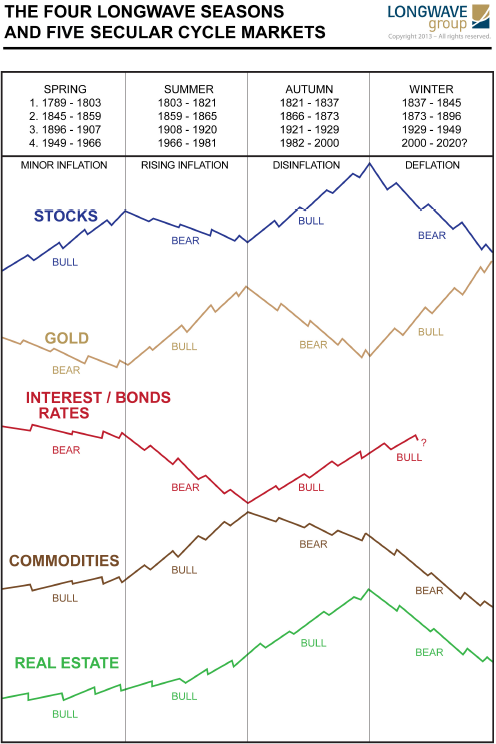

 “Continuing assessment of the efficacy and costs of asset purchases might lead the Committee to decide at some point to change the mix of its policy tools while maintaining a high degree of accommodation.”
-Minutes of Federal Open Mark Committee – October 29-30, 2013
The above text is the most important aspect of the most recent Federal Open Market Committee (FOMC) meeting that took place between October 29 and 30. The text is in no way novel as the sustainability of this economic stimulus program has always been of concern, and thus examining its long term benefits and consequences continues to be the focus of Federal Reserve officials. However, moving past analyzing the efficacy or cost of the program, it is the end of the above quote that is most telling. And that is that the misconception by the financial media of tapering Quantitative Easing meaning that the Fed is attempting to make their policy less accommodative. In fact to the contrary, it is not that their goal is to be less accommodative, but change the medium in which it is delivered.
 Money and Drugs
1. The current decade has logged the heaviest drug use per person per year in the history of the United States. 23.9 million Americans aged 12 or older – 9.2% of the entire population – were “current users” of an illicit drug in 2012, the latest data available from the Center for Disease Control (CDC) shows.
That’s up from 7.1% in 2001, and more than double the rate of 1969’s 4% (according to a 1969 Gallup poll).
2. The most “Typical” drug user is apparently an 18-25 year old male living in the urban South, based on data from the National Survey on Drug Use and Health. The South is the biggest drug consuming region in the country by sheer numbers with 7.5 million current users, according to the National Survey on Drug Use and Health. But New England and the Pacific West had the highest rates of usage at 11.4% and 12.3% of the total population.
Males are almost twice as likely to use as females (11.2% versus 6.8%), though the numbers are rising among both genders. And finally, drug usage among ethnic backgrounds vary widely: 9.1% of whites report being current users, compared to 10.7% of blacks, 3.5% of Asians, and 12.1% of American Indians.
3. According to the CDC, median prices for 0.1-10 grams of the 5 most common drugs are as follows: Powder cocaine – $150; Crack cocaine – $180; Heroin – $650; Meth – $280; Marijuana – $14. Marijuana is actually the only drug that has increased in price (in current dollars) compared to its cost in the 1980s. The CDC’s drug price data shows that, in 2007 dollars, powder cocaine costs have dropped by -87.2% crack cocaine by -66.5%, Heroin by 93.2%, and Meth by -43.1%. Marijuana has doubled from $6.57 in 1981 to about $14 today.
4. While the drug market might generate large amounts of cash for suppliers, its cost to the state is astronomical. Of the roughly 1.6 million people in prison in 2012, some 330,000 were doing time for drug offenses, and at an average cost of about $25,000 per inmate. All together that’s a whopping $8.2 billion.
5. The National Institute on Drug Abuse estimates that illicit drug use costs the U.S. $11 billion in healthcare every year, and $193 billion when accounting for crime costs and lost work productivity. Those abusing prescription narcotics and rotating multiple doctors for scripts are estimated to cost insurers $10,000-$15,000 every year.

Already beleaguered, gold suffered another sharp drop this week. When the minutes from the Federal Reserve’s latest policy meeting implied it might slow its QE3 bond-buying campaign “in coming months”, futures speculators responded with heavy selling. But their extreme gold bearishness is highly irrational, they are missing the forest for the trees. Taper or not, quantitative easing remains super-bullish for gold.
Quantitative easing is the fancy name for the Fed’s massive and unprecedented bond-buying programs of recent years. In order for normal investors to buy bonds, they first have to raise the necessary cash by selling something else. But when central banks like the Fed buy bonds, they conjure the cash out of thin air! The Fed pays the bond sellers with new money that never existed before, which is then immediately spent.
Thus throughout world history the benign-sounding “quantitative easing” was always known by its far-more-sinister label of debt monetization. Central banks literally convert their local government’s debt into new money, which is pure inflation. Governments “finance” their excessive spending by selling their bonds to their central banks for newly-printed money, which the governments directly inject into their economies.
This ultimately results in relatively more money bidding for relatively less goods and services, which inevitably bids up general price levels. There is nothing more inflationary than central banks monetizing debt, which is why it is so incredibly bullish for gold. Due to the inherent limitations of gold mining, the global gold supply perpetually grows vastly slower than the central banks’ endless supplies of fiat money.
The Federal Reserve embarked on the slippery slope of debt monetization in late 2008. It had forced its benchmark interest rate to zero in response to that year’s once-in-a-century stock panic. So without any more conventional easing possible, it decided to print money to buy debt for the first time in its history. And now today fully 5 years later, it has shown no signs of stopping despite endless promises to the contrary.
And indeed the money supply has soared since. Between mid-December 2008 when the Fed launched its zero-interest-rate policy (ZIRP) to today, the M1 money supply is up 68%! That’s why everything we all need to live is much more expensive today than it was 5 years ago. There are far more dollars chasing the goods and services our economy offers, which have bid up their price levels significantly to greatly.
This includes the gold price, the ultimate inflation barometer. In the week leading into the Fed’s decision to punish savers with ZIRP, gold was trading near $800. Less than a few years later it challenged $1900, and even today remains far higher than the pre-QE days. During the first quantitative-easing campaign’s lifespan gold surged 51% higher, and in QE2 it rallied another 25%. Yet gold has withered under QE3.
The Fed birthed QE3, which is destined to be the Fed’s largest debt monetization ever, in September 2012. The day before gold was trading around $1730. This week just 14 months later, it is down 28% over QE3’s lifespan. Is gold’s horrendous performance so far in QE3 because it really isn’t inflationary? No way. All the newly-created money the Fed uses to monetize debt continues to balloon its balance sheet.
When the Fed buys bonds, those bonds appear as assets on its balance sheet. The Fed rather helpfully publishes extensive data on its holdings weekly, which this first chart chronicles. Within the orange total balance sheet, this data is stacked. The red Treasury holdings are on top of the yellow mortgage bonds. The most striking thing in this chart is the gargantuan growth in the Fed’s balance sheet during QE3.
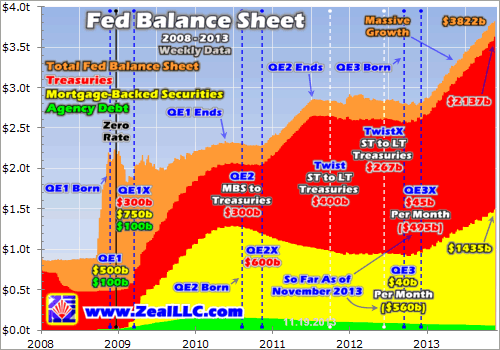
In September 2012 just before the Fed launched its unprecedented open-ended third quantitative-easing campaign, its balance sheet was at $2798b. This was already very high, as it had only averaged around $875b in 2008 before the stock panic. But the Fed joined in panicking, going nuclear with ZIRP and then QE in a matter of months. And the Fed’s massive debt-monetization campaigns have rarely paused since.
After QE3 being expanded to include Treasury monetizations last December, the Fed has been buying up bonds with newly-created money at a blistering $85b-per-month pace. This has catapulted the Fed’s balance sheet to $3822b as of this week, up a staggering $1024b or 37% over QE3’s lifespan! Does it make any sense at all for gold to plunge 28% in just over a year where the Fed’s balance sheet soared 37%?
Absolutely not! The deluge of selling gold has suffered this year is extraordinarily, epically irrational in light of what the Fed is doing with QE3. Other than that emergency initial spike in late 2008, the Fed’s balance sheet has never grown faster than it has over this past year. All the new money it is creating to buy bonds is exploding the money supplies, pure inflation. Gold’s price should be sharply higher over this span.
Yet just the opposite has happened, gold has plunged as debt monetization soared. One of the primary reasons is the way American futures speculators are hysterically reacting to the Fed. Rather than watch what it does, they are fixated on what it says. And for the entire short history of QE3, the Fed has fallen all over itself trying to convince the financial markets that QE3 will soon end. Each time gold futures get dumped.
This whole exercise has been a ludicrous farce right from the beginning. After launching QE3 at its September 2012 meeting, the Fed more than doubled its scale to include Treasuries just a few months later in December. As always, that Federal Open Market Committee meeting’s minutes were released 3 weeks later in early January. That was the first time gold got hit this year on the endless QE3-taper talk.
At the very meeting where QE3 was expanded with a nearly-unanimous 11-to-1 vote, there was already internal discussion on when to end QE3! So futures speculators heavily sold gold contracts, rightfully figuring that lower future inflation was less bullish for gold. But ever since 2013’s initial release of FOMC minutes, the idea that the Fed is debating when to slow and eventually end QE3 has been old news.
The Fed’s FOMC meets 8 times annually, so there are 8 FOMC statements released per year each followed several weeks later by the meetings’ minutes. This works out to some major Fed release about once every 3 weeks. And at every subsequent meeting after QE3 was expanded to include Treasuries, the FOMC members continued to debate how and when to exit QE3. It was never going to be permanent.
Yet American futures speculators continued to dump gold aggressively each time the Fed rehashed this old news that QE3 would eventually end. A couple months ago I superimposed FOMC decision and minutes dates over a gold chart, and the result is striking. Nearly all gold’s sharp and anomalous selloffs this year are the direct result of futures traders reacting to what the Fed is saying. They keep freaking out!
This response is absurdly irrational. Since early January it has been crystal-clear that QE3 wouldn’t last forever, yet each time the Fed repeats that heavy gold selling follows. This week’s is the latest example. Yet despite Fed officials’ constant jawboning that they have to slow and stop QE3 soon, it just keeps on chugging ahead at full steam. The Fed’s balance sheet continues to balloon as it aggressively inflates.
A common proverb we all learn at a relatively young age is “talk is cheap”. People promise to do things all the time, from our friends to politicians to Fed officials. Yet if they don’t carry through on those promises, we quickly discount their credibility. Thus the older and wiser we get, the more we tend to focus on what people do instead of what they say. Fed officials have been promising QE ending soon since early 2009!
By irrationally fixating on the endless Fedspeak that never comes to fruition, futures speculators are missing the forest for the trees. Since early January, despite every FOMC meeting and minutes since, despite the long parade of Fed officials suggesting otherwise, the Fed’s balance sheet has continued to grow at a frightful pace as it continues to monetize debt. It’s high time futures traders start paying attention.
QE1 was gigantic, totaling $1750b of Fed bond buying with newly-conjured money. Yet only $300b of that included direct Treasury monetizations, the purest form of inflation. Thanks to Obama’s insane record deficit spendingand debt growth, every dollar the Fed has created to buy Treasuries has been immediately spent by Washington. All this money injected directly into the US economy is bidding up price levels.
Gold powered 51% higher during QE1, a universal acknowledgement by all market participants including futures speculators that QE is highly inflationary. QE2 was much smaller than QE1, totaling $900b of debt monetizations. But while all of this was in US Treasuries, only $600b was inflationary new buying. Yet this was still twice the size of QE1’s total Treasury monetizations, so gold still powered another 25% higher.
Despite an entire year of Fed officials falsely promising that QE3 would end soon, it has become utterly massive. As of the end of this month, the Fed will have monetized $560b of mortgage-backed bonds and $495b of Treasuries! This means QE3 is already $1055b, dwarfing QE2 and giving QE1 a run for its money. Its $495b of direct Treasury buying is way higher than QE1’s $300b and rapidly approaching QE2’s $600b.
And no matter what the Fed does, QE3 is going to get a lot bigger still! All the Fed officials’ bloviating all year long has made one thing very clear, the FOMC is terrified slowing QE3 will have an adverse market impact. I discussed the risks of this in depth back in September just before the Fed was universally expected to start tapering QE3. Of course the Fed chickened out and failed to keep its implied promises, again.
But back in mid-June, the Fed chairman laid out a best-case QE3-tapering timeline. One thing the Fed has emphasized over and over again is the end of QE3 will be gradual to minimize the risk of spooking the markets. Ben Bernanke’s plan called for QE3’s new bond purchases gradually being reduced to zero over a 9-month span. I strongly suspect no matter when QE3 tapering starts, it will take about 9 months.
Assuming an even taper pace, those 9 months will each average half of QE3’s current $85b per month of buying, or $42.5b. That’s another $383b or so baked in on top of QE3’s already-gigantic $1055b size. This puts QE3 up to $1438b, starting to challenge QE1. And every month that the start of QE3 tapering is delayed increases its total size by $85b. Even a December-meeting taper would leave QE3 at $1523b!
The more-likely March meeting, the first under the new Fed chairman, would mushroom QE3 to $1778b. This exceeds QE1 absolutely, and the Treasury portion of QE3 alone would be $878b. This is almost as big as the new Treasury monetizations in QE1 and QE2 combined! And many analysts believe Janet Yellen, who is far more Keynesian and dovish than Ben Bernanke, will keep buying bonds much longer.
No matter when the Fed starts tapering QE3, this debt-monetization campaign is going to be massive beyond belief. And even after QE3 eventually ends, it is not like the Fed is going to instantly sell its trillions of dollars of bonds. To do so would crash the Treasury market and send yields and general interest rates skyrocketing. Instead the Fed will simply let all the bonds it bought naturally mature and gradually roll off.
This is going to take many years. Way back in QE1, the Fed purchased $200b in agency debt (Fannie and Freddie bonds). It hasn’t purchased any more since. Yet look how slowly this green category is naturally rolling off the Fed’s balance sheet. The Treasuries are going to take considerably longer, as they have longer maturities since the Fed is by its own admissionexplicitly manipulating long rates.
The chart above shows how slowly Treasuries rolled off in the lulls between QE1 and QE2, and then QE2 and QE3. The point is even when QE3 eventually ends, the Fed’s balance sheet is going to remain extremely highfor many years to come. All of this monetary inflation will remain in the economy in the meantime, continuing to keep price levels high. The trillions of QE will take years to unwind after QE3 ends.
So the goofy futures speculators dumping gold every time the Fed or some Fed official implies the FOMC might start slowing QE3 soon is the height of irrationality. QE3 is massive beyond belief, and still growing full-speed. QE3 will keep expanding the Fed’s balance sheet even as it is tapered, and all this inflation will remain baked into the economy for many years to come until all the bought bonds slowly mature.
There is a strong case to be made that gold prices already fully adjusted to reflect a QE3 tapering back in early January, when they were still trading around $1650. All the futures selling since has been the result of emotion, totally hysteric. And the resulting gold-price anomaly grows even more extreme with each passing month as the Fed keeps QE3 fully online, ensuring its ultimate size will be that much larger.
QE3 is almost certainly going to prove the biggest inflationary event in the Fed’s century-long history, wildly bullish for gold. One of the surest bets anyone can make is that gold prices will be much higher when QE3 ends than they were when it began. And since that benchmark is way up around $1730, gold is going to have to regain much ground. Futures speculatorsbuying again will drive this upleg’s early gains.
While we’re on this Fed thread, there’s something even more important than QE for gold’s future, ZIRP. The Fed has been holding interest rates at zero since late 2008, and Fed officials are now saying ZIRP may stay in placewell into 2017, long after QE presumably ends. Keeping short rates so artificially low guarantees negative real interest rates, the most bullish monetary environment possible for gold.
I’ve written many essays on negative real rates and gold, the latest exactly a year ago. ZIRP bludgeons down short Treasury yields, including the benchmark 1-year Treasury Bill yield used in the real-rate calculation. From it the year-over-year change in the chronically-understated US Consumer Price Index is subtracted, revealing real rates. They are going to remain negative for as long as the Fed maintains ZIRP.
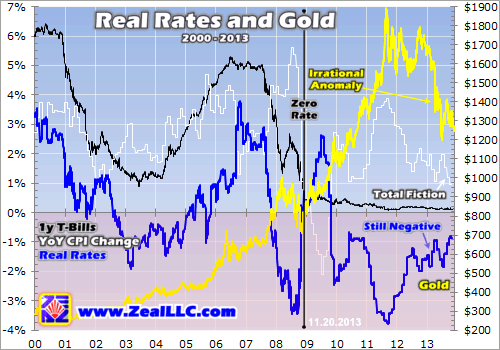
Gold’s current secular bull was born in early 2001 because real interest rates were heading into negative territory due to Fed interest-rate manipulations. Negative real rates guarantee that bond investors will lose purchasing power after inflation, making gold far more attractive. Thus gold tends to power higher as long as real rates remain negative. Secular gold bulls don’t end until real rates spike massively positive.
It took real rates above 6% to kill the 1970s secular gold bull. And even with the absurdly-low and totally fictional 1.0% inflation rate the CPI is claiming today, the Fed would have to hike short rates near 7% to see similar real rates again. I can’t imagine that happening in the next decade, let alone the coming years! This gives gold’s current secular bull years left to run before the Fed starts thinking about ending ZIRP.
And at best in today’s secular bull, gold was merely up 7.4x by mid-2011. That compares to a whopping 24.3x in the 1970s secular bull! We have yet to see the gold popular mania that is necessary to kill a secular bull, and the Fed’s massively-inflationary easy-money policies will certainly contribute to its eventual arrival. ZIRP is at least as bullish for gold as QE, and history argues it may be even more so.
So don’t worry about the myopic American futures speculators freaking out every time the Fed says it ought to slow and end QE3 soon. Futures’ extreme leverage forces these guys to have trading time horizons measured in days or weeks, they can’t see the forest for the trees. But eventually they will figure out that they should watch what the Fed is doing rather than merely saying, and they will flood back into gold.
We’ll be ready at Zeal. This year has been the most brutal imaginable for the entire precious-metals realm, painfully testing the mettle of all contrarian investors and speculators. Most have given up and capitulated, leaving gold, silver, and especially their miners’ stocks absurdly cheap. No one is left but the bears, who have foolishly convinced themselves gold is going to spiral lower forever despite enormous QE.
But this is the time to buy low, with the streets drenched in blood. We publish acclaimed weekly and monthly newsletters for contrarians, that follow the stock markets and precious metals and everything that drives them. We buy low when others are afraid then later sell high when others are brave, gradually growing rich in the process. Join us and put our hard-won experience, knowledge, wisdom, and ongoing research to work for you. Subscribe today before everyone else figures out how cheap gold is!
The bottom line is gold’s recurring selloffs this year each time the Fed announces QE3 isn’t going to run forever are the height of hysteria. This is old news, and the gold price had already adjusted to that reality way back in early January. All the selling since was emotional, driven by unsustainable hyper-bearishness. Sooner or later excitable American futures speculators will start watching what the Fed does.
They will realize QE3 is massive beyond belief, with enormous direct Treasury monetizations. They will grasp that the tapering process will take many months to unfold once started, during which the Fed’s balance sheet will continue growing. And they will understand that it will take many years for QE to gradually unwind through maturing bonds. Then they will return to gold with a fervor few can imagine.
Adam Hamilton, CPA
November 22, 2013
So how can you profit from this information? We publish an acclaimed monthly newsletter, Zeal Intelligence, that details exactly what we are doing in terms of actual stock and options trading based on all the lessons we have learned in our market research. Please consider joining us each month for tactical trading details and more in our premium Zeal Intelligence service at … www.zealllc.com/subscribe.htm
Questions for Adam? I would be more than happy to address them through my private consulting business. Please visit www.zealllc.com/adam.htm for more information.
Thoughts, comments, or flames? Fire away at zelotes@zealllc.com. Due to my staggering and perpetually increasing e-mail load, I regret that I am not able to respond to comments personally. I will read all messages though and really appreciate your feedback!
Copyright 2000 – 2013 Zeal Research (www.ZealLLC.com)


-
I know Mike is a very solid investor and respect his opinions very much. So if he says pay attention to this or that - I will.
~ Dale G.
-
I've started managing my own investments so view Michael's site as a one-stop shop from which to get information and perspectives.
~ Dave E.
-
Michael offers easy reading, honest, common sense information that anyone can use in a practical manner.
~ der_al.
-
A sane voice in a scrambled investment world.
~ Ed R.
Inside Edge Pro Contributors

Greg Weldon

Josef Schachter

Tyler Bollhorn

Ryan Irvine

Paul Beattie

Martin Straith

Patrick Ceresna

Mark Leibovit

James Thorne

Victor Adair