
Personal Finance
 Herd mentality can be as frustrating as it is inexplicable. Once a crowd starts moving, momentum can be all that matters and clear signs and warnings are often totally ignored. Financial markets are currently following this pattern with respect to the unshakable belief that the Federal Reserve is ready, willing, and most importantly, able, to immediately execute a wind down of its quantitative easing program. How this notion became so deeply entrenched is a mystery, but the stampede it has sparked is getting more violent, and irrational, by the day.
The release last week of the minutes of the October Fed policy meeting was a case study in dangerous collective delusion. Although the report did not contain a shred of hard information about the certainty or timing of a “tapering” campaign, most observers read into it definitive proof that the Fed would jump into action by December or March at the latest.
But while the Fed was gaining much attention by saying nothing, the Chinese made a blockbuster statement that was summarily ignored. Last week, a deputy governor of the People’s Bank of China said that buying foreign exchange reserves was now no longer in China’s national interest. The implication that China may no longer be accumulating U.S. government debt would amount to the “mother of all tapers” and could create a clear and present danger to the American economy. But the story barely rated a mention in the American media.
Instead, the current environment is all about the imminent Fed taper: the process of winding down the Fed’s monthly purchases of $85 billion of treasury debt and mortgage-backed securities. However, the crowd fails to grasp that the Fed has embarked on an impossible mission. The herd is blissfully unaware that the Fed may not be able to reverse, or even slow, the course of QE without immediately sending the economy back into recession.
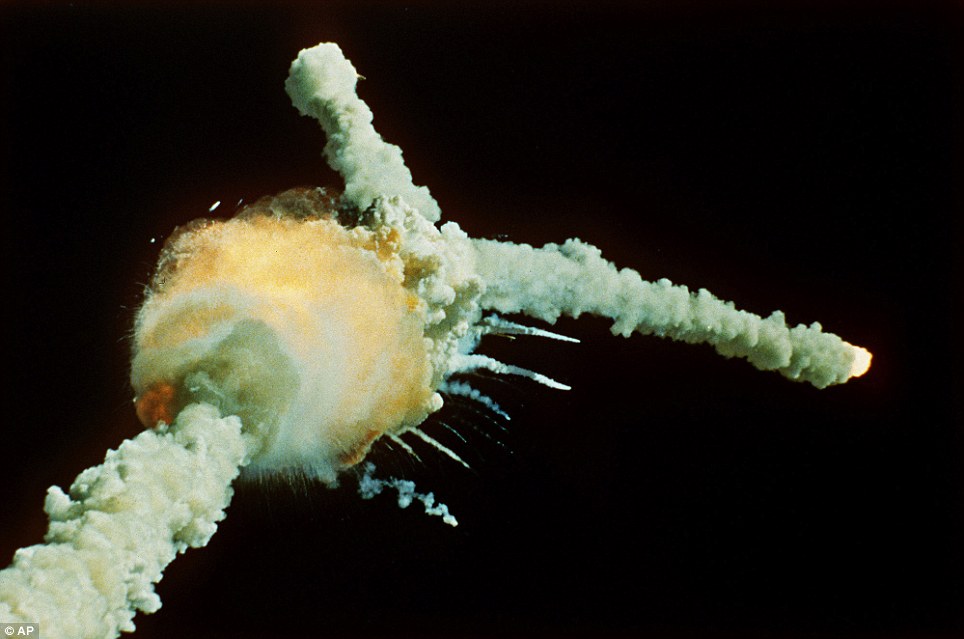
In an interview this week, outgoing Fed Chairman Ben Bernanke likened the QE program to the first stage in a multiple stage rocket that gets the spacecraft off the ground and accelerates it to the point where it is close to achieving permanent orbit. Like a first stage that has spent its fuel and has become dead weight, Bernanke seems to concede that QE is no longer capable of providing positive thrust, and as a result can now be jettisoned (like a first stage) so that the remainder of the spacecraft/economy can now move higher and faster. The Chairman’s nifty metaphor provides some inspiring visuals, but is completely flawed in just about every way imaginable.
In real rocketry, when the first stage separates, it falls back to earth and is no longer a burden to the remainder of the ship. Subsequent booster rockets (which in economic terms Bernanke imagines would be continuation of zero interest rate policies) build on the gains made by the first stage. But the almost $4 trillion in assets that the Fed has accumulated as a result of the QE program will not simply vaporize into the stratosphere like a discarded rocket engine. In fact it will remain tethered to the rest of the economy with chains of solid lead.
In the process of accumulating the world’s largest cache of Treasuries, the Fed has become the most important player in that market. I believe the Fed can’t stop accumulating and dispose of its inventory without creating major market disruptions that will drag the economy down.
This would be true even if the economic rocket were actually approaching escape velocity. In reality, we are still sitting on the launch pad. By keeping interest rates far below market levels and by channeling newly created dollars directly into the financial markets, the QE program has resulted in major gains in the stock, real estate, and bond markets. Many have argued that all three are currently in bubble territory. Yet to the casual observer, these gains are proof of America’s surging economic vitality.
But things look very different on Main Street, where the employment picture has not kept pace with the rising prices of financial assets. The work force participation rate continues to shrink (recently falling back to levels last seen in 1978),real wages have declined, and since the end of 2009 the temporary workforce has grown at a pace that is 14 times faster than those with permanent jobs. Americans are driving less, vacationing less, and switching to lower quality products and services in order to deal with falling purchasing power.
But the herd is closely watching the Fed’s rocket show and does not understand that stocks and housing will likely fall, and bond yields rise steeply, once the QE is removed. The crowd is similarly ignoring the significance of the Chinese announcement.
Over the past decade or so, the People’s Bank of China has been one of the largest buyers of U.S. Treasuries (after various U.S. government entities that are essentially nationalizing U.S. debt). China currently sits on $1 trillion or more in U.S. bond obligations.
So, just as many expect that the #1 buyer of Treasuries (the Fed) will soon begin paring back its purchases, the top foreign holder may cease buying, thereby opening a second front in the taper campaign. This should cause any level-headed observer to conclude that the market for such bonds will fall dramatically, causing severe upward pressure on interest rates. But the possibility is not widely discussed.
Also left out of the discussion is the degree to which remaining private demand for Treasuries is a function of the Fed’s backstop (the Greenspan put, renewed by Bernanke, and expected to be maintained by Yellen). The ultra-low yields currently offered by long-term Treasuries are only acceptable to investors so long as the Fed removes the risk of significant price declines. If the private buyers, the Fed, China (and other central banks that may likely follow China’s lead) refuse to buy Treasuries, who will take on the slack? Absent the Fed’s backstop, prices will likely have to fall considerably to offer an acceptable risk/reward dynamic to investors. The problem is that any yield high enough to satisfy investors may be too high for the government or the economy to afford.
Little thought seems to be given to how the economy would react to 5% yields on 10 year Treasuries (a modest number in historical standards). The herd assumes that our stronger economy could handle such levels. In reality, 5% rates would likely deeply impact the financial sector, prick the bubbles in housing and stocks, blow a hole in the federal budget, and cause sizable losses in the value of the Fed’s bond holdings. These developments would require the Fed to devise a rocket with even more power than the one it is now thinking of discarding.
That is why when it comes to tapering, the Fed is all bark and no bite. In fact, toward the end of last week, Dennis Lockhart, President of the Federal Reserve Bank of Atlanta, said that the Fed “won’t taper its bond-buying until the economy is ready.”He must know that the economy will never be ready. It’s like a drug addict claiming that he’ll stop using when he no longer needs them to stay high.
But the market understands none of this. Instead it is operating under dangerous delusions that are creating sky-high valuations for the latest social media craze, undermining the investment case for gold and other inflation hedges, and encouraging people to ignore growing risks that are hiding in plain sight.
This is not unusual in market history. When the spell is finally broken and markets wake up to reality, we will scratch our heads and wonder how we could ever have been so misguided.
Peter Schiff is the CEO and Chief Global Strategist of Euro Pacific Capital, best-selling author and host of syndicated Peter Schiff Show.
Subscribe to Euro Pacific’s Weekly Digest: Receive all commentaries by Peter Schiff, John Browne, and other Euro Pacific commentators delivered to your inbox every Monday!
Don’t forget to sign up for our Global Investor Newsletter.

-
The Dow has been showing a modest gain, last up about 36 points.
The S&P 500 and Nasdaq have been staying positive, but just barely.
The S&P is up 1 point @ 8:45 am PST, while the Nasdaq was last up about 1 point and holding under 4,000 after briefly conquering that milestone level.
J.C. Penney is up about 5%, making it one of the S&P 500’s biggest gainers in one of its last days as part of that index.
At this point, it’s not coming under any pressure at all from that news late Friday that it’s leaving the S&P 500.
Boeing is down more than 2%, making it the biggest loser today among Dow components. The aerospace company seems to be getting hit by its warning about engine icing risks for certain new planes.
Meanwhile, Caterpillar continues to provide a lift to the blue-chip index, rising more than 2% after an upgrade.
Meanwhile, Caterpillar continues to provide a lift to the blue-chip index, rising more than 2% after an upgrade.
-
Getting back to Facebook and Yelp…
There wasn’t much fundamental news on either Monday, leading some on Twitter to speculate about momentum stocks being in trouble, says the Tech Stocks column.

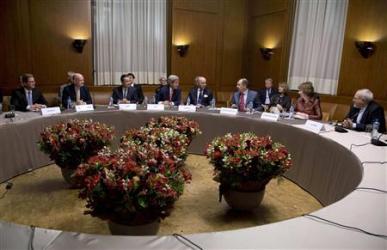
(L-R) Germany’s Foreign Minister Guido Westerwelle, British Foreign Secretary William Hague, Chinese Foreign Minister Wang Yi, U.S. Secretary of State John Kerry, French Foreign Minister Laurent Fabius, Russia’s Foreign Minister Sergei Lavrov, EU foreign policy chief Catherine Ashton and Iranian Foreign Minister Mohammad Javad Zarif gather at the United Nations Palais in Geneva November 24, 2013.
Saturday night had turned into Sunday morning and four days of talks over Iran’s nuclear program had already gone so far over schedule that the Geneva Intercontinental Hotel had been given over to another event.
A black tie charity ball was finishing up and singers with an after party band at a bar above the lobby were crooning out the words to a Johnny Cash song – “I fell into a burning ring of fire” – while weary diplomats in nearby conference rooms were trying to polish off the last touches of an accord. Negotiators emerged complaining that the hotel lobby smelled like beer.
At around 2:00 a.m., U.S. Secretary of State John Kerry and counterparts from Britain,China, France, Germany and Russia were brought to a conference room to approve a final text of the agreement which would provide limited relief of sanctions on Iran in return for curbs to its nuclear program.
At the last minute, with the ministers already gathered in the room, an Iranian official called seeking changes. Negotiators for the global powers refused. Finally the ministers were given the all clear. The deal, a decade in the making, would be done at last.
Now that the interim deal is signed, talks are far from over as the parties work towards a final accord that would lay to rest all doubts about Iran’s nuclear program.
“Now the really hard part begins,” Kerry told reporters. “We know this.”
….read more HERE in this Special Report
Soybeans fell from an eight-week high in Chicago on expectations that crops will benefit from favorable soil moisture in Brazil, the world’s top exporter, and rain in Argentina. Wheat advanced.
Rain this week will eliminate dryness concerns in northeast Brazil, with some areas expected to receive 2.5 inches (6.4 centimeters) in the next five days, Commodity Weather Group said today in a report. Argentina may see rain in the next two days after some precipitation during the past weekend, and further showers will occur in the six- to 10-day period, it said.
“Favorable weather forecasts for Brazil and Argentina are shifting the focus back to the forthcoming supply from South America, which is thought to be very high,” Carsten Fritsch, an analyst at Commerzbank AG in Frankfurt, said in an e-mailed report. “Once this supply becomes available from February, prices should decline noticeably.”
Soybeans for delivery in January lost 0.5 percent to $13.1325 a bushel at 7:34 a.m. on the Chicago Board of Trade. Prices reached $13.22, the highest since Sept. 27, in the prior session on signs of stronger demand for U.S. supplies. The oilseed still dropped 6.8 percent this year as global production may increase to a record 283.5 million metric tons, the U.S. Department of Agriculture predicts.
Production in Brazil is set to reach a record 88 million tons in the 2013-14 season and Argentina’s harvest may jump 8.5 percent to 53.5 million tons, according to the USDA. Soybean planting in Brazil is 79 percent complete, according to researcher AgRural.
Corn for delivery in March was little changed at $4.295 a bushel. The most-active contract tumbled 38 percent this year as the U.S. harvest rebounded from last year’s drought.
Wheat for delivery in March gained 0.6 percent to $6.6125 a bushel. In Paris, milling wheat for delivery in January rose 0.2 percent to 207 euros ($279) a ton on NYSE Liffe.
To contact the reporters on this story: Whitney McFerron in London atwmcferron1@bloomberg.net; Phoebe Sedgman in Melbourne at psedgman2@bloomberg.net
To contact the editor responsible for this story: Claudia Carpenter atccarpenter2@bloomberg.net

European Central Bank Governing Council member Ardo Hansson said the ECB stands ready to cut borrowing costs further and is technically prepared to make its deposit rate negative.
“The options on rate cuts are still not fully exhausted and there are all kinds of other measures that are still on the table,” Hansson said in an interview in Tallinn on Nov 22. “Of course, every time you use one option, you have one less to use. But I don’t see us, by any means, running out of our toolkit of things we can draw on.”
The Frankfurt-based ECB, fighting a slowdown in inflation that threatens to undermine the euro area’s recovery, cut its main refinancing rate by a quarter percentage point to a record low of 0.25 percent this month. Bloomberg News reported last week that policy makers are considering a smaller-than-normal cut in the deposit rate, currently at zero, to minus 0.1 percent if more stimulus is needed.
“We are technically ready” to reduce the deposit rate, said Hansson, who also heads Estonia’s central bank. “We’ve had a tradition of using those 25 basis points so I’d have to look at some analysis of different options. Theoretically, a smaller cut wouldn’t be off the table. Certainly, the bigger the move, the more impact you have.”
…..more HERE

-
I know Mike is a very solid investor and respect his opinions very much. So if he says pay attention to this or that - I will.
~ Dale G.
-
I've started managing my own investments so view Michael's site as a one-stop shop from which to get information and perspectives.
~ Dave E.
-
Michael offers easy reading, honest, common sense information that anyone can use in a practical manner.
~ der_al.
-
A sane voice in a scrambled investment world.
~ Ed R.
Inside Edge Pro Contributors

Greg Weldon

Josef Schachter

Tyler Bollhorn

Ryan Irvine

Paul Beattie

Martin Straith

Patrick Ceresna

Mark Leibovit

James Thorne

Victor Adair