
Timing & trends
- A “chemical” perpetual motion machine?
- Drilling for Nat gas at the dump… and turning garbage into gold…
- Plus: The end of everything… and the 7 wealth accelerators of the next decade.
There should be no surprise that landfills are being drilled to install pipes to collect methane (natural gas) from the decay of trash. And it should come as no surprise that a similar collection process is occurring in municipal wastewater treatment plants by placing domes over aeration tanks to capture methane produced by anaerobic bacteria that help consume the waste. But methane is laden with carbon. It’s not as bad as gasoline, but it still adds a lot of carbon dioxide to the atmosphere.
Now comes a clever professor at the University of California’s Santa Cruz campus, and his group of affable graduate students, to design and build a machine that converts human waste directly into cheap clean energy — something that’s close to the chemical version of a perpetual motion machine.

The device is a unique and nanotechnology-tweaked combination of two unusual fuel cells that have never been combined before. One is called a microbial fuel cell (MFC). That’s most of what you see in the photo above. It’s a two-chambered device (thus the two bottles) with a cathode and an anode and a cation exchange membrane in between.
The left side of the cell is filled with water and the right side with sewage. It turns out that wastewater contains special bugs — called electrogenic bacteria — that eat hydrocarbons and carbohydrates in the sewage and produce excess electrons in the process.
“Wastewater has a complex community of bacteria. Only one or two produce electrons,” says Yat Li, associate professor of chemistry at the Santa Cruz campus. “When they produce these electrons, they need to get rid of them. We help them do that.” The resulting MFC he and his graduate students designed is essentially a wet battery.
Behind the microbial fuel cell in the photo above is a photoelectrochemical cell (PEC) filled with water that sucks up the electricity from the MFC and off-gasses hydrogen by passing a current through the water, a process known as electrolysis.
And that’s the trick of it.
Electrolysis is a great way to produce carbon-free hydrogen for fuel. When you burn hydrogen in a stove or auto engine, for example, the only byproduct is water vapor — no carbon dioxide. But electrolysis takes a hefty input of electricity, so making hydrogen that way is normally expensive and inefficient.
“Our approach is to use sunlight to power the process,” as well as those electron-making bacteria in the MFC, says Li. His PEC creates electricity by using nanotechnologies to make large-surface-area electrodes that are photo-reactive. “You could call it artificial photosynthesis.”
The process is incredibly synergistic because both a microbial fuel cell and a photoelectrochemical cell normally need a jump-start of electricity to begin working. But in Li’s machine, both the MFC and the PEC can jump-start each other. Both can work as a battery for the other. And both are capable of producing hydrogen gas. It’s kind of like a “push me-pull you” of energy.
The only thing that needs to be added from time to time is sewage. And there’s a bonus — the wastewater becomes cleaner in the process. There’s also no loss or gain of electrons in the circuit — the electricity flows from the anode in the MFC to the platinum electrode in the PEC and across to the titanium dioxide electrode in the PEC to the carbon cathode in the MFC and then back to the anode in the MFC — a continuous electrical circuit.
Next, Li and his crew, working with Lawrence Livermore National Laboratory — and its wastewater — will scale up this 100 ml lab project to a 40-liter bottle. “One of the questions we have to address is whether this scales up linearly,” Li says. “Do we have to change the electrodes or the membrane? The surface area of the electrodes, which we can magnify with nanotechnologies, is very important to making this scale up.”
Entrepreneurs and venture capitalists take note: The technology is certain to get the attention of a number of companies trying to get cheap fuel from landfills and wastewater, but so far the process is not licensed.
We will be watching for those developments.
In the meantime, to see a delightful video from Dr. Li about how an MFC works, simply click on this link.
Regards,
Stephen Petranek
Note: As 2013 winds down, you’re going to be bombarded by all manner of “what to look for in 2014” predictions. Allow us to simplify things for you…
We predict: “The End of Everything”
Over the next 10 years, 7 key moments could change everything you know about your health, wealth and prosperity.
Don’t miss your chance to discover these 7 mega-events for yourself.
Watch this short video for all the details.
Thank you for reading Tomorrow in Review. We greatly value your questions and comments. Click here to send us feedback.

 Agri-commodities have seen heavy losses, rebuilding in global inventories suggests headwinds fo the sector are likely to continue. Aside from a moderation in the use of corn for ethanol purposes, possible changes to farm susbsidies in China could also see a reduction in this country’s agricultural imports.
LONDON (Commodity Online): Commodities continue to be the worst performing asset class for second year in a row, but it could signal a recovery in returns heading into next year, according to Deutsche Bank.
The bank expects Crude oil to be sensitive to the possibility of Iranian sanctions easing while Natural Gas is bullish on weather-deficit is seen in storage and further upward price movements could mean its decreasing competitiveness with CAPP coal.
The banks retains its negative view on gold and gold will find solid support when ETF outflows cease, it added.
Among base metals, Copper is showing continued signs of strong demand while surplus concerns pull down the market.
Agri-commodities have seen heavy losses, rebuilding in global inventories suggests headwinds fo the sector are likely to continue. Aside from a moderation in the use of corn for ethanol purposes, possible changes to farm susbsidies in China could also see a reduction in this country’s agricultural imports.
Highlights of technical view on commodities
Technical charts continue to paint a picture of weakness for gold, silver, platinum and sugar having seen its Relative Strength Index (RSI) below 30 indicating extremely oversold conditions.
-Aggregate open interest for the majority of the commodities is above the median of the 2-year range. It is worth noting that aggregate open interest for the PGM sector is at high levels near the 75th percentile.
-However, aggregate open interest for RBOB gasoline and gold is at low levels, below the 5th percentile.
-The performance of the energy sector has been better as compared to the rest of the sector. In the metals and agriculture sector, palladium is the only commodity above the median while the rest of the commodities are trading close to or below the 5th percentile level.
-Implied volatility has deteriorated further for all commodities across four broad sectors. Gold is the only commodity for which implied vol is near the median level. Implied vol for the rest of the complex is at very low levels, below the 5th percentile.
Other Stories
- Natgas powers ahead, Copper, Oil, Gold in negative trend
- Iran Crude Oil output, exports may remain uncertain in 2H 14
- US Natural Gas may remain firm below $4 per mmBtu for near term
- Minister dedicates India’s first Styrene Butadiene Rubber Plant at Panipat
- MCX Crude Oil rises on short covering, Gold sideways, Copper up
- US Ethylene exports negatively impact European, Asian Chemical industry

Increased manufacturing activity bodes well for the economy’s health as the year ends.
Manufacturing activity grew last month at the fastest pace since April 2011, beating economists’ estimates and highlighting an economy that seems poised to gain momentum despite budget battles in Washington, D.C.
A closely-watched index of the nation’s factories rose to 57.3% in November from 56.4% the previous month, the Institute for Supply Management said. The median forecast in a Bloomberg survey of economists was 55.1, Bloomberg News reported. A reading above 50% indicates the sector is expanding.
The index now has risen for the sixth straight month.
Most encouraging is that an index of new orders, which reflects future production, rose to 63.6 from 60.6. Measures of production and employment also rose sharply, with the employment index reaching the highest level since April 2012.
CONSUMER SPENDING: Rises in November
CONSTRUCTION SPENDING: Best pace in 4 years
Fifteen of 18 manufacturing sectors reported growth last month, including plastics, textile mills, furniture and primary metals.
Manufacturing has not slowed the past two months despite the 16-day government shutdown and the potential of another budget standoff over the next six weeks.

The ghost of Very Light Jets hovers over Amazon’s drones
Jeff Bezos’s plan to start delivering packages in the US by drone reminds me of a quote from The Everything Store, the Brad Stone book that recently won the FT and Goldman Sachs Business Book of the Year award:
[Bezos] is not tethered by conventional thinking … he is bound only by the laws of physics. He can’t change those. Everything else, he views as open to discussion.”
….read it all HERE

I hope you had a wonderful Thanksgiving weekend with family and friends. I did!
But now, it’s back to work. It’s back to protecting and growing your wealth. As we come closer to 2014, that’s more important than ever.
The chief reason — and I’ll keep harping on this until I’m blue in the face — is the ramping up of the war cycles.
They are going to wreak havoc starting in 2014. They are going to increase in intensity each and every year for the next six years. They are going to alter everything you thought you knew about the economy, about the markets, about politicians … and more.
And if you are not careful and open-minded, they are going to destroy your wealth.
Let’s get something straight. I am not a pessimist. I am not an “end of the world” analyst. I am simply a historian, steeped in how governments and markets are cyclical in nature, and how those who don’t learn from history are doomed to repeat the mistakes of the past.
The war cycles are real. They are documented and scientifically proven and based on over 14,000 wars spanning 5,000 years of civilization. I have studied them in great detail. They are ramping up big time and they will have a profound impact on everything.
What is behind the war cycles? What drives society and the world to enter turbulent times?
There are two forces: The private economy and the public sector (government).
In the best of times, when the interests of the private and public sectors are aligned, you get as close a partnership as you can.
There’s good economic growth. There’s cooperation. There’s rising employment, little or no inflation, increased productivity.
But in the worst of times, when the underlying economy goes into a bust period, as it has been doing since the year 2000 — you get a divide between the public and the private sectors.
It may seem that their interests are still aligned. After all, both the government and the private sector want the economy to get back on track, employment to rise again and everything to be A-OK.
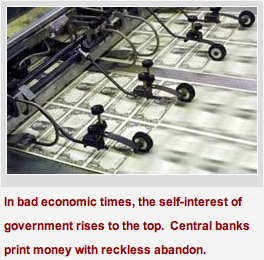 But in bad economic times, the self-interest of government rises to the top. Seeing diminished revenues and unable to curtail spending, governments start to go broke. As they go broke, they turn against their citizens and seek more ways to soak money from them while at the same time cutting and even reneging on promises.
Meanwhile, central banks try to paper over the mess, printing money with reckless abandon.
As the tensions mount between the public and private sectors, protests erupt. There are tax revolts. Riots in the streets. Secession movements. Civil strife.
Between nations, governments battle their own self-interests, with currency wars, protectionism, trade barriers, capital controls and more.
Natural-resource wars intensify. Religious battles intensify. And if leaders don’t act appropriately — which they almost never do — all hell can break loose, leading to domestic and international conflict.
Front and center is none other than your wealth. The purchasing power of your money. The life of hard work you devoted to your family and its financial security. Your liberties. Your privacy.
For in the end, bankrupt governments want to grab your money to make themselves whole.
They engage in propaganda and desperate socialist moves to spread the wealth in some utopian vision of the world that is really nothing more than grabbing everyone’s wealth to feed a monster that is going belly up.
Think of the British and the American revolution. The original Tea Party and “no taxation without representation.” Think of the French Revolution. The fall of Rome and Byzantium.
In each and every one of those instances, and countless others, government crossed the line and invaded the private sector first, confiscating wealth to pay for its mistakes to desperately try and survive.
In times like those — the times we are now entering — the single best thing you can do is to think independently.
Question everything governments say and do. They will be acting entirely out of self-interest. They will deceive you, lie to you, all the while they are reaching into your back pocket to grab what they think is theirs.
Fortunately, today we have a slew of liquid markets where you can protect yourself and even grow your money. But, again, it all depends on your ability to think for yourself.
Case in point: Germany. Remember last January when Germany announced it was repatriating its gold from the New York Fed to take it back to Germany?
Back then, almost every analyst and gold investor on the planet said that was the most bullish news for gold they had heard in a while. That it would set gold on a trajectory to much higher prices.
Not me. I told everyone I could that it was a bearish sign. I told everyone Germany was taking its gold home to do an audit and to prepare to become a gold seller.
And I was right. Twice this year, Germany’s central bank dumped gold. Why? Because it needs the cash to help bail out the weaker European countries that are going bankrupt.
Another case in point: Obamacare. A noble effort to provide health care to every American.
But as we now know, it’s nothing more than another tax on your wealth. A tax that is coupled with 16,000 new IRS agents hired to monitor Obamacare. But, in reality, agents who will be able to eavesdrop and stick their nose into everything you do.
NSA spying on all Americans? How many times have you heard that it’s designed to protect you? Nothing could be further from the truth. A government that protects its citizens never eavesdrops on them, except those it suspects have terrorist ties.
Or look at Angela Merkel’s recent move ? outlawing all referendums in Germany under the guise of a better, more productive government, when in reality, it’s nothing more than a dictatorial power grab.
Or Sen. Harry Reid’s action last week to strike down nearly 225 years of filibuster precedent, handing Obama a similar power grab.
Nothing is ever as it seems in the halls of government. That’s true even in the best of times.
In the weeks, months and years ahead — reading between the lines of what governments are doing and saying on both sides of the Atlantic will be far more important than deciphering economic statistics or central bank monetary policy.
Keep your eye on gold. It is now heading into a January low. Once it bottoms, take that as your sign that the war cycles will be ramping up big time.
Best wishes, and stay safe and well,
Larry
Also on SwingTrader:
Too Much Oil: U.S. Storage Set to Pass the 400 Million Threshold
Triple-Digit Gains Are on Tap for This Investment, History Shows

-
I know Mike is a very solid investor and respect his opinions very much. So if he says pay attention to this or that - I will.
~ Dale G.
-
I've started managing my own investments so view Michael's site as a one-stop shop from which to get information and perspectives.
~ Dave E.
-
Michael offers easy reading, honest, common sense information that anyone can use in a practical manner.
~ der_al.
-
A sane voice in a scrambled investment world.
~ Ed R.
Inside Edge Pro Contributors

Greg Weldon

Josef Schachter

Tyler Bollhorn

Ryan Irvine

Paul Beattie

Martin Straith

Patrick Ceresna

Mark Leibovit

James Thorne

Victor Adair