
Timing & trends
I’m about to put pen to paper and write my December Real Wealth Report issue. It will be a seminal issue with my forecasts for 2014 and beyond. You won’t want to miss it. If you’re not a subscriber, you can join in time to get the issue by clicking here.
2013 was a very good year for investors in the equity markets. However, it was not so good for bond investors, and it was terrible for investors in precious metals and commodities.
While I hate to say I told you so, what happened this year was etched in stone as far back as 2011. And what will unfold in 2014 will have even greater impact in the years ahead.
I’m not talking about theory here. I’m talking about plain old common sense. The world is about to dramatically change, and along with it, the financial markets and your wealth. If you think conventionally and you’re not careful, your wealth will go up in smoke.
 I am a student of the markets, of mass human behavior, of history, of cycles, psychology, and cultural and economic anthropology.
All of those fields can be distilled down to the markets, the great arbiters of all, the measurable but fluctuating figures that determine value, perceptions, optimism, pessimism, greed, and fear.
The markets are beasts with their own minds and personalities. But in the end, they are comprised of the emotions of tens of millions of investors all over the world acting in their own best interests.
If it sounds like I’m getting philosophical, I am. And the reason is simple: The last three years in the markets have been transitional.
The bond market has gone from bull to bear. The stock market, from bear to bull. The gold market, from bull to bear. The dollar, from bear to bull. The collectibles market and alternative assets, from a sideshow to center stage. And more.
This is important because I have learned that great transitions in human behavior and in financial markets tend to occur in three-year periods, just like market reactions against the trend tend to occur in intervals of three days, weeks, months or years.
Once you pass that three-year increment, which started in 2011, the “shift” hits the fan and all heck breaks loose.
That’s especially relevant today because as I’ve said all along …
 The financial crisis that started in 2007 is not over. Not by a long shot.
Europe’s sovereign debt crisis is not over either. To the contrary, it’s about to explode back on the scene.
Washington has done nothing to solve its problems either. The debt can was merely kicked down the road and will resurface in 2014, despite the recent budget agreement.
The war cycles are turning up dramatically. From 2014 to 2020, they will wreak total havoc on Europe and the U.S.
And in Europe and Washington, our leaders are becoming more and more dictatorial, more fascist, more authoritarian.
Why? Because big Western socialist governments are dying and our leaders know it. So they are acting like caged animals and fighting back the only way they know how: By attacking their own citizens.
This is how Rome died. This is how the Byzantine empire fell. It’s how the maritime merchant-based Venetian times ended. And many other civilizations throughout history that have often been at the core of the global economy.
They do not die by hyperinflation, as so many seem to think. They do not die by severe deflation either. Instead, they die by leaders turning against their own people to hunt down every penny of wealth they can find to tax and confiscate — all in the name of saving the government.
Some might say it’s our duty to save our government. I respect that. But I don’t agree.
Instead, I believe it’s our duty to design the right government and elect the right leaders. When the government doesn’t work or the leaders turn out to be as bad as they are now, it is also our responsibility to throw them all out and improve our government and install new leaders.
The same applies to the monetary system. When it’s broke, as it is now, it’s time for a new one.
The good news: Changes are coming. But the process of change is going to seem chaotic, wild, and even violent at times. In society and as a result, in the financial markets.
If there’s one thing I need to tell you today — without spilling the beans on my upcoming Real Wealth Report 2014 forecast issue — it’s this:
We are about to enter a period that I call “The 21st Century Dark Age.”
A period where everything you thought you knew, everything you worked hard to create and save, will be turned upside down.
You can survive it. You can even prosper through it. But you simply must take specific, high-level action to do so. That action is …
First, question everything and anything the government is telling you. They will be lying to your face more than ever before.
Second, question everything and anything you hear about the markets, no mater what market it is, and do your homework. I figure that better than 90 percent of all advisors are going to get the markets wrong in the months and years ahead.
They are either too young or they simply don’t have the historical awareness of the times we live in to understand the future times facing us.
Third, be as emotionally disciplined and as objective as possible. Don’t fall victim to crowd hysteria. That’s always good advice. But in the months and years ahead it will be absolutely critical to your financial survival.
Right now, the three-year transition that I spoke of earlier is coming to a head. In 2014, we will see new trends emerge in most markets.
Those new trends will be the result of the next phase of the financial crisis kicking in and they will also be the consequence of the first phase. For in the end, we have not fixed anything. There has been no real change. Just some healing. The wounds and broken bones are still present.
Right now, gold, your best barometer — not of inflation, but of mass human behavior — is completing its three-year transition period. When it bottoms, watch out. It will be your sign that we are about to enter the beginning of the “21st Century Dark Age.”
Best wishes and stay safe,
Larry
About Larry Edelson

(Reuters) – Industrial production recorded its largest increase in a year in November as mining and utilities output rebounded strongly, in the latest suggestion the economy is gaining steam as the year winds down.
Industrial output increased 1.1 percent last month as auto production swung into higher gear, the Federal Reserve said on Monday. It was the largest rise since November last year.
Production at the nation’s mines, factories and power plants had edged up 0.1 percent in October.
full article HERE

Good Monday morning. Here is what I’m reading to start the week:
• 2014: Here Comes the Dumb Money! (Investing Caffeine) but see Stories From 1999 (Joe Fahmy)
• Companies turning again to stock buybacks to reward shareholders (Washington Post)
• Gold Funds See Unprecedented 31% Slump With World Losing Faith (Bloomberg) see also Precious Metals Charlatans — Freaks of the Industry (Kid Dynamite’s World)
• You Win By Thinking Everyone Else Is Wrong (Motley Fool)
• Investors are hungry for U.S. corporate bonds, snapping them up at a record pace (WSJ) see also Time to Brace for a 20% Correction (Barron’s)
• Surowiecki: How Should We Solve the Pension-Fund Crisis? (New Yorker)
• Is art a good investment? Two NYU economists estimated real returns on art from 1875 to 2000 to be 4.9 percent. (WSJ)
• How to Take Good Photos for Under $1,000 (Prolost)
• This Is the Average Man’s Body (The Atlantic)
• Holiday Tipping Survey: How Much Do You Give? (Zagat)


U.S. equities outperformed commodities this year by a long shot, but commodities have a good chance to regain investor favor in 2014 after three consecutive years of declines.
“Something has got to give in 2014,” said Phil Flynn, senior market analyst at the Price Futures Group in Chicago.
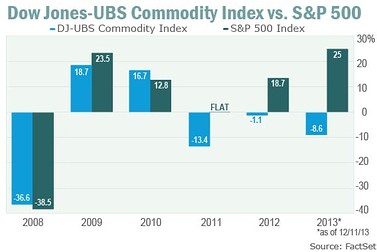
As the investing game draws to an end for the year, the near final score is: commodities down roughly 9%, based on the Dow Jones-UBS Commodity Index. The Dow Jones-UBS Commodity Index Total Return Exchange-Traded Note has lost 10% year to date. The S&P 500 Index, on the other hand, has surged 25%, on track for its best year since 2003.
“Based off historical norms, either stocks are way too high or commodities are way too low. The odds are high for either a massive commodity rally or a rather large stock market selloff,” said Flynn.
This year will mark a third year in a row in which commodities have underperformed U.S. equities. Including 2013, the Dow-Jones UBS Commodity Index has fallen for each of the last three years, as the S&P 500 Index scored significant gains over the past two.
….read more HERE

-
I know Mike is a very solid investor and respect his opinions very much. So if he says pay attention to this or that - I will.
~ Dale G.
-
I've started managing my own investments so view Michael's site as a one-stop shop from which to get information and perspectives.
~ Dave E.
-
Michael offers easy reading, honest, common sense information that anyone can use in a practical manner.
~ der_al.
-
A sane voice in a scrambled investment world.
~ Ed R.
Inside Edge Pro Contributors

Greg Weldon

Josef Schachter

Tyler Bollhorn

Ryan Irvine

Paul Beattie

Martin Straith

Patrick Ceresna

Mark Leibovit

James Thorne

Victor Adair