
Timing & trends
In this report, we will outline how to recognize market tops when they occur.
Every market top is slightly different, but they always have many things in common. There are always tell-tale signs in economic data, market sentiment, capital markets activity, corporate actions, etc. We will look at historical market tops: 2007, 2000, 1990, 1980, 1976, and 1972. We will then look at the current market and see how today compares and what we can learn from that. We hope this research report will be a blueprint and a useful tool for investors for years to come.
Today the market shows many of the elements that are present near market tops. In particular, sentiment is extremely bullish, investors are very long and leveraged, and valuations are extended on a wide variety of measures. However, leading economic indicators are still not negative, and so far breadth and technicals have not deteriorated. Medium term stock market returns are likely to be negative due to excessive valuation, but there is no imminent sign of a market top. We would need to see a deterioration of our leading indicators before calling a market top.

In the following table, we summarize the characteristics of market bottoms and tops. The table is a very useful checklist that investors can print and consult as events unfold in markets around the world. Clearly, many signs of a top are in place, but there are many characteristics that are currently missing. This report looks in detail at each of the signs: corporate, valuation, economic, market and sentiment.
For a larger view of the table below go HERE
If you would like to receive the full 28 page report, please go HERE


Today KWN is putting out a special piece which has some absolutely outstanding gold charts that were sent to us by David P. out of Europe.
These are charts that the big bullion banks follow closely in the gold and silver markets, as well as big money and savvy professionals. David believes that despite the recent weakness, the gold market may now be set up for a remarkable 177% surge that would take the price of gold over $3,500.
….commentary & charts HERE
North American equity markets are in the final stages of their current period of seasonal strength. Short term technical evidence of a top has appeared, but is inconclusive. Preferred strategy is to hold seasonally strong equity positions for now, but start to plan an exit strategy to be triggered on additional technical evidence of a possible downtrend.
Other Issues
A key reversal by the S&P 500 Index and Dow Jones Industrial Average on Friday is a short term bearish technical signal for U.S. equity markets.
First quarter corporate reports start to flow late this week. Initial focus is on the U.S. financial services sector. Consensus shows that year-over-year comparisons for S&P 500 and Dow Jones Industrial companies will be slightly negative. On the other hand, first quarter reports frequently are released during annual meeting that often include good news (increased dividends, stock splits, share buy backs). In addition, many companies are expected to report positive second quarter guidance relative to first quarter, weather weakened results.
Short and intermediate technical indicators remain overbought for most equity markets and sectors.
Economic news this week is expected to be quiet. Focus is on release of the FOMC minutes for the March 19th meeting.
Political focuses this week are on election results from Quebec and Afghanistan.
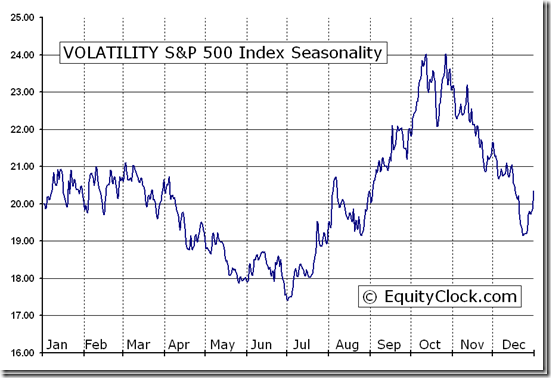
Seasonal influences for U.S. equity markets and sectors normally are positive during the first half of half of April followed by underperformance in the second half of April
Historically, during U.S. Midterm election years, the S&P 500 Index and Dow Jones Industrial Average reach a significant medium term peak in the second half of April followed by a significant intermediate correction lasting until the beginning of October. Tipoff is the start of mid-term election ads.
Economic News This Week
March Canadian Housing Starts to be released at 8:15 AM EDT on Tuesday are expected to increase to 193,000 from 191,200 in February.
February Wholesale Inventories to be released at 8:30 AM EDT on Wednesday are expected to increase 0.5% versus a gain of 0.6% in January.
Minutes from the FOMC meeting on March 19th are released at 2:00 PM EDT on Wednesday
Weekly Initial Jobless Claims to be released at 8:30 AM EDT on Thursday are expected to slip to 325,000 from 326,000 last week.
March Producer Prices to be released at 8:30 AM EDT on Friday are expected to increase 0.1% versus a decline of 0.1% in February.Excluding food and energy March PPI is expected to decline 0.2% versus a drop of 0.2% in February
April Michigan Sentiment to be released at 9:55 AM EDT on Friday is expected to improve to 81.0% from 80.0.0% in March.
Equity Trends
The S&P 500 Index gained 7.47 points (0.40%) last week despite the 1.25% drop on Friday. Note the negative key reversal on Friday when the Index also touched an all-time high. Intermediate trend remains up. The Index fell below its 20 day moving average on Friday. Short term momentum indicators are overbought and showing early signs of rolling over.
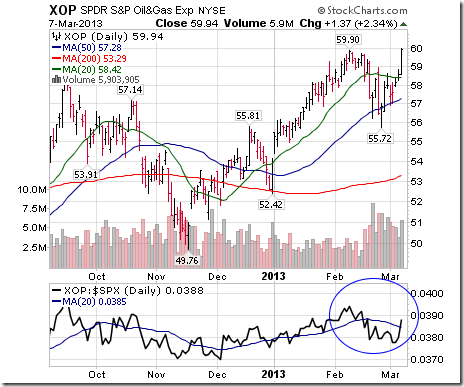
The TSX Composite Index added 132.38 points (0.93%) last week. Intermediate trend remains up (Score: 1.0). The Index recovered back above its 20 day moving average (Score: 1.0). Strength relative to the S&P 500 Index remains neutral (Score: 0.5). Technical score based on the above indicators improved to 2.5 from 1.5 out of 3.0. Short term momentum indicators are overbought and showing early signs of rolling over.
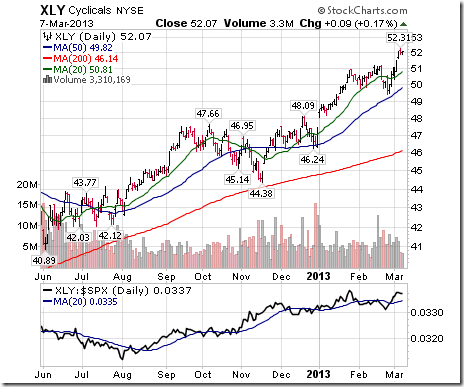
…..more HERE including 45 Charts

 Here’s what FX traders should do in the meantime …
The euro has been strong this year against the US dollar.
The rationale for euro strength? Money flow into Europe, both speculative and longer-term portfolio flow as the European banking system deleverages global credit lines and brings money home.
But, over the intermediate- to long-term, the strongest driver for the euro and US dollar relationship has been relative yield, with expectations impacted by relative economic growth forecasts.
Things will change …
Presently, there is quite a large divergence in play, i.e. the path of euro-US dollar has tightly followed the yield differential. If it is rising in favor of the Eurozone, then the EUR/USD pair tends to follow in similar fashion, and vice versa.
This year, however, the yield differential is moving strongly in favor of the US which is to be expected given the relative growth forecasts comparing the US and Eurozone, but EUR/USD continues to rise.
I believe this divergence gap will be closed,
I believe we’ll see a sharp decline in the EUR/USD rate in the months ahead as price turns to reflect the value suggested by the yield differential.
What should we do now?
Well, long-term minded investors could sell short immediately using a euro ETF. But the real money to be made is directly through the forex market.
Now one probably shouldn’t short EUR/USD and then just forget about it. That’s an easy way to get burned. Rather, one should be prepared for a substantial euro decline without necessarily betting on it.
That means trust the short-term technical setups. Make money based on what the charts say NOW. And let the big trades (like a euro implosion) happen when they may. If you’re consistently applying a proven and structured trading framework, I can assure you you’re not going to miss the bus on the euro trade.
If you don’t consider yourself equipped, then start preparing.
Jack Crooks
About Jack Crooks
President & Chief Trading Officer
Jack has over 25 years of experience in the currency, equity, and futures arena. He has held key positions in brokerage, investment research, money management, and trading.
Jack is founder and president of Black Swan Capital LLC. He was also founder of Ross International Asset Management (a Registered Investment Advisory firm specializing in global stock, bond, and currency asset management for retail clients), General Manager of Plexus Trading (specializing in currency futures and commodities trading) and Black Swan Capital Management (a commodities advisor trading firm specializing in foreign exchange trading).
He’s recently outlined my entire personal trading framework, the nuts and bolts of what helped my members harness the potential to make as much as 42% ROI last year. And He’s sharing it with those who are committing themselves to improving their trading.
Click HERE to find out how you can (and should) jump at this opportunity to map out trading success and profit in forex.

As I pen this column, gold and silver continue to build a base. That base will strengthen dramatically as long as gold holds the $1,278 level on a weekly closing basis, and silver holds its June 2013 low at $18.18, also on a weekly closing basis.
Meanwhile, the euro appears ready to crack, and deflation still has the upper hand in an assortment of commodities — ranging from oil to wheat, and soon to follow, soybeans, which could be about to fall very hard.
Also, keep your eyes on the U.S. equity market: If the Dow can give us a weekly close above 16,650, it could be headed for 18,000-19,000. If not, I still think a sharp market pullback is in order, especially in Europe.
That’s the near term. But now, let’s turn to the Big Picture. I am often asked …
“Larry, what can we do to prevent our country
from continuing to slide down a slippery slope?”
(while concentrated on the US, a lot of this applies to Canadians – Editor Money Talks)
“What can we do to get our country out of debt? What can we do to rebuild America? What are your ideas?”
I have ten proposed ideas, all of them controversial, too. And all of them difficult to execute, to be sure.
But in my opinion, in order to get our country back on track, at a minimum, we MUST get started on the following:
FIRST, and foremost, aim to pay off our foreign creditors. 100 percent on the dollar. Stop the bleeding interest payments and become 100 percent invulnerable to foreign financial threats.
SECOND, aim to ultimately pay off domestic creditors to the U.S. government as well. There isn’t enough money to do so. But, there are assets and equity.
How will that ever be possible? Here’s an idea: Offer domestic creditors a second, alternative choice: A swap of their domestic U.S. debt for equity in a newly established, not-for-profit federal government. Make the equity transparent and liquid and tradable on an established exchange, but only by U.S. citizens.
That would be radical and far off, of course. But a first step in that process is not: Just move step by step to privatize as much of the federal government as possible to free up cash, to stop cronyism, and to get rid of a bloated, wasteful government.
THIRD, aim to abolish the tax code. Replace it with a consumption tax, with the only exempt items being food and clothing. By getting rid of the current tax code, we also get rid of politicians’ non-stop efforts to play God and socially engineer society.
FOURTH, move toward maximum term limits for all members of Congress. For example, they could serve one 3-year term, and that’s it. Also enact term limits for federal, state and local judges.
FIFTH, take steps to privatize Social Security and Medicare. Most fears about privatizing Social Security and Medicare are unfounded. Consider Chile and other countries that have very successfully privatized national retirement and health programs.
SIXTH, abolish Obamacare. Also bust the informal union of malpractice, ambulance-chasing lawyers.
SEVENTH, put all votes on ALL major federal and local bills and laws to the public via referendums. No more coming up with insane laws and burying them in some larger bill so they get passed without the public having any clue what’s going on whatsoever.
Consider the FACTA foreign reporting of American overseas bank accounts and how that was slipped into Obama’s 2010 Hiring Incentives to Restore Employment Act … how that is now causing banks all over the world to stop doing business with Americans.
EIGHTH, stop all spying on domestic U.S. citizens, unless a legitimate search warrant has been issued.
 NINTH, scale back the police state that we now have.
Just consider how the esteemed Economist describes the American paramilitary force, where SWAT teams are now used around 50,000 times a year, compared to 3,000 times in 1980.
Or consider the small town of Keene, New Hampshire, which spent $286,000 on an armored personnel-carrier known as a BearCat — to patrol Keene’s annual “Pumpkin Festival.”
TENTH, open up the spigots on our new energy independence and become an energy exporter.
And more, including deregulating small business, which is 70 percent of our economy and the home of American entrepreneurship.
Difficult to do? Absolutely. Controversial? You can bet on it. But these kinds of steps will put us on the right track — back to the great Constitution our forefathers drew up that made America a great nation. That gave us liberty and the pursuit of happiness, for all.
It’s time for change. You know it. I know it. So does the rest of the world.
Best wishes,
Larry
More from Swing Trading: A Very Bad Chart Day

-
I know Mike is a very solid investor and respect his opinions very much. So if he says pay attention to this or that - I will.
~ Dale G.
-
I've started managing my own investments so view Michael's site as a one-stop shop from which to get information and perspectives.
~ Dave E.
-
Michael offers easy reading, honest, common sense information that anyone can use in a practical manner.
~ der_al.
-
A sane voice in a scrambled investment world.
~ Ed R.
Inside Edge Pro Contributors

Greg Weldon

Josef Schachter

Tyler Bollhorn

Ryan Irvine

Paul Beattie

Martin Straith

Patrick Ceresna

Mark Leibovit

James Thorne

Victor Adair