

Real Estate

Money pours into real estate ETFs

‘Canadians are buying everywhere’

Investors are putting money into real estate companies outside the U.S. at a record pace as interest rates recede, economies expand and opportunities remain to buy assets at discounts amid lingering distress from the global financial crisis.

The SPDR Dow Jones International Real Estate Exchange– Traded Fund, the largest ETF for non-U.S. real estate, attracted net inflows of $304-million in August, the most of any property ETF, driving its shares outstanding – a proxy for demand – to a record, according to data compiled by Bloomberg. Last month’s surge catapulted property ahead of energy for the first time in industry fund flows year to date, the data show. ETFs are passively managed funds that aim to replicate the performance of benchmark indexes for various industry groups.

Real estate has emerged as the asset of choice following the global financial meltdown because of its relatively high yields. While the U.S. has claimed a large share of interest for its perceived stability and enduring appeal of gateway markets such as New York and Los Angeles, investors also have increased purchases in Europe, Asia-Pacific and Latin America.

“Many investors that have moved to have real estate allocations in the U.S. are now looking to do so internationally,” said David Mazza, head of ETF investment strategy at State Street Global Advisors. “Investors are looking ahead to greater cyclical recovery and taking advantage of some pockets of distress” outside the U.S.

re

Japan, U.K.
Japan has the largest weighting in the SPDR Dow Jones International Real Estate ETF, at 21 per cent, followed by the U.K. at 14.1 per cent, Australia at 13.6 per cent, Hong Kong at 10.5 per cent, Canada at 10 per cent, France at 9.2 per cent and Singapore at 7.7 per cent. The Netherlands, Switzerland and South Africa round out the top 10.

A Bloomberg index of U.S. real estate investment trusts fell 2.3 per cent in the fourth quarter amid concern the prolonged period of suppressed interest rates would cease, then rallied 21 per cent this year as the yield on the 10-year Treasury note fell to 2.3 per cent from 3 per cent at the end of 2013. That meant borrowing costs would stay low for the time being.

Whether it’s private-equity firms and foreign pensions flush with cash chasing commercial and housing distress in Europe and Australia and economic growth in South America, or Russian billionaires and wealthy Chinese buying homes in London, Canada and the U.S., cross-border real estate flows are increasing.

GIC, Manulife Singapore’s GIC Pte Ltd., barred from investing in Singapore itself, bought a half stake in London’s Broadgate office complex last year for more than 1.7 billion pounds ($2.8-billion), a record for a central London property.

In June, Citigroup Inc. paid a record HK$5.4-billion ($697-million) for a Hong Kong office tower that will bring most of its 5,000 employees under one roof. Canada’s Manulife Financial Corp. last year paid HK$4.5-billion for a similar-size tower and development in the city’s Kowloon district.

“Canadians are buying everywhere,” said Ross Moore, director of Canada research at CBRE Group Inc., the biggest commercial broker. “They are shopping the world. What’s happened in the last five to 10 years is the big pension funds pretty well own everything of quality in Canada. They love real estate and have all this money coming in and they have to put it somewhere.”

Toronto-based Brookfield Asset Management Inc. has started investing in European warehouse properties and Indian offices after accumulating the biggest holdings of office buildings in both the U.S. and Canada. The real estate unit of Ontario Teachers’ Pension Plan has been investing in Brazil as well as the U.K. and Australia. Canadian Pension Plan Investment Board has bought London residential, retail and office properties.

Easy targets
Markets such as the U.K. and Australia are easy targets for North American investors, Moore said.

“The ownership structures are familiar, the legal structures are very similar, they understand what they’re getting into and the transparency is good,” he said.

In Japan, where interest rates are near zero thanks to central bank stimulus, investors can borrow cheaply to buy buildings whose rents translate into an investment yield that’s three or more percentage points higher, said Sonny Kalsi, co– founder of GreenOak Real Estate, who previously led Morgan Stanley’s real estate investment unit.

Investment yields on properties are measured in terms of capitalization rate, a building’s net operating income divided by purchase price. A property valued at $100-million with income of $5-million a year would translate to a cap rate of 5 per cent.

Liquidity, stability
“Liquidity, stability and the view that rents have a lot of upside” are driving real estate investment in Japan, said Kalsi. “You can buy for a 4 to 6 per cent cap rate, and borrow at 1 to 2 per cent so there’s significant positive spread with real potential upside.”

By company, the international property ETF’s biggest holdings are Mitsui Fudosan Co., Japan’s second-largest developer; Brookfield Asset Management; Paris-based Unibail– Rodamco SE, the biggest developer in Europe; Scentre Group, the Westfield Group spinoff that owns shopping malls in Australia and New Zealand; and Land Securities Group Plc, the largest developer in the U.K.

ETF Gains
The SPDR International Real Estate ETF had a record 117.8 million shares outstanding as of Aug. 29 – a proxy for fund flows since more shares are created to meet demand – up from 400,000 shares when the fund was formed in December 2006. The ETF has gained 10.3 per cent year to date with dividends reinvested, compared with 9.8 per cent for the Standard & Poor’s 500 Index, the U.S. equity benchmark gauge.

Also paving the way for more real estate deals are the early stages of a rebound in the commercial mortgage-backed securities market in Europe and new REIT legislation in India.

Some investors say the heightened liquidity is a warning sign. Hyper-liquidity in 2007 was a prelude to the real estate crash, as the flood of debt made available through the CMBS market encouraged borrowers to pay ever higher prices.

Additionally, overbuilding in China on the residential and commercial side have kept some investors wary of putting money in Chinese properties.

“Asia’s tough,” said Moore. “You think everybody should go there but that’s also where a lot of the construction is occurring. No sooner do you buy something than a new building competing for your tenants goes up.”

Real estate companies’ earnings are rising faster than interest rates and as long as that remains the case, demand and asset values will likely hold up, said State Street’s Mazza.

“If we get to a place where leverage because of the excess liquidity is increasing faster than revenue growth and earnings, that is a sign there is some overheating,” he said. “We don’t see that at present.”


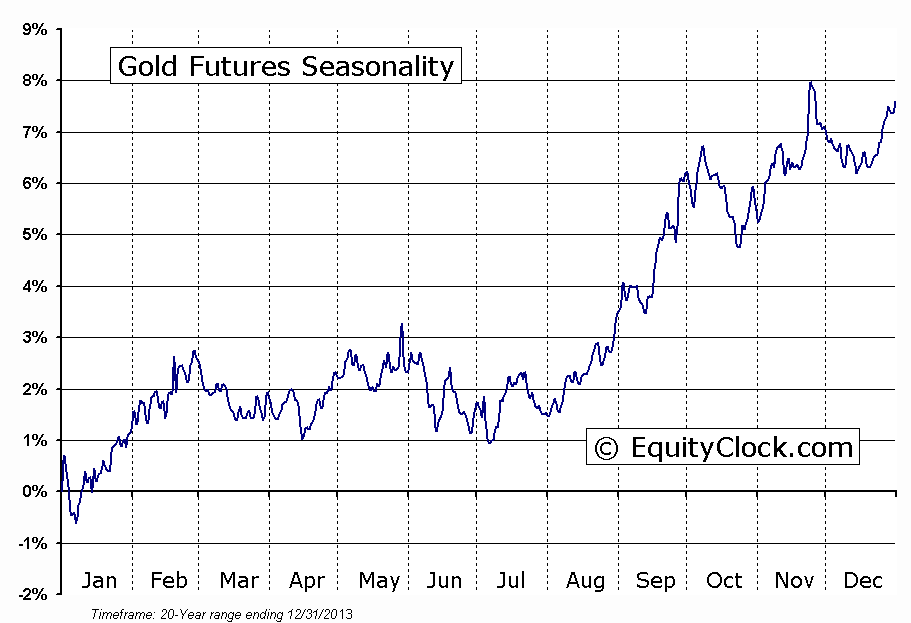
Gold Seasonality Chart Points to Strong Gains Sept through February

The month of September has historically been the strongest for precious metals. Since the start of the current bull market, gold has averaged a gain of 2.6% during the month of September. This is typically followed by a smaller gain of 0.8% in October and then a few more strong months in November, January and February. Taken together, we are exiting the weakest seasonal period for gold (Spring-Summer) and entering into the strongest seasonal period (Fall-Winter).

Chart & more commentary HERE

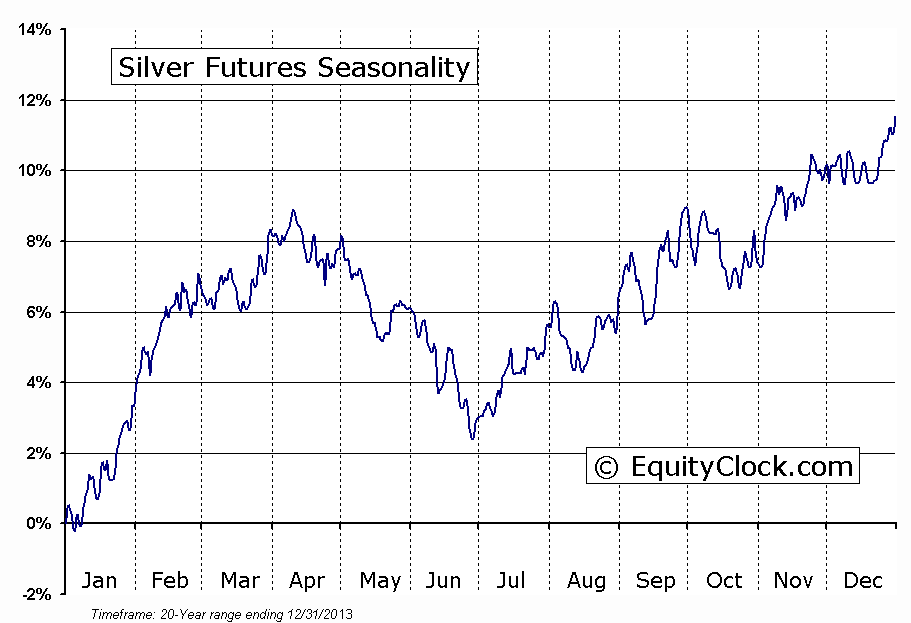
…Also seasonal charts from Equity Clock, you might also want to click on a chart below to be taken to Jon Vialoux’s excellent Stock Market Report for Sept. 4th – Money Talks Editor

FUTURE GC1

FUTURE SI1

Oil Trading Alert: Stronger Greenback & Its Implications for Crude Oil

Oil Trading Alert originally published on September 3, 2014, 9:32 AM

On Tuesday, crude oil lost 2.70% as the combination of disappointing Chinese data and stronger U.S. dollar weighed on the price. Because of these circumstances, the commodity bounced down the medium-term resistance zone and approached the recent lows. Will they withstand the selling pressure?

Yesterday’s data showed that China’s official manufacturing index dropped to 51.1 in August, while the HSBC manufacturing index ticked down to 50.2. These disappointing numbers fueled worries over demand in the world’s second-largest oil consumer and affected negatively the price of light crude.

Additionally, later in the day, the Institute for Supply Management reported that its manufacturing purchasing managers’ index increased to 59.0 in August, beating expectations of a drop to 56.8. Although these bullish figures confirmed that the U.S. economy continues to show signs of improvement, they also supported the greenback, which made crude oil less attractive on dollar-denominated exchanges. This was bearish for the commodity and pushed it to slightly above the recent lows. What’s next? Let’s check the technical picture of light crude and find out (charts courtesy of http://stockcharts.com).

Larger Image

35008 b

Larger Image

The weekly chart clearly shows that the strong resistance zone created by the previously-broken 200-week moving average and the rising, long-term support line, successfully stopped further improvement and the commodity reversed, declining sharply to around the recent low. This is a bearish signal, which suggests that if crude oil moves lower, the last week’s upswing will be nothing more than a verification of the breakdown and we’ll see a test of the strength of the Jan low of $91.24. At this point, it’s worth noting that although the CCI and Stochastic Oscillator are oversold, they didn’t generate buy signals, which could support oil bulls at the moment.

Will the very short-term chart give us more clues about future moves? Let’s check.

Larger Image

35008 a

Larger Image

Quoting our yesterday’s summarize:

(…) Although the very short-term picture suggests further improvement as light crude remains above the upper line of the consolidation and buy signals are still in play, it seems to us that this medium-term resistance zone could trigger a pullback in the coming day (or days). If this is the case, we may see a comeback to the upper border of the formation.

As you see on the daily chart, oil bears not only realized the above-mentioned scenario, but also managed to push the commodity lower and light crude approached the recent lows. Taking this fact into account, you’re probably wondering whether they withstand the selling pressure or rather we’ll see a test of the 2014 low.

From the technical point of view, this is the point from where crude oil should go north (at least later today) as the proximity to the support level will likely encourage some investors to push the buy button. But is this the right place to open long positions? Not really. The reason? Firstly, light crude is still trading in the declining trend channel, which means that even if we see a rebound from here, oil bulls will have to push the price above the upper line of the formation before we’ll see another sizable upward move. Secondly, as we mentioned earlier, crude oil still remains below the strong medium-term resistance zone, which keeps gains in check. Finally, when we take a closer look at the daily chart, we clearly see that the recent corrective upswing is much smaller than the previous one, which means that oil bulls are even weaker than they were in July. Therefore, in our opinion, the downward trend is not threatened at the moment and another attempt to move lower should not surprise us. If this is the case, we think that the next downside target will be the combination of the 2014 low and the lower border of the declining trend channel around $91.24-$91.50.

Summing up, the medium-term outlook remains bearish and in our opinion opening long positions is currently not justified from the risk/reward perspective. Yesterday, crude oil reversed and declined sharply, approaching the recent lows and as we have pointed out before, although we may see a rebound from here in the very short-term (especially if the EIA weekly report on crude oil inventories will be bullish for the commodity), it will not serve as a buy signal unless the medium-term resistance is taken out. We’ll keep you informed.

Very short-term outlook: mixed
Short-term outlook: bearish
MT outlook: bearish
LT outlook: bullish

Trading position (short-term; our opinion): No positions are justified from the risk/reward perspective at the moment.

Thank you.

How is Doug Casey Preparing for a Crisis Worse than 2008? He & His Fellow Millionaires Are Getting Back to Basics

Trillions of dollars of debt, a bond bubble on the verge of bursting and economic distortions that make it difficult for investors to know what is going on behind the curtain have created what author Doug Casey calls a crisis economy. But he is not one to be beaten down. He is planning to make the most of this coming financial disaster by buying equities with real value—silver, gold, uranium, even coal. And, in this interview with The Mining Report, he shares his formula for determining which of the 1,500 “so-called mining stocks” on the TSX actually have value.

The Mining Report: This year’s Casey Research Summit is titled “Thriving in a Crisis Economy.” What is the most pressing crisis for investors today?

Doug Casey: We are exiting the eye of the giant financial hurricane that we entered in 2007, and we’re going into its trailing edge. It’s going to be much more severe, different and longer lasting than what we saw in 2008 and 2009. Investors should be preparing for some really stormy weather by the end of this year, certainly in 2015.

TMR: The 2008 stock market embodied a great deal of volatility. Now, the indexes seem to be rising steadily. Why do you think we are headed for something worse again?

DC: The U.S. created trillions of dollars to fight the financial crisis of 2008 and 2009. Most of those dollars are still sitting in the banking system and aren’t in the economy. Some have found their way into the stock markets and the bond markets, creating a stock bubble and a bond superbubble. The higher stocks and bonds go, the harder they’re going to fall.

TMR: When Streetwise President Karen Roche interviewed you last year, you predicted a devastating crash. Are we getting closer to that crash? What are the signs that a bond bubble is about to burst?

DC: One indicator is that so-called junk bonds are yielding on average less than 5% today. That’s a big difference from the bottom of the bond market in the early 1980s, when even government paper was yielding 15%.

TMR: Isn’t that a function of low interest rates?

DC: Yes, it is. Central banks all around the world have attempted to revive their economies by lowering interest rates to all-time lows. It’s discouraging people from saving and encouraging people to borrow and consume more. The distortions that is causing in the economy are huge, and they’re all going to have to be liquidated at some point, probably in the next six months to a year. The timing of these things is really quite impossible to predict. But it feels like 2007 except much worse, and it’s likely to be inflationary in nature this time. The certainty is financial chaos, but the exact character of the chaos is, by its very nature, unpredictable.

TMR: Casey Research precious metals expert Jeff Clark recently wrote in Metals and Mining that he’s investing in silver to protect himself from an advance of what he calls “government financial heroin addicts having to go cold turkey and shifting to precious metals.” Do you agree or are you more of a buy-gold-for-financial-protection kind of guy?

DC: I certainly agree with him. Gold and silver are two totally different elements. Silver has more industrial uses. It is also quite cheap in real terms; the problem is storing a considerable quantity—the stuff is bulky. It’s a poor man’s gold. We mine about 800 million ounces (800 Moz)/year of silver as opposed to about 80 Moz/year of gold. Unlike gold, most of silver is consumed rather than stored. That is positive.

On the other hand, the fact that silver is mainly an industrial metal, rather than a monetary metal, is a big negative in this environment. Still, as a speculation, silver has more upside just because it’s a much smaller market. If a billion dollars panics into silver and a billion dollars panics into gold, silver is going to move much more rapidly and much higher.

TMR: Are you are saying that because silver is more volatile generally, that is good news when the trend is to the upside?

DC: That’s exactly correct. All the volatility from this point is going to be on the upside. It’s not the giveaway it was back in 2001. In real terms, silver is trading at about the same levels that it was in the mid-1960s. So it’s an excellent value again.

TMR: In another recent interview, you called shorting Japanese bonds a sure thing for speculators and said most of the mining companies on the Toronto Stock Exchange (TSX) weren’t worth the paper their stocks were written on, but that some have been priced so low, they could increase 100 times. What are some examples of some sure things in the mining sector?

DC: Of the roughly 1,500 so-called mining stocks traded in Vancouver, most of them don’t have any economic mineral deposits. Many that do don’t have any money in the bank with which to extract them. The companies that I think are worth buying now are well-funded, underpriced—some selling for just the cash they have in the bank—and sitting on economic deposits with proven management teams. There aren’t many of them; I would guess perhaps 50 worth buying. In the next year, many of them are likely to move radically.

TMR: Are there some specific geographic areas that you like to focus on?

DC: The problem is that the whole world has become harder to do business in. Governments around the world are bankrupt so they are looking for a bigger carried interest, bigger royalties and more taxes. At the same time, they have more regulations and more requirements. So the costs of mining have risen hugely. Political risks have risen hugely. There really is no ideal location to mine in the world today. It’s not like 100 years ago when almost every place was quick, easy and profitable. Now, every project is a decade-long maneuver. Mining has never been an easy business, but now it’s a horrible business, worse than it’s ever been. It’s all a question of risk/reward and what you pay for the stocks. That said, right now, they’re very cheap.

TMR: Let’s talk about the U.S. Are we in better or worse shape as a country politically and economically than we were last year? At the Casey Research Summit last year, I interviewed you the morning after former Congressman Ron Paul’s keynote, and you said that you hoped that the IRS would be shut down instead of the national parks. There’s no such shutdown going on today, so does that mean the country is more functional than it was a year ago?

DC: It’s in worse shape now. The direction the country is going in is more decisively negative. Perhaps what’s happening in Ferguson, Missouri, with the militarized police is a shade of things to come. So, no, things are not better. They’ve actually deteriorated. We’re that much closer to a really millennial crisis.

TMR: Your conferences are always thought provoking. I always enjoy meeting the other attendees—it’s always great to talk to people from all over the world who are interested in these topics. But you also bring in interesting speakers. In addition to your Casey Research team, the speakers at the conference this year include radio personality Alex Jones and author and self-described conservative paleo-libertarian Justin Raimondo. What do you hope attendees will take away from the conference?

DC: This is a chance for me and the attendees to sit down and have a drink with people like Justin Raimondo and author Paul Rosenberg. I’m looking forward to it because it is always an education.

Another highlight is that instead of staging hundreds of booths of desperate companies that ought to be put out of their misery, we limit the presenting mining companies in the map room to the best in the business with the most upside potential. That makes this a rare opportunity to talk to these selected companies about their projects.

TMR: We recently interviewed Marin Katusa, who was also excited about the companies that are going to be at the conference. He was bullish on European oil and gas and U.S. uranium. What’s your favorite way to play energy right now?

DC: Uranium is about as cheap now in real terms as it was back in 2000, when a huge boom started in uranium and billions of speculative dollars were made. So, once again, cyclically, the clock on the wall says buy uranium with both hands. I think you can make the same argument for coal at this point.

TMR: You recently released a series of videos called the “Upturn Millionaires.” It featured you, Rick Rule, Frank Giustra and others talking about how you’re playing the turning tides of a precious metals market. What are some common moves you are all making right now?

DC: All of us are moving into precious metals stocks and precious metals themselves because in the years to come, gold and silver are money in its most basic form and the only financial assets that aren’t simultaneously somebody else’s liability.

TMR: Thanks for your time and insights.
dc

International investor Doug Casey, chairman of Casey Research, LLC, has written several books on crisis investing, including the groundbreaking “Crisis Investing: Opportunities and Profits in the Coming Great Depression” (1979). He has appeared on NBC News, CNN and National Public Radio, and he’s been featured in periodicals such as Time, Forbes, People, Barron’s and The Washington Post. He has also written countless articles for his own publications.

Want to read more Mining Report interviews like this? Sign up for our free e-newsletter, and you’ll learn when new articles have been published. To see a list of recent interviews with industry analysts and commentators, visit our Streetwise Interviews page. 

Related Articles


DISCLOSURE: 
1) JT Long conducted this interview for Streetwise Reports LLC, publisher of The Gold Report, The Energy Report, The Life Sciences Report and The Mining Report, and provides services to Streetwise Reports as an employee. 
2) Doug Casey: I was not paid by Streetwise Reports for participating in this interview. Comments and opinions expressed are my own comments and opinions. I had the opportunity to review the interview for accuracy as of the date of the interview and am responsible for the content of the interview. 
3) Interviews are edited for clarity. Streetwise Reports does not make editorial comments or change experts’ statements without their consent.
4) The interview does not constitute investment advice. Each reader is encouraged to consult with his or her individual financial professional and any action a reader takes as a result of information presented here is his or her own responsibility. By opening this page, each reader accepts and agrees to Streetwise Reports’ terms of use and full legal disclaimer.
5) From time to time, Streetwise Reports LLC and its directors, officers, employees or members of their families, as well as persons interviewed for articles and interviews on the site, may have a long or short position in securities mentioned. Directors, officers, employees or members of their families are prohibited from making purchases and/or sales of those securities in the open market or otherwise during the up-to-four-week interval from the time of the interview until after it publishes.



How to Follow the Big Money

One of the most important aspects of the rising tide of geopolitical disruptions — as spelled out by the research I have done on war cycles — is how they are impacting the world’s financial markets.

As I’ve discussed many times, they are changing everything you thought you knew about investing.

Consider the U.S. property markets, which have already recovered from their lows quite nicely — even as mortgage rates have stabilized and started moving higher.

Or consider gold, which is now nearly 8 percent above its three-year bear market low of last year, even though the U.S. dollar is also sharply higher.

Or the U.S. stock markets, whose bull ride higher this year far exceeds what one would expect given the U.S. economy’s performance.

You are likely to see more of these types of moves in the months and years ahead. Moves that defy old rules of thumb. Moves that defy normal inter-market relationships.

Moves that dumbfound most U.S. analysts, especially those — still in the majority — who still focus merely on the U.S. economy and who ignore what’s happening globally.

Gold is set to rise with a stronger dollar. Commodity prices in general will soon bottom and head higher, even though the global economy remains lackluster. Equity markets and property prices will increase with rising interest rates.

So what then is the common denominator behind these market moves?

What’s the fuel that is causing the linkages between them to change, wreaking havoc on old rules of thumb and ushering in new relationships between markets, with the economy or with traditional logic?

Creating forces that you must grasp to truly protect and grow your wealth?

It’s international capital flows. Or put more simply, what I call “Following the Big Money.”

You’ve undoubtedly heard the saying “Follow the Money” in the past. But today, it’s more important than ever.

It’s not just domestic in scope; it’s international.

And it’s BIG.

Here’s why …

Today, we live in a world where governments are at war with each other. Propaganda wars. Trade wars. Currency wars.

Today, we live in a world where governments are getting ready to reignite “hot” wars: Russia/Ukraine. China/Japan. Israel/Gaza. Not to mention the rampage of ISIS in Iraq and Syria.

And today, we also live in a world where the bankrupt governments are waging wars against their very own citizens, via tax hikes, confiscatory schemes and capital controls.

All of this is causing capital in nearly every corner of the globe to take flight, leaving risky countries or investments and heading toward safer shores.

In a recent column, Martin told you of the middle-class and wealthy families he personally knows who are living in some of the riskiest places in the world … and how they are packing up their families and their capital, seeking safety in other venues.

Then, this week, he told you how terrorists and militias are turning into full-fledged armies, prompting even larger flows of flight capital.

For many months now I have told you that those capital flows are pointing directly toward the U.S.

Savvy European investors are moving their investments out of Europe in droves. Middle Eastern money is also coming to our shores. Savvy Chinese investors are moving funds to the U.S. hand over fist, especially into U.S. property markets.

So how can one measure the amount of capital that’s pouring into our relatively safe borders and markets?

It’s no easy task. Reason: The data on capital flows collected by the U.S. Department of Commerce’s Bureau of Economic Analysis (BEA) and the Organization for Economic Cooperation and Development (OECD) often lag the actual flows by as much as a year’s time, making them subject to significant revisions.

Plus, the figures are subject to definitional problems, as capital flows are difficult to monitor and categorize.

Nevertheless, they give you a good handle on the amounts of capital that are flowing into our borders, supporting the big-picture conclusion that …

Capital is literally pouring into the U.S.

First, some notes. Both the BEA and the OECD keep track of our country’s “International Investment Position” (IIP). It’s a financial statement setting out the value and composition of our country’s external financial assets, assets that U.S. citizens and entities own abroad …

Versus our country’s liabilities, assets in the U.S. owned by foreign entities.

The net of the two is called our country’s “Net Investment Position” (NIP).

The data are further divided into several different categories, including our government’s reserves (including gold) … financial derivatives … government debt held overseas … foreign exchange and more.

For our purposes, we only need to look at the liabilities side of the data — financial assets in our country owned by foreigners.

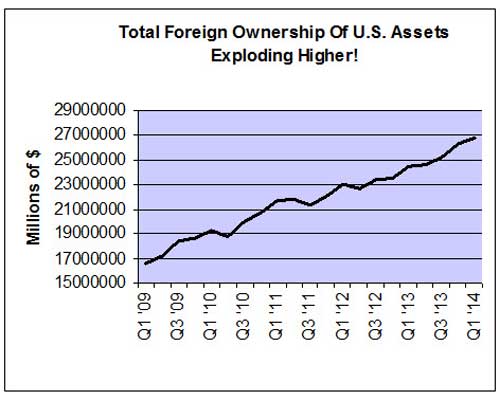
And they show that the foreign ownership of U.S. assets is surging:

chart1s

Click for larger version

– Total foreign ownership of U.S. assets (excluding complicated financial derivatives) rose from $16.594 trillion at the beginning of 2009 to record $26.791 trillion at the end the first quarter of 2014.

That’s an astounding 61 percent gain in a short five years, a record for such a short time period.

It’s a total of more than 10 TRILLION DOLLARS that has flowed into U.S. investments from abroad.

Of that $10 trillion …

chart2s

Click for larger version

– $4.088 trillion, or more than 40 percent, was directly invested in portfolios that include equity investments, mutual funds, and other equity-related investments.

Moreover …

– Nearly 20 percent of the $4.088 trillion … or $820 billion, came flooding in from foreign shores in 2013 alone.

Considering that, at the start of 2013, the total market cap of all publicly traded stocks in the U.S. on all exchanges was just shy of $20 trillion, $820 billion in foreign investment means that foreign investors effectively purchased about 4 percent of our stock markets last year alone.

My view: Based on how the war cycles are ramping up for still another five years … and the fact that they indicate no relief until 2020 … capital is likely to continue to stampede into U.S. investments.

Reason: Despite our country’s problems, we remain one of the safest countries on the planet, with the most open, liquid and diverse markets in the world.

My words for you: Follow the big money; the large international capital flows. They are the single biggest key to protecting and growing your wealth — now and for many moons to come.

They are why U.S. equities are in long-term bull markets. They are largely why property prices are doing well, especially in high-end markets such as New York, Los Angeles and Miami.

Soon, they will also be an important force driving commodity prices higher, especially precious metals.

As always, I’ll be reporting on all of the above with regularity and frequency.

And remember, you can let me know what you think about this and other topics right here.

Best wishes,

Larry

P.S. Martin’s urgent video briefing is online now! Please click here now to watch! He will also be hosting a 2nd online briefing tomorrow at noon! Stayed tuned for more information.


test-php-789