


Currency

Oil bounce is overdue. If it Bounces CAD is the Horse to Ride.

Quotable 

Yin and yang aren’t sentimental.

They exist without moralizing.

They act regardless of our wishes

within the ebb and flow

of every pregnant moment…

                                                Lao Tzu, Tao Te Ching

Commentary & Analysis

Oil bounce is overdue.  If it bounces CAD may be the horse to ride. 

Just in case you’ve been stranded in outer space for the last several weeks, you probably didn’t realize the price of oil has been heading south.  And in fact today, oil prices challenged a technical uptrend line going all the way back to the beginning of 1999 and bounced (a little). 

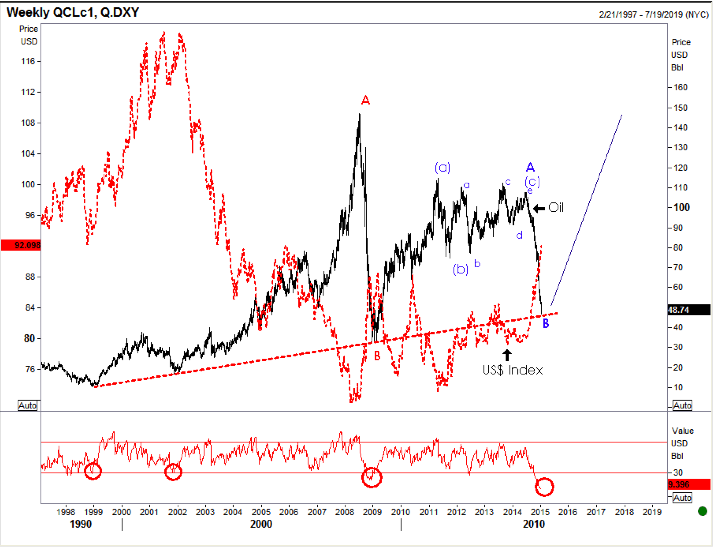
The uptrend line in crude oil, as seen in the chart below, was created by drawing a line from the 1999 low (December 18th 1998 to be exact) touching the low made in November 2001. Today’s low in oil was the second major test of the trend—the last came back in 2008 during the credit crunch (and they say markets have no memory; at least that’s what Professors who don’t trade like to say).   Also in the chart I have overlaid the US Dollar Index (red) and it shows a pretty nice negative correlation to oil. Given that everyone with a pulse seems bearish on oil (even the “Peak Oil” nuts from the newsletter houses have been appropriately mugged by reality) what a great place for a rally to begin.  It would confirm the magic of the market process indeed—the yin and yang aspects, so to speak.

Of course to suggest oil may start to bounce higher would suggest the US dollar may start to correct lower.  I am not sure if the crowd is more bearish on oil or more bullish on the US dollar…hmmm…

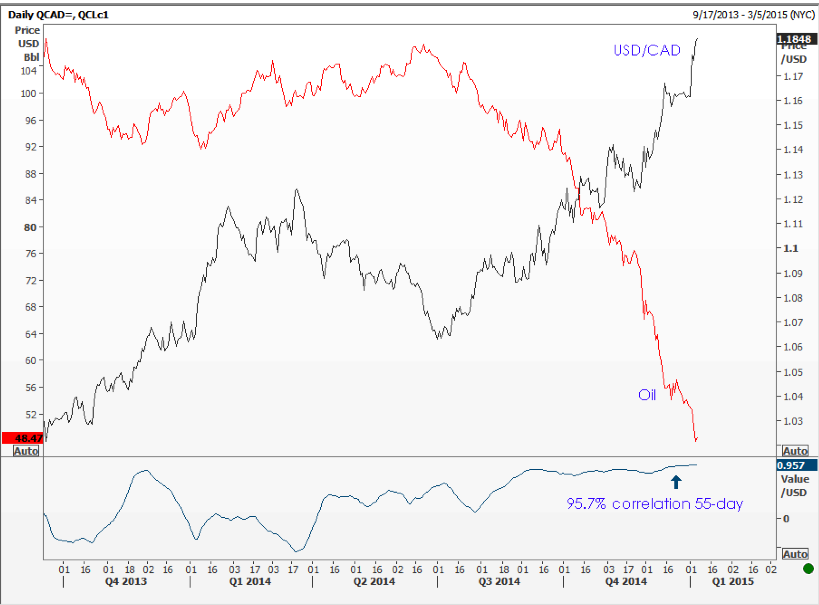
Of the major currency pairs, the Canadian dollar may be the best horse to ride if a US dollar correction does materialize.  In the chart below you can see USD/CAD’s correlation with oil prices, i.e. lower oil  prices and weaker CAD against the US dollar, and vice versa.

USD/CAD versus WTI Crude Oil Futures: In the bottom pane of the chart it shows there has been a whopping 95.7% correlation between the two price series.  That’s what you call tight. 

I’m not saying this is the moment for a big rally in oil.  But I am saying a rise in the Canadian dollar is highly likely when (if) crude moves northward again. 

 Thank you. 

Jack Crooks

President, Black Swan Capital

www.blackswantrading.com ,

info@blackswantrading.com

Dollar/Loonie Stalls on Oil Bounce

After tagging a new 6-year low under 47.00 earlier, WTI has bounce back to the mid-48.00s as of writing. This brief recovery is spilling over into oil-dependent currencies like the Norwegian krone and Canadian dollar. My colleague Kathleen Brooks already discussed the NOK in detail earlier today, but USD/CAD is also at a very interesting crossroads.’

After consolidating within a tight pennant formation around 1.16 over the slow holiday trading period, USDCAD aggressively broke out to a new 5.5-year high on the first trading day of 2015. The pair has since surged all the way to the top of its bullish channel in the mid-1.18s, helped along by strong bullish momentum as shown by the MACD indicator (below).

well1 4

While the medium-term trend remains constructive (indeed, this is one of our favorite bullish charts over the next few months), there is scope for a possible pullback over the short term. If oil prices manage to stablize in the coming days (and we admit, it’s a big “if”), USD/CAD may dip from its overbought extreme back to the middle or bottom of the established channel. On the other hand, if oil continues to collapse at a mind-boggling pace, USD/CAD could accelerate out of its channel and surge to 1.20 or higher. Either way, the price action over the next 24 to 48 hours could set the tone for the next week or two.


Richard Russell – Peace Of Mind, Gold & The Erratic Stock Market

richardWith continued uncertainty in global markets, today the Godfather of newsletter writers, 90-year old Richard Russell, covers everything from peace of mind, to gold and the erratic world stock markets.  Russell also takes a close look at the importance of January in determining market direction for 2015.

….read it all HERE


Small-Cap Stocks Poised To Move

Januaryarrow580

Highlights from this Interview

• Almaden Minerals Ltd. “Stocks such as AMM could benefit from the January Effect.”

• Galane Gold Ltd. “GG has a great management team.”

• Integra Gold Corp. “ICG is the best story in Quebec and could be a takeout target.”

• Pershing Gold Corp. “PGLC’s project is open pit and all infrastructure is in place, a rare situation.”

• Red Eagle Mining Corp. “RD has one of the most economic, high-grade, low-cost mines out there.”

• Goldcorp Inc. “The Canadian mines could be a big benefit for G.”

Are You Ready for the January Effect? As far back as 1942, economists have noted that small-cap companies in particular tend to surge at the beginning of the year in a cycle known as the January Effect. After the year we have seen in the natural resources space, The Mining Report checked in with sector experts to find out whether they are expecting this traditional gift, how they are preparing for it and what companies could benefit.

Rick Mills, founder, Ahead of the Herd: There has been a general long-term downward trend in the resource sector. Junior resource companies have had the stuffing knocked out of them; many are oversold and ripe for a bounce. 

The January Effect is a calendar or seasonal-caused increase in the relative strength of small-cap stocks over large caps in late December and early January. This seasonal effect is mostly over by the end of the first full trading week in January and is not to be confused with the “January Barometer,” an old market saw saying, “As goes the Screen Shot 2015-01-07 at 4.55.08 AMfull month of January so goes the market for the year.”

The January Effect, as it pertains to the junior resource sector, is caused by both large and small individual investors (and institutional investors window dressing—dumping laggards so they won’t show up in year-end reports) selling their stocks/rebalancing their portfolios starting in November and well into December to create a tax loss to offset capital gains. 

Smart investors and traders buy select stocks, starting as early as late November, through to the last day, or even a day or two beyond, of eligible tax-loss selling for the year. 

An excellent example of a consistent short-term January Effect trade would be Copper Fox Metals Inc. (CUU:TSX.V) recently trading as low as $0.095 and hitting a high of $0.15.

Januaryeffectchart

Discovery is reaping shareholders rewards so worth watching is a uranium junior, Lakeland Resources Inc. (LK:TSX.V), exploring in the Athabasca Basin. A great way to leverage any uptick in the uranium price is Uranerz Energy Corp. (URZ:TSX; URZ:NYSE.MKT). [Editor’s Note: This interview was conducted on Friday, Jan. 2, 2015. On Monday, Jan. 5, Uranerz announced an all-share buyout by Energy Fuels Inc. (EFR:TSX; EFRFF:OTCQX; UUUU:NYSE.MKT)].

Great Panther Silver Ltd. (GPR:TSX; GPL:NYSE.MKT) is on top of the list of producers that are well positioned to take advantage of an uptick in gold and silver prices. Kootenay Silver Inc. (KTN:TSX.V) discovered and is developing the Promontorio project into an open-pit mine in Sonora, Mexico. The company recently drilled one of many prospects on its immense project and discovered another significant high-grade silver deposit, La Negra. 

New Carolin Gold Corp. (LAD:TSX) is an exciting gold project. The company is working old mines in an underexplored area in southwestern British Columbia. Success here could open up a lot of people’s minds about junior mining overall.

Diamonds are exciting and could certainly lift the Toronto Stock Exchange out of its funk. Two to watch in the new North Saskatchewan Craton Diamond Play are Strike Diamond Corp. (SRK:TSX.V) and Athabasca Nuclear Corp. (ASC:TSX.V).

Nickel is definitely a metal to have on your radar screen. Today nickel sulfide discoveries are as rare as chicken teeth, but North American Nickel Inc. (NAN:TSX.V) has found an incredible amount of smoke in Greenland and should find fire soon. Meanwhile in Canada, Equitas Resources Corp. (EQT:TSX.V; T6U1:FSE) is just getting going. It has a large prospective for nickel property in the right type of rock in the right place.

In the copper space the low-hanging fruit has been picked but VMS Ventures Inc. (VMS:TSX.V) is a junior producer that owns 30% of the now producing high-grade Reed copper mine. Carmax Mining Corp. (CXM:TSX.V) has an exciting copper-gold project, the Eaglehead, in northwest British Columbia. 

Cobalt is a critical metal with no production in North America. Global Cobalt Corp. (GCO:TSX.V) is working on a project in northwestern Ontario and has recently acquired a project in the U.S. Global Cobalt could be instrumental in meeting a growing demand. 

I believe in commodities. If you do as well, then all these companies are worth putting on your radar screen. 

Steve Palmer, founding partner, president and chief investment officer of AlphaNorth Asset Management: December, January and February are historically the best performing months of the year. There is no reason to believe the current situation will be any different. The TSX Venture index has been under severe pressure over the past few months, which has taken it down 30+% since August. It has recently been below the lows of the 2008 financial crisis despite an economic environment that is far better. I believe the current risk/reward is highly skewed to the upside for the TSX.V. 

Several resource names that could rally nicely are Blackbird Energy Inc. (BBI:TSX.V)Sintana Energy Inc. (SNN:TSX.V)Talon Metals Corp. (TLO:TSX), and U3O8 Corp. (UWE:TSX; UWEFF:OTCQX).

Angelo Damaskos, founder and CEO of Sector Investment Managers Ltd.: We generally do not trade short-term technical volatility in markets but prefer to focus on fundamental value that is likely to be rerated over the medium term. Nevertheless, given the extreme selling conditions we have experienced in the last four months of 2014 in the energy space, there is a higher probability of a sharp rebound early in 2015. Historical review of previous corrections before the year-end in oil-related shares shows a seasonal pattern of recovery in the first quarter of the following year: The winter double-bottom pattern was observed in 2008–2009, 2006–2007, 2001–2002, 1998–1999, and 1993–1994.

We, therefore, advise our clients to increase their allocations to mid-cap oil producers for three reasons:

1. Extreme adversity against oil shares has led to solid companies trading at Price/Cash Flow and Price/Net Asset Value multiples last seen in the 2008 meltdown;

2. Bearish calls for the oil price dropping below $50/barrel ($50/bbl) are widespread; a contrarian investment view would support a rebound to above $60/bbl. Fundamentally, it is widely accepted that oil prices at $60/bbl are extremely damaging to supply from marginal fields and prolonged trading at this level would result in a lot of supply shut-ins, thus removing any supply overhang within 6–12 months; markets are likely to discount such change in supply with a 3–6 month lead;

3. Large short-selling interest built up in the months of November and December that may be closed on first signs of rebound—mid-cap shares are likely to respond first, followed by small caps after a sustained rally.

We believe, nevertheless, that investments should be focused on companies with strong production growth even at lower oil prices based on sustainable capital expenditure programs (primarily funded out of organic cash flow), lower average cost of production contributing to profits at current prices and strong balance sheets with low debt and fixed obligations. Examples of such companies include RMP Energy Inc. (RMP:TSX)Advantage Oil and Gas Ltd. (AAV:TSX; AAV:NYSE) and Parex Resources Inc. (PXT:TSX.V).

We are generally cautious/bearish on the overall markets as we feel global economic growth is likely to slow, impacting earnings expectations. Central banks of both developed and emerging economies may raise interest rates, thus further slowing growth and negatively impacting equity valuations. Resources sectors have been sold off hard, so it is unlikely they would suffer further in correlation to a general market correction.

Look for an article about the January Effect on precious metals in The Gold Report on Wednesday, Jan. 7.

Want to read more Mining Report articles like this? Sign up for our free e-newsletter, and you’ll learn when new articles have been published. To see recent interviews with industry analysts and commentators, visit The Mining Report home page.

Related Articles


DISCLOSURE: 
1) JT Long conducted this interview for Streetwise Reports LLC, publisher of The Gold Report, The Energy Report, The Life Sciences Report and The Mining Report, and provides services to Streetwise Reports as an employee. She owns, or her family owns, shares of the following companies mentioned in this interview: None.
2) The following companies mentioned in the interview are sponsors of Streetwise Reports: Uranerz Energy Corp., Energy Fuels Inc., Great Panther Silver Ltd. and North American Nickel Inc. The companies mentioned in this interview were not involved in any aspect of the interview preparation or post-interview editing so the expert could speak independently about the sector. Streetwise Reports does not accept stock in exchange for its services.
3) Rick Mills: I own, or my family owns, shares of the following companies mentioned in this interview: New Carolin Gold Corp. I personally am, or my family is, paid by the following companies mentioned in this interview: None. My company has a financial relationship with the following companies mentioned in this interview: Great Panther Silver Ltd., Kootenay Silver Inc., New Carolin Gold Corp., Equitas Resources Corp., Lakeland Resources Inc., Carmax Mining Corp., VMS Resources Inc. and Global Cobalt Corp. I was not paid by Streetwise Reports for participating in this interview. Comments and opinions expressed are my own comments and opinions. I determined and had final say over which companies would be included in the interview based on my research, understanding of the sector and interview theme. I had the opportunity to review the interview for accuracy as of the date of the interview and am responsible for the content of the interview.
4) Steve Palmer: I own, or my family owns, shares of the following companies mentioned in this interview: None. I personally am, or my family is, paid by the following companies mentioned in this interview: None. AlphaNorth Funds own all of the companies mentioned. I was not paid by Streetwise Reports for participating in this interview. Comments and opinions expressed are my own comments and opinions. I determined and had final say over which companies would be included in the interview based on my research, understanding of the sector and interview theme. I had the opportunity to review the interview for accuracy as of the date of the interview and am responsible for the content of the interview.
5) Angelo Damaskos: I own, or my family owns, shares of the following companies mentioned in this interview: None. I personally am, or my family is, paid by the following companies mentioned in this interview: None. Funds I advise hold shares in RMP Energy Inc., Advantage Oil and Gas Ltd. and Parex Resources Inc. I was not paid by Streetwise Reports for participating in this interview. Comments and opinions expressed are my own comments and opinions. I determined and had final say over which companies would be included in the interview based on my research, understanding of the sector and interview theme. I had the opportunity to review the interview for accuracy as of the date of the interview and am responsible for the content of the interview.
6) Interviews are edited for clarity. Streetwise Reports does not make editorial comments or change experts’ statements without their consent.
7) The interview does not constitute investment advice. Each reader is encouraged to consult with his or her individual financial professional and any action a reader takes as a result of information presented here is his or her own responsibility. By opening this page, each reader accepts and agrees to Streetwise Reports’ terms of use and full legal disclaimer.
8) From time to time, Streetwise Reports LLC and its directors, officers, employees or members of their families, as well as persons interviewed for articles and interviews on the site, may have a long or short position in securities mentioned. Directors, officers, employees or members of their families are prohibited from making purchases and/or sales of those securities in the open market or otherwise during the up-to-four-week interval from the time of the interview until after it publishes.

 

Four Major Forces Shaping the Investment Climate

fear-greed-cycles

The investment climate is being shaped by four forces:

  1. De-synchronized business cycle with the U.S. ahead of the pack.
  2. The prospects of sovereign bond purchases by the ECB, amid political uncertainty sparked by Geece’s snap election.
  3. The continued drop in energy prices is a stimulative writ large but poses challenges for oil producers and the leveraged eco-system that has been built on the premise of high oil prices forever.
  4. Rather than a race to the bottom, as many saw it previously, several emerging market countries are resisting further depreciation of their currencies.

1. De-synchronized business cycle: This is the meaning of divergence. The U.S. policy response to the financial crisis, and the flexibility of the U.S. institutions bolsters the world’s largest economy. The U.S. economy expanded more in Q3 (5% annualized) than the euro zone (less than 1%) and Japan (less than 0.5%) in 2014 put together. China, the world’s second largest economy, is slowing.

While the euro zone, Japan, and China provide more stimulus for their economies, the U.S. is expected to lift rates around the middle of the year. This anticipation underpins the U.S. dollar. Given the importance of exchange rates (foreign exchange variability can be 2/3 of the return on international fixed income portfolios and 1/3 of the return of international equity portfolios), the prospects of a stronger dollar also make U.S. assets more attractive for non-dollar-based investors. Interest rate differentials are also moving in the U.S. direction.

Even though the above trend growth in the U.S. is not sustainable, employment and consumption can still expand. The U.S. reports the December jobs data at the end of the week and another 200k+ report is expected. Although it will likely not match the November 331k increase, such a number is still healthy, and the internals are also improving.

Auto sales will be interesting. The decline in the price of gasoline, easy and low financing, and the improving labor market underpin a strong year of sales. Manufacturer incentives also help. Industry figures suggest there was an average $2,894 in incentives or discounts during the month. This is almost a 6% increase from a year ago. The consensus expects a 16.9 mln unit pace down slightly from the 17.03 mln pace in November. It would put the entire year sales around 16.4 mln, the strongest in a decade. This compares with 15.5 mln vehicle sales in 2013 and 14.4 mln in 2012.

Strong sales are behind the strong production figures. The industry is integrated on a continental basis. Output in North America is projected to have risen by 7% in 2014 to a little more than 17.2 mln vehicles. To put this in perspective, consider that the peak was in 2000 at 17.3 mln vehicles.

2. Eurozone: January is shaping up to be a very important month for EMU. On January 14, the European Court of Justice will issue a non-binding opinion on ECB’s OMT (Outright Market Transaction facility), under which the central bank would buy sovereign bonds in the secondary market to aid a country provided the country met four requirements:

  1. The country was on an EFSF/ESM support program, which could include a precautionary line of credit.
  2. It had signed a memorandum of understanding, which is the policy adjustments the country would be expected to make.
  3. The country had access to the capital markets, which means able to issue 10-year bonds.
  4. Its bond yields were higher than fundamentally justified.

Recall that the Bundesbank testified against OMT, even though it appeared to have Berlin’s support. Although the ECJ opinion is non-binding, it is likely to be consistent with the final ruling. The facility has not been triggered. There is some thought that any conditions the ECJ cites may influence next steps of the ECB. On January 22, the ECB meets. It is the first meeting under the new regime of less frequent meetings, rotating voting scheme. Some record (minutes) of the meeting may be published for the first time 3-5 weeks after the meeting.

It is possible that the ECB announces that it will increase the speed at which it will increase its balance sheet by buying a broader range of assets, including sovereign bonds. If the ECB waits for its next meeting (March 5 in Cyprus), which at his December press conference Draghi hinted was a possibility, the peripheral bonds (and other so-called risk assets in Europe) could sell-off in disappointment. This will be especially true if this week’s flash CPI for the euro zone shows its first negative print as the consensus expects.

[Listen toBrian Pretti: Central Banks Are Afraid to Let Asset Prices Fall]

Given that the current programs, which include the TLTRO, ABS and covered bond purchases, are projected to increase the ECB’s balance sheet by 400-500 bln euros, the sovereign bond buying program is likely to be modest compared with the programs in the U.S., UK and Japan. A sovereign bond buying program of around 500-600 bln euros might be sufficient to reach the ECB’s balance sheet goal. The modest size and limit could help secure support for such a plan. Also, allowing the national central banks to execute the purchases and to hold the assets on their respective balance sheets (as opposed to the ECB’s balance sheet) may also make the scheme more acceptable.

The Greek election will be held on January 25, three days after the ECB meeting. Polls currently suggest that no party will secure a majority. The party with a plurality, currently looking like Syriza, will be given the first chance to form a government. If it cannot do so in three days, the party with the second highest votes, now the New Democracy, would be given a chance. If it fails to secure a majority of votes in parliament, it will go to the third party and if it too fails there will be new elections, which is what happened in 2012. See our analysis of Greek politics here and why we expect Greece will remain in the monetary union.

3. Drop in energy prices: Oil prices have been more than halved over the past six months, but a significant low remains elusive. Additional losses are likely. An unscientific survey indicates that many see 2/3-3/4 of the decline is being driven by supply considerations. A quarter to a third of the decline is a function of weak demand. Demand may take some time to improve. China, as we noted, is slowing. Large swathes of Europe are stagnant.

Supply is also slow to respond. In addition to the weekly inventory data, investors will be closely watching Baker-Hughes weekly rig count figures that are reported on Fridays. The most recent data covers the last full week of December. The oil rig count declined by 37 in the week ending December 26, leaving 1499 onshore oil rigs. This is the least since April. Over the latest three week period, 76 rigs have been taken out of production. These are the least productive rigs. Output remains high despite the rig count decline. The U.S. produced 9.13 mln barrels a day in the week ending December 19, just off the modest record pace of 9.14 mln barrels the previous week.

[AnalysisJoseph Dancy: Crude Oil Markets Surprise Analysts and Investors]

Saudi Arabia shows no sign that it will reconsider its decision not to cut output. The latest figures show Russia and Iraq may have increased production, which is the only way to preserve revenue in a falling price market. Other high cost producers, such as the UK and Canada are feeling the squeeze. Canada may fare better with the help of the U.S. Senate (now in Republican hands), which will likely approve the Keystone Pipeline. The U.S. is also moving toward allowing greater exports of condensate (lightly processed), and could move toward lifting the ban on crude exports.

The drop in energy prices will lower measures of headline inflation. The secondary impact could seep into core measures. At the same time, it will help boost the disposable income of many and help lift consumption. On the other hand, there are some regions, such as Texas and North Dakota that will be adversely impacted from the decline in energy prices. Investors will be watching these states weekly initial jobless claim figures and regional surveys, such as the Dallas Fed survey, which at the end of December was reported at 4.1, less than half of the consensus expectation.

4. Currency wars and the lack thereof. We have long found the claims of currency wars to be hyperbolic; often confusing an analogy with the real thing, juxtaposing means and ends, with limited explanatory ability, and even less predictive power. U.S. officials have not objected to the dollar’s strength or expressed much misgivings about the policy thrust of the euro area (Germany is a different matter) or Japan, and neither have other global financial officials.

Although many observers talk about the race to the bottom, none have proclaimed victory for Russia, which saw a 46% decline in the ruble in 2014, or Argentina, which saw a 23% decline in the peso. Nor is it true that many emerging market countries are simply hell-bent on currency depreciation for mercantilist reasons.

In a weak dollar environment, it is true that many countries seek to slow their currencies’ appreciation. Reserves tend to grow in a weak dollar environment and central banks fill the void left by private sector investors. However, the dollar is strong now. Reserve growth typically slows in a strong dollar period. A number of countries seek to prevent or slow their currencies decline. This often requires the sales of dollars (and Treasuries, which the dollars are kept in, though it may also now include the sales of euros). Many emerging market countries, and especially their companies have taken on foreign currency debt. The decline of their currencies exposes a potentially destabilizing currency mismatch. Some countries may also seek to mitigate the inflationary implications of currency weakness.

[HearAxel Merk: Volatility the Big Issue in 2015 – Markets and the Dollar Could Weaken]

Turkey’s announcement on Saturday is a case in point. It hiked the foreign exchange reserve requirement for Turkish banks. Effective the middle of next month, banks will have to hold 18% reserves on foreign exchange deposits of one year, up from 13%. On two-year deposits, banks have to hold 13% in reserves, up from 11%. The central bank projects this measure is worth about $3.2 bln. In order to induce longer-term deposits, the central bank cut the reserves required on deposits of three-years to 8% from 11%. Officials also made technical adjustments in their reserve-option facility (allows banks to use dollars to meet their local currency reserve requirements) that the central bank projects will free up $2.4 bln in the banking system.

According to BIS data, at the end of Q3 ‘14, Turkey’s total foreign borrowing stood at near $400 bln, just below the record high reported for Q2. Just shy of two-thirds of the debt is from Turkish corporations, with local banks accounting for the remainder. We have highlighted the currency mismatch, especially among emerging market businesses as a vulnerability in the stronger dollar environment.

test-php-789