
Stocks & Equities
Briefly: In our opinion, no speculative positions are justified.
Our intraday outlook is now neutral, and our short-term outlook is neutral:
Intraday outlook (next 24 hours): neutral
Short-term outlook (next 1-2 weeks): neutral
Medium-term outlook (next 1-3 months): neutral
Long-term outlook (next year): bullish
The main U.S. stock market indexes gained between 1.1% and 1.3% on Wednesday, extending their recent move up, as investors reacted to the Fed’s Decision release. The S&P 500 index got closer to its February 25 all-time high of 2,119.59, as it reached daily high at 2,106.85. The nearest important resistance level is at around 2,100-2,120. On the other hand, support level is at 2,080-2,090, marked by previous resistance level, as we can see on the daily chart:

Expectations before the opening of today’s trading session are virtually flat. The European stock market indexes have gained 0.1% so far. Investors will now wait for some economic data announcements: Initial Claims at 8:30 a.m., Leading Indicators, Philadelphia Fed number at 10:00 a.m. The S&P 500 futures contract (CFD) is in an intraday consolidation, following yesterday’s rally. The nearest important level of resistance is at around 2,100, as the 15-minute chart shows:

The technology Nasdaq 100 futures contract (CFD) follows a similar path, as it trades along the level of 4,420. The nearest important level of resistance is at around 4,420-4,430, marked by local highs. On the other hand, support level is at 4,400, among others:

Concluding, the broad stock market retraced most of its March move down, as investors reacted to Fed’s Decision announcement. For now, it looks like some further medium-term consolidation, following last year’s October-November rally. We prefer to be out of the market, avoiding low risk/reward ratio trades. We will let you know when we think it is safe to get back in the market.
Thank you.

 Commodities guru shares his latest thoughts on the markets.
When Jim Rogers talks, investors listen. Rogers may be the world’s best-known commodity investor, with his Rogers International Commodity Index and best-selling books, including his latest, “Street Smarts: Adventures on the Road and in the Markets.” HAI Managing Editor Sumit Roy recently spoke with Rogers about a wide range of market topics.
….read the entire interview HERE
 With the eyes of the world still focused on the Fed meeting, today Dr. Paul Craig Roberts warned King World News about the greatest human threat the world has ever known. This is an ominous warning from the former U.S. Treasury official as he is warning global leaders the world is headed for disaster.
By Dr. Paul Craig Roberts Former U.S. Treasury Official
March 17 (King World News) – Washington’s EU vassals might be finding their backbone. Britain, Germany, France, and Italy are reported to have defied Washington’s orders and applied to join the Chinese-led Asian Investment Bank. Australia, Japan, South Korea, Switzerland and Luxembourg might also join……continue reading HERE

The markets have been very volatile. This has led to many questions and the most frequently asked questions follow…
Q. We’re hearing a lot about deflation, but how bad is it?
A. Currently, it’s intensifying. Inflation is declining around the world and it’s gone negative (deflation) in the Euro area and most recently in the U.S. (see Chart 1).

The central banks are fighting these forces with quantitative easing (QE) economic stimulus programs and negative
interest rates to help boost their economies and get inflation up to at least 2%.
At this point, the biggest danger would be a deflationary downward spiral, which is what everyone wants to avoid.
Here’s the bottom line…
As interest rates fall, it becomes more attractive to borrow rather than save.
So central banks are hoping that banks will lend more money to consumers who will spend, as opposed to just holding the money in their bank reserves. That’s primarily why the velocity of money has been falling.
The money created via QE programs has been sitting in banks but it needs to get out there and circulate. That’s the main reason why inflation has been declining.
That will also help turn the deflationary pressures around and get inflation to finally pick up. It’s not happening yet, but hopefully it will.
Q. What are the chances of another economic crisis?
A. Based on the fact that the stock market is still bullish, despite its recent decline, and it tends to lead, the economy should continue to plug along in the months ahead. But the global economic foundation is not healthy.
The biggest problem is debt and we believe it’s passed the tipping point. That is, it’s become a real drag on the global economies.
In 2007, for instance, world debt was $142 trillion. In 2014, it had soared to $199. That’s a 40% increase in seven years.
So nothing has really changed since the last big recession. In fact, it’s gotten worse. There has been no deleveraging and debt is much bigger than the world economy can handle.
Many feel this will lead to another crisis or a collapse, and it’s indeed a possibility. Remember, during the last crisis in 2007-08 the world was taken to the brink.
Every major U.S. bank would have failed if the Fed hadn’t intervened. And something along these lines could happen again.
Debt is a Deflator
Debt, for instance, is definitely keeping a lid on global growth. In the U.S., average annual economic growth has only been 1.2% over the past eight years. And that’s the best it could do after years of QE and super low interest rates.
Plus, median wealth for over half of the people has also dropped 40% since the last recession.
The rich, however, are getting richer via assets that’re rising.
So despite the good economic news you keep hearing about, you can see that the underlying economic foundation is on thin ice.
Q. How will this affect gold?
A. Gold prices fell further, hitting an almost four month low, quickly approaching its November lows. The soaring dollar and expectations of higher U.S. interest rates have pushed gold to the back seat.
GOLD: 2nd in currency ranking
Low interest rates are bullish for gold because gold is then not competing with the currencies. And with most major countries dealing with low to negative rates, gold moves up in the currency ranking.
And indeed it has. Gold, as the ultimate currency, is only second to the U.S. dollar in terms of major currency strength. But the soaring fast paced dollar rise is now causing turmoil in the currency market.
This is now very interesting.
It almost seems unreal for investors to think the U.S. will raise rates when the dollar is soaring. It already has the highest rates in the major countries.
But anyway, at some point coming up pretty quick, the dollar rise will be stemmed, either by intervention or exhaustion.
And when that happens, a dollar decline will give gold a boost. To think that gold did not hit new lows near $1143 already during the dollar rise, shows its underlying, subtle strength.
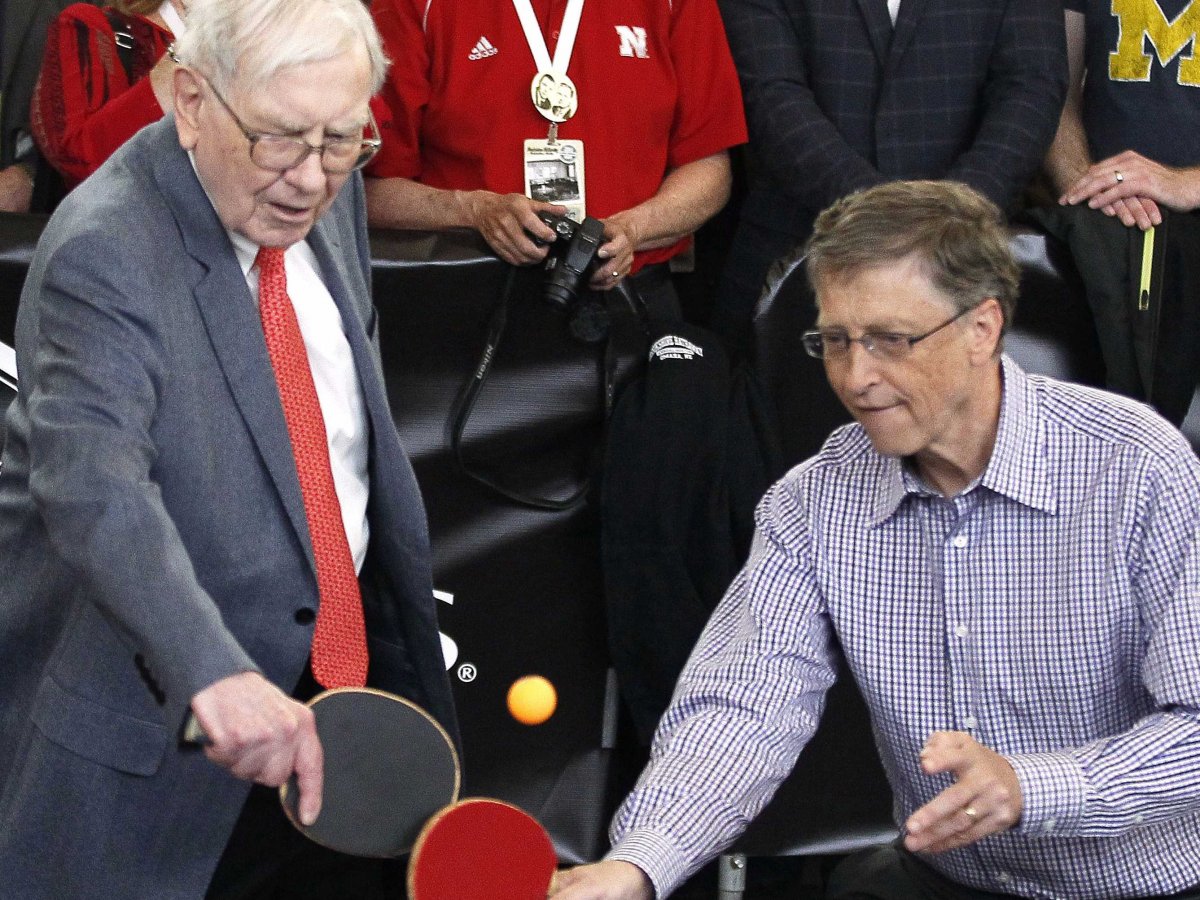 Bill Gates says you should start on page 23.
In a tweet on Tuesday morning, Gates highlighted what he thought was the most important section of Buffett’s latest letter to shareholders, the 50th edition of the widely circulated missive.
And Gates loves the history of Berkshire Hathaway.
Gates links readers to page 23 of Buffett’s letter, where Buffett walks through the earliest days of Berkshire.
In a YouTube video posted Sunday, Gates also explained what he loves about Buffett’s annual letter, and this section in particular.
Gates said: “What really struck me this time about the letter was the value of experience. [Buffett] is better today than ever because he’s seen so many businesses and he understands business profitability so incredibly well.”
In the video, Gates also explains that what works about the “Berkshire system” is that it maximizes the potential of businesses by giving them autonomy as well as the explicit support of the whole Berkshire organization, even if mistakes are made. Gates added that it was the most important annual letter Buffett has written.
Notably, the page Gates highlights starts with what Buffett calls a “monumentally stupid” decision Buffett made back in 1964, an anecdote Business Insider’s Sam Ro highlighted when Berkshire’s letter was released on February 28.
Gates’ charity, the Bill & Melinda Gates Foundation, was gifted shares of Buffett’s Berkshire Hathaway, worth almost $30 billion back in 2006, and Buffett serves as a trustee of the foundation.
Read Buffett’s full letter here »
SEE ALSO: Warren Buffett’s $100 billion mistake
NOW WATCH: How to invest like Warren Buffett


-
I know Mike is a very solid investor and respect his opinions very much. So if he says pay attention to this or that - I will.
~ Dale G.
-
I've started managing my own investments so view Michael's site as a one-stop shop from which to get information and perspectives.
~ Dave E.
-
Michael offers easy reading, honest, common sense information that anyone can use in a practical manner.
~ der_al.
-
A sane voice in a scrambled investment world.
~ Ed R.
Inside Edge Pro Contributors

Greg Weldon

Josef Schachter

Tyler Bollhorn

Ryan Irvine

Paul Beattie

Martin Straith

Patrick Ceresna

Mark Leibovit

James Thorne

Victor Adair