
Gold & Precious Metals
 It’s a jungle out in the silver markets. Investors are holding on for their lives as the price of metals swings to higher highs and lower lows and junior equities bounce along the bottom. In this interview with The Gold Report, David H. Smith, senior analyst at silver-investor.com’s The Morgan Report, navigates the jungle by advising which explorers, midtiers, stalwarts and royalties to consider buying in tranches on the way down and selling on the inevitable way up.
The Gold Report: David, Silver Investor analyzes the long-term macro trends and specific stock catalysts in the silver market. What do you see as the risk/reward profile over the next 12 to 36 months in the space?
David Smith: A lot of people, including myself, are looking for a bottom. It may be in—or it may not be in. The secret is to focus on the upside, which could be 10 or 15 times higher, rather than asking if it could be two or three dollars lower. That makes it easier to buy at these prices.
TGR: How long could this slump last?
DS: Mining stocks have been disconnected from the metals prices for almost two years. We had major tops in gold and silver, but the mining stocks, almost across the board, regardless of quality, have gone down, down, down. The disconnect is greater than two standard deviations away from the norm. That sort of thing can last a while, but it doesn’t happen very often. In fact, there’s a 97% probability that it wouldn’t happen or that it wouldn’t stay there if it did. I think that we are nearing the end. We could see this weakness go into the late summer/early fall, but I think we are building an important base even if we go lower. The stronger that base gets and the broader it becomes, the more likely it will move violently on the upside. If you have no position waiting for this, you will be left behind.
TGR: How do investors survive the horrendous swings going on in the meantime?
DS: Volatility can be a good thing if you are prepared for it. The secret is to not wait for those swings to occur and try to predict them because you’ll be jumping on what Jsmineset’s Jim Sinclair calls a rhino horn and you’ll get speared. If you’re able to do the opposite of what most people do, to buy weakness and then sell a little bit into strength, you can smooth out the big swings. I believe that we’ll see swings of $100–200/ounce ($100–200/oz) a day in gold when this thing finally moves into the public mania phase. It would not surprise me to see $5–10/oz swings in the price of silver in one day. We saw this during the bull market that ended in 1980 and I think the price increases are going to be much greater this time around. If you have layered your positions, your mining stocks, your exchange-traded funds (ETFs), your physical purchases into weakness, when the swings happen you won’t be affected as much as most of the public.
TGR: Would you like to make any predictions about the silver prices over the next 10 years?
DS: This is always very difficult. Economic conditions are a major variable because, as you know, about 70% of the supply of silver comes from byproduct production of copper, lead and zinc. The global economy will affect how much of that is dug out of the ground. Relatively few silver miners receive most of their income from silver as opposed to base metal credits.
Additionally, some of the really large projects now in planning may be delayed or may not come on at all. This includes the Navidad project, which I visited in Argentina before it was purchased by Pan American Silver Corp. (PAA:TSX; PAAS:NASDAQ). It was estimated as a 700 million ounce (700 Moz) to 1 billion ounce (1 Boz) deposit, but due to regulatory problems, that project has been shelved. It may be quite a while before it gets going or it may not go at all.
The Pascua Lama deposit that Barrick Gold Corp. (ABX:TSX; ABX:NYSE) is working on, on the Chile/Argentina border, has also encountered serious legal issues. It could be delayed for a year or two or shelved for good. We don’t know. Barrick has already put a reported $6 billion ($6B) into this deposit. That could mean 20–30 Moz of silver annually that doesn’t go into the stream in the next 10 years. That is a significant impact on supply/demand calculations.
Also let me add that we have an exclusive interview that David Morgan conducted regarding the ownership of Pascua Lama. Right now we are reserving this for our members only.
TGR: We often hear how silver is like gold’s little brother. Other than silver having an industrial demand profile, how are these metals different as investments?
DS: Almost all of the gold that has ever been produced is still out there in some form: in central banks, in private holdings, or in jewelry. A certain amount is used in medical or industrial applications, but not on the scale of silver. When silver is used in radio frequency identification (RFID) chips or electronics, it is gone and must be replaced.
Another increasingly important factor is the emerging popularity of ETFs. Like gold, silver has been real money for people going back thousands of years. It has outlasted every paper system ever developed by humankind. It’s going to outlast the current ones as well, because it preserves purchasing power as paper money loses it.
TGR: Does owning silver equities, particularly small-cap equities, still make sense in this market?
DS: Equities make sense more than ever before because of the disconnect between the price of metals and what the companies can dig out of the ground. The entire mining sector, whether it’s a large producer or an explorer, is high risk. But after buying the physical metal, it makes sense to pick up the equities at all stages. Buy a few of the majors, then go into the midtier section and finally the explorers, which are the highest risk because they may or may not ever go into production. Put a small amount of capital in and allocate it roughly proportionately so that if one choice blows up, the others will make enough that you will still make a profit. Owning equities is very important, but be selective. Scale down any purchases into this historic decline.
TGR: Before we started our interview, you talked about the concept of keeping some money back for what you called stupid cheap prices. Tell us more about that strategy.
DS: I think Doug Casey used this term first, but it was certainly correct. Prices are now lower than what most people thought they would ever sink. I learned something very important in the 2008–2009 meltdown. I started out with about 30% cash at the top. Prices kept dropping as part of what nearly became global financial destruction. I bought quality mining companies down, down, down. Then I ran out of money before the end. I had good quality companies I had bought at pretty low prices, but I didn’t keep back a little bit for what Doug Casey calls stupid cheap prices.
That was when I learned to buy larger price differences. In other words, instead of buying every dollar on a company like Goldcorp Inc. (G:TSX; GG:NYSE), I might buy every $4 down on Goldcorp and keep a little bit back just in case the price went even lower. It was likely to be temporary because it was similar to a rubber band being stretched almost to the breaking point. If you had the courage, the money and the foresight to buy at that point, when that rubber band snapped back, you could make a great deal of money with very little commitment.
Those concepts are as important today as they were in 2008. We may or may not be at the bottom now. There are indications that the mining stocks are bottoming. Some of them may have already, but if we get one more washout, which is possible this summer, and if you have a little bit of money left, you may be able to pick up a company that today is selling for $2/share, for $0.75 or $0.50/share. You will already have your core position, but you will be buying down into that lower level.
Dollar cost averaging is one of the most powerful tools an investor can use. If you’re buying in tranches on the way down, you’re almost rooting for lower prices because you’re going to lower your cost of having that position. There is a saying that when the price goes up you never have enough shares and when it goes down you never have few enough shares. The reality is that you get your initial position in and then you can be calm and watch for lower prices.
TGR: Some of David Morgan’s recent presentations have included royalty equities. What are some royalty equities you’re telling your subscribers about?
DS: David likes stocks that pay dividends. We’re seeing more and I think this is a trend that will continue.Newmont Mining Corp. (NEM:NYSE) has a history of paying good dividends. Royal Gold Inc. (RGLD:NASDAQ; RGL:TSX) and Franco-Nevada Corp. (FNV:TSX; FNV:NYSE) are established, well-managed companies with good cash hoards. They could make the bedrock holding of a portfolio because they can keep giving you some extra profit vitamins while you’re waiting for the share prices to turn around. A lot of times the dividend can be more reflective of the company’s viability than the current share price.
TG: As of March 31, 2013, Franco-Nevada had $867 million ($867M) in working capital, another $60M in marketable securities and about $500M in a credit facility that they haven’t used. That’s $1.4B at the company’s disposal. Any idea how that cash might be used?
DS: I’m sure Franco-Nevada is looking for undervalued acquisitions, extra streaming possibilities. People like Franco-Nevada’s President Pierre Lassonde tend to make decisions that really make sense under the circumstances. The fact that the company is holding on to its money and focusing on getting costs down is what investors want to see. Companies like Franco-Nevada, Agnico-Eagle Mines Ltd. (AEM:TSX; AEM:NYSE) and Goldcorp know how to solve problems.
TGR: You mentioned Agnico-Eagle. That company has recently begun taking bite-sized pieces of a number of smaller companies in an effort to get an inside view perhaps of what’s going on in these companies. What do you make of that strategy?
DS: That’s a very viable strategy. A number of companies are doing this right now. Taking a 19% position of an exploration company with an exciting project could give exposure to some big upsides. For example,Hecla Mining Co. (HL:NYSE), which David Morgan followed some 12 years ago, was the highest gaining company percentage-wise on the New York Stock Exchange. It went up 500%. David recommended this when it was around $0.50/share and it went to $5/share. Like Agnico-Eagle, Hecla has taken a position in several of these exploration projects. If they hit well that will be nice for Hecla. If they don’t, they’re not going to be out a lot of money. It also gives a lifeline to these exploration companies that might otherwise not make it because of the tremendously difficult financing environment.
Large companies like Agnico-Eagle, Goldcorp and others are realizing that they have a responsibility to help good exploration companies keep the doors open. If all these companies blow away, the feeder stream that nourishes the large mining companies is going to dry up. It’s like the food chain. If all the baitfish in the Atlantic were gone, the big fish would die because they are dependent on that food chain. Eventually it would be a disaster.
TGR: Are there any other royalty plays you want to talk about?
DS: We were early on the scene with Sandstorm Gold Ltd. (SSL:TSX) before it did a reverse split and then formed, in addition, Sandstorm Metals & Energy Ltd. (SND:TSX.V). The spin-off is struggling a bit now, but has a lot of potential down the line. It’s going to take longer to develop. The royalty companies really have a lot less risk than an outright mining company.
We followed Silver Wheaton Corp. (SLW:TSX; SLW:NYSE) for a number of years. Everybody knows that one now. It is the premier silver streaming company with about 1 Boz under stream. It is a pretty incredible success story.
TGR: Are there some smaller silver names with near-term catalysts that could see a bump on news, whether it’s a study or drill results?
DS: A lot of companies are really undervalued right now. For example, we have followed Endeavour Silver Corp. (EDR:TSX; EXK:NYSE; EJD:FSE) for a number of years. Management constantly follows through and solves problems when they arise. First Majestic Silver Corp. (FR:TSX; AG:NYSE; FMV:FSE) is also best of breed and deserves a place in my portfolio because of its high-quality properties and relatively low country risk.
TGR: Endeavour recently bought the El Cubo project from AuRico Gold Inc. (AUQ:TSX; AUQ:NYSE) and seems to have turned that asset around. What could El Cubo add to Endeavour’s balance sheet?
DS: El Cubo is an interesting situation because Endeavour Silver has done this before. It has taken a relatively high cost property that others spent a lot of money trying to run and introduced efficiencies of scale and production to bring the cost down. I have not visited El Cubo, but I have been to Endeavour Silver’s properties in Mexico twice over the last few years. I have no doubt prices will fall even further. Endeavour is always ahead of the curve in seeing where efficiencies can be made while treating the workforce fairly. This is a company that really knows what it is doing.
TGR: Any other companies you like?
DS: A company we followed a number of years ago and now we are keeping an eye on is Silvercorp Metals Inc. (SVM:TSX; SVM:NYSE) in China. The price is around $3/share right now. It was a $22/share stock at one time. It has a less favorable tax status than it did a few years ago. Some people don’t want to buy a Chinese company, but all the silver production is sold in-country. It has base metal credits that are so significant that it takes the cost of production to a minus level when figuring the dollar price for silver. The company is ramping up production. Some it is expensive right now and there have been social issues, but that will be one to watch. It has a lot of money in the bank and it has been successful in the past.
TGR: How about one more company you like?
DS: Everyone in the industry respects Rob McEwen. I had the honor of being on a tour with him in Argentina seven years ago and have followed him ever since. He’s really someone who does both good and well in the market. He received Canada’s highest civilian honor for service to the society a few years ago. His McEwen Mining Inc. (MUX:NYSE; MUX:TSX) is looking for an elephant in Nevada. We’re not directly following McEwen Mining right now as a formal recommendation, but you should never cancel out someone like that.
TGR: One of McEwen Mining’s key projects is El Gallo in Mexico. What do you think about that project?
DS: McEwen is building a pretty good asset down there. I have a small position in McEwen Mining and given the state of the market now, if things keep declining, I would personally buy more. He also has a 49% share in the San Jose silver-gold project in Argentina and if things improve in-country, it could be a real exciting place to be an investor again.
TGR: You have written about ETFs lately. Do you think that they’ve killed mutual funds or trusts?
DS: I think ETFs can be an important part of a portfolio depending on the investor. They can be used as a management tool. Obviously you can’t redeem them for the metal and some people don’t like it because of that, but the iShares Silver Trust Fund (SLV:NYSE), which is the one best known for silver, tends to mimic the price of the metal. David Morgan has suggested the use of ETFs as a way to hedge at times in his videos to members, as a way to trade. The ETFs based on baskets of mining stocks can also lower equity risk by diversifying the portfolio.
Not all ETFs are well run. Some of them don’t perform as advertised. But they give investors more flexibility than mutual funds. You can only buy and sell mutual funds at the end of the market day but you can buy or sell an ETF just like a regular stock at any time. Some ETFs don’t have a lot of volume, but most of them do. It wouldn’t surprise me if the time comes when the mutual fund industry is just a shell of what it is today because the ETFs are providing a tremendous alternative for large and small investors.
TGR: The tag line on silver-investor.com is “Buy Real. Get Real. Be Real.” How are you staying real?
DS: I love that quote. You buy real by buying the physical metal. You start with that. You get real by looking at yourself in the mirror and understanding that the market doesn’t know you, it doesn’t have anything against you, but you need to know the rules if you’re going to persevere and survive. You stay real by keeping things in perspective. It isn’t just about making money. It’s about doing the right thing, treating people properly, being straightforward and being a lifetime learner.
TGR: Thanks for your insights, David.
David H. Smith is senior analyst for The Morgan Report, as well as a professional writer and communications consultant through his business, The Write Doctor Inc. He is a regular on HoweStreet.com. Smith has visited and written about properties in Argentina, Chile, Mexico, China, Canada and the U.S. He is an investment conference/workshop presenter at gatherings in Canada and the U.S. His work for subscribers can be found on Silver-Investor and for the general public at Silver Guru.

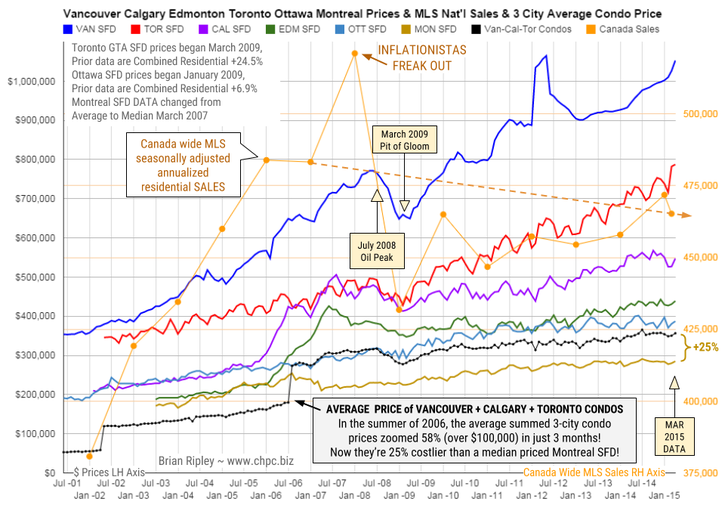
The chart above shows the average detached housing prices for Vancouver, Calgary, Edmonton, Toronto*, Ottawa* and Montréal* (the six Canadian cities with over a million people) as well as the average of the sum of Vancouver, Calgary and Toronto condo (apartment) prices on the left axis. On the right axis is the seasonally adjusted annualized rate (SAAR) of MLS® Residential Sales across Canada.
For more commentary on the above chart go HERE
For Brian’s Plung-O-Meter go HERE

 Remember 1999? What a great time to be alive! Mankind stood on the threshold of Olympus, ready to join the assembly of gods, rollicking, frolicking and generally misbehaving without regret.
The internet was gaining velocity. It was widely believed that breakthroughs in communications had ‘removed the speed limits’ to economic growth. Information was now readily and easily available to everyone.
Any dope in Peoria could go on the internet and find out how to manufacture a bomb in his basement, or make a cherry pie in his kitchen.
And the genius in Kuala Lumpur or Kabul was now liberated from the low-bred, backward, and benighted people around him; he could see what fun it would be to have a Beverly Hills zip code. And he could reach across the worldwide web and get a chisel and a steel file – to create a ‘killer app’ – and free himself from his miserable circumstances.
The End of History
So many people… in so many places… all yearning for home-delivered pizza and fortunes from day trading stocks – this was supposed to lead to rates of progress never before seen by human eyes.
The evidence could be witnessed in the stock market. Shares of start-ups promising breakthroughs in all areas – from transportation to medicine to home entertainment – were selling at earnings multiples utterly disconnected from the norms that had ruled investing hitherto fore.
What price was too high for a technology that revealed the secrets of the cosmos and unleashed its hidden power?
Progress in statecraft and politics, too, seemed unstoppable. China took the capitalist road in 1979. Russia followed a decade later. Turkey, India, Brazil – all the big “Third World” countries – became “emerging markets”… aping the US capitalist-democratic model.
This model – of democracy and state-aided capitalism – looked like a winner. In 1989, American political scientist Francis Fukuyama wrote his famous “The End of History” essay, arguing that political and economic perfection may have been achieved:
What we may be witnessing is not just the end of the Cold War, or the passing of a particular period of post-war history, but the end of history as such: that is, the end point of mankind’s ideological evolution and the universalization of Western liberal democracy as the final form of human government.
And in 2005, New York Times columnist Thomas Friedman published The World Is Flat. It hallucinated that all the world’s economies competed on the same level ground… according to the same rules and same principles (shown to them by the US, of course).
Amid this giddy euphoria came the crash of the Nasdaq… and bursting of the dot-com bubble.
Central Bankers to the Rescue
“Well, maybe we got carried away by those dot-coms,” was the general response. “But now we have real heroes in the public sector who can save us.”
In February 1999, the “Committee to Save the World” – Alan Greenspan, Robert Rubin and Larry Summers – appeared on the cover of Time. The trio was purportedly saving the world from the Asian financial crisis.
Six years later, President Bush awarded Alan Greenspan America’s highest civilian award, the Presidential Medal of Freedom, for his work in goosing up the economy following the recession of 2001.
And in 2009, Time named Greenspan’s successor, Ben Shalom Bernanke, its “Person of the Year” for taking “extreme measures” to “stop the panic” of 2008.
In the 20th century, a relative handful of inventors, tinkers and scientists – working in relative isolation, often with little funding – had given the world the automobile, radio, atomic power, painless dentistry, the Pill, moving pictures, antibiotics, airplanes, air-conditioning and the Internet.
Now, in the 21st century, millions of scientists, entrepreneurs and engineers – all connected by the Internet – are on the job. They should be able to set the world on fire. Instead, at least so far, it has been a cold shower.
This Century Has Been a Flop
Today, we will focus on the proof: This century, for America at least, has been a flop. Tomorrow and next week we will explain why.
We are 15 years into the 21st century. Can you think of a single innovation that is equal to the automobile or the airplane? Or air-conditioning?
We can’t. All we can think of is Facebook, Twitter, WhatsApp, Snapchat and other frivolities that are more trouble than they are worth.
But the most damning evidence of a failed century comes from the realm we study every day: the economy.
And here, we are much obliged to President Reagan’s former budget adviser and author of The Great Deformation David Stockman for rehearsing the many failures of 21st-century economic policy. (You can follow David at his website: David Stockman’s Contra Corner.)
What, he asks, have “$700 billion in TARP, $800 billion worth of fiscal stimulus, upward of $4 trillion of QE money printing and 165 months out of 1,890 months in which interest rates were cut or were held at rock bottom levels” wrought?
“The number of breadwinner jobs is still 2 million below where it was when Bill Clinton” was in the White House, says David. Jobs in manufacturing, construction and mining/energy are down 21% so far this century.
You’d think that all these scientists and engineers would mean a big increase in productivity and wages.
Nope.
Since 2007, nonfinancial business productivity growth has fallen to just half the rate experienced between 1953 and 2000.
This is a big part of the reason that real median US household income has fallen from $57,000 in 2000 to $53,000 today. If incomes continue to fall at that rate, the typical American family will have only $25,000 of income by the end of the century.
The Part-Time Economy
In the 20th century, more and more people joined the workforce and earned money.
According to Stockman’s site, 56% of Americans aged 16-54 had work in 2000. Since then, Americans have been falling out of the labor force. Today, just 45% of the working-age population is employed.
Part-time work is increasing, however. The part-time economy is where people work an average of 26 hours a week and earn an average of less than $10 an hour (not even $15,000 a year).
The only sectors that have seen net new job creation are in the “HES complex” (health, education and social services) – the parts of the non-military economy most heavily controlled and financed by government.
In all other sectors, more jobs have been lost than gained.
GDP growth, jobs, productivity and incomes – all the things that matter to regular people – have slowed, or fallen, in the 21st century.
So far, the century is a dud. A disappointment. And a barely contained disaster.
Why?
Tune in tomorrow
Regards,
Bill
Market Insight:
Emerging Markets Still On Sale
by Chris Hunter, Editor-in-Chief, Bonner & Partners
Yesterday, we reported that European blue-chip stocks had left the Dow in their dust since the start of the year.
Also, outperforming US stocks this year are the emerging markets.
As you can see from today’s chart, the iShares MSCI Emerging Markets Index ETF (NYSE:EEM) – which tracks prices of 800 stocks in 23 emerging markets – is up 8% this year.
By contrast, the S&P 500 is up just 1.2%.
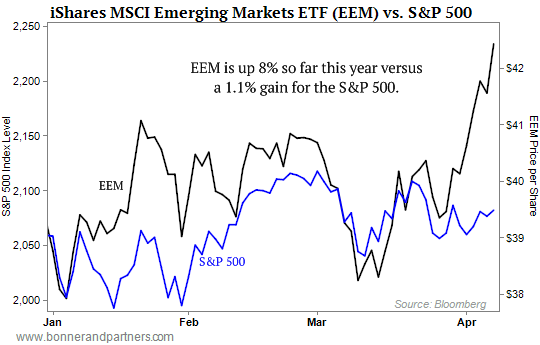
Even better, the MSCI Emerging Markets Index continues to trade at a steep discount.
It trades at just 13.5 times reported earnings versus a 20.3 multiple for the S&P 500.
Put another way… you can pick up a dollar of reported emerging market earnings for one-third less than a dollar of reported S&P 500 earnings.
P.S. If you haven’t already claimed your copy of Bill’s latest book, Hormegeddon, don’t delay. Right now, you can get the book and a subscription to Bill’s new monthly publication, The Bill Bonner Letter… as well as special bonus materials… for just $4.95. Read a full review of Hormegeddon and access your special bonuses here.
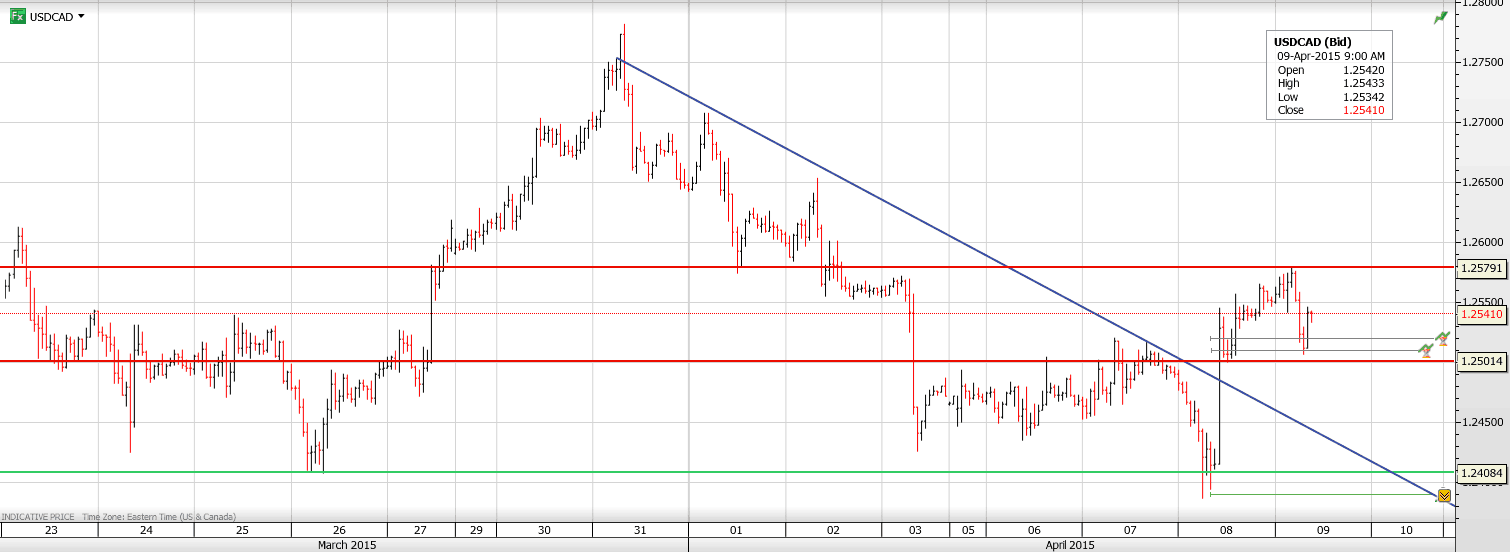
USDCAD Overnight Range 1.2512-1.2577
USDCAD found a short term floor yesterday at 1.2390 and bounced like a “Wham-O SuperBall” off pavement, rising 0.0150 points before a pause and then grinding even higher after the FOMC minutes. News headlines trumpeted “FOMC split on June rate hike”. That headline isn’t just misleading its plain wrong. The FOMC minutes said “Several participants judged that the economic data and outlook were likely to warrant beginning normalization at the June meeting”. Several is not a split. Nevertheless, it got the ball rolling and the US dollar was in demand.
The overnight FX markets were a tad wonky with Asian US dollar sellers becoming European dollar buyers. Greece apparently made a €450 million payment to the IMF giving a short lived pop to EURUSD. To the surprise of no one, the Bank of England left rates unchanged
USDCAD dropped from 1.2560 to 1.2520 as NY walked in coinciding with a jump in EURUSD to 1.0775 from 1.0738. Canadian Building Permits were below consensus at -0.9% (Forecast 2.2%) and the New House Price Index edged higher. The impact on the currency was negligible.
USDCAD technical outlook
The intraday USDCAD technicals are bearish. The failure to extend gains beyond 1.2580 with a break of minor support in the 1.2490-1.2505 area will lead to another visit to major support at 1.2390-1.2410. Only a gain above 1.2880 would negate the downward pressure. For today, USD support is at 1.2490 and 1.2460. Resistance is at 1.2540 and 1.2580.
Chart: USDCAD hourly showing the range (between the red lines)

 “Jim has
publicly stated that he is looking to get all of his money out of the dollar in
the coming months.”
Do you know
Jim Rogers?
The
legendary investor first went to work on Wall Street with $600 in his pocket in
the late ‘60s. In 1970, he and George Soros founded the Quantum fund: one of
the greatest investment funds in history.
Between 1970
and 1980, the Quantum fund returned 3,365%, outperforming the S&P 500’s
performance of 47% by an enormous margin. On an annual basis, Rogers and Soros
produced average returns of 38%. Rogers then “retired” with millions in his
bank account at the ripe age of 37…..continue reading until you get to his current recommendations HERE

-
I know Mike is a very solid investor and respect his opinions very much. So if he says pay attention to this or that - I will.
~ Dale G.
-
I've started managing my own investments so view Michael's site as a one-stop shop from which to get information and perspectives.
~ Dave E.
-
Michael offers easy reading, honest, common sense information that anyone can use in a practical manner.
~ der_al.
-
A sane voice in a scrambled investment world.
~ Ed R.
Inside Edge Pro Contributors

Greg Weldon

Josef Schachter

Tyler Bollhorn

Ryan Irvine

Paul Beattie

Martin Straith

Patrick Ceresna

Mark Leibovit

James Thorne

Victor Adair