
Gold & Precious Metals
 More and More Countries Join the War on Cash
The War on Cash is now going into hyper-drive.
In the last 24 months, Canada, Cyprus, New Zealand, the US, the UK, and now Germany have all implemented legislation that would allow them to first FREEZE and then SEIZE bank assets during the next crisis.
These moves will be sold as “for the public’s good,” when they happen. But the reality is that it’s all about stopping people from moving their capital into actual physical cash.
The whole template for this was set out in Cyprus in 2013. The quick timeline for what happened in Cyprus is as follows:
June 25, 2012: Cyprus formally requests a bailout from the EU.
November 24, 2012: Cyprus announces it has reached an agreement with the EU the bailout process once Cyprus banks are examined by EU officials (ballpark estimate of capital needed is €17.5 billion).
February 25, 2013: Democratic Rally candidate Nicos Anastasiades wins Cypriot election defeating his opponent, an anti-austerity Communist.
March 16 2013: Cyprus announces the terms of its bail-in: a 6.75% confiscation of accounts under €100,000 and 9.9% for accounts larger than €100,000… a bank holiday is announced.
March 17 2013: emergency session of Parliament to vote on bailout/bail-in is postponed.
March 18 2013: Bank holiday extended until March 21 2013.
March 19 2013: Cyprus parliament rejects bail-in bill.
March 20 2013: Bank holiday extended until March 26 2013.
March 24 2013: Cash limits of €100 in withdrawals begin for largest banks in Cyprus.
March 25 2013: Bail-in deal agreed upon. Those depositors with over €100,000 either lose 40% of their money (Bank of Cyprus) or lose 60% (Laiki).
The most important thing I want you to focus on is how lies and propaganda were spread for months leading up to the collapse. Then in the space of a single weekend, the whole mess came unhinged and accounts were frozen.
One weekend. The process was not gradual. It was sudden and it was total: once it began in earnest, the banks were closed and you couldn’t get your money out (more on this in a moment).
There were no warnings that this was coming because everyone at the top of the financial food chain are highly incentivized to keep quiet about this. Central Banks, Bank CEOs, politicians… all of these people are focused primarily on maintaining CONFIDENCE in the system, NOT on fixing the system’s problems. Indeed, they cannot even openly discuss the system’s problems because it would quickly reveal that they are a primary cause of them.
For that reason, you will never and I repeat NEVER see a Central banker, Bank CEO, or politician admit openly what is happening in the financial system. Even middle managers and lower level employees won’t talk about it because A) they don’t know the truth concerning their institutions or B) they could be fired for warning others.
Please take a few minutes to digest what I’m telling you here. You will not be warned of the risks to your wealth by anyone in a position of power in the political financial hierarchy (with the exception of folks like Ron Paul who are usually marginalized by the media).
With that in mind, now is a good time to prepare for systemic risk. I cannot forecast precisely when things will get as ugly as they did in Cyprus for the financial system as a whole (no one can).
However, the clear signals are clear that the Feds are preparing for something big. The Treasury Department has ordered survival kits for the Big Banks’ employees… and the NY Fed is expanding its satellite office in Chicago in case something major happens that forces the market to collapse.

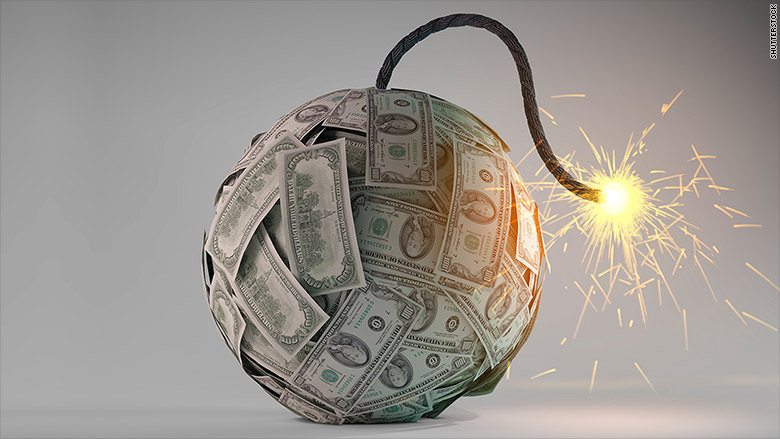 Nouriel Roubini, who called the 2008 financiial crisis, outlines the 4 things that investors should be worried about. He says a paradox has emerged in the financial markets since the 2008 global financial crisis. A series of recent shocks suggests that macro liquidity has become linked with severe market illiquidity.
High-frequency traders and illiquid Bond exchanges compared to Stocks are just two reasons for investor concern. Read the other two reaaons in his full editorial HERE or an analysis of his editorial HERE – Money Talks Ed.

“Old people, they should be killed at birth.”
Boris Vian
Still nothing to report from the financial markets. The Dow and S&P both ticked up about a half a percentage point yesterday. And gold has been hovering around $1,190 for over a week.
Is everyone at the beach already? Are investors waiting for something to happen? We don’t know…
Meanwhile…
“France is a dead country.”
A young man gave it to us straight.
“If you are young and you have any ambition, you leave France. You go to London, or the U.S.A., or China. There’s no point staying in France. I am French. It breaks my heart to leave. But I can’t stay. I don’t like being dead that much.”
Our friends in Paris tell us the same thing. Their children have left. If they want to visit their grandchildren they have to travel overseas.
Meanwhile, prices of top properties in London, Vancouver, and New York are higher than ever. But prices in Paris are soft.
“We’d like to sell our house [in Paris],” says a friend. “It’s perfect for a young family. But the young family we would sell it to has moved to London.”
Maybe it’s the weather. Maybe it’s the economy. But the capital of the Fifth Republic seems depressed. And old.
“The Biggest Scandal in France”
Yesterday, we took the train out to Normandy. We bought first-class tickets, hoping to have some extra space to work. But the first-class
compartment was the same as second class. Only shabbier. The seats were grimy. The upholstery was worn and greasy.
“What is the difference between first class and second class?” we asked the ticket taker when he went down the aisle.
“Well, there really isn’t any, except that first class is more expensive, so there are fewer people.”
We looked into the second-class compartment. It had no more people than the first.
But we are not writing to pass along travelers’ tales. We keep our eyes open in the hopes of learning something. And what we are learning here in France is that it has the same problems as the U.S. – maybe worse.
Young people do not leave the country only because it is sluggish and stale; they leave because it is rigged against them.
This is “The biggest scandal in France,” as the magazine Le Pointcalls it. It calls its young “The Generation of Pigeons.”
In France, as in America, older people have used government to give themselves money and privileges… and turned the young into chumps.
For example, the average income tax rate on a 30-year-old is nearly three times as high as the rate on a 65-year-old.
The unemployment rate for young people aged 15 to 24 is two to three times higher than the rate for older people.
For those who dropped out of high school, barely one out of two has a job.
And French employment law is infamously favorable to people who are already in the system – but vicious to those who aren’t.
We spoke to a friend of ours who works for the EDF Group – the big power company. “How many weeks of vacation do you get?” we asked.
“Ten…” came the answer. And recently, his fellow workers went on strike when the company tried to reduce it. Nearly two and a half months of paid vacation! Good grief… he could take the whole summer off.
Again, this may be great for existing employees, but it makes the company very reluctant to bring on new ones.
Our Generation Has Failed Its Own Children
The poor jeune Frenchman also has the burden of debt. In this sense, at least, he has an advantage over the American. French schools – even university studies – are paid by the taxpayers. So graduates do not leave school with student debt as they do in America. Still, they have their share of government debt on their shoulders.
A young person in Germany has about $30,000 worth of government debt to look forward to. In France, the figure is closer to $40,000.
By way of comparison, the U.S. total is about $57,000 (according to our back-of-the-envelope calculation). And if we include the financial obligations not included in the official “national debt” figures, the sum rises to about $700,000.
Most, but not all, of this debt comes from reaching into the future in order to give things to old people today.
But wait. Le Point brings up another way in which the old – our generation – has failed its own children.
It cites the work of American sociologist Robert Putnam and his book Our Kids: The American Dream in Crisis. Putnam points out that almost all old people grew up in families with two parents present.
They weren’t necessarily good parents. They weren’t often rich parents. They smoked. They drank. They referred to homosexuals in terms that would be regarded as hate crimes today. But they gave their children something that many of today’s young people will never have.
In 1960, only 6% of American children lived in a household with only one parent. Since then, says Putnam, American society has split apart. Only a third of today’s children live in traditional families, where they are encouraged to do well in school, get jobs, and form “normal” families of their own.
The other two-thirds live less orderly, less purposeful lives. And about half of today’s children spend at least part of their childhood in single-parent households, with higher rates of school failure and subsequent unemployment.
What to make of it?
Regards,
 |
Bill
June 03, 2015
Paris, France

““Financial Repression can mean many things but basically in a nutshell it is a lack of free market finance and human activity, where the government thinks it is smarter than we are!”
 Special Guest: Jim Rogers is the author of the bestseller, Investment Biker: Around the World with Jim Rogers. His other books include Adventure Capitalist: The Ultimate Road Trip, A Gift to My Children: A Father’s Lessons for Life and Investing, Hot Commodities: How Anyone Can Invest Profitably in the World’s Best Market, and A Bull in China: Investing Profitably in the World’s Greatest Market. Jim grew up in Demopolis, Alabama, and got started in business at the age of five, selling peanuts. Winning a scholarship to Yale, Rogers was coxswain on the crew. Upon graduation, he attended Balliol College at Oxford. After a stint in the army, he began work on Wall Street. He cofounded the Quantum Fund, a global-investment partnership. During the next ten years, the portfolio gained more than 4,000 percent, while the S&P rose less than 50 percent. Rogers then decided to retire–at age thirty-seven–but he did not remain idle.Continuing to manage his own portfolio, Rogers served as a professor of finance at the Columbia University Graduate School of Business and as moderator of The Dreyfus Roundtable on WCBS and The Profit Motive on FNN. At the same time, he laid the groundwork for his lifelong dream, an around-the-world motorcycle trip: more than 100,000 miles across six continents. He has contributed to Fox News, Worth, CNBC and others.
23 Minutes
Financial Repression
“Financial Repression can mean many things but basically in a nutshell it is a lack of free market finance and human activity, where the government thinks it is smarter than we are!”
“History has shown many times that we are smarter than governments, politicians and the bureaucrats – but they don’t like to give up power. When they make mistakes they blame it on us and try and make us pay for it! When they see a problem arise their first instinct is to try and suppress the public and markets. They try and do things they think will make things better, but of course it doesn’t, and only makes things worse!”
Government Controls & Regulations
“When problems arise they put on exchange controls which is a time honored tradition of politicians and bureaucrats to correct mistakes
they have made. We will have exchange controls in the US again – no question. We already have exchange controls to some extent such as FATCA and other things to make it more and more difficult for Americans to do anything as far as finances are concerned. They will put on trade controls, tariffs quotas – they will come up with all sorts of things.”
Politicians don’t know what they are doing. History proves many times that politicians make things worse instead of better because what they do since they don’t know anything themselves, they ask the bureaucrats how they can save themselves. The bureaucrats rush in and say “this is the way you save yourself”. “It isn’t your fault, it is the markets fault and those evil speculators and the people! They then come up with regulations and controls. They don’t know what they are doing!”
Regarding ZIRP, Operation Twist and three rounds of Quantitative Easing, Jim Rogers predicts:
“We are going to have to pay a horrible price for yet another mistake made by the bureaucrats”
What Should Investors be Thinking About?
- “The first thing investors should do is only do things they know a lot about! Don’t listen to me or anyone else who you don’t know what they are talking about. Do not so something that you yourself don’t understand perfectly.”
- “Everyone should know about having assets outside their own country. We all have fire insurance which we hope we will never use. Look upon international diversification as a kind of insurance. … diversify internationally.
- “If you don’t know about other asset classes then please, for goodness sake, learn about them because there are going to be many strange things happen in the next decade.
“The Certainty of Economic Slowdown”
“History shows in the US we have had economic slowdowns every four to seven years since the beginning of the republic. We are going to have them again no matter what people tell you. If someone tells you we will never have another economic slowdown – please put your money in your pocket and head as far away as you can!”
“It is going to be much, much worse than 2008. There is higher debt everywhere than previously!”
“We have never had history all the central banks printing such vast amounts of money at the same time! There is a hugh ocean of liquidity floating around out there!”
… and much more
- Coming Exchange, Trade and Quota controls,
- The dangers the coming Cashless Society,
- The $5T Nominal Negative Interest Rate Sovereign Bonds,
- The destruction of the US savings and working class,
- The slowing Chinese Economy,
- Why recessions are healthy. Why the avoidance of recessions leads to serious malfeasance.
- The importance of investing in productive assets.
About Gordon Long
Mr. Long is a former senior group executive with IBM & Motorola, a principle in a high tech public start-up and founder of a private venture capital fund. He is presently involved in private equity placements internationally along with proprietary trading involving the development & application of Chaos Theory and Mandelbrot Generator algorithms.

When I first forecast a rise in geopolitical turmoil in January 2013, few people believed me.
Many thought I was crazy or I was simply fearmongering.
Yet, here we are, only two and a half years into my warnings of a rising cycle of social and international unrest that will not peak until 2020 to 2022 …
And already, nearly everywhere you turn, geopolitical unrest is exploding off the charts.
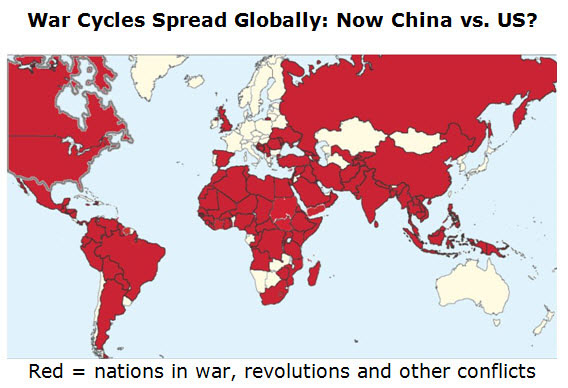
Just consider the above map of the world from Uppsala University, the leading think tank on conflict, that highlights in red the countries at war, racked by revolutions or suffering other kinds of violent conflicts.
And consider …
– Israel and Gaza, still fighting a war that could easily spread throughout the entire Middle East.
– Vladimir Putin, bullying his way through Ukraine and likely to target other former Soviet Union satellite countries.
– Syria’s civil war, where more than 210,000 are now dead.
– Boko Haram, murdering and kidnapping hundreds of innocent people, crusading to create another Islamic state on the world’s second largest continent.-
– Nearly all of Africa, where there are now fully 24 countries engaged in wars, involving 146 different militias-guerrillas, separatist and anarchic groups.
– Asia, where 15 countries, involving 129 different radical and separatist groups, are waging wars and uprisings.
– Europe, where nine countries are under siege by 70 different militias, representing mostly separatist and anarchist groups.
– The Middle East, where eight countries and 169 different rebel groups are now engaged in conflict.
– The Americas, where five countries are either at war or experiencing massive domestic unrest, involving 25 different rebel and separatist groups and drug cartels.
– And the most violent of all, ISIS, the Islamic State, known for its harsh Wahhabist interpretation of Islam and brutal violence directed at Shia Muslims and Christians in particular. Terrorizing the Middle East, killing tens of thousands.
And these are just the “officially” recognized conflicts.
They do not include other hot spots around the world that are likely to lead to either civil or international war, including yes, the potential for armed conflict between China and the U.S.
I was perhaps one of the first to warn of this potential conflict, way back in 2004. In an issue of my Real Wealth Report, I explicitly described how China would move into the South China Sea, specifically targeting the Spratly Islands, the region’s oil and gas reserves and shipping routes.
That’s where China can grab an undeveloped, but easily exploited, 100 billion barrels of oil and 882 billion cubic feet of natural gas.
And that’s where the volume of oil — shipped through the South China Sea — is three times greater than the volume shipped through the Suez Canal (pipeline included) and fifteen times greater than the oil that flows through the Panama Canal.
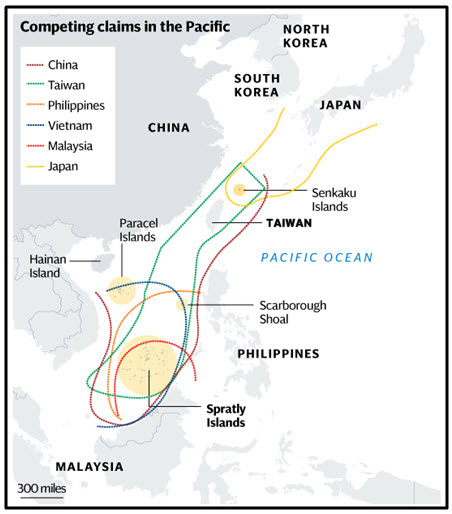 And yes, over the past year, Beijing has been very aggressive seeking to stake out its territorial claims and reach.
So much so that now, there’s the very real threat of a conflict between the U.S. and China.
Just consider the latest fighting words from U.S. Defense Secretary Ashton Carter, demanding a halt to land reclamation in disputed waters and vowing that the U.S. “will remain Asia’s leading power for decades to come.”
And that “There should be no mistake about this: The United States will fly, sail and operate wherever international law allows, as we do all around the world.”
China’s response, via the Global Times, a newspaper run by the Communist Party:
“If the United States’ bottom line is that China has to halt its activities, then a US-China war is inevitable in the South China Sea.”
Will there be a war between the U.S. and China?
It’s impossible to say at this time. But I do know this:
A. China will not back down on its efforts to claim what it believes is its sovereign claims to the South China Sea and the Spratly Islands. It needs the area’s vast natural resources and shipping lanes.
B. Washington will not back down either. Unfortunately, the powers-that-be in Washington still think they can be the lead influence in the rest of the world and have consistently failed to recognize that the geopolitical sands of time are changing.
C. Leaders in both countries would like nothing more than to distract their people’s attention from growing domestic problems. In the U.S. — a sluggish economy and a widening gap between the rich and the poor. In China — an extremely nationalistic population that views the South China Sea, like Hong Kong or Taiwan, as part of China … and a population that increasingly sees the U.S. as a threat to its economic rise.
Hopefully, it won’t come to war in the South China Sea. But given how the war cycles are slated to ramp higher for the next five to seven years, I wouldn’t be surprised if some sort of military conflict erupts between Washington and Beijing in the South China Sea or elsewhere.
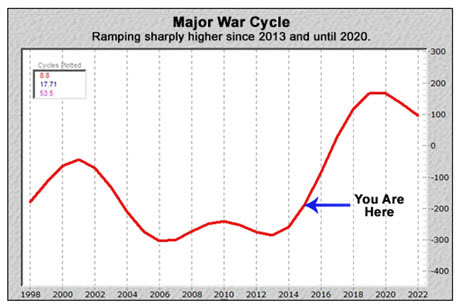 However, nearly all of these conflicts — even a future Sino-American war — are
merely a manifestation of the deeper, pervasive impact of the big war cycle that’s ramping up and should continue to do so for the rest of the decade.
This is the same war cycle I’ve told you about repeatedly. And it’s the same one I’m displaying here again. —->
We see it everywhere. Rising domestic violence. Spreading international conflict. An unmistakable shift toward more separatism, anarchism and terrorism. Currency wars. Trade wars. Cyberespionage. Capital controls. And more.
What’s behind it? Much of the cycle is in parallel to a coming sovereign debt crisis — a crisis the likes of which hasn’t been seen in developed economies since the 1930s. It’s a crisis that …
Takes Europe into bankruptcy …
Leaves Japan unable to fund its massive liabilities, and …
Exposes the $235 trillion of patently unpayable debts of the United States of America for what they really are — the handiwork of emperors with no clothes.
That’s why these are dangerous times, far more dangerous than most realize.
And that’s why the investment implications are equally fraught with dangers — and opportunities, provided you have a good sense of history, a knowledge of how markets truly work, and you position yourself accordingly.
Start taking some big steps right now:
First, don’t let anyone convince you that all these global conflicts are somehow going to “die down” or “peter out.”
Second, remember that it’s never too early to prepare for the worst.
Third, if you own any sovereign bonds of the U.S., Europe or Japan — get the heck out and don’t look back.
Above all, stay safe!
Larry
The post War Cycles Spread Globally: Now China vs. US? appeared first on Money and Markets – Financial Advice | Financial Investment Newsletter.

-
I know Mike is a very solid investor and respect his opinions very much. So if he says pay attention to this or that - I will.
~ Dale G.
-
I've started managing my own investments so view Michael's site as a one-stop shop from which to get information and perspectives.
~ Dave E.
-
Michael offers easy reading, honest, common sense information that anyone can use in a practical manner.
~ der_al.
-
A sane voice in a scrambled investment world.
~ Ed R.
Inside Edge Pro Contributors

Greg Weldon

Josef Schachter

Tyler Bollhorn

Ryan Irvine

Paul Beattie

Martin Straith

Patrick Ceresna

Mark Leibovit

James Thorne

Victor Adair