
Energy & Commodities
Despite three consecutive weeks of losses precious metals have failed to mount much of a rally. Gold closed last week above $1170 and may close this week below $1180. Meanwhile, Silver has struggled to mount any rebound and appears to have lost $16 as the week comes to a close. While the risk of a final breakdown is growing, one positive we see is the relative strength in the riskiest parts of the mining sector.
GDX tracks the senior miners (including royalty companies now) while GDXJ tracks what we would term “the largest juniors.” When the sector is performing well, we’d expect GDXJ to outperform and when the sector is performing poorly, we’d expect GDXJ to underperform.
The chart below plots GDXJ against GDX. The ratio peaked in April 2011 and may have bottomed in March 2015. Even as the spring rally in precious metals fizzled GDXJ continued to outperform. A few days ago the ratio reached a 5-month high.
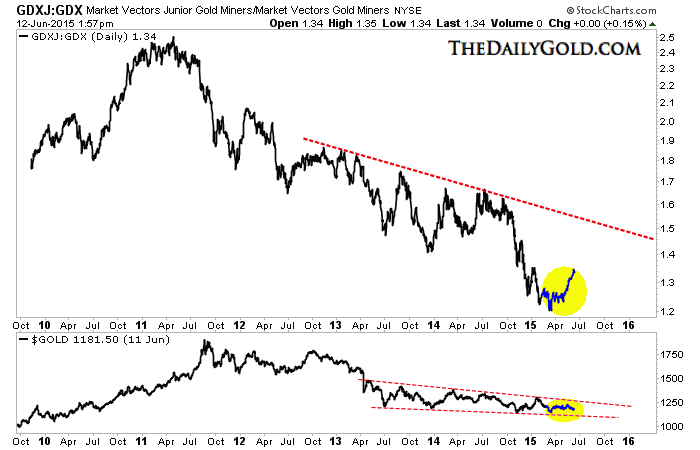
GDXJ vs. GDX
Take a look at GLDX against GDX. GLDX tracks exploration companies which are much smaller in market cap than those in GDXJ. The ratio has formed a 2-year base and rounded bottom that appears to be quite strong. Last week the ratio touched a 7-month high.

GLDX vs. GDX
Stepping back from relative strength, I want to take a look at GDXJ in nominal terms. GDXJ is far more liquid and therefore relevant than GLDX. The chart below is the weekly candle chart for GDXJ. Note that GDXJ has made three lows in the past eight months. Volume has decreased at each subsequent low. This indicates that the strength of the selling has abated. It will be interesting to see how GDXJ performs if and when Gold breaks below $1150. GDXJ is trading near $25 and has good support at $21-$22.

GDXJ
While not a buy signal, the relative strength in GDXJ and GLDX tells us a few things. It argues that the bear market is likely to end soon and that with respect to all mining stocks, GDXJ and GLDX could lead the recovery. However, in the meantime we are waiting for Gold to break below $1150 and then $1100 and we are waiting for GDXJ to retest its lows. Be patient as those developments would bring about better and safer opportunities. Consider learning more about our premium service including our favorite junior miners which we expect to outperform in the second half of 2015.
Jordan Roy-Byrne, CMT

 Markets typically bottom out when popular sentiment is negative. And a recent analysis by Bloomberg confirms that the public has all but given up on precious metals. Assets in exchange-traded products tied to metals prices fell to their lowest point since 2009.
While holders of coins and other physical bullion products tend to hang tight during adverse market conditions, holders of derivate instruments are more likely to move in and out of the market – usually at the wrong times.
Sentiment could conceivably go from bad to worse. But history shows that opportunists who buy when times are tough ultimately rewarded with an opportunity to sell when times are euphoric.
Time for Presidential Aspirants to Take a Stand on Sound Money
 So, how many Republicans will announce a run for the White House this week?!
The most recent candidate to officially throw his hat into the crowded ring is Rick Perry, former governor of Texas. Perry had supported legislation to establish a Texas Bullion Depository in 2013. Just a few days ago, the Texas legislature finally approved a bill to that effect.
The Texas Bullion Depository will allow government agencies, private institutions, and individuals to hold gold with the backing of the state Comptroller’s Office.
Down the road, the first of its kind Bullion Depository could enable Texas to become more financially independent of the U.S. government and Federal Reserve System.
Monetary reform is an issue that could give Governor Perry traction. Though his shaky debate performances doomed his candidacy last time around, he is one of the few candidates who can viably run on a record of growing jobs.
In fact, without the 1.5 million job gains produced in Texas from 2008 through 2014, the U.S. would have suffered a net loss of 400,000 jobs.
The extent to which Governor Perry caused Texas’ private-sector hiring spree is debatable. What’s not debatable is that for the vast majority of Americans living outside Texas, the economy isn’t producing enough jobs.
 Official reports may show unemployment steadily declining nationwide, but the “unemployment rate” is such a sham statistic that not even Federal Reserve officials give it much credence in assessing the state of the jobs market. They know that the actual rate of workforce participation has barely budged from multi-decade lows recorded at the onset of President Obama’s second term.
And privately, Fed officials must know that their policies are failing most Americans. The public by and large hasn’t participated in the Fed-fueled stock market advance.
Wall Street has been taken care of. The banks have been taken care of. The government has been taken care of. But Main Street still struggles.
Instead of getting a bailout, taxpayers are getting a massive bill. Thanks to the Fed’s trillion-dollar Quantitative Easing bond-buying campaign, Congress gets to borrow at artificially low rates.
The Fed-backed Congress feels no pressure to cut spending, and few members of Congress are willing to do so purely out of principle.
It’s politically easier just to saddle future taxpayers with unconscionable levels of debt.
When the debts become too large for taxpayers to service, the Fed gives Congress the ability to pull a stealth default through inflation. As Pippa Malmgen, former member of the President’s Working Group on Financial Markets, explained in an exclusive Money Metals podcast interview last week, “Inflation is a form of default. It’s a means by which a government ends up paying back less than they borrowed.”
That’s the road policymakers are taking us down.
It’s not our place here at Money Metals Exchange to endorse candidates for public office. However, we do view it as part of our mission to help educate the electorate about sound money. Toward that end, we hope the presidential candidates are asked – and asked until they give a straight answer – how they would rein in the Fed.
 Stefan Gleason is President of Money Metals Exchange, the national precious metals company named 2015 “Dealer of the Year” in the United States by an independent global ratings group. A graduate of the University of Florida, Gleason is a seasoned business leader, investor, political strategist, and grassroots activist. Gleason has frequently appeared on national television networks such as CNN, FoxNews, and CNBC, and his writings have appeared in hundreds of publications such as the Wall Street Journal, Detroit News, Washington Times, and National Review.
In the wake of the IMF walking out of negotiations with Greece, the Financial Times says the Pullout is Amid an “Air of Unreality”.
What’s Unreal?
Sure, everyone expected Greece to buckle. But what if Greece did buckle for the nth time? Greece was eventually going to default anyway.
There is not now, nor was there ever, anything “unreal” about the inevitable default.
Earlier today German officials said “European taxpayers have been generous” to Greece. What a hoot. Now, that’s “unreal”.
What’s also “unreal” is forcing €330 billion worth of debt on a tiny country, pretending that it can be paid back.
This alleged “generous” bailout did nothing but bail out banks while forcing a hellacious depression on Greece. Taxpayers have not footed the bill yet, but they will, thanks to bondholder and bank bailouts.
Some blame Greece. And to be sure Greece made mistakes. But the real culprits are the ECB’s one size fits Germany interest rate policy, the stupidity of the eurozone agreement itself, the lack of a fiscal union, etc.
Everyone knew Greece lied to get into the eurozone. They let Greece in anyway. Isn’t that “unreal”?
“Do You Feel Lucky, Punk?”
The Guradian reports the IMF walkout this way: IMF to Alexis Tsipras: ‘Do you feel lucky, punk?’
“You’ve got to ask yourself one question. Do I feel lucky? Well, do ya, punk?” The lines spoken by Clint Eastwood in Dirty Harry sprang to mind when the International Monetary Fund (IMF) announced that it had called its Greek negotiating team home from talks in Brussels.
The IMF’s message was short and brutal. There were still major differences between Greece and its creditors. There was no progress in narrowing those differences. The two sides were well away from an agreement.
The IMF, clearly, has had enough. This, then, is the IMF holding the gun to Alexis Tsipras’s head. It feels like a pivotal moment, the point where the creditors are saying “take it or leave it” and the Greeks have to decide whether the IMF really means it.
They are fed up with Tsipras acting like he is the one holding the .44 Magnum and they are threatening to pull the trigger.
This movie climaxes next week.
Who Has the Gun?
The IMF? OK. Pull the trigger.
Tsipras wants someone to blame. If he can point the finger at the despised IMF, the IMF will effectively have shot itself.
Greece has nothing to lose. The Troika does have something to lose.
Let’s look at things from the point of the best case scenario.
Best Case Scenario
- Greece defaults.
- Greece sheds €330 billion worth of debt.
- Greece opens up trade with Russia, killing EU sanctions once and for all (and exposing the stupidity of the unanimous nature of EU rules in the process).
- Greece threatens to yank US access to the US military base in Crete.
- Russia builds pipeline through Greece. In turn, Greece collects shipment and storage fees.
- Russia provides interim funding for Greece until Greece runs a primary account surplus.
- The interim agreement from Russia requires Greece to initiate some market reforms that will pay big dividends down the road.
- Greece reforms and does very well in a relatively short time frame.
- Italy, Spain, Portugal, get some clever thoughts of their own.
US Naval Base in Greece

The military Base is in Souday Bay, Greece.
Note the strategic location.
In August of 2013, the US Asked Greece for Military Base Access in Kalamata and Souda for a possible strike on Syria over the alleged use of toxic gas in Ghouta on the eastern outskirts of Damascus.
In 2013, Greece said yes. What will they demand to say “yes” the next time?
Nothing to Lose
From my perspective, Greece has nothing to lose.
To be sure, Greece would be far better off defaulting and reforming rather than simply defaulting. But default is the best option for sure.
Even staunch euro supporter Wolfgang Münchau agrees. See his April 19 column: Greek Default Necessary but Grexit is Not.
For my take on Grexit, please see Can Greece Default and Stay in Eurozone? Russia is the Key!
When default is inevitable (and it is), it’s best to do it sooner rather than later.
When You Ain’t Got Nothing
I offer a musical tribute to Greece. Click here to play “Like a Rolling Stone” by Bob Dylan.
It’s an excellent video, but not directly embeddable. Click on link to play.
Key Lines
Now you don’t seem so proud
About having to be scrounging for your next meal
…
You said you’d never compromise
With the mystery tramp, but now you realize
He’s not selling any alibis
As you stare into the vacuum of his eyes
And say do you want to make a deal?
…
When you ain’t got nothing, you got nothing to lose
Speece Revisited
Some will insists this is all Greece’s fault. Most others will insist it’s primarily Greece’s fault.
Actually, it’s neither of those.
I make the case in From ZIRP to NIRP: Virtues of Germany vs. the Vices of Greece; What About “Speece” and Gold?
The big fear out of the eurozone should not be that Greece fails miserably, but rather that Greece succeeds!
Success as I have pointed out above is quite possible. If Greece were to immediately initiate the necessary reforms, I would even go so far as to say “success is likely”.
Unfortunately, I don’t believe Greece will reform.
Regardless, Greece is better off without a €330 billion albatross around its neck for the next 40 years.
In the previous post Tom McClellan highlights Peter Eliades’ work on the cyclical top due in the S&P 500 this year. To add some color to it, here is the chart I produced for NFTRH subscribers several weeks ago after purchasing and reading an Eliades report myself. His work came to my attention by way of Robert Prechter.

Bear in mind that this big picture cycle is a blunt tool, much like market sentiment or other indicators that show risk, but for extended periods, little risk discovery. So as McClellan mentions, it takes much finer detail management to gauge a topping process. That is what makes market management interesting and sometimes even fun; adding details and color to big picture theses.
We should not look at one chart and its message without cross referencing other charts, data and indicators. The best risk vs. reward scenarios come about when multiple data points come to similar conclusions.
Anyway, staying on the big picture, here is another monthly chart of the S&P 500 we have been using in NFTRH that shows yes indeed, a top (of some kind) is indicated by the monthly MACD signal, but…

…that each of the last two major tops included a bearish MACD signal that preceded a drop to the monthly EMA 20, which turned out to be a pause to refresh prior to ultimate bull market highs in both cases.
Will it be different this time? Very possibly, but also very possibly not. The stock market cycle indicates that it will be different because the S&P is supposedly due for a major top. But the color and detail can only be painted in by doing the shorter-term work each week. Especially since this cycle has had a certain ‘rule breaker’ aspect to it, due in my opinion to historically aggressive policy maker inputs (and resulting distortions) from its birth in Q4 2008/Q1 2009 to today.
Subscribe to NFTRH Premium for your 25-35 page weekly report, interim updates (including Key ETF charts) and NFTRH+ chart and trade ideas, or the Free eLetter for an introduction to our work. Or simply keep up to date with plenty of public content at NFTRH.com and Biiwii.com. Oh, and follow @BiiwiiNFTRH.

 About 100 years ago, in his testimony before Congress, banking giant J.P. Morgan famously stated: “Gold is money, and nothing else.”
At the time, this was true in every sense of the word “money,” as the U.S. was still on the gold standard.
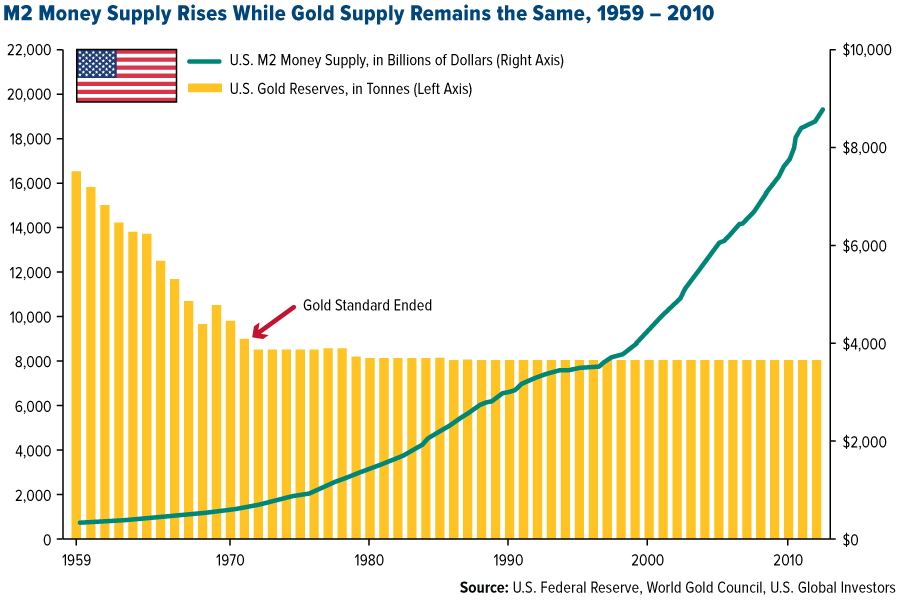
Of course, that’s no longer the case. Despite the fact that previous attempts in other countries to adopt fiat currency systems wreaked havoc on their economies, the U.S., under President Richard Nixon, cut all ties between the dollar and gold in 1971. Gold rose 2,330 percent during the decade, from $35 per ounce to $850.
Today, money supply continues to expand while federal gold reserves remain at the same levels.
Many people still view the yellow metal as something more than just another asset. They also contend that it’s grossly undervalued. In a recent interview with Hard Assets Investor, author and veteran gold investing expert James Turk explained that the money we use now in transactions is not real money at all but a substitute for gold—real money—which he sees fundamentally valued at $12,000 per ounce.
That is to say, if the U.S. government decided tomorrow to return to the gold standard, one ounce of the metal could be valued as high as $12,000, according to Turk’s model.
The current fiat currency system in the U.S. is more than 40 years old. That’s much longer than many in the past lasted, including two of the earliest attempts by central bankers Johan Palmstruch and John Law, both of which I summarize below. Some readers might identify more than a few parallels between then and now.
 Johan Palmstruch, the Dutchman Who Started a Paper Ponzi Scheme in 1661
In the mid-1600s, a Dutch merchant named Johan Palmstruch founded the Stockholms Banco in Sweden, the first bank in Europe to print paper money. The Swedish currency at the time was the daler, essentially a copper plate. Palmstruch’s bank began holding these and issuing banknotes, which were exchangeable in any transaction and fully backed by the physical metal.
At least, that’s what customers were told.
As you might imagine, people found these notes to be much more convenient than copper plates, and their popularity soared. But there was one (huge) problem. Palmstruch had been doling out so many paper bills, that their collective value soon exceeded the amount of metal on reserve. When customers heard the news, a major bank run occurred, but Palmstruch was unable to honor the rapidly-weakening notes.
By 1664, a mere three years into his monetary experiment, the Stockholms Banco was ruined and Palmstruch was jailed—just as Bernie Madoff would be three and a half centuries later.
John Law, the Infamous Scottish Gambler Who Defrauded the French with Worthless Paper
A little over 50 years later, in the early 1700s, a similar experiment was conducted in France, with even more disastrous consequences. This time, the perpetrator was a Scottish gambler and womanizer named John Law, who as a young man had been forced to flee Britain after he killed a man in a duel over a love interest—and bribed his way out of prison. After escaping jail time, Law spent 10 years or so gallivanting about Europe and developing his economic theories, which he outlined in an academic paper.
It was the Age of Enlightenment, when great iconoclastic thinkers such as Descartes, Locke and Newton emerged, changing our understanding of consciousness, politics and physics. Baroque music was all the rage in Europe, as were composers like Bach, Handel and Vivaldi. It was also a golden age of get-rich-quick schemes, and as investors, it’s important that we be aware of the history of human behavior.
In 1715, France was insolvent. It had just lost its king, Louis XIV, and the Duke d’Orléans was named regent until the late monarch’s great-grandson came of age to rule. Familiar with Law and his unorthodox ideas, the duke established him as head of the Banque Générale in hopes that he might reduce the massive debt Louis XIV left behind.
To this end, Law began printing banknotes—lots of them—and flooding the economy with easy money. Doing so, he believed, would expand employment, boost production and increase exports.
 It indeed had those effects—for a time. Paris was booming. The number of millionaires multiplied.
Unlike Palmstruch, Law made no claims that the notes could be converted back into gold or any other metal. He believed that a currency, whether gold or paper, had no intrinsic value other than as a government-sanctioned medium of exchange. Instead, his notes were “secured,” vaguely, by French land, including its colonies in the Americas. There was also no limit to the amount of money that could be pumped into the French economy. Like many of today’s central bankers, Law was of the opinion that if 500 million notes were good, a billion were even better.
But to make it all work according to plan, he had to take extreme measures. Law outlawed the hoarding of money, the use of coins and the possession of more than the minimalist amount of gold and silver.
The system turned out to be untenable and the paper money became worthless. After only four short years, the currency bubble burst. Law was not only removed from office but exiled from the country. Until his death in 1729, he roamed Europe heavily in debt, making his way by his former occupation, gambling.
The incident had long-lasting effects. It sustained the country’s economic woes for years and contributed to the start of the French Revolution later in the century, as it stoked working class disenfranchisement.
Lessons Learned?
Just as we still read Locke and listen to Bach, we should remember what Palmstruch, Law and other reckless central bankers did—which was essentially pull the rug out from under their countries’ monetary systems. It would be extreme to suggest that a similar collapse in currency might one day happen in the U.S., but it’s worth repeating that the gold supply has not kept pace with the money supply.
This could have huge implications.
As James Turk points out:
Eventually people are going to understand that all of this fiat currency that is backed by nothing but IOUs is only as good as the IOUs are good. And in the current environment, the IOUs are so big, a lot of promises are going to be broken.
Should those IOUs one day become as worthless as Palmstruch’s or Law’s paper—however unlikely that might be—I suspect many readers would feel relieved to know that they had had the prudence to invest in gold.
I always advise investors to hold 10 percent of their portfolios in gold—5 percent in bullion, 5 percent in gold stocks, then rebalance every year.


-
I know Mike is a very solid investor and respect his opinions very much. So if he says pay attention to this or that - I will.
~ Dale G.
-
I've started managing my own investments so view Michael's site as a one-stop shop from which to get information and perspectives.
~ Dave E.
-
Michael offers easy reading, honest, common sense information that anyone can use in a practical manner.
~ der_al.
-
A sane voice in a scrambled investment world.
~ Ed R.
Inside Edge Pro Contributors

Greg Weldon

Josef Schachter

Tyler Bollhorn

Ryan Irvine

Paul Beattie

Martin Straith

Patrick Ceresna

Mark Leibovit

James Thorne

Victor Adair