
Energy & Commodities
With Oil prices down and dividend percntages up its a good idea to take a look where in Canada future gains can be made – Money Talks Ed.
 Introduction
The election of a new, more leftist politician in the province of Alberta has some Canadian oil companies starting to look to investments outside of the oil sands province. Canadian Natural Resources (NYSE: CNQ), Canada’s largest heavy oil producer, has three quarters of its assets inside Alberta, but with the prospect of heavier taxation coming down the pike, Canadian Natural is considering a shift of resources, diverting more of its investment to non-Alberta projects. That could see more of a focus not just abroad, but also in the provinces of Saskatchewan and British Columbia.
But the future could also be bright for some of Canada’s eastern provinces.
Newfoundland and Labrador
The province of Newfoundland and Labrador on the Atlantic Coast is not normally thought of as a huge growth area for oil production. But the provincial government is looking to overhaul its tax regime in order to attract new investment. The exact terms, expected to be more enticing for the industry, should be revealed in a few weeks. Newfoundland Premier Paul Davis recently spoke at a conference and said that the terms his province will offer will be modeled after successful structures seen in Norway and other high production areas. Newfoundland has a lot riding on the prosperity of the industry, which could help plug a $1.1 billion deficit.
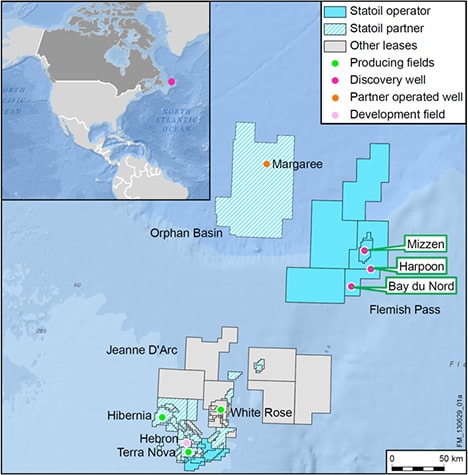
The signature project on offer is the Bay du Nord, a field discovered by Statoil (NYSE: STO)that could hold around 600 million barrels of oil. Located 500 kilometers east of St. John’s, the 2013 discovery was Statoil’s third in the Flemish Pass. Statoil has a 65 percent stake and Husky Energy Inc. (TSE: HSE) controls the remaining 35 percent. The two other discoveries – Mizzen and Harpoon – also have potential for significant oil reserves, but the Bay du Nord is the most promising.
But unlike a lot of other offshore basins around the world, the province of Newfoundland requires that companies allow the provincial energy company, Nalcor Energy, to take a minority stake. That has been a key stumbling block for Statoil, which has thus far been reluctant to commit any financial resources to developing the prospect.
Statoil has been negotiating with the provincial government over development terms and on June 16, 2015, Premier Paul Davis said the two sides are “weeks away” from sealing an agreement. “Statoil wants a deal. We want a deal,” Davis said. “I’m optimistic that we will be successful in reaching terms.”
Statoil came out a day later with a more measured tone, with a company spokesman sayingthat it needs a deal “that provides us with competitive terms given the global fight for capital that we’re in.”
If developed, the Bay du Nord would be Canada’s fifth offshore project. Statoil says it will finish its exploration program by May 2016. A final investment decision on Bay du Nord is unlikely before then. If all goes according to plan, it could begin producing by 2020.
The Bay du Nord has raised excitement about Newfoundland’s offshore potential. There are currently only a handful of rigs plying the cold waters off the coast of Newfoundland, but they have been surprisingly resilient amid the bust in oil prices. That demonstrates the seriousness with which some of the oil players are approaching the Flemish Pass, and the Jeanne D’Arc basin just south of there. The number of rigs operating in the region could in fact double over the next three to five years. In an Executive Report from December 2014, we took an initial look into Newfoundland’s offshore potential.
Nova Scotia
Southwest of Newfoundland is the province of Nova Scotia, not too far from the U.S. state of Maine. Nova Scotia has a much smaller history with oil and gas. The Sable offshore natural gas project run by ExxonMobil (NYSE: XOM) has seen its production suffer from consistent decline. The field is running out and will eventually have to be put to rest.
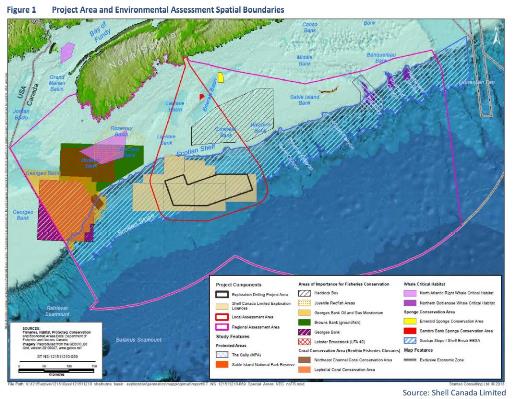
The province thus far has been a minnow when it comes to hydrocarbon production. But the government hopes for that to change. East of the Nova Scotian coast is a project that Shell Canada, a division of Royal Dutch Shell (NYSE: RDS.A), is targeting. Shell just received an environmental permit to begin exploratory drilling off the coast of Nova Scotia. Drilling could begin before the end of 2015.
Shell plans on drilling seven exploratory wells. It finished 3D seismic surveying of the area and if it moves forward, it will drill two wells in the first phase, with follow up drilling dependent on the preliminary results. Shell spent almost $1 billion for four sections in the Shelburne basin, along with its partners ConocoPhillips (NYSE: COP) and Suncor Energy (NYSE: SU). The latter two companies bought stakes in Shell’s Shelburne program, which should be seen by investors as a vote of confidence in the play.
The provincial government estimates that the Shelburne holds 120 trillion cubic feet of natural gas along with potentially 8 billion barrels of oil.

BP (NYSE: BP) also paid around $1 billion to secure the rights to drill of the coast of Nova Scotia. The four blocks BP won the rights to are 300 kilometers southeast of Halifax. BP completed a seismic survey of its holdings in September 2014, and the results looked good. The British company is in the process of putting together a drilling program, which could begin in 2017.
Nova Scotia has only modest prospects for its oil and gas potential but, having had very little to date, the addition of BP and Shell to the mix is nothing short of momentous for the province. It is still early days, however.
Conclusion
Canada is one of the world’s top oil producers. The bulk of that production is in Alberta’s oil sands. But companies are suddenly looking at other Canadian provinces that are trying to roll out the welcome mat.
Of course, provinces like Nova Scotia and Newfoundland and Labrador do not have the vast reserves that are found in Alberta. But they are also extraordinarily underdeveloped, offering enormous upside potential. Many companies have stayed away due to insufficient data on what lies beneath.
But if a few companies push forward and drill some promising exploration wells, the attention could grow. Statoil’s project in Newfoundland remains the most promising at this point. But it will be up to the provincial government to hash out an attractive deal with Statoil.

 Jim Rogers says Choose Farming for Your Family and Finances
and…
Latin America – the Saudi Arabia of Agriculture
“Sometimes we investors can get blinded by statistics. The numbers can hide the truth. But in this case the stats say it all. We all know the world’s population is growing exponentially, and therefore food demand will increase. So who will supply it? Latin America.
Latin America has always been one of the world’s breadbaskets …
According to the Inter-American Institute for Cooperation on Agriculture (IICA), Latin America has 42% of the world’s agricultural ‘spare capacity’. I take these sort of exact projections with a pinch of salt. But if you look at a world map its clear that’s not far off. Latin America has less than 10% of the world’s population but almost 30% of the world’s freshwater supply and 30% of the globe’s spare farmland. In short it’s the Saudi Arabia of agriculture…”
…..read more about Latin America – the Saudi Arabia of Agriculture HERE
…..read more about the Jim Rogers interview “Choose Farming for YOur Family and Finances HERE“

Here are today’s videos and charts (double click to enlarge):
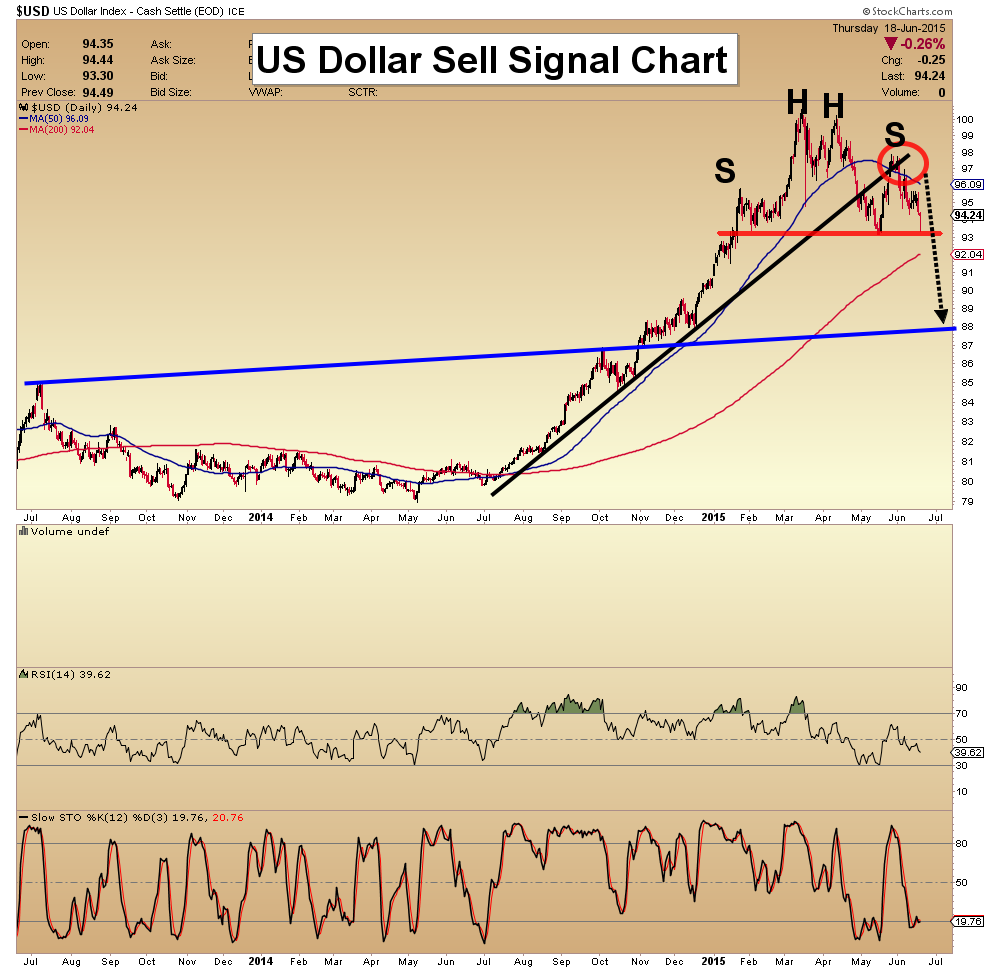
Gold Blastoff Video Analysis (& US Dollar Sell Signal Chart)

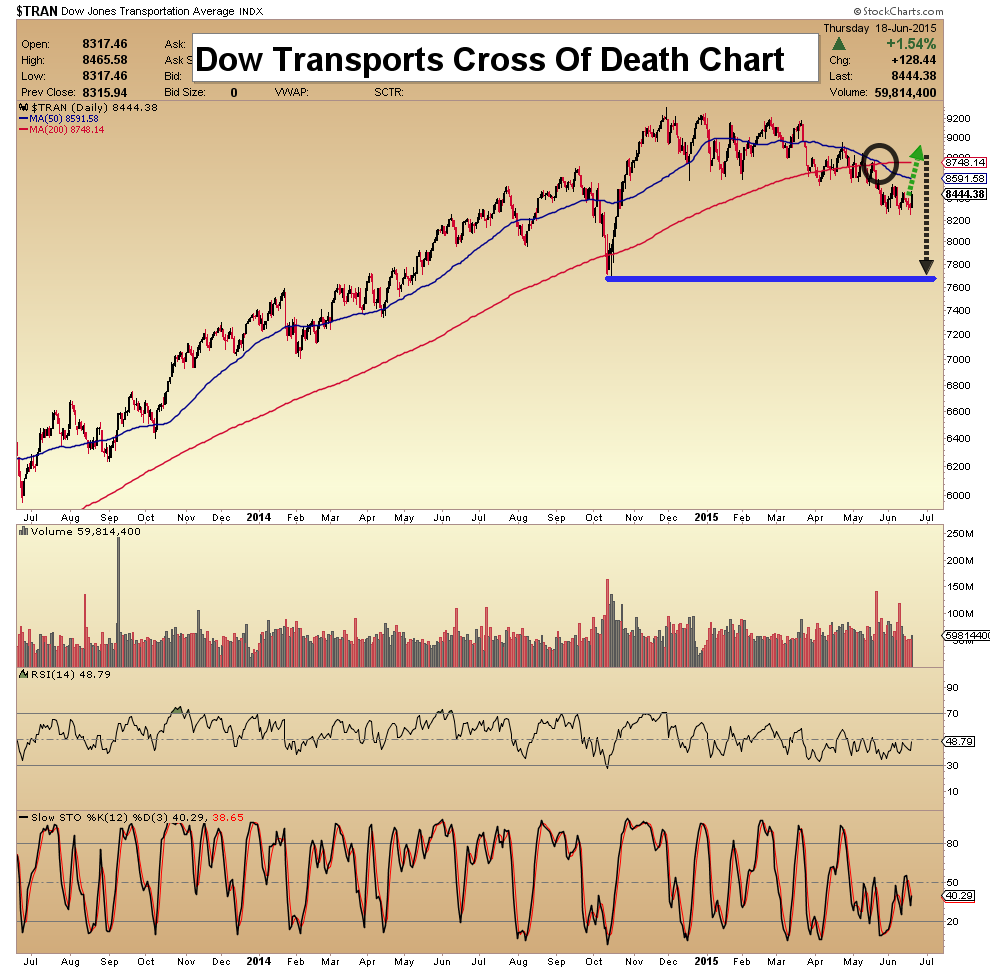
Dow Industrials & Dow Transports Video Analysis
GDX, GDXJ, & SIL Blastoff Video Analysis

Gold & Silver Stocks Blastoff Video Analysis
Here is a further look at some junior precious metal sector stocks that are showing some important price and volume action:
More Great Junior Gold & Silver Stocks Video Analysis
Thanks,
Morris
Friday, Jun 19, 2015 Super Force Signals special offer for Money Talks Readers:
Send an email to trading@superforcesignals.com and I’ll send you 3 of my next Super Force Surge Signals free of charge, as I send them to paid subscribers. Thank you!
The SuperForce Proprietary SURGE index SIGNALS:
25 Surge Index Buy or 25 Surge Index Sell: Solid Power.
50 Surge Index Buy or 50 Surge Index Sell: Stronger Power.
75 Surge Index Buy or 75 Surge Index Sell: Maximum Power.
100 Surge Index Buy or 100 Surge Index Sell: “Over The Top” Power.
Stay alert for our surge signals, sent by email to subscribers, for both the daily charts on Super Force Signals at www.superforcesignals.com and for the 60 minute charts at www.superforce60.com
About Super Force Signals:
Our Surge Index Signals are created thru our proprietary blend of the highest quality technical analysis and many years of successful business building. We are two business owners with excellent synergy. We understand risk and reward. Our subscribers are generally successfully business owners, people like yourself with speculative funds, looking for serious management of your risk and reward in the market.
Frank Johnson: Executive Editor, Macro Risk Manager.
Morris Hubbartt: Chief Market Analyst, Trading Risk Specialist.
website: www.superforcesignals.com
email: trading@superforcesignals.com
email: trading@superforce60.com
SFS Web Services
1170 Bay Street, Suite #143
Toronto, Ontario, M5S 2B4
Canada
 More Stimulus And More QE Coming As The World Economy Falls Off A Cliff
“For quite a while the Fed has led the market to believe that there would have been a rate increase at their meeting this week. But of course that did not happen. So now the guidance is that there will be rate increases at the next two meetings, with the first one in September. But, Eric, soon the data-dependent Fed will realize that there will be no room for rate increases. Instead, there will be more stimulus and more QE, as the U.S., the EU and the rest of the world economy falls off a cliff.”
….continue reading Egon von Greyerz’s interview with King World News HERE

 No deal yet, and time is running out.
ECB Not Sure If Greek Banks Can Open Monday
– Below from the Associated Press:
7:55 p.m. (1755 GMT, 1:55 p.m. EDT)
The eurozone’s top official, Jeroen Dijsselbloem, says bailout talks with Greece on Thursday yielded very little and no agreement is in sight yet.
He says Greek Finance Minister Yanis Varoufakis presented too few measures that were credible and serious at a meeting Thursday.
He says the talks over the last week have not progressed and “time is running out.”
Dijsselbloem says it’s up to the Greeks to submit new proposals in the coming days.
Greece is in talks to get more loans from its creditors — which include the eurozone states and the International Monetary Fund. Without help, Greece will struggle to make a debt repayment on June 30.
7:40 p.m. (1740 GMT, 1:40 p.m. EDT)
A leading European Union official says Greece and its international creditors have failed to secure a bailout deal that would help the country avoid a debt default at the end of the month.
Valdis Dombrovskis, an EU vice-president whose remit includes the euro, wrote on his official Twitter account that there was no deal at the meeting of the eurozone’s 19 finance ministers in Luxembourg.
He wrote that there was a strong signal for Greece “to engage seriously in negotiations.”
He added that the group of eurozone finance ministers “stands ready to reconvene at any moment.”
7:00 p.m. (1700 GMT, 1:00 p.m. EDT)

-
I know Mike is a very solid investor and respect his opinions very much. So if he says pay attention to this or that - I will.
~ Dale G.
-
I've started managing my own investments so view Michael's site as a one-stop shop from which to get information and perspectives.
~ Dave E.
-
Michael offers easy reading, honest, common sense information that anyone can use in a practical manner.
~ der_al.
-
A sane voice in a scrambled investment world.
~ Ed R.
Inside Edge Pro Contributors

Greg Weldon

Josef Schachter

Tyler Bollhorn

Ryan Irvine

Paul Beattie

Martin Straith

Patrick Ceresna

Mark Leibovit

James Thorne

Victor Adair