
Personal Finance
 Habit #3 – Set Clear Strategy
“Strategy is about making choices, trade-offs; It’s about deliberately choosing to be different.”
Michael Porter
Successful business owners know the importance of setting clear goals and how to achieve them, aka strategy! They set clear strategy because they are agile, close to the customer, bold and not afraid to accentuate what makes them different.
The understand that the essence of good strategy is to leverage whatever resource they have in front of them now, while aligning everyone in the company behind the strategy. Dodging and weaving as they go, they don’t wait for a perfect 50 page document, rather they get their ideas into the market as quickly as possible for validation or rejection. When they get a hit, they run with it and plow resources into the greatest opportunity.
Successful business owners set strategies to dominate their sector, not just compete. It becomes a mindset, an approach, not a boring corporate document.
Successful business owners have developed the habit of being strategic thinkers, without over thinking, while being great on execution, without being hasty. They know good strategy leverages the existing strengths of the business, makes them different in the market place, creates values and is simple.
Leveraging Strength: Even the smallest business has some strength that can be leveraged in a unique way; its location, a unique product or service, the way it connects with a customer, customer experience or some unique talent in its staff. Don’t reinvent the wheel, work with what you have.
Be Different: Successful business owners know to avoid the commodity trap or competitive pricing and low margins. If customers cannot tell the difference between you and the competitor, they will not pay a difference and you will trade at commodity levels. While low cost can be a good strategy, be prepared with great execution, exceptional systems and the ability to scale. Accentuate what makes you unique, or even peculiar. Stick out, get attention, and fight through the noise so people remember you.
Create Value: Good strategy creates value, and successful business owners know that value creation is the essence of business. This starts with a decision on how to make the customer experience better and how to do it at the lowest price and highest quality. In other words, starting with value creation for the customer and then figuring out how to deliver, not the other way around.
Simple: Successful business owners know that good strategy is usually simple, and can normally be explained to a new employee in one sentence. For instance, it can be response time, value added services, freemium business model, logistics or product delivery, customization, or anything else that is easy to execute around.
Building strategy can be as simple or as complex as you like. At its most basic level, I normally recommend companies at least have the following four elements in a strategic plan: precisely and clear known, well documented, communicated to key stakeholders, and supported by culture and actions of the organization. For larger companies, particularly in the technical space, I recommend a more comprehensive 10 step process which you can read HERE.
For most companies, a simple planning exercise, will help put together a great approach to understanding the market sector, creating significant value and leveraging their hard-earned strengths to win and dominate the sector.
By Eamonn Percy



In This Week’s Issue: Overcome Your Enemy
In This Week’s Issue:
– Stockscores’ Market Minutes Video – Chart Message and Timing
– Stockscores Trader Training – Overcome Your Enemy
– Stock Features of the Week – Trading Volatility
Stockscores Market Minutes Video – Chart Message and Timing
Some charts provide the message, others the timing for putting the message in to action. That and the weekly market analysis in this week’s Market Minutes Click Here to Watch
Trader Training – Overcome Your Enemy
Emotion is the enemy of every trader.
Our emotional attachment to money is what causes us to lose our discipline, to take big losses, to not let our strong and profitable trades run higher. It causes us to own too many stocks in one sector or fall in love with a stock that will only hurt us. Letting emotion in to our trading decisions is a fast way to insomnia.
The perception is that the stock market is too risky, many investors don’t like the potential for a sharp sell off that can destroy their portfolio in a very short time period. The collapse of the stock market in 2008 has given many a form of post-traumatic stress disorder, leaving them on the sidelines when it has not made sense to do so.
The stock market may be volatile at times but that is not what determines risk. Risk is how you respond to the volatility, how you manage the potential size of your losses. The stock market is not risky, the people that play it are. It is how you deal with price volatility that determines risk.
If you want to sleep well while invested in stocks, you need to have a plan for managing risk. The notion that you can buy some “good” companies and forget about them is outdated and reckless.
Here are my essentials to being invested in the stocks and sleeping well:
Plan to lose. When you buy a stock, know the price level where the stock market will have proven you wrong. Learn how to determine where a stock’s support price is and if the stock closes below that level, realize that the market is telling you that something is probably wrong at the company. Get out.
Know your tolerance for risk. How much are you willing to lose on any one stock trade? If you risk more than this amount, you will get emotional. Take the difference between the entry price and the stop loss price and divide that in to your risk tolerance to determine how many shares to buy. If you are buying a stock at $10 with a stop loss point at $9 and you are willing to lose $500 on any one trade then you should buy 500 shares.
Don’t obsess. You don’t need to watch your stocks constantly, if you are position trading then only look at the once a day or even once a week. You only need to check to see if your stock has given an exit signal, obsessing over every gyration will make you emotional and lead you to make mistakes.
Have a written plan. You must write down your trading rules. When will you buy, when will you sell, how will you manage risk and how will you review your positions. Keep the plan simple but concise enough that there is no room for interpretation.
Stick to your plan. Your plan should be based on strategies that you have tested and believe in. Deviating from the plan means you are going in to areas that have not been tested and that puts you closer to being a gambler. Gambling traders may win in the short term but in the long term they lose.
Remember that trading stocks is as risky as you make it. Not having a plan with rules for limiting the size of your losses leaves you exposed to big losses if the market corrects sharply. With loss limits and discipline, you should never be the victim of a major market correction.

The market is showing signs that further weakness is coming. There are few stocks showing strength and concern about what is happening with Greece has sellers taking a stance. While corrections cause anxiety for many traders, they do present great trading opportunities. Here are two Exchange Traded Funds that move up when the market is correcting:

1. VXX
The VXX is based on the CBOE Volatility Index (VIX) for the S&P500 Futures. When volatility is expected to rise, this index goes up which is why the price of the VXX tends to rise when the market is correcting. I like to day and swing trade the VXX when the market is pulling back but I don’t tend to hold it for very long as there is some value decay over time.

2. UVXY
UVXY is also based on the VIX but this ETF is leveraged two to one. That means a 1% rise in the VIX leads to a 2% rise in the UVXY. I find it tends to do a little less than 2 to 1 but it is still a good way for traders with less capital to trade volatility. It also suffers value decay over time so it is important to only use this is a short term trading vehicle.

References
- Get the Stockscore on any of over 20,000 North American stocks.
- Background on the theories used by Stockscores.
- Strategies that can help you find new opportunities.
- Scan the market using extensive filter criteria.
- Build a portfolio of stocks and view a slide show of their charts.
- See which sectors are leading the market, and their components.
Disclaimer
This is not an investment advisory, and should not be used to make investment decisions. Information in Stockscores Perspectives is often opinionated and should be considered for information purposes only. No stock exchange anywhere has approved or disapproved of the information contained herein. There is no express or implied solicitation to buy or sell securities. The writers and editors of Perspectives may have positions in the stocks discussed above and may trade in the stocks mentioned. Don’t consider buying or selling any stock without conducting your own due diligencT

As I stated in last week’s column: “The Greek default is merely the opening act of the worst sovereign-debt crisis in history.”
And now that Greece has told European leaders to take a hike, the crisis will start spreading.
The consequences will unfold in a series of debt defaults, civil conflicts, social and financial upheavals and more.
It will spread — without a doubt — to the other peripheral economies of the European Union, namely Portugal, Spain and Italy.
Each one of them has unsustainable debts. Each and every one of them does not have the economic growth to support the debts.
 Each and every one of them will eventually have to go the way of Greece, at first defaulting, then trying to stay in the euro, and then finally recognizing that it’s impossible to do so …
And that the only way out for their citizens and their economies is to leave the euro and take back their own currencies.
You see, when the euro got started, it contained the seeds of its own destruction.
For one thing, European leaders tried to put a one-size-fits-all hat on all of Europe, through a single currency. Nice idea, but it failed to recognize the many disparate languages, histories and cultures of Europe.
For another, it subjugated each country’s sovereign identity to the powers that be in Brussels and Germany, robbing them of their democracies, and enslaving them to the wishes of European leaders who were nothing more than power-hungry mongers back then, in 1999 … and are even more power hungry today, to try and keep the euro intact.
And for yet another, those European leaders who expected to unite the Continent from a political perspective to avoid Europe’s long history of wars, they are about to see the entire experiment backfire.
For in the end, Europe’s euro advocates tried to do what Hitler tried: Unite the Continent into one union, one country, one financial system.
Whereas Hitler tried it militarily, and no doubt, was the most insane man ever …
Europe’s euro masters thought they could unite Europe peacefully through economic might.
But they were wrong, dead wrong, and the crisis that is now unfolding is going to produce precisely the opposite:
A Europe financially war-torn because euro leaders like Angela Merkel think they can call all the shots … think they can enslave other countries and people with debt … and dictate everything to them, under threats of no new loans, no humanitarian help, no futures unless you comply with their wishes.
Well, now it’s unraveling, right before their eyes. The Greek “No” vote is the best thing that Greece could have done. Now, Greece has clout. Now, Greece has stood up for itself. Now, Greece can move forward. Now, Greece does indeed have a future.
But in the short-term, it’s not going to be pretty. For Greece, for other peripheral economies, for Europe as a whole.
Portugal will soon realize it can do the same and tell Merkel and Brussels to take a hike. Then Spain will jump into the fray. Then Italy, and more.
Protests and riots will spread. Civil conflict within nations between those who want to say yes to the euro and those who want to leave will erupt.
Conflict between the periphery and the core, namely Germany, will escalate.
The entire euro experiment will fail, violently.
And the entire process — as it unfolds over the months and years ahead — will turn everything you thought you knew about economics and financial markets, inside out and upside down.
What was once considered safe — like government bonds — will become the riskiest of investments …
While, on the flipside, what was once considered risky — like gold and precious metals, or even Greece’s stock market — will become the safest types of investments.
Mark my words: The crisis will change your life. It will threaten your finances like never before.
If you don’t have a handle on how the crisis will unfold, it will squash any chance you have at protecting and growing your wealth …
But if you do have a handle on it, not only will you be able to protect your wealth, you’ll be able to grow and multiply your wealth many times over.
My Real Wealth Report subscribers are not only tuned in to the crisis and what it means, they are and will always be prepared to protect their wealth and grow it as the crisis unfolds in the months and years ahead.
You can be too.
The first step is to educate yourself on how a crisis like this unfolded before.
For starters, I recommend reading Volumes II and III of President Herbert Hoover’s memoirs, available online for free via his presidential library.
Simply click on volumes II and III near the top of the page in his memoirs section to download the .pdf files.
Read them and pay particular attention to how he describes Europe’s sovereign debt crisis in the 1930s … and how capital darted back and forth around the globe “like a loose cannon on the deck of a ship in the middle of a torrent.”
It will open your eyes to how capital can move in times of crisis, and what kinds of investments are sought out, and why.
It’s the other side of the Great Depression that almost no one ever tells you about, yet is so very important for you to understand.
Your second step: Stay close in touch with my columns, and even better, consider joining my Real Wealth subscribers,
who, year-to-date, have handily beat the S&P 500 with a 13.3 percent return.
Best wishes, stay safe and stay tuned …
Larry

Larry Edelson, one of the world’s foremost experts on gold and precious metals, is the editor of Real Wealth Report, Power Portfolio and Gold and Silver Trader.
Larry has called the ups and downs in the gold market time and again. As a result, he is often called upon by the media for his investing views. Larry has been featured on Bloomberg, Reuters and CNBC as well as The New York Times and New York Sun.
$1.4 trillion of Chinese stocks have stopped trading. Greece is finally imploding. The US trade deficit is widening on falling exports.Copper just fell back to 2009 levels. And safe-haven capital flows are revving up again, with Swiss 10-year bonds once again trading with negative yields.

Yet somehow a majority of economists and money managers continue to believe that not only will the fed hike rates at its next meeting, but that it should do so.
The IMF isn’t normally the voice of reason on major financial issues, but in this case — perhaps because it has its hands full with Europe — its caution seems appropriate:
IMF Reiterates Call for Fed to Hold Off on Rate Rise Until 2016
WASHINGTON–The Federal Reserve risks stalling the U.S. economy by raising interest rates too early, the International Monetary Fund warned Tuesday as it detailed further its call for the central bank to delay a move until 2016.
The IMF’s push for a delayed rate increase is at odds with the current signals Fed officials are sending for a move later in 2015. Last week’s job numbers bolstered the Fed’s plans to increase short-term rates in the months ahead.
The IMF, which cut its growth forecast for the U.S. last month, said the Fed could be forced to reverse course next year if the central bank proves overly optimistic about the health of the American economy. IMF staff argue that, barring upside surprises, there is still too much uncertainty around inflation, employment and wage prospects for the Fed to pull the trigger in coming months.
“Raising rates too early could trigger a greater-than-expected tightening of financial conditions due to some combination of a further upward swing in the U.S. dollar, lower equity prices, and/or a repricing of risk premia and the yield curve,” the IMF said in its detailed annual analysis of the U.S. economy.
“There is a risk that the tightening impact on the economy could go well beyond the initial [0.25 percentage point] increase in the fed-funds rate, creating a risk that the economy stalls,” fund staff said.
A policy U-turn wouldn’t be without precedent. Both the European Central Bank and Sweden’s Riksbank were forced into rate reversals in 2011, and the Bank of Japan seesawed through rate moves in the 1990s and 2000, fund economists noted.
Such an about-face puts the Fed’s all-important credibility at stake, the IMF said.
The emergency lender also said the crises in Greece and Ukraine represent “unpredictable wild card” risks to the U.S. economy. So far, the impact in U.S. markets from the Greek crisis has been limited. The country has little direct exposure. But if it deteriorates further, it could hit broader European growth, which could weigh on the U.S. recovery.
Weaker global growth or a faster slowdown in China could also hit the U.S., sparking a selloff in equity markets, the IMF said.
“Weaker global growth” indeed. The next two charts show GDP growth for Japan and Germany. Note that they’re both positive (barely) but are also lower than the previous year. So momentum was already slowing before Greece blew up and China’s stock bubble burst.
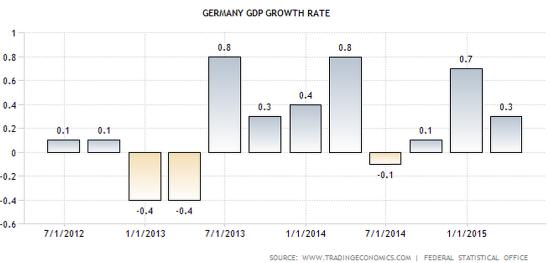
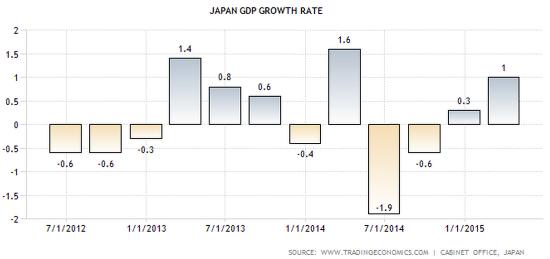
For the world’s biggest economy to respond to the above with steps to slow down its growth would be at best ill-mannered and at worst the kind of slap in the face that sets off global contagions. So yeah, it’s kind of hard to imagine.

 The Lesson for the World Coming from Greece
“This is just the tip of the iceberg. We are facing terrible times ahead because socialism is completely collapsing.
“The heartbreaking photographs of a 77-year-old retiree Giorgos Chatzifotiadis pensioner showing he has just collapsed on the ground openly in tears driven to despair outside a Greek bank with his savings book and identity card strewn next to him on the ground illustrates the horror the Troika is deliberately trying to inflict upon the Greek population.”
also:
“With the sell-off seen in European Equities and commodity based currencies, a lot of the talk was around the US$ as the safe-haven trade. Sterling particularly hit hard today last traded down 0.9% and FTSE -1.3%.”
also:
Chicago Looks at 30% Property Tax Increase to Pay Gov’t Pensions
“This is why it appears that real estate should peak out with this turn 2015.75.”


-
I know Mike is a very solid investor and respect his opinions very much. So if he says pay attention to this or that - I will.
~ Dale G.
-
I've started managing my own investments so view Michael's site as a one-stop shop from which to get information and perspectives.
~ Dave E.
-
Michael offers easy reading, honest, common sense information that anyone can use in a practical manner.
~ der_al.
-
A sane voice in a scrambled investment world.
~ Ed R.
Inside Edge Pro Contributors

Greg Weldon

Josef Schachter

Tyler Bollhorn

Ryan Irvine

Paul Beattie

Martin Straith

Patrick Ceresna

Mark Leibovit

James Thorne

Victor Adair