
Wealth Building Strategies
 “An expert is someone who has succeeded in making decisions and judgments simpler through knowing what to pay attention to and what to ignore” – Edward De Bono
This weekend I came across an article from the world of healthcare that is very applicable to the world of business. The 1982 article by Patricia Benner, called “From Novice to Expert”, describes the five levels of competency and the leadership attributes of each level. The
levels are: Novice, Advanced Beginner, Competent, Proficient and Expert. While the article was written in the context of Nursing Leadership, it applies as much to business as it does to nursing.
What really caught my attention was her description of an Expert. Benner stated, “At the expert level, the performer no longer relies on an analytical principle (rule, guideline or maxim) to connect her/his understanding of the situation to appropriate action. The expert…has an intuitive grasp of the situation and zeroes in on the accurate region of the problem without wasteful consideration of a large range of unfruitful possible problem situations. It is very frustrating to try to capture verbal descriptions of expert performance because the expert operates from a deep understanding of the situation, much like a chess master who, when asked why he made a particularly masterful move, will just say, ‘Because it felt right. It looked good.’.”
This description is very consistent with the business experts I have known over the years that have highly developed emotional intelligence (EQ) and deep reservoirs of knowledge based on many years of business. They trust their instinct and are able to make great decisions with fragments of information, since the critical data is not seen by the novice.
This raises two very big questions for the business leader, owner or entrepreneur: Firstly, where am I on the Novice to Expert scale, and what am I doing now to move to the Expert level?
If you are just getting started in your career, or even in the first 10 to 15 years of your career, you still have much to learn as you will likely don’t know what you don’t know. If you are much further into to your career, you still likely have much to learn but at least will know what you don’t know. Be honest with yourself and assess where you are. Get third party assessments and be open to feedback about your skill level from mentors and coaches. Be realistic and pragmatic about your competency, particularly if you are relatively new to a field or profession.
If you want to move up the proficiency scale, do the following:
- Dedicate yourself to a lifelong program of personal development and continuous improvement. Read good books, take courses, and build good habits.
- Find a mastermind group, coach or mentor that will help you accelerate your improvement and teach you.
- Get as much experience as possible and embrace the difficulties in order to accelerate growth, so you can make mistakes, learn and get there faster.

For the third month in a row, the Case-Shiller 20-city seasonally adjusted home price index declined. Last month was revised lower. Economists were surprised.
The Bloomberg Econoday Consensus was for a month-over-month rise of 0.1%, instead prices declined by -0.2%.
Case-Shiller is reporting what is becoming striking weakness in home prices, at -0.2 percent in July for the adjusted 20-city index which, after a downward revision to June, is the third straight 2 tenths decline. Twelve of 20 cities show contraction in the month with the deepest for a third straight month in a row coming from Chicago at minus 1.2 percent. Year-on-year readings are all still positive led by San Francisco at plus 10.4 percent with Washington DC at the bottom at 1.7 percent.
Year-on-year, the 20-city index, whether adjusted or unadjusted, is at plus 5.0 percent vs 4.9 percent in July. The unadjusted month-to-month index, reflecting summer strength in home sales, was up 0.6 percent in August for however the weakest reading since the winter weather of February.
This report is very closely watched and offsets last week’s gain for FHFA prices which are trending slightly higher than Case-Shiller. Home sales have been mixed this year with existing homes showing strength through most of the year but weakness in the latest report and vice versa for new homes which had been weak but have since popped higher. Lack of home-price appreciation is a negative for household wealth and spending and may be another symptom of general price weakness.
Case Shiller 20-City Index
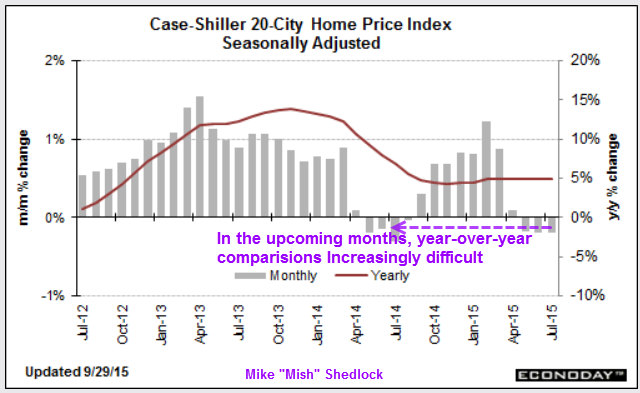
Year-over-year comparisons have held stable at 5% in spite of month-over-month declining prices because of easy comparisons. Year-over-year comparisons will be increasingly difficult in the upcoming months.
Mike “Mish” Shedlock

The Following is an update that was sent to NFTRH Premium subscribers yesterday. It’s content is still applicable today, so I thought I would share it for your review and consideration during these interesting times in the markets.
Well folks, ‘August low retest’ it is, as per plan. Part 1 was the drop from the August breakdown. Part 2 was the ‘bounce’ recovery (ended at SPX 2020). Part 3 is the current drop to test the August 2015 (and October 2014) lows. Again, we define test from a dictionary: a procedure intended to establish the quality, performance, or reliability of something, esp. before it is taken into widespread use
Now it gets interesting because the procedure is in process.
To read, view more as well a the conclusions…click HERE or the chart

To read, view more and read the conclusion…click HERE


The major news from the week is Royal Dutch Shell’s (NYSE: RDS.A) decision to scrap its Arctic drilling program. The future of oil development in the U.S. Arctic depended heavily on the success of Shell’s exploration campaign in the Chukchi Sea. With other companies having previously put their Arctic ambitions on hold, Shell was the last to remain. Shell did encounter the presence of oil and gas, but ultimately not enough to warrant further spending, especially given low prices. The “disappointing” results from its exploration well led the company to withdraw from the Arctic for the “foreseeable” future. Despite spending $7 billion, and expecting to take more than $4 billion in impairment charges, there is no doubt that many shareholders of Shell will be relieved to see the company pull the plug.
Russia and Ukraine came to terms on a gas deal that will ensure the taps stay open for Ukraine through the winter season. The two sides have been at odds over the price at which Ukraine will pay for Russian gas since the ouster of former Ukrainian President Viktor Yanukovych in early 2014. The latest agreement will allow Ukraine to import natural gas at about $227 per 1,000 cubic meters for the rest of the year. That price is above what Ukraine wanted but below what Gazprom initially demanded. The deal will ensure that the flows of natural gas to Europe will remain stable, and could go a long way to lowering tensions between Russia and the West.
The corruption probe into Brazil’s state-owned oil company Petrobras continues to widen. The latest details have raised links between the embattled Brazilian firm and Transocean Ltd. (NYSE: RIG), the Swiss offshore rig supplier. A former Petrobras executive recently testified, saying that he received payments from someone representing Transocean in exchange for awarding the Swiss company a contract from Petrobras. “Transocean has not identified any wrongdoing by any employee or any of its agents in connection with the company’s business,” Transocean said in a statement. Meanwhile, the Bill and Melinda Gates foundation has decided to sue Petrobras for the massive losses the philanthropic organization has suffered due to the selloff in Petrobras’ stock over the past year. The foundation is merely the most famous in a long line of other entities seeking compensation for losses due to Petrobras’ extensive corruption investigation.
The debt problems for many U.S. shale companies may be coming to a head. Goodrich Petroleum (NYSE: GDP) managed to secure a haircut from its investors, with holders of $158.2 million in debt agreeing to take 47 cents on the dollar. The deal comes only three weeks after a separate agreement to write down some of its debt. Companies like Goodrich are running on fumes, and debtholders are willing to take a haircut in order to increase the likelihood that they get something for their positions. With credit redeterminations underway, and oil prices far from a convincing rebound, more write-downs and defaults are likely.
California regulators decided to restore the state’s low carbon fuel standard, a policy that has been on hold since 2013. The standard would require a 10 percent cut in greenhouse gas emissions from liquid fuels by 2020. The oil industry objected to the regulation, but the state overcame legal challenges and will re-implement the program. California regulators estimate that the standard will only raise fuel prices – the principle criticism of the measure’s critics – by a few cents per gallon of gasoline. The regulation will require more fuel efficient vehicles or cleaner fuel, such as biofuels, to cut down on pollution. California already has some of the highest fuel prices in the country, a ranking that could get worse under the state’s initiative, the industry argues.
North Dakota sided with oil and gas industry in its decision to delay a measure that would limit flaring. The North Dakota Industrial Commission decided in July 2014 to require drillers to reduce flaring down to just 15 percent of associated gas by March 2016, and then down to just 5 to 10 percent by 2020. The commission, in a nod to industry pleas, will only require drillers to reduce flaring to 20 percent of associated gas beginning on April 1, 2016, and the 15 percent target won’t have to be achieved until November 1. Explaining its decision to push back the timeline, the commission said a lack of pipeline infrastructure made meeting the standards difficult.
Sir Ian Wood, who has advised the British government on how to rescue the country’s flailing oil industry, now says that the UK needs to prepare for a future without oil. In an interview with the FT, Sir Ian Wood says the downturn could last quite a while. “The industry will lose jobs, whole teams, plants and equipment. But we must be really careful we don’t lose infrastructure, as the damage will then be permanent,” he told the FT. There are certain things that the government can do to keep the industry alive. However, the long-term prospects remain dire. “By the middle of the century, the UK will have largely exploited its offshore oil and gas reserves,” Sir Ian Wood said conclusively.
Finally, while crude oil garners the most attention, the meltdown in other commodities continues to make news. Glencore (LON: GLEN), the Swiss mining giant, has seen an extraordinary sell off in its stock in recent weeks. The company’s share price was down an eye-watering 29 percent on September 28, and is down nearly 40 percent since mid-September alone. The mining multinational is buckling under the weight of low commodity prices. But an investor’s note from Investec saying that there is little value left in the company for shareholders sent a dire warning across financial markets on Monday. The rout is a reminder that the massive bust for prices is not unique to oil.
We invite you to read several of the most recent articles we have published which may be of interest to you:
With Shell’s Failure, U.S. Arctic Drilling Is Dead
How Much Longer Can Venezuela Keep The Wolves At Bay?
Exxon CEO: Alaska Is Its Own Worst Enemy
EV Market Has An Unlikely Backer
Germany Now Faced With Thousands Of Aging Wind Farms
What Oil Investors Can Learn From Gold
Commodities investors had been riding on momentum for years and with a diminishing supply of the product coming from producers, prices seemed destined to keep rising for the foreseeable future.
Then in the span of a few months, the commodity’s price crashed and billions upon billions in investment value and producer company market capitalization was wiped out. For many energy investors, this story might sound familiar. But it’s not the story they are thinking of.
In 2013, after a price run-up that had lasted for a decade, investors in gold found out that the precious metal was not as safe as many had assumed. Gold is supposed to be the ultimate safe-haven asset. Like land, as Mark Twain once said, they’ve stopped making it. Unlike stocks or bonds or even green pieces of paper, gold is tangible and has been traded for centuries. It also has a global demand base that is largely built in and reasonably consistent. Yet, after prices neared $2000 an ounce, gold’s price fell by hundreds of dollars an ounce in the span of a few weeks….continue reading HERE

 Peter Schiff Live at Jackson Hole Summit
While central bankers gathered for their annual Wyoming meeting, another group of free-market activists held The Jackson Hole Summit. In his speech, Peter Schiff succinctly explained how the Federal Reserve simply postponed the 2008 economic disaster. Despite promises, Janet Yellen has made no progress towards shrinking the Fed’s balance sheet to $1 trillion by the end of the decade. This massive balance sheet is exactly why the Fed cannot raise interest rates. Since 2015 could be the worst year of GDP growth of the entire so-called recovery, the Fed is trapped – it will continue on this easy money path until the US dollar has been destroyed.


-
I know Mike is a very solid investor and respect his opinions very much. So if he says pay attention to this or that - I will.
~ Dale G.
-
I've started managing my own investments so view Michael's site as a one-stop shop from which to get information and perspectives.
~ Dave E.
-
Michael offers easy reading, honest, common sense information that anyone can use in a practical manner.
~ der_al.
-
A sane voice in a scrambled investment world.
~ Ed R.
Inside Edge Pro Contributors

Greg Weldon

Josef Schachter

Tyler Bollhorn

Ryan Irvine

Paul Beattie

Martin Straith

Patrick Ceresna

Mark Leibovit

James Thorne

Victor Adair