
Stocks & Equities
 It was a wild ride for Toronto’s main index this past week as what was Canada’s largest company by market cap, Valeant Pharmaceuticals Intl Inc. (VRX:TSX), woke up Monday to a significant storm.
Democrats on the U.S. House of Representatives committee on oversight and government reform sent a letter to the committee’s Republican chairman seeking a subpoena that would force Valeant, to turn over documents tied to the U.S. price hikes of two heart drugs.
At one stage Valeant’s shares traded down 16% before recovering a portion of the losses. The pharma sector itself was off over 10% on Monday alone. Well respected fellow Canadian Pharma stock Concordia Healthcare Corp (CXR:TSX) which, like Valeant, has an aggressive acquisition strategy, whereby it manages and acquires legacy pharmaceutical products and acquires and develops orphan drugs, fell more than 25% on Monday.
At issue for both was the practice of hiking drug prices after acquisition. Reports state that Valeant’s heart drugs, Nitropress and Isuprel, saw a 212% and 525% price increase after Valeant acquired them.
Politicians have chimed in on the issue as Hillary Clinton’s tweet this week received significant attention: “Price gouging like this in the specialty drug market is outrageous.”
Clearly, sky-rocketing drug prices is an area of focus for a number of Democratic presidential-hopefuls and raises a spectre of uncertainty for companies selling into the U.S. market at present.
Concordia is also facing backlash from investors who subscribed to the company’s recent US$520 million financing which was priced in the CDN$88.80 range. The financing closed last week and the company’s shares have already dropped 35%. While Concordia is up over 23% year-to-date and have been a tremendous success story over the past several years, these are not the best time to be a new owner of the company’s shares.
There have been rumblings that investors in the recent offering may try and use the so-called material out clause to get them out of their purchases. This would be a very rare occurrence, but those feeling burned are wondering aloud what they can do or if anything can be done.
We would suggest that this is the risk of subscribing to a financing which prices in a current price-to-earnings multiple in the range of 100. The valuations were extremely rich. While the promise of growth is enticing, we have now witnessed firsthand the type of violent drop that can occur in a stock that is “priced to perfection” when the company hits a bump in the road. It is not pretty.
The silver lining here is that asset prices have come down and we are starting to see value once again from a market that offered little by early to mid 2015. While issues may be on the horizon for U.S. exposed pharma stocks, those exposed to other regions including Europe (such as our top pick in the sector), could be trading at bargain levels.
|
KeyStone’s Latest Reports Section 9/10/2015 |
Disclaimer | ©2015 KeyStone Financial Publishing Corp.

 Marc Faber, Editor and Publisher of “The Gloom, Boom & Doom Report’” talks about the commodities-super-cycle.
In your 2002 book “Tomorrow’s gold” you identified two major investment themes: emerging markets along with commodities. That was a great call. As for commodities, they had a great run up until 2008. Then they crashed sharply along with everything else just to recover strongly into 2011. Since then they have acted weakly, and recently commodities even reached a 13-years low. Is this the end of the commodities-super-cycle, as some have claimed, or is it more like a correction?
Well that’s a very good question because obviously the weakness in commodities this time is not due to, like, contraction in liquidity as we had in 2008. 2008 commodities ran up very quickly in the first half until July. The oil prices in 2007, just before they started to cut interest rates in the US were still at 78 dollars a barrel and then by July 2008 they ran up to 147 dollars a barrel. Afterwards they crashed within six months to 32 dollars a barrel and then as you said in 2011-2012, they recovered and were trading around 100 dollars a barrel. Now they have been weak again as well as all other industrial commodities and precious metals.
My sense is that this time around, commodity prices are weak because of weakness in the global economy, specifically weakening demand from China,
because if you look at the Chinese consumption of industrial commodities, in 1970 China consumed 2% of all industrial commodities, by 1990 it was 5% of global commodity consumption for industrial commodities and by the year 2000 it was 12% and then it went in 2011-2012 to 47%, in other words almost half of all industrial commodities in the world were consumed by China.
Therefore a slowdown in the Chinese economy has a huge impact on the demand for industrial commodities and on the wellbeing of the commodity producers, whether that is the commodity producers in Latin America, in Central Asia, Middle East, Australasia, Africa and Russia.
And so because of the reduced demand from China, the prices have been very weak and I think that may last for quite some time because the Chinese economy will not go back and grow at 10% per annum any time soon. My view is that at the present time, there is hardly any growth in China. In some sectors there is a contraction and in some sectors, and don’t forget China is a country with 1.3 billion people, so some provinces may still grow and other provinces may contract, as well as some sectors may grow and others may contract. But in general I think the economy is weak.
My estimate is that at the very best the Chinese economy is growing at the present time at say 4% per annum and not at 7.8 or 8% as the government claims. We have relatively reliable statistics like auto sales and freight loadings that are down year on year, electricity consumption, exports, imports and so forth. So there has been a remarkable slow down and to answer your question about commodity prices, if the global economy slows down as much as I do believe, because other economists predict an acceleration of global growth, a healing of global growth, my sense is that it is the opposite, that within 6 months to one year we are back into recession and then it will depend on central banks and what they will do. Up until now, they have always printed money and I suppose they will continue to do that.
… within 6 months to one year we are back into recession and then it will depend on central banks and what they will do. Up until now, they have always printed money and I suppose they will continue to do that.
Now from a longer term perspective, commodity cycles last 45 to 60 years roughly, from trough to trough or peak to peak. In other words we had a peak in 1980 and then commodity prices were weak throughout the 1980s and 1990s, then in 1999 they started to pick up and went and made a peak for most commodities in 2008 and for the grains 2011-2012. Since then everything has been weak. I could argue that well, maybe this is a major correction in the commodities complex within still an upward wave of commodity prices and that the final peak prices are not yet seen.
Interview conducted by Johannes Maierhofer and Peter Matay
Marc Faber is an international investor known for his uncanny predictions of the stock market and futures markets around the world.Dr. Doom also trades currencies and commodity futures like Gold and Oil.

 A week of very difficult market conditions calls for another macro view on the energy sector – and a further emphasis on my recommendation of oil and gas stocks being at fantastic, generational values.
One of the most important value quotients in any investment is not just about price – it is about relative price. What I mean is that when we allocate to invest, we’re not just thinking about the upside potential – or at least we shouldn’t. We should also consider the downside risk should the rest of the macro environment turn sour. This is precisely where we are now, as energy shares show relative strength, even as the ‘correction’ in the major indexes continues.
It is telling to me that oil has shown mid-$40’s stability in light of a continuing commodity and stock market down cycle – and I believe that even if prices don’t get constructive for the next two quarters, I am doing the right thing in recommending repositioning into the energy sector now.
To be fair, oil companies have surprised me in their nimbleness. I had expected to see much more carnage from the exploration and production companies and many more signs of clearing markets by this time late in 2015. Production efficiencies including heavy sand fracs, refracs of previously inefficient wells, spacing and water renewal programs have helped all of the E+P’s get more oil and gas out using less and less money. Add that to the staunch wills from both investor banks and bondholders to continue to add capital and credit to failing oil producers and you’ve got a recipe to see production slacken only slightly and slowly through the rest of 2015.
All of this, however, only extends the timeline of the oil bust cycle I’ve often outlined. Oil companies at $45 crude still go broke – they’re just managing to do it more slowly.
That nimbleness on the part of energy players also extends the timeline for investment in the energy space – a good thing for those of you who have been slow to rotate into oil. It now seems energy stocks are destined to stay lower for longer, like oil prices themselves. But even if prices idle here for another quarter or so doesn’t make me hesitate from buying more.
Even in this environment of weak stock indexes and commodity prices, I continue to be tempted to add shares to those I already own and start new positions in others. Whether your risk profile is ultra conservative or mad, there are incredible values out there:
Exxon Mobil (XOM) – my favorite U.S. major is now yielding over 4% (!)
Total (TOT) – my overall favorite major is yielding 6 1/2%
Schlumberger (SLB) – is well under $70 a share for the first time in 3 years – and yielding 3%
Kinder Morgan (KMI) – is, in my mind, by far the best of a horrible sector of pipeline companies, surely the last to recover from the oil bust. And yet, if yield were your only thought, I cannot help but love it yielding over 7%. If KMI can’t survive, no one can.
For those who want more beta, I reiterate:
EOG Resources (EOG) – the best of the shale players, in my view. $70 is just cheap.
Cimarex (XEC) – Best in the Permian. Anything under $100 a share is a tremendous buy.
Hess (HES) – quality Bakken assets and solid restructuring will see it through. Under $50? Wow.
Devon (DVN) – Near $35? Hasn’t been in my top pick list, but at this price?
Anadarko (APC) – Everything continues to go wrong, except they still have the best asset portfolio and deepest flexibility going forward. $60? Please. Try and stop me.
What’s important here is not the absolute stock price – we know that other macro events are possible to push them lower. What we want to do right now is start positioning away from stocks that have a lot more froth to possibly give back, stocks which I believe are near their skin-and-bones valuations right now.
That’s the game we need to play in this China and Fed-dominated market that’s still wondering where it wants to go. And if you’re playing that game with me, I think its wise to do it with some of these stocks, and worry about the price you paid 12 months from now. My guess is you’ll be smiling.

-
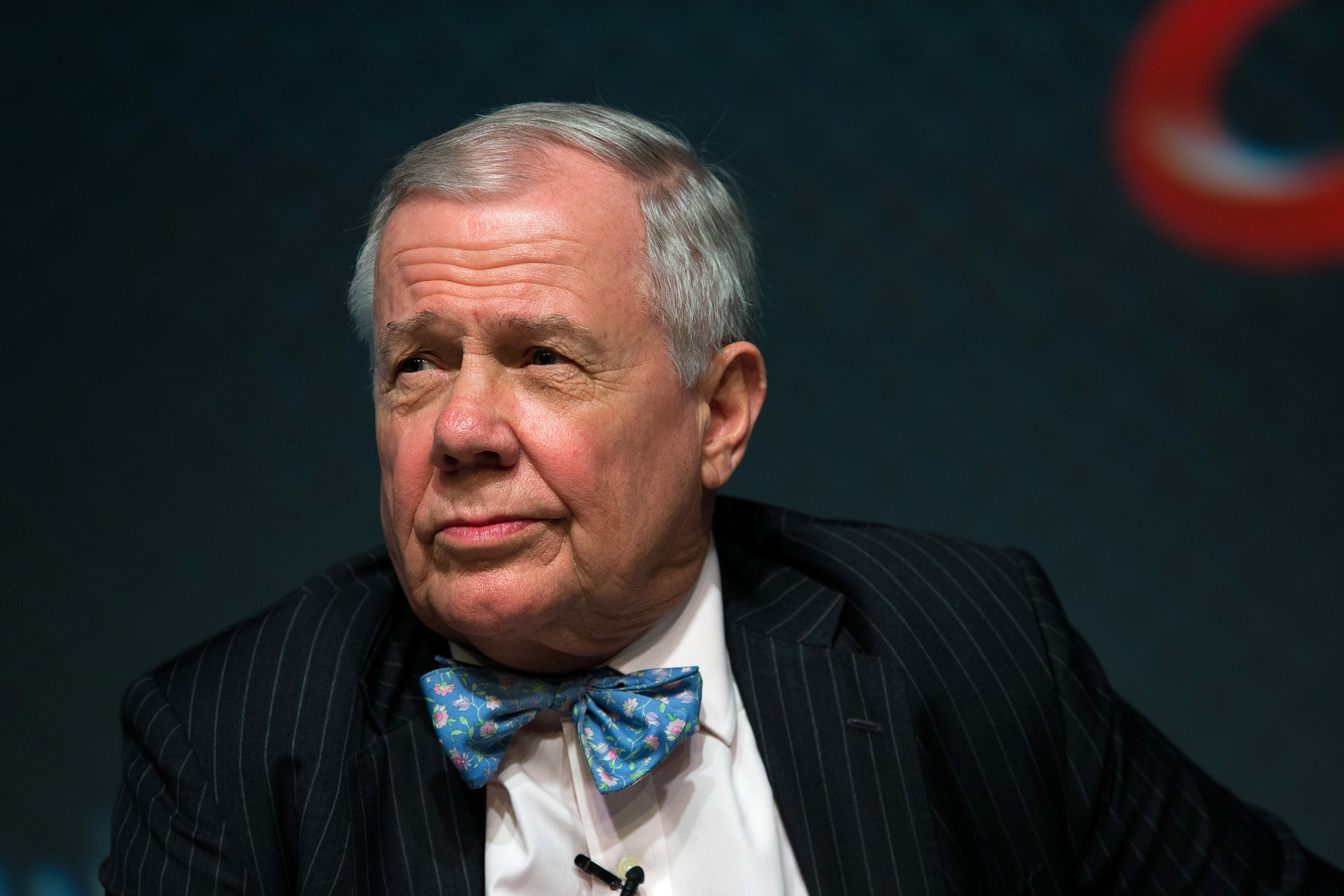 Rogers sees decline in U.S. output helping stabilize prices
 -
Investor also sees opportunities in agricultural commodities
Oil is holding near $45 while the bad news keeps coming. For investor Jim Rogers, that’s usually a sign a rebound is near.
The Organization of Petroleum Exporting Countries is still pumping near record amounts of oil, China’s imports have slowed and U.S. crude stockpiles remain about 100 million barrels above the five-year seasonal average. Yet, U.S. benchmark prices have held steady for more than four weeks since plunging to a six-year low at the end of August.
Here are today’s videos and charts (double click to enlarge):

Nasdaq Bear Market Signal Video Analysis
Gold, Silver, & Copper Video Analysis
Gold & Silver Stock ETFs Video Analysis
Key Precious Metal Stocks Video Analysis
Here’s some interesting video analysis of some of the stocks and ETFs we swing trade at my premium trading service (both short and long):
Key (Swing) Trades Video Analysis
Thanks,
Morris
| Friday, Oct 2, 2015 Super Force Signals special offer for Money Talks Readers: Send an email to trading@superforcesignals.com and I’ll send you 3 of my next Super Force Surge Signals free of charge, as I send them to paid subscribers. Thank you! |
The SuperForce Proprietary SURGE index SIGNALS:
25 Surge Index Buy or 25 Surge Index Sell: Solid Power.
50 Surge Index Buy or 50 Surge Index Sell: Stronger Power.
75 Surge Index Buy or 75 Surge Index Sell: Maximum Power.
100 Surge Index Buy or 100 Surge Index Sell: “Over The Top” Power.
Stay alert for our surge signals, sent by email to subscribers, for both the daily charts on Super Force Signals at www.superforcesignals.com and for the 60 minute charts at www.superforce60.com
About Super Force Signals:
Our Surge Index Signals are created thru our proprietary blend of the highest quality technical analysis and many years of successful business building. We are two business owners with excellent synergy. We understand risk and reward. Our subscribers are generally successfully business owners, people like yourself with speculative funds, looking for serious management of your risk and reward in the market.
Frank Johnson: Executive Editor, Macro Risk Manager.
Morris Hubbartt: Chief Market Analyst, Trading Risk Specialist.
website: www.superforcesignals.com
email: trading@superforcesignals.com
email: trading@superforce60.com
SFS Web Services
1170 Bay Street, Suite #143
Toronto, Ontario, M5S 2B4
Canada
###
Oct 2, 2015
Morris Hubbartt


-
I know Mike is a very solid investor and respect his opinions very much. So if he says pay attention to this or that - I will.
~ Dale G.
-
I've started managing my own investments so view Michael's site as a one-stop shop from which to get information and perspectives.
~ Dave E.
-
Michael offers easy reading, honest, common sense information that anyone can use in a practical manner.
~ der_al.
-
A sane voice in a scrambled investment world.
~ Ed R.
Inside Edge Pro Contributors

Greg Weldon

Josef Schachter

Tyler Bollhorn

Ryan Irvine

Paul Beattie

Martin Straith

Patrick Ceresna

Mark Leibovit

James Thorne

Victor Adair