Gold & Precious Metals

Day Follows Night : Gold Follows US Bonds

For the same reason as the Euro was sharply lower today, so was gold, namely, a hawkish Yellen testimony in which see used the words, “living possibility” when referring to a potential December rate hike.

With interest rates moving higher on the Ten Year Treasury once more today, ( at 2.23% as I type this), gold simply cannot compete with better returns on interest bearing assets such as notes and bonds as it casts off no yield whatsoever and depends completely on capital gains to produce any sort of increase for its owners.

Here is a chart of the yield on the Ten Year Treasury… it is near a 7 week high…

Chart 15-11-04 13-25-53

The relationship between gold and the price of the Ten Year Treasury futures contract has resumed with both moving in near perfect sync. Remember as the price of the futures contract moves lower, the actual rate or yield moves higher.

Chart 15-11-04 13-31-26

As the yields move higher, gold is moving lower. Nothing sinister – no “malevolent force” as Dennis Gartman foolishly suggested the other day in which he played the gold cult card for his own misreading of the charts on some evil, sinister gold cartel attack, etc. Look, any time any trader is on the wrong side of a move, he is always tempted to blame it on something other than his own analysis. But that is something we expect novice traders to do, not seasoned pros like Mr. Gartman. 

I think we can also say with relative confidence at this point is that if interest rates were to fall lower on Friday on the heels of what might be a negative jobs report, gold will simply follow the Ten Year Treasury futures contract as it will most likely rally on a weak number. If the number is very strong, and plays into ideas that the Fed will move in December, then the futures contract for the Ten Year will probably fall lower ( interest rates rising) and gold will follow it down.

Chart 15-11-04 13-32-18

On the actual gold chart itself, support near round number and psychologically significant $1100 looks like it is going to be tested. There might be some buying in Asia this evening during the hours at which India comes on but Western sentiment towards gold has soured tremendously since last week’s hawkish FOMC statement and was further undercut by her hawkish comments today.

If $1100 were to give way, $1080 comes into play. 

Both indicators remain in negative technical postures giving the bears the clear advantage. The loss of the level 40 for the RSI points out how weak the market has become.

Severe technical damage has been done to this price chart and it is going to take a Herculean effort on the part of the bulls to turn it around. If they do not get some help from Friday’s upcoming payrolls number, they are in big, big trouble as long liquidation is now picking up speed with new shorts coming in as well on the speculative side.

http://traderdan.com/

Is This 80/20 Portfolio the Best Plan for Your Money?

Time to Be in Stocks?

DRE-Bill-BonnerYesterday, we learned from Wall Street Journal reporter Brett Arends that this is the best time to invest in the stock market: 

“The best estimates argue that over the long term, stocks have beaten bonds, cash and deposits by an average of about 4 to 5 percentage points a year. Compounded over time, that has amounted to an enormous difference. After 30 years, someone who invested in stocks has often ended up with three times as much money as someone who kept it all in cash and bonds. 

Meanwhile, those gains have typically all come during the winter months. Peculiar, but apparently true. The most recent academic study, which has looked at stock markets around the world and went back in some cases more than 100 years, has found that winter has beaten summer pretty consistently in almost every country and almost every period.”

Point? 

If you want to do well with your investments, you will buy stocks… and buy them now. 

Arends goes further. He tells us how much of our money we should have in stocks. Citing the work of valuation expert Andrew Smithers, he concludes that… 


“…a long-term investor who wants an easy life should keep 80% of their money in stocks and 20% in short-term bonds or cash.”

But wait. Smithers believes stocks are very expensive now (as we do). And everybody knows you can’t make money by buying high and selling low. You have to do it the other way around. So, what do you do? 

“Buy foreign stocks,” says Arends. 

“Putting all this together: If history is any guide, you should log on to your online brokerage account today, or at least this week. And if you are trying to save for a retirement that is more than five years away, you should make sure that your portfolio is at least 60% allocated to global stocks, even if you’re nervous about the market, and more if you aren’t.”

Meanwhile, CNBC reports that this could turn out to be the worst time to buy stock in eight years: 

“Stocks with big buyback programs are struggling this year, and according to one technician, a similar lag has previously preceded two market crashes.” 

Out of the nine S&P 500 companies with the biggest buyback programs, four are down in stock price over the last year. Exxon Mobil, IBM, 21st Century Fox and Merck are all negative for the year, and Oracle and Intel are fighting to hold onto incremental gains.

Out of the nine S&P 500 companies with the biggest buyback programs, four are down in stock price over the last year. Exxon Mobil, IBM, 21st Century Fox and Merck are all negative for the year, and Oracle and Intel are fighting to hold onto incremental gains.

Strange as a $3 Bill

What to make of it? 

Nothing. These technical studies are entertaining. But they are useless from an investment point of view. The first focuses on the last 30 years. It tells us that people who bought and held stocks did very well. 

Well, big whoop! 

Thirty years ago stocks were cheap. They had a lot of room to go up. If they had been expensive when the period started, the gains would have almost certainly been more modest. 

In the second place, this period was extraordinary, unique, and as strange as a $3 bill. It was marked by the biggest rush of money and credit into the world’s asset markets in history – with an increase of $12 trillion in world foreign exchange reserves. 

Where was all this money going to go? 

Meanwhile, a new study by Patrick Artus at Natixis Research shows that almost none of the base money increases as a result of QE over the last seven years led to the kind of increase in money supply that boosts consumer prices and stirs economies. 

QE benefited Wall Street, not Main Street. 

Which is why the rich got so rich. And why real economies did not benefit. And why wages did not rise. And why the whole program was more larceny than monetary policy… 

…and why stock owners made so much money. 

Now, those stock market investors think they are geniuses. Analysts add the numbers and confirm it. Reporters give out the word… 

…and a whole new generation of investors believes it. They want to make money, too. What better way than to do what worked for their parents? Buy stocks! 

Alas, past performance is no guarantee of future results. The fix was in. And just because some lucky stiff made money in a rigged market over the last 30 years doesn’t mean you will now. 

Regards, 

Signature 

Bill


Tech Insight

(Dairy of a Rogue Economist) Editor’s Note: We’ll soon be launching a new investment advisory, Exponential Tech Investor, to help you profit from game-changing innovations. Below, editor Jeff Brown identifies an exciting area of breakthrough technology.]

As you step through the portal, it’s dark and cool. You are in a research facility in the future in search of an alien life form. You can hear the hum of the machinery and cool air on your face. You have entered a virtual world created by a company called The Void. 

The Void has built the first of many virtual reality (VR) game facilities in Lindon, Utah. It is not experimental technology; in fact, you can go there today and experience its “beta” version for an early view of the future of VR. Full commercial deployments will begin early next year and additional facilities will open up. 

Before you say, “but these are just games,” think about this… The video-gaming industry will generate more than $110 billion in revenues this year… and VR is forecast to be a $30 billion business by 2020. 

It is not just about gaming either. Imagine learning in a virtual environment. What if you could see what a forest looks like through the eyes of a wolf? What if you could explore the ocean through the eyes of a dolphin? Or view an organism from the inside out? 

The applications for skills training are also immense. Training using VR is less expensive and allows the learner to avoid making mistakes in the real world. 

Believe it or not, real work will be conducted in a virtual world as well. With advances in network bandwidth, microprocessor power, and graphics processor speeds, people will telecommute to virtual offices, where they will work and interact with colleagues in a wholly digital world. 

Another interesting company that I am following is called High Fidelity. It was founded by Philip Rosedale, the original founder of Second Life. If you haven’t heard of Second Life, it was a fantastic technological and social experiment. It is a virtual world accessible via your computer that functions just as the real world does. Everyone has an “avatar” that represents who they want to be in this second life. 

Second Life launched in 2003. But technology has changed exponentially in the last 12 years. Today, High Fidelity is taking advantage of all of those advancements to create a completely new virtual world. Rosedale and many others believe that much of future education, work, and play will exist in virtual environments. 

P.S. If you want to be among the first to learn about my top picks for breakthrough tech stocks on the verge of huge gains, follow this link


Sickly stock market internals, plus gold update …

If you’re like most investors, traders and analysts, then you’re enamored with the strength in the Dow Industrials, the S&P 500, and the Nasdaq and you expect them to simply keep on soaring.

You’d be adding to your stock holdings, chasing hot tips and dreaming of riches. 

Yet as always, counting your chickens before they’re hatched is a big mistake. Even more so because all available evidence tells me that U.S. and European stock markets are now a recipe for disaster.

All you have to do is look beyond the illusion of the major indices to see why. Since the August low in global stock markets, the rally that has occurred …

FIRST, has been accompanied by declining volume. When a market rises and volume simultaneously declines, it’s a bearish sign.

SECOND, most stocks traded — both here and in Europe — are actually declining. There are very few leaders pushing the major indices higher. In fact, as I pen this column, here in the U.S. …

Of all publicly traded stocks …

 — 44.63% or fully 6,442 are now down at least 10% year-to-date.
 — While a whopping 36.9% or 5,204 are down more than 15%.

And only 32.5% are actually up for the year. 

Put another way, 77.5% of all publicly traded U.S. stocks are either flat for the year or down more than 10%.

THIRD, of the stocks that are actually advancing, their numbers are also shrinking. Also a very bearish omen. 

FOURTH, most other indices are actually down for the year. The Dow Transports are down 10.2%. The Dow Utilities, down 3.5%. The Russell 2000, down 2.5%.

Meanwhile …

FIFTH, total margin buying of U.S. equities — according to latest data (Sept. 30) — stands at a whopping $454 billion, just a tad below record highs.

Given the internally fractured soul of the markets, enumerated above, such massive leverage by investors and institutions is a recipe for disaster. Even the slightest move down can end up causing panic liquidation.
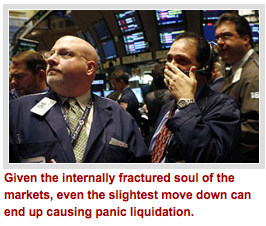
Screen Shot 2015-11-04 at 8.37.54 AMSIXTH, earnings expectations are largely being slashed, the dollar is starting to soar (a negative for corporate earnings going forward) and several other indicators I monitor …

All tell me the stock market is about as risky now as it ever gets. 

The thing is, I’m telling you this despite the fact that I am long-term bullish on the market. 

I fully expect the Dow Industrials, for instance, to move up to over 31,000 in the years ahead. 

But I won’t touch any stocks here now. No way. Because I know how markets work. And if the Dow Industrials is going to move above Dow 31,000 in the years ahead — which it will do …

It will NOT do so unless it first collapses and scares the dickens out of nearly everyone. 

Bottom line: In my opinion, no one in their right mind should be heavily invested in stocks right now. 

So what should you do then if you are heavily invested? 

What about if you aren’t invested?

Here are my answers:

A. If you’re heavily invested, just get out now. If you cannot get out, for whatever reason, consider hedging your holdings with inverse ETFs, such as the Short Dow 30 ETF (DOG), Short S&P 500 ETF (SH), or Short QQQ ETF (PSQ).

B. If you are not invested, then great. But do consider the potential for some rich capital gains by purchasing the above inverse ETFs, or for even more leverage, their equivalent double and triple leveraged inverse ETFs. 

It’s that simple.

Now, to another market dear to many: Gold.

Gold’s latest rally has failed, miserably, and as expected. That’s music to my ears. As I have said all along, this month is an important cyclical target for both gold and silver. It should produce a major low. 

How low? It’s too early to say. Ideally, gold will soon close below the $1,138 and $1,133 levels. If it does, then gold should slide to a new low this month, below $1,073.

Let’s keep our fingers crossed …

Best wishes,

Larry

Why governments can’t just print the money they need

money-printing-pressDue to the nature of modern money, it would technically be possible to adjust the way the monetary system works such that governments directly print all the money they need. If this change were made then there would be no requirement for the government to ever again borrow money or collect taxes. This would have an obvious benefit, because it would result in the dismantling of the massive government apparatus that has evolved to not only collect taxes but to monitor almost all financial transactions in an effort to ensure that tax collection is maximised. In other words, it would potentially result in greater freedom without the need to cut back on the ‘nanny-state services’ that so many people have come to rely on. So, why isn’t such a change under serious consideration?

The answer is that it would expose the true nature of modern money for all to see, leading to a collapse in demand for the official money. Taxation, you see, isn’t just a method of forcibly diverting wealth to the government; it is also an indispensable way in which demand for the official money is maintained and modulated.

Think of it this way: If the government were to announce that in the future there would be no taxation and that it would simply print all the money it needed, there might initially be a great celebration; however, it probably wouldn’t take long for the average person to wonder why he/she should work hard to earn something that the government can create in unlimited amounts at no cost. People would become increasingly eager to exchange money for tangible items, causing prices to rise. The faster that prices rose due to the general decline in the desire to hold money, the faster the government would have to print new money to pay its expenses. With no taxation and no government borrowing, there would be no way for the government to stop an inflationary spiral once it was set in motion.

One of the best historical examples of how taxation creates demand for money is the use of “tally sticks” in England from the 1100s through to the 1600s. In this case, essentially worthless pieces of wood were converted into valuable money by the fact that these pieces of wood could be used to pay taxes. Moreover, once taxation had created demand for the sticks, the government was able to fund itself by issuing additional sticks. A summary of the tally stick story can be read  HERE

Money can currently be created out of nothing by commercial banks and central banks, but hardly anyone understands the process. Also, many economists and so-called experts on monetary matters who understand how commercial banks create money are either clueless about the mechanics of central-bank quantitative easing (they wrongly believe that QE adds to bank reserves but doesn’t add to the economy-wide supply of money) or labouring under the false belief that money and debt are the same. The ones who wrongly conflate money and debt tend to wrongly perceive QE as a non-inflationary swap of one “cash-like” asset for another.

The point is that under the current system there is great confusion, even in the minds of people who should know better, regarding how the monetary system works. The combination of taxation and the general lack of knowledge about how money comes into existence helps support the demand for money.

Simplify the process by having the government directly print all the money it needs and the demand for money would collapse. That, in essence, is why taxation must continue.

###

Steve Saville
email: <ahref=”mailto:sas888_hk@yahoo.com”>sas888_hk@yahoo.com
Hong Kong

Regular financial market forecasts and analyses are provided at our web site:
http://www.speculative-investor.com/new/index.html.

We aren’t offering a free trial subscription at this time, but free samples of our work (excerpts from our regular commentaries) can be viewed at: http://tsi-blog.com

Copyright ©2002-2015 speculative-investor.com All Rights Reserved.

John Hathaway is a Senior Portfolio Manager, and currently co-manages the Tocqueville Gold Fund (TGLDX). Beyond expertise as an investment advisor and portfolio manager, John is one of the most popular writers and speakers in the investment world, particularly in the precious metals market. His insights on gold have been published in numerous online and printed publications and he makes regular appearances as an expert in the financial media.

 Transcript

Geoff: Hello and welcome back to this month’s Ask The Expert here on Sprott Money News. I’m your host Geoff Rutherford and on the line today we have the senior portfolio manager at Tocqueville Gold Fund, Mr. John Hathaway. John, thank you for joining us today sir.

John: Good morning Geoffrey.

Geoff: So John as usual we have a number of questions from our listeners today. Not surprising we have a number of questions about investing, particularly in purchase metals and mining investment. With that, let’s get started. Our first question is if the prices of precious metals remain blasé for the short to medium term is there still room for long term orientated management teams of miners to reduce costs and improve operating cash flow or have we already seen a significant portion of these efficiency gains and input cost reductions over the last few quarters?

John: I would say there’s probably further room I don’t think I could quantify that. It’s quite clear that they’ve made significant progress on that front. In a lot of cases it is a combination of good luck and hard work. The good luck obviously is lower oil prices lower energy costs and lower currencies vs the US dollar gold price. That’s been a huge contributor. Most of the companies we follow are highly conscious of the need to do some belt tightening and I think there’s probably still some benefits to come, but I don’t think it will be dramatic.

Geoff: So John moving over to precious metals again here we have a question in regards to silver. The question here is Citi’s four trillion commodity position has been reduced to millions as of June. What does this say about where the silver markets are heading? Is it possible John the illogical price of silver which is below the median cost of production break free from it’s imprisonment? If so can the banking industry provide the higher silver price given the apparent extreme position?

John: My deal on silver is that it probably doesn’t do anything without leadership from gold. I’ve always focused on gold but recognize that silver has the same precious metal monetary characteristics as gold but the things that you just mentioned relating to large financial institutions possibly being underwater on their hedgebook. I think that could be a contributing factor on the upside and maybe give a lot more octane to an upside move than would otherwise be the case. I don’t think that silver can make headway on it’s own without leadership from gold.

Geoff: Now another interesting topic that always comes up with our listeners is the idea of mining it and investing in mining companies. I guess generally speaking this question is please provide the best argument in favor of investing in precious metals mining companies as well as the best reason to stay away from this particular asset class. Good question.

John: I don’t think we have enough time. Look, this industry has committed “hari kari” as far as I’m concerned. I’m talking now about the industry they have carpet bombed investors with paper in the form of new shares, increased debt and the delusion that has taken place during the rise in the gold price from where it was at the beginning of the last decade to the peak in 2011. The delusion has been enormous. It’s no wonder that gold stocks are hated. Having said that there are managements and companies that have actually added value and haven’t committed the sins that I’ve just described. They paid attention to share issuance, they’ve avoided debt and they’ve added value by building mines. Those are the companies that we have in our portfolio with Tocqueville Gold. There’s no question in my mind that when the turn does come in the precious metals markets, and that’s another conversation, well-chosen gold stocks will provide a much more dynamic response to that than let’s say a broad index. Pick your index. It could be XAU it could be HUI or some sort of passive ETF instrument. That’s the argument for active management in precious metals. The industry’s done a bad job maybe they’ve learned some lessons time will tell. There have been companies and we think we own a good number of them and hopefully not too many that don’t meet this qualification that have done a very good job in terms of adding value, keeping share counts low, turning off the phone from investment bankers from Toronto. All the things you need to do to add value. Those are the stocks to own. That’s my sermon on metal gold stocks.

Geoff: Moving over again talking about the idea of prices being artificially depressed. What do you see as the most likely catalyst to allow the miners to break out of the artificially imposed oppression in this sector?

John: It’s really very simple. We need to have a bear market in stocks. You saw a foretaste of that in the third quarter and obviously since the end of the quarter we’ve had central bankers in warp-speed mode trying to juice up financial assets. That’s a game that’s becoming more and more obvious. The short answer to the question is that the catalyst will be a bear market. That experience in both stocks and bonds and the reason that would drive gold prices and silver prices much higher is that financial markets are a creation of central banking. Almost by definition it’s a reflection of confidence in the behavior and the actions of central bankers. If that experience i.e a bull market turns to adversity which I think is inevitable then you will see loss of confidence in central bankers long overdue and certainly well-deserved. People will look for answers. One of those answers unquestionably will be precious metals. That’s the change that I see that has to occur. Beyond that yeah, the markets are rigged we know the markets are rigged all our markets are rigged. You start with interest rates and go on from there. The mechanism of rigging is in the case of gold you have synthetic paper which way outweighs the amount of physical gold that’s traded on a daily basis or a yearly basis. As annoying as it is these same paper traders which played a large part in driving the gold price down at a time when demand is starting to exceed supply will turn on a dime and they’ll get behind higher prices because they’re basically high frequency traders and algorithmic traders. If there’s conspiracy involved I don’t know who Dr. Evil is I’m sure there’s one out there. I think the bigger story is that the gold market is been so financialized by synthetic instruments that we’re at the mercy of whichever way that school of fish decides to swim. Again if we have a bear market and I think that’s somewhere in our future or maybe just around the corner these algos and HFTs will get behind gold in a big way and I think that all that paper trading that’s been the bane of all of our existence for the last four years will suddenly, you have to be careful the company you keep, but they’ll have a big to do with driving prices higher. There is manipulation in all markets why should gold be exempt. It’s hard to fully understand circumstantial as to what the motives are but it’s quite clear that the last thing Janet Yellen or Mario Draghi or their counterparts in Asia want would be a huge gold price. $3000 or $4000 gold would say checkmate for public policy. They don’t want it one way or another they’re resisting it maybe through machinations with synthetic gold trading, I really don’t know. 3 or 4000 dollar gold would be an indication to anybody with half a brain that public policy on all fronts is bankrupt. That’s why investors should stay with gold stay with gold stocks and the vindication I think will be well worth the pain.

Geoff: John we know for a fact the mainstream media really hasn’t been painting a very pretty picture of gold or precious metals for the longest time. So the question’s based around that likewise how that frames this for financial advisors as well too. The question is why do you think that most other financial advisors steer clear of precious metal miners when they’re clearly and objectively the most underpriced asset class in the marketplace? Is it because they still believe that buy and hold is dead? Or do you think that they have been deceived by all the anti precious metals propaganda in the mainstream media?

John: I think it’s probably a combination of that. I find the constituency for gold in a bull market for stocks gets smaller and smaller. You have to respect the sensitivities of the financial advisor who might have had a decent commitment to gold and it’s killed him in terms of performance. He’s hearing it from his clients. I think that’s the dynamic you have going here. There’s no doubt in my mind that when the worm turns and the gold space these people who are sitting on the sidelines will be there front and center as buyers and new money coming in. As far as the mainstream media and it’s anti precious metals campaign that certainly has a contributing effect. There’s a huge lack of understanding of the role of gold in a portfolio. How it can behave in an uncorrelated fashion to enhance returns over time and protect wealth. That all goes by the wayside when you’ve been in a four year downswing for the gold price and for the silver price. That’s sort of accentuated by the piling on effect of the mainstream media. Those media guys will get on board as well. I’ve seen it before. In fact, you can count on them to call the top just by turning bullish on the front page. I’m glad that they’re aligned in a negative way right now.

Geoff: John let’s take a moment just talk about in terms of how other markets affect gold and gold stocks as well too. The question is equity markets appear to be firming up again during the past couple of days. is this temporary? What does this trend mean for gold stocks?

John: In the short term it means that my idea that a bear market to drive gold prices higher has yet to be tested. As I said we saw a little taste of it in the third quarter we’ll see where this current central bank induced rally goes how long it can last. I don’t know how long it can be sustained. I would say the general trend of corporate earnings is down. Top line revenue growth is flat to down. Margins are at all time highs. All the things that you would expect to see in a market top are taking place. The one thing that trumps all of that which is fundamental analysis is the desire of central banks to jam the shorts and drive stocks higher. That’s what’s taking place right now. I guess I should have learned this lesson 40 or 50 years ago when I came into the business don’t fight the fed. Now we’re fighting not only the fed, we’re fighting the European Central Bank and their counterparts in Asia and they’re all doing what they’re doing together. Passing the baton on who can be the most radical in their monetary experimentation. Hard to say how long this can go on. What I like about gold is we’ve been through some very tough years here and it’s beginning and I’m knocking on wood as I say this, beginning to ignore and show resistance to the stock market making new highs. I view that in a small way as being a positive sign, base building and maybe all the weak hands having been shaken out. From this point on I think for those of us in the precious metals space, it’s more of a waiting game. I don’t think there’s a lot of downside risk, I think it’s how much more time and patience is it going to take for the things I’ve talked about and probably some things I couldn’t even begin to think about fall into place that will make investors decide they want to have more gold rather than either none at all or less. A waiting game as far as I can see from here on out.

Geoff: John here’s a question that gets around specifically the Tocqueville Gold Fund itself. What this listener wants to know is what are your fund’s top gold positions and why? Likewise which are the most interesting companies that you are following but do not yet own?

John: Let me talk more about our process. We have a team it consists of myself, my co-portfolio manager Doug Groh who’s very experienced in precious metals has a background in geology he’s been on the team for over ten years, and then we have two younger analysts both Canadians for what it’s worth very very good analysts. We spend a lot of time doing due diligence that includes visiting mines and spend a lot of time in meetings with management they come to New York looking for money or just checking in. We have a great dialog with the executive suite. Our ability to conduct due diligence is very very high. That’s where we start. Our turnover is low. What we look for are companies that are adding value. I’ll give an example or two before I finish. Sometimes that value that’s being added is not reflected in the share price because as we’re all aware, gold has been in this likely correction since the peak of 2011. There could be progress made either drawing or mine building sometimes at M&A that doesn’t get recognized in the market. That’s where we start. I would add that our turnover is very low. We don’t trade in and out. The holdings that we have as core holdings today haven’t changed a whole lot from where they were three or four years ago. We’ll certainly sell things that seem overvalued at least at the margin we’ll sell them, and recycle them into things that we think offer better risk reward. In that sense it’s a fairly conventional approach to portfolio management. As far as our top holdings go they are publicly disclosed as they must be. If I forget some of the top names it’s just because I can’t remember them in this conversation. Our largest holdings include names like Detour Gold, we have a big exposure to royalty companies the usual names, Frank Gold, Royal Gold, Silver Weaton and now more recently Cisco. One of our favored big cap holdings is Gold Corp which I think has done a very very good job of navigating these difficult times and they have a nice growth profile and management that we think highly of. Those are some of the names. In terms of themes which would be like what would it be like to own more that we don’t have today we are quite enamored with the more entrepreneurial mid and smaller size companies that are buying assets from distressed sellers. Namely big cap companies I don’t want to go into names, but there are forced divestitures because of excessive debt on balance sheets of big cap companies. It’s a very weak market. It’s a buyers market. We see value being created by just to throw out a name Evolution Mining which is an Australian company we like Premiere Gold, we like the recent Alamo acquisition. I’d say the theme that we’re seeing this year is smart guys who have kept their balance sheets in decent shape kept their powder dry during this period and are now taking advantage of the distress of some of the bigger cap companies that are basically in a stripping mode to streamline and reduce debt burden. That’s a bunch of names that I recommend that anybody trying to get a full picture of our exposures to go to our website and there our top holdings are all there for everyone to see.

Geoff: John sticking with the idea of companies. The next question is what do you think of the all in sustaining costs metric that companies are increasingly using? Is this a valid metric? Which companies are performing the best in this regard?

John: I’m not sure that it’s a valid metric. I like it better than cash cause because it shows that the industry is just hanging on by it’s fingernails from a sustainability point of view. It’s very subjective. It is probably flawed but it’s not as flawed as the metric the companies were using going into the top in 2011 which was cash cost which was a phony as it gets. First of all I think that you can’t just stop the metric that’s management’s presented in a slide deck in a conference or on their website which doesn’t tie back to the financials and what’s really lacking in this industry, it’s probably lacking in many industries, but certainly from my perspective is the metrics that are presented really don’t tie back to financials. One person’s all in sustaining costs is not the same as somebody else’s all in sustaining costs. That again is because there’s so many subjective inputs, different accounting practices. That’s my major beef. That’s something that we pay attention to in our analysis. We look well beyond those metrics. The all in sustaining cost is the better metric that cash costs which was widely used before all in sustaining costs came into greater popularity. Even that metric really falls short of proper financial disclosure. For that I think you just have to go to the financial statements read the footnotes look at the accounting and that kind of thing to get a proper sense of what’s being represented. We look at all in sustaining costs only because everybody else does but we go well beyond that in our analysis.

Geoff: John, going back to gold now. We wanted to take a look at gold from a historical perspective. The question is what lessons do you draw from history as to how gold might perform during a time of deflation? For example gold stocks outperform the index in the wake of the market crash of 1929 and ensuing Great Depression. Could this happen again in times of deflation?

John: The answer is that gold always performs well when there is financial disruption. Whether that’s expressed in the form of deflation as it was in the 1930s or inflation as it has been expressed more recently and by the way if you look at the gold price in any other currency than the dollar you would thank your lucky stars that you had it because you’re local currency is toast. This is what so many don’t understand and it’s really just missionary work for those of us who like and advocate precious metal exposure. That is that gold is property that exists outside of the financial system. it’s the sort of thing that would provide liquidity when the exchange is closed down. Or when the banks are shut down. It’s a reserve asset and thought there might be some that would argue well, I have paintings I have antique sports cars I have homes here and there, they’re my hedge against inflation or deflation but none of those are liquid. The bid and asks on Picassos or Austin-Healeys or whatever you want to mention is just wide enough to drive a truck through. Gold is a liquid 24 hour a day market you can always get a bid you can always buy it and there’s no other non-financial asset, I’m including silver in this, silver also has the same virtues as gold in this respect, but there’s nothing else that really gives you reserve buying power. I’m not talking about the kind of buying power you would use to go to 7-11 or whatever you have in Canada to buy a quart of milk. That’s kind of an idiotic construct for why you would have gold during extreme events. The idea of having gold during periods when you have a financial meltdown of any kind whether caused by inflation, deflation, geopolitical, all the things that one can imagine. It gives you the ability to take advantage of distress and maybe the Standard and Poors when it’s trading at two times the earnings when nobody else has any buying power whatsoever. That’s the reason to own physical gold and that’s the attraction that it should have at the end of the day. It’s wealth insurance and that’s very different than the view that so many have that it’s basically a trade. You buy it at $1100 an ounce and you sell it at $2000 an ounce. That’s fine, I’m not saying that’s not a good reason but the deeper reasoning getting back to your question about history is that over time, and I’m talking centuries now, course most people don’t think in centuries they think in terms of next week. From the perspective of a wealthy family, from the perspective of a pension fund, a university endowment some component of gold makes all the sense in the world because the time frame for those kinds of investors is generations. Not a six month trade.

Geoff: John we’re getting into the end of the interview here now. Usually our interviews always end up on the same note and the question is, the golden question, no pun intended, is what is your immediate outlook for gold prices and why?

John: First of all my record as a market timer is probably as bad as anybody else’s in this space. But I’ll make a couple of observations and hopefully they’ll be helpful. It looks to me like gold is firming up. I haven’t checked it these last couple of days but over the last several weeks we’ve had some mild backwardation the spot price being a little bit higher a few dollars higher than the most active future. That’s usually constructive, signifying maybe a little bit of tightness in the availability of physical metal. We’ve seen this before as we’ve been heading down over the last four years but I just point that out as at least a short term constructive sign the downside risk is somewhat limited. Let me just add a couple of things to that. These are observations. I’m not a big technical analyst but I do get various services and I’m beginning to see technical research whether it’s based on Elliott wave, or the more traditional off the shelf kind of, talking MACDs and stocastics and that kind of thing. That is turning more constructive than I can remember in at least a year. The backwardation technical research which I do not generate myself I only look at it like I look at the weather forecast seems to be a little more constructive. Those two things I would say might suggest that the timing is positive. Even more positive than it has been. Let me just add one other thought and that is if you look at not just people like me or Eric Sprott we’ve been in the gold space for a long time and we’re advocates. If you look at the views of people who might be agnostic who are investment luminaries I’ll just mention three. Stan Druckenmiller formerly of the Soros Funds, Paul Singer with Elliott Advisors and Seth Klarman of the Baupost Group all of them tremendously successful investors who have made fortunes away from gold who were, could be market neutral and they can invest in anything. What I’m saying is that they’re all over in terms of their mandates. All three of them are very constructive on gold right now. There are others that I can mention but those are three that are quite famous, well-known easily researched. Let me mention the three things that are hopeful signs. One is and I’m just reviewing what I just said. Backwardation a somewhat positive short term sign, technical research turning more constructive, and then lastly big thinker, successful investor luminaries some of whom are much better at market timing than I have ever been, are saying that this is a good place to be right now. No promises, but maybe there’s a faint dim glow at the end of the tunnel and maybe it’s the end of the tunnel coming soon to a theater near you. Hopefully that’s the case because we’ve been through a really tough four years particularly these last two and long-term I’m just unrepentantly bullish but I’m with so many others who’ve been in that direction and without any sort of vindication for several years. I do think we’re starting to see some glimmers some positive glimmers that the worst is behind.

Geoff: Again we’ve been speaking to John Hathaway who is a senior portfolio manager at the Tocqueville Gold Fund and we urge our listeners to go to tocquieville.com and likewise continue to read some of the phenomenal work that John has published in numerous online publications in the financial world. With that we’d like to thank John Hathaway for joining us today. Thank you John for joining us today it’s been a pleasure speaking to you sir.

John: Thank you Geoffrey. Pleasure on my part too.

Geoff: To our listeners thank you for listening this is Geoff for Ask The Expert here on Sprott Money News. Have a great day.

test-php-789