
Bonds & Interest Rates
 Late last week, a consortium of financial regulators in the United States, including the Federal Reserve and the FDIC, issued an astonishing condemnation of the US banking system, highlighting “continuing gaps between industry practices and the expectations for safe and sound banking.” They identified a huge jump in risky loans due to overexposure to weakening oil and gas industries. Make no mistake; this is not chump change. The total exceeds $3.9 trillion worth of risky loans that US banks made with your money. Given that even the Fed is concerned about this, alarm bells should be ringing….continue reading HERE

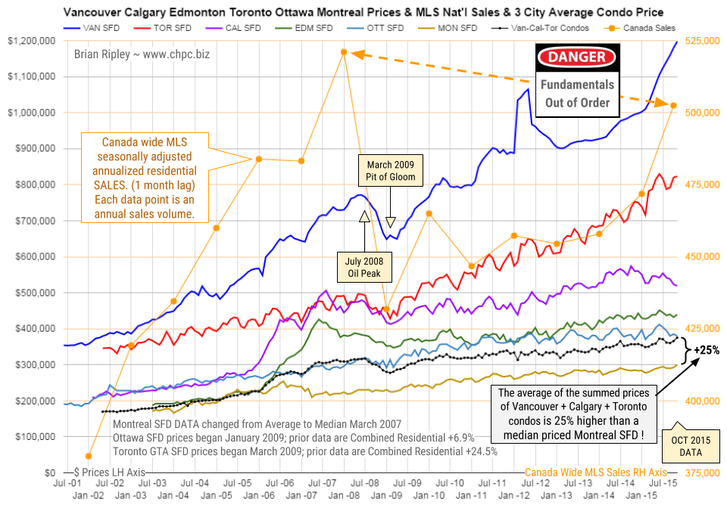
The chart above shows the average detached housing prices for Vancouver, Calgary, Edmonton, Toronto*, Ottawa* and Montréal* (the six Canadian cities with over a million people) as well as the average of the sum of Vancouver, Calgary and Toronto condo (apartment) prices on the left axis. On the right axis is the seasonally adjusted annualized rate (SAAR) of MLS® Residential Sales across Canada (one month lag)…..
….for more commentary and a much larger chart go HERE
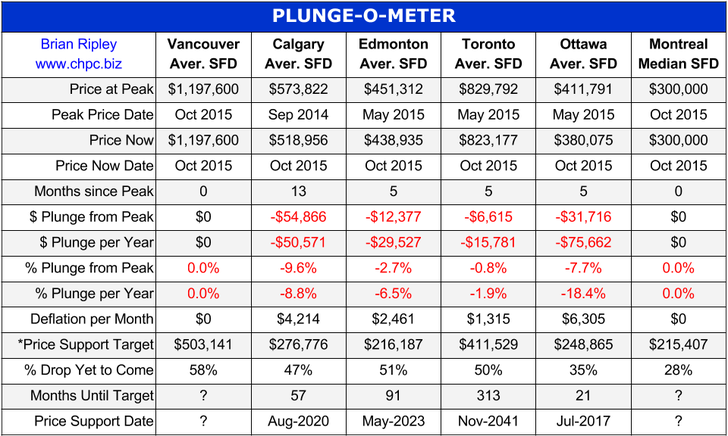
The Plunge-O-Meter below tracks the dollar and percentage losses from the peak and projects when prices might find support.




…and what can be done to prepare…
 Financial Repression
On financial repression Michael prefers to look at it from the angle of who is doing the repression, which in his opinion is being carried out by the governments and central banks. He believes that markets work best when free market forces are allowed to play out without interference, and that the governments and central banks are anathemas to the market.
He says the area that has witnessed the greatest distortions as a result of outside interference are the emerging markets. He goes on to explain that the period of easy money and quantitative easing flowing into the markets caused a boom in the lending of money to emerging markets all over the world. As a result of these markets gorging on all this cheap money with low interest rates, a lot of debt has been accumulated, and most of that debt is denominated in U.S dollars.
As a result of a crash in commodity prices, the emerging markets are getting less for their exports and due to the reduction in quantitative easing, the dollar is increasing in value and its taking a lot more of their currency to service and pay these debts.
Michael noted that there is no easy way out from this, He believes that the current crisis will keep on getting worse especially as global economy is slowing down.
“I think that what we are seeing already is just going to accelerate we are going to have emerging markets really struggle and this is carrying on into global trade”. This is a global problem created by a global bubble that was created by the Federal Reserve and others and so I don’t know that there is any easy solutions and in fact, what we are seeing now is just the initial stage of a crisis that is going to get much much worse.”
He expects that initially major financial institutions all over the world will get into trouble with some of them even failing resulting in the banks refusing to lend to themselves and us thereby causing a credit crunch or freeze, which in turn will bring economic activity to a standstill and as a result cause a short severe period of deflation.
“I believe we are going to see financial crisis financial crash more intervention which is going to cause other problems, ultimately I believe we are going to see major financial intuitions all over the world fail, I believe we are going to see a loss of faith completely and entirely this time around in the central bank of the world and governments and I believe this is going to causes economic chaos around the globe in a scale we have never seen before in our times, and I believe this is going to be a tragedy that is going to play out over years and it’s going to fundamentally transform our standard of living and the world around us as we move forward.”
Preparation
On what can be done to prepare for this eventuality Michael advises that as for the short term people should evaluate financial assets that could crash in value. He also advises a 6month emergency fund at the very least. On long term protection, he recommends gold, silver and precious metals as ways people can protect their wealth. As for a longer term of protection he suggests people should have supplies of food and supplies in the event of a long term emergency, as well as having some cash at home in the event of bank holidays or shutdowns. Finally he strongly recommends a greater level of self-sufficiency from the system as he believes that it is going to fail soon.
Abstract written by Chukwuma Uwaga – //chuwaga@gmail.com/“>chuwaga@gmail.com
 “Stanley Druckenmiller doesn’t think the Federal Reserve’s experiment of keeping interest rates near 0% to spur economic growth will end well.”
“all you do” when keeping interest rates at 0% for this long is “pulling demand forward today.” “This is not some permanent boost you get — you’re borrowing from the future”


-
I know Mike is a very solid investor and respect his opinions very much. So if he says pay attention to this or that - I will.
~ Dale G.
-
I've started managing my own investments so view Michael's site as a one-stop shop from which to get information and perspectives.
~ Dave E.
-
Michael offers easy reading, honest, common sense information that anyone can use in a practical manner.
~ der_al.
-
A sane voice in a scrambled investment world.
~ Ed R.
Inside Edge Pro Contributors

Greg Weldon

Josef Schachter

Tyler Bollhorn

Ryan Irvine

Paul Beattie

Martin Straith

Patrick Ceresna

Mark Leibovit

James Thorne

Victor Adair