
Timing & trends
 1. Loonie Road Kill
Because Canada relies on exports of commodities the multi-year decline in the prices of metals, minerals, natural gas and oil wrecked havoc on the Canadian dollar under the Conservatives.
A Federal Liberal win in Canada’s last election ensured the ‘loonie’ will be crushed further.
2. 5 Stocks For 2016 With 6%+ Dividends & 10%+ Upside
Many closed-end funds are now trading at double-digit discounts to their net asset values (NAVs). Doubleline Capital founder and famed bond guru Jeffrey Gundlach recently told CNBC that buying a fund trading at a 15-20% discount is “sort of a no-brainer.”
Reason being, you’re getting $1 worth of assets for just 80 or 85 cents.
3. Princely Finance and Taxation
by Bob Hoye of Institutional Investors
Continuing promises by Chairman Reckless to use the “printing press”, “helicopters” and more recently “bazookas” to inflate anything should be considered startling only in the resort to honesty.


The Question To Consider Is How You Will Make Money When The Crack-Up Boom Arrives?
… or Has It Already Arrived?
1- Venezuela
As Zero Hedge Reports: Consider Venezuela
It’s that time of year again. When hindsight is 20/20 and coulda/woulda/shoulda gives way to reality. With the US equity market barely able to keep its head above green water, a look around the world shows investors could have done a lot better (or not).
In fact, as Handelsblatt shows, the best investment in the world in 2015 would have been – drum roll please – Venezuelan stocks!
I’m often asked what I think are the most common, most ruinous mistakes that investors make. Unfortunately, there are a lot of them.
There are things such as risking too much money on a single trade or investment … not using protective stops … not using disciplined money management … trading too often … not doing your homework … taking on too big a position in any market … not diversifying enough … and so forth.
But in today’s column, I want to cover what I think is the most dangerous mistake investors make, bar none.
It’s what I call getting caught up in all the “market myths” that are always out there. Or put another way …
It’s having a set of preconceived notions
about what markets can and can’t do.
The fact of the matter is that markets can do whatever they want to do.
Markets are never wrong. Markets are never irrational.
They are what they are and if you don’t understand a market, it’s not the market’s fault, the fault lies instead with your analysis.
For instance, have you ever heard someone say “a market is defying all logic?”
Or that a market is “disconnected from its underlying fundamentals?”
I’m sure you have. I hear those kinds of phrases all the time on shows such as Bloomberg and CNBC.
But the fact of the matter is that …
Markets NEVER defy logic.
And they never defy the fundamentals.
Only people defy logic. Only people can make such statements about fundamental forces as well, because when a market is allegedly defying fundamentals, what it’s really doing is operating on fundamental forces that the analyst or investor simply hasn’t figured out yet.
I fully realize that what I’m talking about here is hard to grasp at first. But if you take the time to think deep and hard about what I’m saying, you will elevate your trading and investing to a whole new level. Markets are never wrong. Only people are.
Especially dangerous for most traders and investors is
getting caught up in the various “market myths” that are out there.
For instance, how many times have you heard that rising interest rates are bad for the stock market, and that declining rates are good for stocks?
If you’re like the average investor, you’ve heard that theory literally hundreds, if not thousands, of times before. Tune into any media show today, and I’m sure you’ll hear it at least once, if not more.
Most stock brokers, and the majority of analysts and newsletter editors espouse the same causal relationship between interest rates and stock prices.
But the fact of the matter, the plain truth, is that there is no “standard relationship” between interest rates and stock prices. Period.
Consider the period from March 2000 to October 2002, where the Federal Funds rate declined from 5.85% to 1.75%, and the Nasdaq plunged 78%. Put simply, stocks and interest rates went down together! Exactly the opposite of what most would expect.
Or the period from March 2003 to October 2007, where the Federal Funds rate more than tripled and rose from 1.25% to 4.75% …
And the Dow exploded higher, launching from 7,992 to 13,930 — a 74.2% gain! Stocks and interest rates went higher together!
The fact of the matter is that the relationship between interest rates and stock prices varies considerably depending upon a host of factors, including the value of the dollar and where the economy is in terms of its economic cycles.
 But the bottom line is this: Never assume anything and never, ever get caught up in conventional thought about what a market can or can’t do — or you will most likely lose your shirt.
Let’s look at another market myth. Almost everyone believes that gold and the dollar cannot go up together.
And so, they also believe that the dollar and gold can’t go down together.
But that’s completely inaccurate. There have been plenty of times when the dollar and gold have gone up together … and there have also been plenty of periods when they have gone down together.
In fact, in the not-too-distant future we are probably going to see another such period for gold, where it and the dollar go higher together.
Indeed, when the European Union really disintegrates, which is not that far off, that’s probably exactly what we will see: A mad rush of European money into the dollar and into gold — and out of the euro.
Or consider the normal view about a country’s widening trade deficit. The common theory is that a widening trade deficit is bad for stock prices and a narrowing deficit is good.
But history proves that to be entirely wrong, and nothing more than a myth.
Fact: From 1976 to 1998, the U.S. trade deficit ballooned from $6.08 billion to $166.14 billion, and guess what? The Dow Jones Industrials went from 848.63 to 9,343.64!
In truth, the relationship between the trade deficit or surplus and stock prices is exactly the opposite of what most pundits claim.
Or consider the myth about corporate earnings that says they have to rise for stock prices to continue higher. Yet from 1973 to 1975, the combined earnings of the S&P 500 companies rose strongly for six consecutive quarters — and guess what? The S&P 500 Index fell more than 24%.
In other words, rising corporate earnings does not guarantee rising stock prices, by any means. Nor do falling corporate earnings guarantee falling stock prices!
There are many myths or biases out there about the relationships between economic fundamentals and markets, about stocks, or between markets and other markets.
But the fact of the matter is that almost all of them are exactly that: Myths, and nothing more.
The bottom line: To avoid making the biggest investing and trading blunders …
1. Never assume anything when it comes to the markets …
2. Question everything, and most of all …
3. Think independently!
Happy New Year, stay tuned and best wishes,
Larry

The price of gold has see-sawed since the Federal Reserve raised interest rates on Dec. 16, and market experts debate if the action is good or bad for gold. Rob Chang of Cantor Fitzgerald Canada believes that after the small rate hike doomsayers are overstating their case and that gold should sell in 2016 for about $100/oz more than today. In this interview with The Gold Report, he argues that in today’s climate cash costs below $1,000/oz are the bare minimum requirement for survival. Happily, Chang highlights three gold producers and one silver producer that have what it takes.


Forex Trading Alert originally sent to subscribers on December 31, 2015, 5:35 AM.
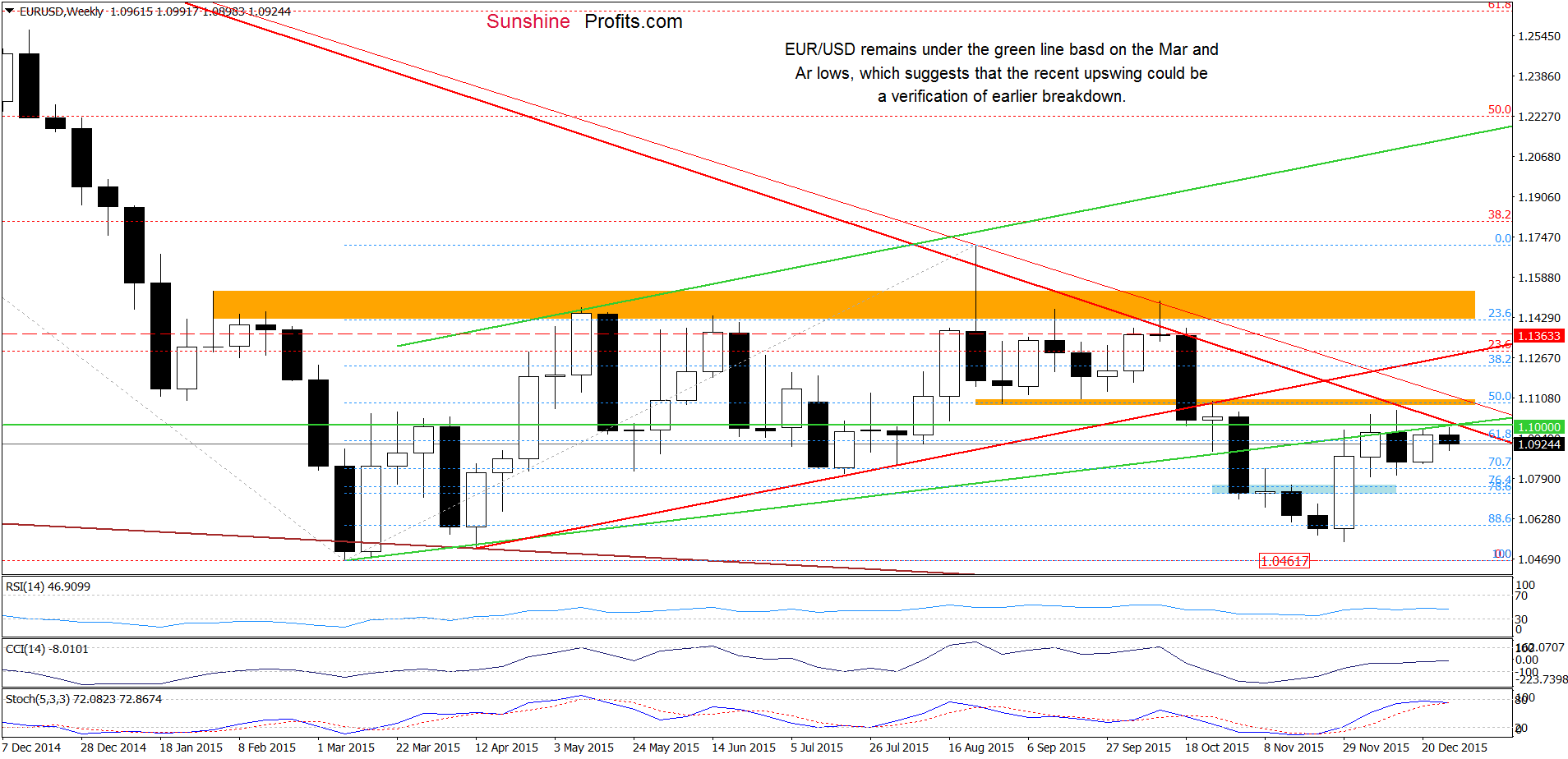
Yesterday, EUR/USD moved little lower as Tuesday’s solid consumer confidence data continued to support the greenback. Thanks to these circumstances, the probability of further declines increased as the bearish formation is underway. What impact could it have on the exchange rate in the coming days?
In our opinion the following forex trading positions are justified – summary:
- EUR/USD: short (stop-loss order at 1.1363; initial downside target at 1.0462)
- GBP/USD: none
- USD/JPY: none
- USD/CAD: none
- USD/CHF: none
- AUD/USD: none


-
I know Mike is a very solid investor and respect his opinions very much. So if he says pay attention to this or that - I will.
~ Dale G.
-
I've started managing my own investments so view Michael's site as a one-stop shop from which to get information and perspectives.
~ Dave E.
-
Michael offers easy reading, honest, common sense information that anyone can use in a practical manner.
~ der_al.
-
A sane voice in a scrambled investment world.
~ Ed R.
Inside Edge Pro Contributors

Greg Weldon

Josef Schachter

Tyler Bollhorn

Ryan Irvine

Paul Beattie

Martin Straith

Patrick Ceresna

Mark Leibovit

James Thorne

Victor Adair