
Timing & trends
Special Report: Chinese Sunset
by A. Gary Shilling
Earlier in the week I asked my friend Gary Shilling if he could give me a summary of his 2016 forecast. He agreed to do so and sent it on. Then this morning he sent out a special short report on China that offers what I think is a valuable perspective that differs from what we’re seeing in the headlines – John Mauldin
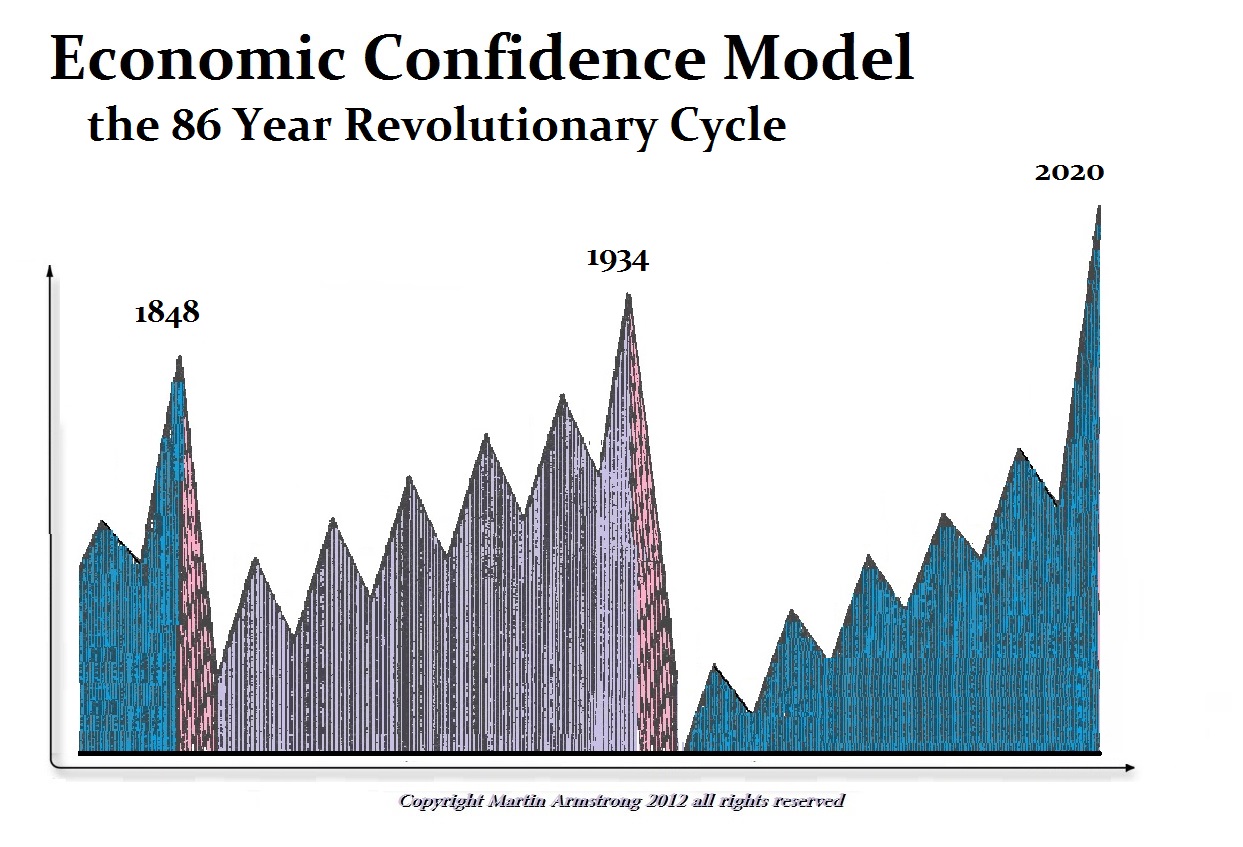 The Coming European Revolution…
by Martin Armstrong
I have warned that 2017 will be the political year from hell. What I am illustrating here is the link between a sovereign debt crisis and the Revolutionary Cycle. In 1933, Roosevelt came to power in the USA and turned the country toward socialism. That same year, 1933, brought Hitler and Mao to power. So 1934 was the revolutionary year. Such revolutions do not always bring blood in the streets. The next one is due in 2020 and we should see the system we currently live under go completely upside-down.
Investing Lessons from the Farm
Expect Storms. Whether or not my father had a good year depended on three things: (1) no late frosts, (2) no early frosts, and (3) no natural disasters like hail storms, tornados, droughts, or massive insect infestations.
While you can’t avoid disasters, you can plan for them and run for cover when they do come. The wise investor diversifies in anticipation of those things that are beyond his control and buys insurance to protect against catastrophic losses.

 “You can ignore economics and finance, the scary part is that they will not ignore you.” – JP Morgan
Meanwhile…
- The Dow Jones had its worst five day start to the year since 1897
- The S&P 500 had its worst start since 1929
- China’s Shanghai Index is down 20% from its December high
- Oil has broken its 2008 subprime low of $31.27
- The loonie traded in the 69 cent range for the first time in 13 years
- The Pennsylvania state pension plan has a $50 billion unfunded liability
Whether we are paying attention or not there’s an earthquake happening in financial markets around the world. The big question is – when will the majority notice?
When their grocery bill rises 9% this year? When they get their RRSP or mutual fund statement? When they go to the bank and find out that $1,000 Cdn only buys $699 US?
In the oil related sector 100,000 plus jobs have been lost, but do we really have to do the full Ronald Reagan – where you call it a recession if your neighbor loses his/her job but a depression when you lose yours?
In other words, do we have to get hit right between the eyes before we see what’s in front of us?
I’m proud to say that at the World Outlook Financial Conference and on MoneyTalks we clearly outlined the falling oil prices, the drop in the loonie, euro and yen, as well as the fall in interest rates (hint: not over yet) and the collapse of commodity prices well in advance. People who took that advice made a lot of money. So did those people who took our advice and bought real estate in Phoenix in 2011, 2012 and 2013. As did the investors who bought our World Outlook Small Cap portfolio, which has made double digit profits every year since it’s inception.
Here’s the Secret To Getting Those Fantastic Results
There’s no guarantee in the markets. Sure, we were right about the drop in oil but we are just a Saudi missile strike on Iran away from a dramatic up-move in oil. There’s always uncertainty but one way to stack the odds in your favour is to listen to analysts with proven track records.
Big News
I am pleased to say that Martin Armstrong will be returning for two sessions at this year’s Conference. As I have said many times in the past – over 39 years of having the privilege of talking to and reading a massive number of top-flight analysts, if I could only follow one – it would be Martin Armstrong.
I don’t know where he’ll be joining us from – Switzerland, London, New York – but he will join us live from where ever he is and I have a boatload of questions on stocks, gold, the debt crisis, the US dollar … well just about everything, which is why I need two sessions with him.
By the way, Marty has already scheduled his $10,000 a seat investment conference in May but we have the opportunity to pick his brain at The 2016 World Outlook Financial Conference.
Special Guests
For the first time at the Outlook Conference I will be interviewing one of the top analysts in the english speaking world, Dr Gary Schilling. About 10 months ago I put Dr Schilling on my speakers wish list for the Conference and it took until this week to get him confirmed to do a Q&A. Dr Schilling was on my list because his brilliant analysis of the problems in China, the negative impact on commodities and the consequences of global deleveraging on currencies, bonds and stocks. (Wait til you hear his forecast on oil and gold.)
Don’t Forget Tech
If you are a regular listener to MoneyTalks you know I believe that understanding the impact of the tech revolution, on both society and the investment markets, is essential. I am thrilled to say that for the first time at an event like the World Outlook Conference, Canadian tech superstar, Ryan Holmes, founder and CEO of Hootsuite, will join me to talk about the latest in tech – including the next big, new things you have to know about.
I can’t tell you how excited I am about this line-up – as well as the opportunity to hear all the other all-star analysts:
– Keystone’s Ryan Irvine, who will introduce this year’s Small Cap portfolio
– Davis Rea’s John Johnston, who’s track record on the loonie is the best in the country (you’ll fall off your seat when you hear what he thinks is next).
– Josef Schachter, who was alone in predicting oil’s dramatic fall from over $100 to $32 dollars. (Does he think this recent wash-out is a buying opportunity or fool’s gold).
– Ozzie Jurock – his best bets in each of the last five years have yielded significant returns in Canada and massive returns in the US.
– Vision Capital’s Jeff Olin, – who has made his investors big money in real estate both sides of the border – but the call that separated him from the pack was his decision two years ago to play the Calgary commercial market to go down.
– Mark Leibovit – Scored the analysts’ hat trick by winning Timer’s Digest Timer of the year in stocks, bonds and gold.
Finally – Here’s My Sure Fire Prediction
2016 is going to feature massive moves, incredible volatility – and most people will lose – whether they are in the market or not. My goal is to provide you with the information and insights necessary so that you can survive and thrive in this environment.
But I can only do so much. The rest is up to you. You have to show up or buy the video if you can’t make it in person. And while the past is no guarantee of future returns – the quality and success of the recommendations of past conferences has returned the price of admission many times over.
On the other hand, you can ignore the economic and financial trends that will impact your life directly – the only problem is that as JP Morgan warned, they won’t ignore you.
I sincerely wish you all the best in 2016,
Mike
Conference Details
Where: Westin Bayshore, Downtown Vancouver
When: Friday, January 29th beginning at 1:00pm with the Real Estate Outlook, and all day Saturday, January 30, 2016
Agenda: http://moneytalks.net/agenda.html
Cost: $129 for a full access General Admission pass.
To book Your Ticket: CLICK HERE
or Call # 604.926.6848 – email info@moneytalks.net
P.S. As you may know I am hugely interested in educating our younger generation. And thanks to the sponsorship of the Online Investment Club service at myvoleo.com we are able to offer a complimentary ticket for young people/students when you purchase a ticket for yourself. And I might add that in the past those that took advantage of the offer really enjoyed the Conference. It is a great way to share/create a common interest with your children – no matter what their age.
P.P.S. Can’t make it in person? No worries, we will have the archive video – shot in HD this year with a four camera crew – available for viewing within 48 hours of the event. It is a great way to access all these speakers and more on an unlimited basis for a year. CLICK HERE to order


With the Dow tumbling more than 500 points, the global stock market rout continues as panic begins to engulf the world.
And there goes the Gold/Oil ratio as it hits another 70-year high!
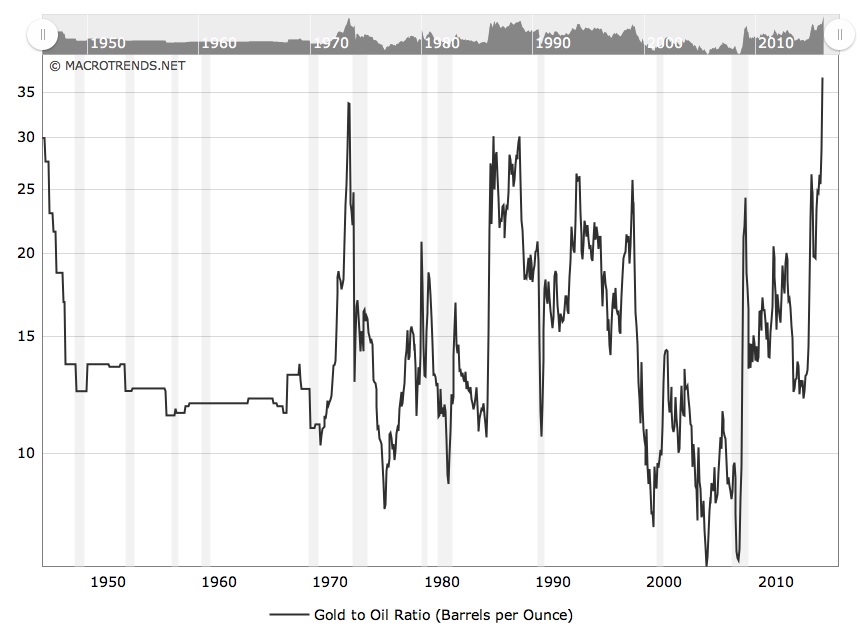
The Gold/Oil ratio had already taken out the high from July of 1973 (33.69), and today it is now trading at 36. Again, people will see gold float across the ticker at roughly $1,100 and think it’s weak but it’s actually trading quite strong vs key commodities such as oil.

“a major reason why I’m so optimistic about the future”
 Eight centuries ago as Marco Polo traveled across the vast dominion of the Mongolian Empire, he encountered what few westerners had ever seen.
One of those astonishing experiences was how the Mongols happily and willingly used paper currency.
Marco Polo was so intrigued by this that he devoted an entire chapter in his famous diaries to the Mongolian monetary system.
Back then, Kublai Khan’s imperial mint was located in the city of Kanbalu, part of modern day Beijing.
Polo describes the ritualistic process of how these Chinese “alchemists” produced paper money “with as much form and ceremony as if it were actually of pure gold and silver.”
This was a major novelty for Polo.
Back in Europe where he had come from, gold coins like ducats and florins circulated across the continent as the standard international reserve currency.
But it wasn’t just the use of paper money that was so surprising for Marco Polo; it was how willing people were to use it.
As he writes in his diaries, “in most states, the issue of government paper is the resource of an exhausted treasury.”
In Polo’s experience, only bankrupt nations issued paper money.
But in the Khan’s empire, the economy was healthy and robust, and people had tremendous confidence in their paper currency.
It lasted for more than a century, but eventually they printed far too much money, confidence eroded, and the system collapsed.
The collapse was so severe that one deposed Mughal ruler was actually charged with inflicting paper currency on to his people.
So just like every other experiment with paper money in the history of the world, it ultimately failed.
Today paper money is somewhat of a rarity; it and all financial transactions have now become digital.
Your bank balances and credit card transactions are all merely accounting entries stored in electronic databases.
There are very few pieces of paper circulating in the monetary system anymore.
But the basic concept remains the same as it did in the Mongolian Empire: unelected bureaucrats wield totalitarian control over the money supply, creating and destroying money at will.
Money is one of the most important social technologies in history.
Like language or even the Internet, money is something that we all use regularly.
It’s a sad testament to modern humanity that the framework we have selected for this critical social technology is based on a failed model from eight centuries ago.
You’d think that with all the other technology we have at our disposal, money would have been brought into the digital age by now.
Well, in the private sector, it has.
Two of the most important developments in the history of money have recently emerged over the last few years– the Blockchain, and Peer-to-Peer (P2P) platforms.
The Blockchain is revolutionary.
It provides a way to for any data or information to be stored electronically and distributed across the entire user base.
If you’ve ever used a file-sharing application, you’ve seen this in action.
You’re essentially downloading bits and pieces of your favorite movie from dozens, perhaps hundreds of other users who have installed the same software.
The Blockchain has some similarities in that it stores encrypted data with anyone who has installed the software.
Right now that data primarily consists of bitcoin transactions.
But the Blockchain could be used for anything– financial records, property title, stock certificates, bonds, business contract– just about anything.
The second major idea is Peer to Peer transactions.
Centuries ago, banks were vital components of the financial system.
They facilitated trade and commerce by acting as a financial middleman who made loans with their depositors’ money.
That function may have been useful in the past. But now it’s no longer necessary to have a bank in the middle of all financial transactions.
Rather than using a bank, today there are several P2P platforms that can directly match up savers and borrowers, completely cutting out the financial intermediary.
If you want to borrow money to start a business, buy a car, or even a house, you no longer need a bank. You can crowdsource it online.
P2P technology has been applied to so much else; AirBnB is essentially a P2P platform that matches up travelers with homeowners. Uber is the same with vehicles.
The key idea of both of these developments is that they cut out the central authority like a bank or government.
Needless to say, the people in charge don’t like this.
Yesterday a Russian minister told the media that Bitcoin “will represent a real threat to the financial stability of the state.”
But no matter what they do, the power now is trending towards the users. The individual. Not the bureaucracy.
This is a major reason why I’m so optimistic about the future.
There’s an incredible amount of risk in the financial system right now. Governments all over the world are broke, central banks are borderline insolvent, many commercial banking systems are dangerously undercapitalized.
The currency wars are back, and currencies are being devalued everywhere.
Debt bubbles are starting to burst, and economic growth worldwide is grinding to a halt.
This is clearly not a consequence-free environment and requires some rational, sensible steps to protect yourself.
But here’s the bright side: no matter how pitifully the people in charge screw things up, in the end, they’ll always lose.
If some politician decides to ban firearms tomorrow morning, we now have the ability to 3D print them.
If they continue to snoop and spy on our emails, we now have state of the art encryption technology that would take them centuries to break.
Even if they try to flip the Internet kill switch, we have mesh network technology to ensure that we stay connected.
No matter how hard they try, they’ll never be able to contain the extraordinary technological developments that propel humanity ever upward.
Have a great weekend,
Simon Black
Founder, SovereignMan.com
 Don’t let the Bear send you into a panic frenzy
- Using a typical hedge strategy with options and futures
- Taking advantage of lower prices to rebalance your portfolio
Bear markets when they happen are never a pleasant event for any investor. Long only investors especially tend to be the worst hit. If you are wealthy enough to invest in Hedge Funds you may be damaged less, if you chose the right managers and the right strategies. Despite the pain felt, market corrections if managed correctly, should be seen as an opportunity.
Many investors run for the door when markets become volatile, meaning the turn south sharply. Yet that may not be the best choice. There are certainly more alternatives to simply cutting your positons in stocks. If you have built up a portfolio of stocks you feel will perform brilliantly and have an exciting future ahead you may not be willing to take losses simply because the market is making a correction.

-
I know Mike is a very solid investor and respect his opinions very much. So if he says pay attention to this or that - I will.
~ Dale G.
-
I've started managing my own investments so view Michael's site as a one-stop shop from which to get information and perspectives.
~ Dave E.
-
Michael offers easy reading, honest, common sense information that anyone can use in a practical manner.
~ der_al.
-
A sane voice in a scrambled investment world.
~ Ed R.
Inside Edge Pro Contributors

Greg Weldon

Josef Schachter

Tyler Bollhorn

Ryan Irvine

Paul Beattie

Martin Straith

Patrick Ceresna

Mark Leibovit

James Thorne

Victor Adair