
Timing & trends
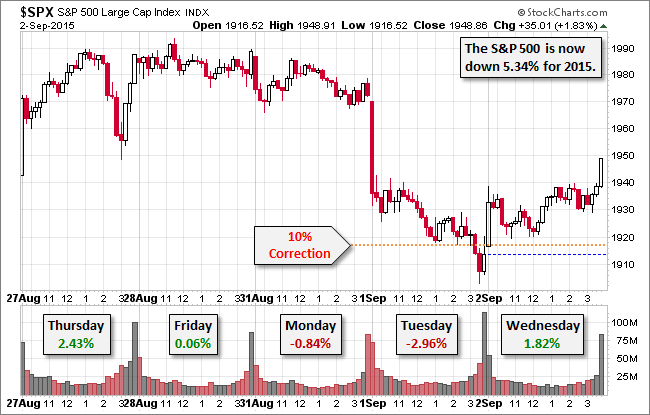
The two-day rally off last Wednesday’s interim low ended today, apparently triggered by renewed selling in oil and in nervous expectations of major economic indicators later this week (Consumer Sentiment, Durable Goods, Q4 GDP, etc.). The end-of-day spot price for West Texas Crude plunged 7.6%. The S&P 500 opened lower and zigzagged in a narrow range to a trend of renewed selling after the lunch hour. The index closed with a 1.56% loss, just a hair above its -1.62% intraday low in the closing minutes.
The yield on the 10-year note closed at 2.03%, down 4 basis points from the previous close.
Here is a snapshot of past five sessions.


- The gold price rally is accelerating. Please click on the chart above to enlarge. That’s the four hour bars gold chart, and the price action is solid. Gold has broken out to the upside, from a second inverse head and shoulders bottom pattern.
- After a sharp pullback to the $1100 – $1108 area, gold should move nicely higher, towards my $1145 target zone.
- Please click here now. Double-click to enlarge. That’s the four hour bars chart for silver, and it’s staging a solid upside breakout from a symmetrical triangle pattern this morning! The target is the $15 area, which is the break-even point for a number of silver mining companies.
- From a fundamental perspective, gold now has a vast array of supportive price drivers. In the immediate term, Chinese New Year buying is a factor.
- Also, India’s finance minister may be poised to unveil a massive gold import duty cut in the upcoming annual budget. That’s because supply-related collapse in oil prices has dramatically cut the nation’s current account deficit, as a percentage of GDP. The gold import duty is no longer a viable scapegoat for that shrinking deficit.
- The El Nino weather system may end as early as May, and La Nina is poised to replace it. La Nina is bad news for US grain and South American crops, and good news for Indian crops, which is good news for Indian farmers, who are the world’s largest buyers of gold.
- Gold peaked near $1923 in 2011, just a few months after the horrific Japanese earthquake occurred. The dollar then began soaring against the yen, but now it has stalled, and yesterday Japan announced the first monthly trade surplus since the earthquake.
- On that note, please click here now. Double-click to enlarge this important dollar versus yen daily bars chart.
- Most amateur technicians follow the USDX (dollar index) chart for cues about gold, but the dollar versus yen chart is vastly more important. Large FOREX traders view the yen, not the dollar, as the world’s safe haven fiat currency.
- When money flows out of the yen, it flows out of gold. When money flows into the yen, it moves into gold. The yen and gold are both poised to begin what will likely be the largest rally of the past five years.
- Janet Yellen and her fellow Fed workers are scheduled to begin their next meeting today, with an announcement expected tomorrow. Please click here now. Goldman Sachs economists feel the US stock market will have another “wet noodle” year, and that’s my view.
- Ben Bernanke was Wall Street’s best friend. He unveiled a bizarre QE program that ravaged Main Street. That program encouraged Wall Street to borrow money and use it for stock buybacks and dividends. In a nutshell, Ben Bernanke helped engineer what I call “marked to model price/earnings ratios” for US companies.
- Over the past seven years, Wall Street arguably spent more money on stock buybacks and dividends than it did on company operations, and the piper must be paid.
- Janet Yellen should not be confused with Ben Bernanke. She is Main Street’s friend. She proved it by tapering Ben’s horrific QE program off the board, exactly as I predicted she would. Now, she is poised to raise interest rates repeatedly, much to Wall Street’s chagrin.
- US citizens (Main Street) will then put money into bank accounts, and banks will lend that money in the fractional reserve system, reversing US money velocity.
- The US stock market will probably experience many more violent sell-offs as Janet hikes again, again, and again. That will fuel more FOREX trader safe haven buying of the yen, and of gold.
- Janet could hike rates this week, but I think she’ll give Wall Street a break. She’ll likely wait until the spring, before hammering global stock markets with her next hike.
- Please click here now. Double-click to enlarge this daily bars oil chart. Horrifically, some oil producers are getting less than $20 a barrel for their oil right now. That’s because their oil is not the high quality “West Texas Intermediate” oil that the NYMEX uses for their benchmark pricing.
- Please click here now. Ominously, the storage tanks in Cushing, Oklahoma are in danger of reaching full capacity, and may have already briefly done so last week.
- US frackers are still pumping oil fiendishly, trying to pay substantial debt from unprofitable revenues. OPEC can produce profitably at much lower prices than the frackers, but OPEC governments need high revenues to prevent social unrest.
- While oil could now rally to my $37 – $41 short term target zone, storage tanks are likely to hit full capacity by then, triggering a terrible meltdown to the $10 – $20 zone.
- Civil unrest could occur in OPEC nations as the oil price tumbles, and Iran-Saudi tensions could grow, creating a gold buying frenzy by institutional investors. It’s hard to know how the US stock market would respond to such a horrific event, but I would suggest that the Western gold community may want to seek shelter from that storm, before it happens.
- On that note, please click here now . Double-click to enlarge. Barrick has just staged a solid upside breakout, and where Barrick goes, most gold stocks tend to go.
- Please click here now. Double-click to enlarge this key GDX daily bars chart. The massive bull wedge pattern in play suggests than an “institutional awakening” is at hand for the gold stocks sector, as the oil supply glut and Janet’s rate hikes send global stock markets into a financial gulag. I’ll dare to suggest that equity-oriented money managers are soon going to view gold stocks as asset class champagne!


Jan 26, 2016
Stewart Thomson
Graceland Updates
website: www.gracelandupdates.com
email for questions: stewart@gracelandupdates.com
email to request the free reports: freereports@gracelandupdates.com
Graceland Updates Subscription Service: Note we are privacy oriented. We accept cheques. And credit cards thru PayPal only on our website. For your protection we don’t see your credit card information. Only PayPal does.
| Subscribe via major credit cards at Graceland Updates – or make checks payable to: “Stewart Thomson” Mail to: Stewart Thomson / 1276 Lakeview Drive / Oakville, Ontario L6H 2M8 / Canada |
Stewart Thomson is a retired Merrill Lynch broker. Stewart writes the Graceland Updates daily between 4am-7am. They are sent out around 8am. The newsletter is attractively priced and the format is a unique numbered point form; giving clarity to each point and saving valuable reading time.
Risks, Disclaimers, Legal
Stewart Thomson is no longer an investment advisor. The information provided by Stewart and Graceland Updates is for general information purposes only. Before taking any action on any investment, it is imperative that you consult with multiple properly licensed, experienced and qualifed investment advisors and get numerous opinions before taking any action. Your minimum risk on any investment in the world is 100% loss of all your money. You may be taking or preparing to take leveraged positions in investments and not know it, exposing yourself to unlimited risks. This is highly concerning if you are an investor in any derivatives products. There is an approx $700 trillion OTC Derivatives Iceberg with a tiny portion written off officially. The bottom line:
Are You Prepared?

 Massive Reserve Hemorrhage
China hemorrhaged $663 billion of its reserves since June 2014 in a misguided attempt to prop up the yaun. Once the biggest buyer of US treasuries China Starts Dumping U.S. Government Debt.
Note the irony of that headline. Misguided analysts long clung to the belief that the US dollar would go to hell when China started dumping treasuries, “certificates of confiscation” as they were commonly called.
Instead, China has used a significant portion of its reserves to prop up the Yuan. It still has about $3.3 trillion left according to estimates, but China cannot keep the current pace up forever.
“Temporary” Capital Controls the Solution?
The Financial Times reports Capital Controls May be China’s Only Real Option.
Chinese officials readily admit that communication has not been their strong point when it comes to dealing with international investors. Policymakers have now made it explicit that they have no wish to engineer a big devaluation. However, they are much less forthcoming about how they plan to reconcile a desire for currency stability with the realities of capital flight and a slowing economy.
Central bank guidance is most effective when the policy is clear and it is relatively straightforward to work out how it will evolve in response to changes in economic data. At present, the reality in China is that the PBoC has no clear course of action and wants to leave itself flexibility.
No amount of clarification would help to varnish the underlying problem: capital flight. The corruption clampdown and a lack of investment opportunities at home are driving Chinese people to take their money out of the country, just as the prospect of higher US interest rates is prompting companies to pay off dollar debt. Fear of a devaluation has fuelled the outflows. Far from seeking a weaker renminbi, the central bank has been forced to spend a big chunk of its reserves to prop it up
This goes against the grain of recent liberalising measures, which last year helped China win the renminbi’s inclusion in the International Monetary Fund’s special drawing rights basket, alongside traditional reserve currencies. However, the IMF has become far more willing to accept the case for temporary capital controls since quantitative easing sparked huge flows of hot money into emerging markets.
Capital controls are not a long-term solution but, at present, they are the correct step for Beijing to take in a very difficult situation. However, they will only work if China uses the breathing space to articulate a clear policy to rebalance its economy and liberalise its currency in the longer term — a process that will take many years.
Yuan’s Fall Is Just ‘Noise’ Amid Deeper China Woes
The Wall Street Journal hits the nail on the head with this headline: Yuan’s Fall Is Just ‘Noise’ Amid Deeper China Woes.
When the financier George Soros attacked the British pound in 1992 and famously “broke the Bank of England” he was trading on a conviction that the currency was misaligned.
Britain devalued after squandering its reserves in a vain defense. Mr. Soros walked off with $1 billion or more. To the surprise of many, though, the U.K. economy soon picked up once the pound found its proper level.
China’s raging battles with currency speculators are unlikely to end as happily for the country. That’s because turmoil in the currency markets reflects a much more perilous imbalance than an overvalued yuan: China is now lopsidedly dependent on ever larger inputs of local bank credit to keep sputtering growth from declining further.
The country is already littered with “zombie” factories, empty apartment blocks that form ghostly suburbs, mothballed power stations and other infrastructure that nobody needs. But yet more wasteful projects are in the pipeline, even as the government talks about cutting industrial overcapacity.
“That’s the misalignment–everything else is noise,” says Rodney Jones, the Beijing-based principal of Wigram Capital Advisors, who was a partner at Soros Fund Management during the 1990s.
If debt keeps piling up at the current rate, China faces an eventual financial crisis, perhaps leading to years of subpar growth, mirroring the fate of Japan after its bubble burst in the early 1990s.
Mr. Jones argues that global equity markets haven’t property adjusted to this risk, even after a 16% decline in U.S. dollar terms from their May peak. “The world will have to learn to live without demand from China,” he says. “It’ll come as a shock.”
Managing a Crisis of China’s Own Doing
As we sit here discussing “temporary” measures that often seem to last decades, we need to step back and ask: What caused this mess?
The answer is a ridiculous growth targets. To hit 7% growth targets for years on end, China had to waste a lot of money on projects, many of which are now worthless.
While the boom lasted, China, like Japan before it, was considered an “economic miracle”.
To top it off, China did not float the yuan, but now wants to defend an untenable target.
Unlike the above writers, I suggest China do what it should have done a decade ago: float the yuan and stop micro-managing the economy.
Sure there will be a lot of short term pain. But short term pain is a lot better than three lost decades as Japan is experiencing.
…more from Mike Shedlock:
Dallas Fed Region Activity Plunges to Lowest Reading Since 2009; Production Collapsed

Strengths
- The best performing precious metal for the week was spot gold, up 0.84 percent. Gold held its ground, despite a second half of the week surge in the broader equity markets.
- Gold climbed higher as the week progressed on the back of global market turmoil spurring demand for the safe haven asset, reports Bloomberg. Weaker-than-expected Chinese economic data in December added to market uncertainty, with Citigroup even raising its forecast for gold prices in 2016.
- Data released from the Russian central bank on Thursday implies that the country added around 208 metric tonnes to its official gold reserves in 2015. This number is 21 percent higher than the 186.6 metric tonnes reported in 2014, according to a Platts news article this week.
Weaknesses
- The worst performing precious metal for the week was platinum, still up 0.21 percent, but likely weaker due to the slack Chinese data that set the tone for trading action.
- Greece’s top administrative court announced the annulment of the government’s decision in 2015 to revoke Eldorado Gold’s mining license. Although this news is positive for Eldorado, the root of the issue still exists. It seems the real problem here is the Greek’s belief that they own the land where the mining project is planned, along with all the gold in it, and they don’t seem keen on letting a private company exploit the state’s assets.
- A prolonged gold slump has forced Barrick Gold Corp. to revise its price assumptions for 2016, Bloomberg reports. The company announced it may book as much as $3 billion in impairment charges, though this should come as no surprise during a challenging commodity market. In contrast to this news, Barrick became Canada’s most valuable gold miner last week for the first time in 19 months, and taking the mantle from Goldcorp as their largest gold company by market capitalization.
Opportunities
- As a supply crunch takes hold this year, we could see the price of gold rise substantially. Thomson Reuters reports that global gold production is expected to fall 3 percent in 2016. This would end a seven-year streak of rising gold supplies (which peaked in 2015 at 3,155 tonnes), according to a Business Insider article.
- Citigroup has raised their gold price forecast to $1,070 per ounce for 2016, up 7.5 percent, according to a January 19 report from the group. Citi analysts cite “ongoing global macro concerns” lending support this quarter, along with a “modestly more benign U.S. dollar outlook.”
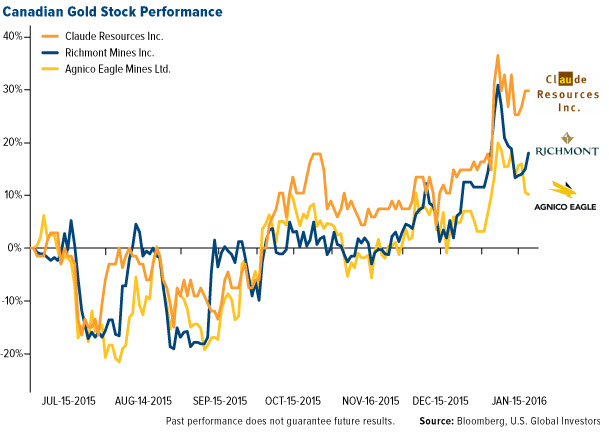
- Canadian gold companies (that have labor costs in Canadian dollars and revenue in U.S. dollars) should profit from the rising U.S. dollar, according to a Bloomberg interview with 1832 Asset Management’s Robert Cohen. As you can see in the chart below, Canadian-based gold companies like Claude Resources, Richmont and Agnico Eagle are performing well during this gold bear market.
Threats
- Last year marked the fifth consecutive year of negative returns and underperformance for gold stocks versus the S&P, reports Goldman Sachs. Gold miners (GDX) were down 25 percent in 2015. Goldman doesn’t expect any positive catalysts for gold over the next 12 months, but says one key indicator will be the Federal Reserve’s pace of future rate hikes.
- Wal-Mart finished 2015 down 30 percent, yet another sign of U.S. economy weakness. The store recently announced 269 store closures, with at least 10,000 employees being laid off. ZeroHedge uses Wal-Mart’s woes as evidence of the U.S. being “at the center of the global economic meltdown” – this might be a good time to own gold.
- Price action in the North American gold stocks lagged behind the performance of bullion most of the past week. It was as if someone was forced to exit their gold equity exposure (or a large player was overcome with frustration and told the street to just get them out of their position now), as gold stocks started the year strong but are now losing momentum. Sales desk noted that Canadian generalists were seeing a pickup in shareholder redemptions.


STRATEGY OF THE WEEK
For Active Traders, this is a great time. The volatility in the market provides lots of reward for risk potential if you have a very short term time horizon and the skill to trade the market through the day. For the longer term investor, I recommend staying on the sidelines in cash until the market shows stability and a reversal of the downward trend. Correction bring great opportunity but you have to be patient and wait for the dust to settle. Sit on your hands for now.

-
I know Mike is a very solid investor and respect his opinions very much. So if he says pay attention to this or that - I will.
~ Dale G.
-
I've started managing my own investments so view Michael's site as a one-stop shop from which to get information and perspectives.
~ Dave E.
-
Michael offers easy reading, honest, common sense information that anyone can use in a practical manner.
~ der_al.
-
A sane voice in a scrambled investment world.
~ Ed R.
Inside Edge Pro Contributors

Greg Weldon

Josef Schachter

Tyler Bollhorn

Ryan Irvine

Paul Beattie

Martin Straith

Patrick Ceresna

Mark Leibovit

James Thorne

Victor Adair