
Gold & Precious Metals
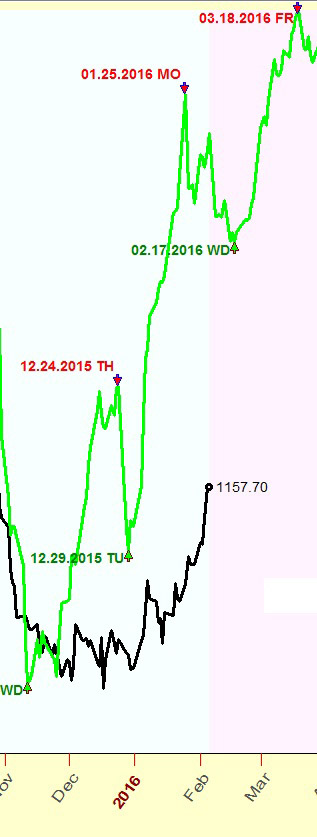
I hope you’ve been watching gold and silver. They’ve been moving nicely higher, after having made a low right on target in December with my cycle forecast for a potential major low.
Just in case you missed it, I have an updated cycle forecast gold chart. As I pen this column, gold is actually trading higher at near the $1,183 level. Silver a hair over $15.00.
 That said, I thought I’d take this opportunity to answer your most pressing questions on precious metals (as well as other markets).
After all, the precious metals are the markets where there is the most amount of misinformation.
And the markets that most pundits seem to completely misunderstand. So let’s get right to those questions.
Q: Larry, you’ve been right as rain about deflation. So why are gold and silver now rallying when deflation still seems to be dominant?
A: There are numerous reasons. But the most important is the following:
Precious metals can do extremely well in deflation.
In fact, historically, gold gains the most purchasing power during periods of deflation, not inflation. The reason for that is also simple: During extreme deflation, the debt and credit structure of the world’s monetary system — especially sovereign debt — come under increasing stress.
As such, savvy, big money starts to seek out hedges against collapsing sovereign debt. Hence, new bull markets in precious metals can be born, even during deflation.
That is exactly what happened during the Great Depression. And it is exactly what is happening now.
Q: Have gold and silver truly bottomed, or is this a fake-out rally?
A: I believe they have bottomed. But that’s based on experience and not my unemotional models.
Based on my models, the first confirmation of a bottom in gold will come on a close above $1,187.80 on a Friday. Final confirmation will come with a close above $1,368.20 on a month-end basis. Silver will generally follow gold.
Failing those two signals and gold and silver can indeed slide back down, possibly even to new lows.
Q: The stock market can’t seem to breakout to the upside. But it can’t seem to pullback much either. What gives?
A: Three things:
First, I believe the market’s resilience is a testament to its long-term strength. As I have said all along, the Dow is headed to 31,000+.
Second, looking simply at the Dow Industrials, or even the S&P 500, is deceiving. The majority of publicly traded U.S. stocks are down for the year, more than 20%. The Dow Jones Transports, the Dow Utilities, the Russell 2000 — are all down and weaker than the main indices.
So in a very real sense, U.S. equities are already in a stealth pullback. Odds are that the Dow Industrials and S&P 500 will soon succumb too. Indeed, the wild swings you have seen since the start of the new year are merely the preparatory stages for a steep decline.
Worst case in the Dow Industrials should be roughly 13,900.
Nevertheless, keep in mind that any pullback you see will merely serve to get the majority of investors bloodied and bearish. The long-term trend is higher.
Q: I can’t believe how accurate you have been when in late 2012 you forecast a rise in global stress and geopolitics. How much worse can it get?
A: Unfortunately, a lot worse. We are still early in the cycle, which calls for rising social and international stress and discontent all the way in to late 2020.
Europe is the hotbed, and will be the entire time. The refugee crisis has allowed terrorists to infiltrate Europe, and Europe is also buckling under the financial stress of providing for as many as 2 million refugees.
But don’t kid yourself. You will soon see all of this migrate to Japan, then to the United States as well. Not to mention rising troubles in the Middle East.
Not just terrorism, but civil discontent too. Protests against government. Secession movements. And more. It will get very ugly.
Q: Do you believe gold and silver will eventually be confiscated?
A: No, I do not. Why would governments move to confiscate gold and silver when what they want to do is make them obsolete? Confiscating gold or silver would send the opposite message; that they are too important to be in the hands of investors.
This is also why I believe investors, when buying gold or silver, should opt for ingots and bars. Why pay premiums of 4 to 7% on bullion coins when you don’t have to?
Governments of the world are not interested in gold or silver. They are more interested in, and will expend more effort on, moving toward electronic money and eliminating cash, so they can track and tax you more.
Q: Will inflation ever come back?
A: Yes. But not until the current monetary system crashes and burns, via deflation and sovereign debt defaults.
Q: Bitcoin crashed, just as you predicted. But now it’s rallying again. What are your thoughts on Bitcoin?
A: I still wouldn’t touch it. It’s too thin a market, and subject to government interference.
That said, there may come a time when it does indeed go mainstream. The monetary system is breaking down even more quickly that I had expected. And there may be a future role for Bitcoin in investors’ portfolios. But right now, no.
Q: Oil is rallying just as you forecast. Is the bottom in?
A: Quite possibly. We need to see a close above $40.78 on a daily basis to confirm a bottom, or $29.25 on a weekly basis. The $25 low looks good, but more upside work is needed in oil to confirm a real bottom.
Best wishes,
Larry
P.S. I want you to have Winds of World War III FREE! It is a step-by-step guide for understanding the coming crisis — and taking the necessary actions to protect and grow your wealth, even as new wars explode across the globe.

So, how can ordinary investors apply the academic evidence – the lessons learned from more than a hundred years of rigorous research? How can they apply that to achieving their financial goals?
Well, this might sound dramatic, but the work of Louis Bachelier, and of Nobel Prize-winners like Samuelson, Sharpe and Fama, should make us question almost everything we thought we knew about investing; and almost everything the financial industry and the media tell us we should be doing. Let’s watch….
“If you are serious about investing and building wealth the video documentary series ‘How To Win The Losers Game” is a must see. It’s excellent.
After watching the video if you want to learn more about better low-cost, long-term, low-maintenance, diversified investment strategies, download our free guide “12 Essential Ideas For Building Wealth” by clicking on the banner at the top of this page.
Paul Philip, Financial Wealth Builders Securities

 Education has remained largely the same for hundreds of years. Technology is changing that and at a rapid pace. So what exactly is Education Technology or “EdTech” as it is commonly termed?
What is the definition of EdTech?
EdTech includes everything from using computers or tablets in classrooms, to the submission of homework online, online class discussions, entire online degrees, mobile learning applications, data analytics or gamification.
However, EdTech is not just about reformatting books and training materials, or even about the individual technologies themselves. It is about applying digital technology to deliver a new form of learning. A personalized architecture that delivers individualized learning and training that can automatically adjust to an individual’s learning proficiency and that uses big data analysis to understand the most effective ways for learners to improve.
In changing the traditional architecture of education, EdTech has the power to create efficiencies, cut costs, enable new levels of standardization and unparalleled access. It is set to transform the future of how education is sourced, taught, consumed and, ultimately, the results that it can then yield – both for the individual and for society as a whole as we continue to build the knowledge economy.
A crisis in English language learning education
Leaders in both developing and developed nations recognize that education is critical as a means of improving earning power and bringing more skills-based incomes to their national economies. However, in an overwhelming number of instances, there is a lack of qualified teachers to teach English, which makes widespread English education a very difficult task.
For example, in Colombia a 2013 report revealed that a depressing 75 per cent of English teachers cannot speak the language to the European B2, or “Upper Intermediate” standard. Even more worrying, 14 per cent struggle to pass the A1, or “Beginner” level.
With the immense worldwide demand for learning English far outpacing the amount of skilled teachers available (or lack thereof), there is a crisis in English language learning education.
EdTech is disruptive
Jay Walker explains why two billion people around the world are trying to learn English. He shares photos and spine-tingling audio of Chinese students rehearsing English — “the world’s second language” — by the thousands.
Harvard’s Clayton Christensen’s explains how EdTech is disrupting the education system at the university and college level: he recently predicted that 15 years from now, half of the universities and colleges in the US may be insolvent.
Education: a tradition-bound industry with industrial-era processes = seems ready for the kind of radical transformation that often makes money for investors (VCs). Over $500 million of investors’ money was poured into US and Canadian education startups in 2012 and that number has grown steadily over the past four years.
The impact of EdTech on Costs
Traditional education systems are inherently inefficient.
Worldwide, the combined education and training industries account for spending of more than $4 trillion, representing an 84% increase since 2000. Despite this, literacy and math scores have remained stagnant in the US, while it is estimated that 85 percent of every dollar spent on education is spent delivering it – teaching staff, support staff, physical buildings and facilities, etc.
The correlation between rising education expenditure and educational performance is therefore weak, and improving efficiencies and/or reducing the costs associated with traditional education delivery is a clear opportunity for EdTech and EdTech investors.
This is particularly true for e-learning, which allow for the delivery of one-to-one or one-to-many on a completely new cost basis. Furthermore, the adoption of other technologies like the Cloud have facilitated policies like Bring Your Own Device (BYOD) in schools, allowing students to use their own equipment. As a result, less money is spent on hardware for schools – which currently makes up about 60 percent of IT budgets in the education space.
Improved user engagement and learning outcomes
By implementing EdTech initiatives in the classroom to augment traditional learning methodology and to create a blended learning environment, more money can then be allocated to educational elements such as smart learning software which provides personalized lesson plans, or innovative digital content such as engaging interactive materials which will improve learning outcomes.
Undeniably, user experience and engagement is fast becoming the main differentiator among the ever-growing field of education technology options.
The integration of multi-media, gamification, and mobile to Lingo Media’s ELL Technologies’ digital product suite makes its content increasingly immersive; designed to not only attract students but also keep them engaged. These learning solutions have been able to accelerate the learning process and have proven to be attractive and results orientedfor users.
EdTech is also creating a stronger link between what happens in the classroom and outside the classroom (at home, in transit, etc.), making teacher-endorsed digital educational resources available at all times. This has shown to be particularly efficacious in developing nations where learning resources have historically been quite limited. By allowing students access to assignments and study materials beyond the classroom, this creates a continuum of touch points in the learning experience for students (and their parents, educators, etc.).
This is changing the way learners are consuming education in the same way Cloud technology has changed the way we consume music (i.e. iTunes or Spotify) and television (i.e. Netflix).
The benefits of big data and adaptive learning
The growth of EdTech has also provided teachers, assessors and parents with far greater access to data on individual strengths, weaknesses, achievements and overall progress.
The arrival of data analytics in education has driven adaptive learning, where data is fed back into the system to influence learning materials. Personalized learning programs are therefore able to be identified and created, bridging previous knowledge gaps that might have previously existed.
Unparalleled access to education
The importance of EdTech is also about the way in which it can equalize standards and enable access for all, resulting in the democratization of education where inequalities of latitude and longitude no longer matter.
Online platforms, mobile applications and new learning formats have drastically improved access to education, as well as enhancing the learning process itself. Immersive learning through gamification has proven to yield extremely successful results.
Now, an unfunded rural school can receive the same standard and depth of content as a well-funded one in a wealthier urbanized area. And this is true not just on a school by school or country by country basis, but globally; offering developing nations access to developed educational institutions, both in an academic and professional learning setting.
Reforming the world through education
The knowledge economy that we invest in for our children via the education system, right through to higher education and on-going, professional development and training is a fundamental support to the rest of our economic lives.
Without it we lose our ability to develop skilled workers, build competitive advantages as nations and generate growth.
To keep developing the knowledge economy we need to ensure, as with other sectors, that we maintain a level of innovation to improve the efficacy and efficiency of our learning systems and methodologies.
This is the importance of EdTech.
Please visit us on our website at www.lingomedia.com to learn even more about investing in EdTech where 2015 was actually a record-setting year for EdTech investment. Investment analyst firm CB Insights wrote this that “the period from 2010 to 2014 saw more than a 503% growth in investment dollars.” Don’t be left behind with this opportunity and be sure to stay tuned to the remaining installments of this miniseries
 The computer has been warning that 2015 was the 13th year up from the 2002 low in the stock market following the DOT.COM Bubble. That low was rather significant for many markets have yet to exceed even that 2000 nominal high such as in France. This has warned, as was the case in Gold from 2011, that a correction became possible. However, simultaneously, we see the collapse of Socialism on the horizon and this does not speak well for the markets from a traditional pattern expectation.

Canada is the world’s fifth largest oil and gas producer and its energy export revenues are a significant part of the economy. In 2014, energy contributed 10% to Canada’s GDP, 28% of its export revenues were from energy products, and 97% of those energy exports were destined for US markets:



-
I know Mike is a very solid investor and respect his opinions very much. So if he says pay attention to this or that - I will.
~ Dale G.
-
I've started managing my own investments so view Michael's site as a one-stop shop from which to get information and perspectives.
~ Dave E.
-
Michael offers easy reading, honest, common sense information that anyone can use in a practical manner.
~ der_al.
-
A sane voice in a scrambled investment world.
~ Ed R.
Inside Edge Pro Contributors

Greg Weldon

Josef Schachter

Tyler Bollhorn

Ryan Irvine

Paul Beattie

Martin Straith

Patrick Ceresna

Mark Leibovit

James Thorne

Victor Adair