
Real Estate
 A new book by financial adviser and author Hilliard MacBeth says that Canadian home prices are about to fall by nearly 50 per cent, leading to the biggest housing crash the country has ever seen – but its author says this could present an opportunity for well-financed investors.
“Investors who own properties with substantial equity can hang on without any trouble and they will see a new supply of renters who will be looking to rent after being burned as owners,”


The Rats Keep Pressing The Bar: Two Amazing Stories, One Inevitable Result
Anyone who doubts that the global financial system has run out of (good new) ideas has only to track the recent words and deeds of central bankers and mainstream economists: Slightly-negative interest rates didn’t lead people to borrow more? We’ll go more negative! Buying up all the government bonds didn’t prevent deflation? We’ll start buying corporate bonds and equities!
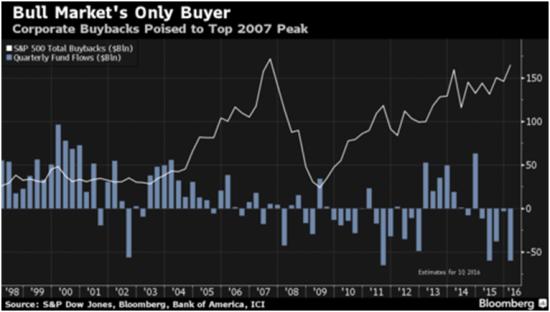
Still, it’s shocking to see where this endless repetition of the same actions takes us. A recent Bloomberg article, for instance, notes that even though corporate profits are falling and individual investors are dumping equity mutual funds, company share buybacks are surging:
Demand for U.S. shares among companies and individuals is diverging at a rate that may be without precedent, another sign of how crucial buybacks are in propping up the bull market as it enters its eighth year.
Standard & Poor’s 500 Index constituents are poised to repurchase as much as $165 billion of stock this quarter, approaching a record reached in 2007. The buying contrasts with rampant selling by clients of mutual and exchange-traded funds, who after pulling $40 billion since January are on pace for one of the biggest quarterly withdrawals ever.
“Anytime when you’re relying solely on one thing to happen to keep the market going is a dangerous situation,” said Andrew Hopkins, director of equity research at Wilmington Trust Co., which oversees about $70 billion. “Over time, you come to the realization, ‘Look, these companies can’t grow. Borrowing money to buy back stocks is going to come to an end.”’
“Corporate buybacks are the sole demand for corporate equities in this market,” David Kostin, the chief U.S. equity strategist at Goldman Sachs Group Inc., said in a Feb. 23 Bloomberg Television interview. “It’s been a very challenging market this year in terms of some of the macro rotations, concerns about China and oil, which have encouraged fund managers to reduce their exposure.”
Should the current pace of withdrawals from mutual funds and ETFs last through the rest of March, outflows would hit $60 billion. That implies a gap with corporate buybacks of $225 billion, the widest in data going back to 1998.
Another recent Bloomberg article highlights the emerging school of economic thought that says governments’ big mistake of the past decade was to borrow and spend too little:
Ignored for Years, a Radical Economic Theory Is Gaining ConvertsIn an American election season that’s turned into a bonfire of the orthodoxies, one taboo survives pretty much intact: Budget deficits are dangerous.
A school of dissident economists wants to toss that one onto the flames, too.
It’s a propitious time to make the case, and not just in the U.S. Whether it’s negative interest rates, or helicopter money that delivers freshly minted cash direct to consumers, central banks are peering into their toolboxes to see what’s left. Despite all their innovations, economic recovery remains below par across the industrial world.Calls for governments to take over the relief effort are growing louder. Plenty of economists have joined in, and so have top money managers. Bridgewater’s Ray Dalio, head of the world’s biggest hedge fund, and Janus Capital’s Bill Gross say policy makers are cornered and will have to resort to bigger deficits.
“There’s an acknowledgment, even in the investor community, that monetary policy is kind of running out of ammo,” said Thomas Costerg, economist at Standard Chartered Bank in New York. “The focus is now shifting to fiscal policy.”
Currency Monopoly
That’s where it should have been all along, according to Modern Money Theory. The 20-something-year-old doctrine, on the fringes of economic thought, is getting a hearing with an unconventional take on government spending in nations with their own currency.Such countries, the MMTers argue, face no risk of fiscal crisis. They may owe debts in, say, dollars or yen — but they’re also the monopoly creators of dollars or yen, so can always meet their obligations. For the same reason, they don’t need to finance spending by collecting taxes, or even selling bonds.
In the U.S., one presidential candidate is at least listening to MMT economists. Advisers to Bernie Sanders include some of the school’s leading advocates: Stephanie Kelton, a Sanders hire to the Senate Budget Committee, and James K. Galbraith, whose father helped shape President Lyndon Johnson’s “Great Society” programs.
The match makes sense. Sanders is promising massive investments in health, education and infrastructure. Economists who see more danger in fiscal austerity than looseness make natural allies.
At first glance, corporate share buybacks and a theoretical debate over fiscal policy might seem like unrelated developments. But in reality they’re both parts of the meta-trend of policy makers becoming lab rats obsessively pressing the bar that used to dispense treats, even though the treats have run out.
Corporations buying back their shares at record prices while their profits are plunging (thus requiring them to buy at the top on margin, a classic dumb-money behavior) are doing something that has failed miserably at the peak of most previous business cycles. Yet corporate treasurers and CEOs, despite being old enough to remember several such cycles, are still compelled to press the bar because they have no other way of quickly goosing the share price — and thus the year-end bonus pool.
Economists who want governments to run bigger deficits financed with newly-created currency seem to miss the fact that today’s policy is already pretty much that. When a central bank buys most of the bonds its government issues, that government is in effect financing itself directly through money printing. So Modern Monetary Theory is being tried on a vast scale as this is written.
And so far, this combination of massive deficits and multi-trillion-dollar bond purchases isn’t working. Inflation is negative in huge sections of the world and growth is anemic at best pretty much everywhere. But here again, that bar is just so tempting because back in the 1950s or 1980s or whenever it yielded such tasty treats. So we get the spectacle of the BoJ and ECB running out of government bonds to buy and turning to corporate bonds and equities, thus directly financing even more than their governments’ deficits.
The implication is that these ideas will be taken farther than ever in coming years. And their inevitable failure will be commensurately epic.
Welcome To The Currency War, Part 22: China Devaluation Watch

But of that day and that hour knoweth no man, no, not the angels which are in heaven, neither the Son, but the Father. – Mark 13:32
Again, not much movement in the U.S. stock market.
All eyes were on U.S. politics.
The Ides of March came… and yea, went… with poor Marco Rubio out of the race…
Yes, it was “Goodbye, Rubio Tuesday”… leaving Donald Trump and Hillary Clinton way ahead of the pack in the race to win their parties’ nominations.
Meanwhile, a dear reader wrote in to complain that the Dow was up some 1,500 points since he acted on our gloomy view… and sold out of the market.
But we hold to our opinion: This ship is sinking.
As an investor, you face two kinds of risk: the risk of missing out on gains and the risk of taking losses.
It’s up to you whether you continue to bet on rising U.S. stocks. But our view is you will be glad you got out when you did.
Death Sentence
 We all live under a death sentence. Markets… societies… and our very lives must follow an unstoppable pattern.
We breathe in… and then we breathe out. We are born… and every mother’s son ever born from the beginning of time until today is programmed for death. Every ship ever built is destined for the bottom of the sea… or the scrap yard.
Up, down… in, out… expansion, contraction. Hey, don’t blame us! We didn’t invent it. That’s just the way it is. And since that is the way it is: Vive la mort!
We don’t necessarily want it. But since it is inevitable, we will look forward to it, like a pair of new boots yearning for mud.
There are times to go forward… and times to back up. There are times to buy. And there are times to refrain from embracing stocks.
This is one of those times.
The Fed has stood pat on rates since December. But the Japanese, the Chinese, and the Europeans have continued to try to goose up their economies with increasingly crackpot monetary policies.
Much of the money thus created has found its way into U.S. markets… which probably explains the refusal of the Dow to go down.
Day of Reckoning
It could be, of course, that we are totally wrong… and that some trend is in place we don’t recognize.
Stock markets are said to “discount the future.” Maybe they see something we don’t.
Or maybe they are simply preparing for a more spectacular day of reckoning by drawing more mom-and-pop investors into deeper water; as always, we wait to find out.
Still, it looks as though the bull market that began in the U.S. in March 2009 is over. And the contraction is not limited to the stock market.
Our economy, our society, and our body politic are all closing up… looking inward… turning their backs on the wider world.
Yes, we are connecting the dots. It is not just the world of money that contracts and expands. The economy breathes, too… and so does our political world.
Why is Donald J. Trump running so strongly in the Republican primaries?
Why is National Front leader Marine Le Pen doing so well in France?
How did Jeremy Corbyn – otherwise a nobody – become the leader of the second-largest party in Britain?
Why is world trade plunging?
Why are inflation expectations running at about 1% for the next decade… despite the biggest increase in central bank balance sheets – the monetary footings of the entire system – in history?
Why are growth rates in Europe, Japan, and the U.S. at their lowest levels since World War II?
And why is $7 trillion of government debt – about one-third of all issuance – now trading at sub-zero yields?
Warning Shot
“Economists fire warning shot on risks of negative interest rates,” reported the Financial Times in a front-page story last week.
“Japan’s negative interest backfire…” it added, again on the front page, two days later.
Why?
Because we are breathing out. Borders are tightening up. Barriers are erected. The “globalism” heralded by New York Timescolumnist Thomas Friedman and others as a solution to all the world’s problems is giving way to “nationalism.”
The expansive EZ money world of the last 30 years is losing air.
Yesterday brought news that consumer savings from the lower price of oil is NOT leading to greater consumer spending… not even in autos. Bloomberg:
U.S. retail sales dropped in February and the prior month’s gain was revised to a decline, calling into question the narrative that bigger gains in consumer spending would propel economic growth at the start of 2016.
The decrease in purchases, which included auto dealers, department stores, and furniture outlets, showed Americans were salting away money saved at the gas pump amid volatile financial markets. The disappointing reading on the biggest part of the economy comes as Fed officials meet to gauge whether growth is strong enough to eventually warrant another increase in interest rates.
“We’re seeing higher rents, higher healthcare expenses, so that may be offsetting a lot of the benefit of lower gasoline prices,” said Scott Brown, chief economist at Raymond James Financial Inc. in St. Petersburg, Florida.
The New Subprime
While current spending slacks off, past spending continues to rattle its chains. Newsmax:
Delinquencies on subprime auto debt packaged into securities reached a high not seen since October 1996, as late payments continued to worsen in February, according to Fitch Ratings.
The number of car borrowers who were more than 60 days late on their bills in February rose 11.6% from the same period a year ago, bringing the delinquency rate to 5.16%, Fitch wrote Monday in a report. During the financial crisis delinquencies peaked at 5.04%, Fitch wrote.
You’ll recall that when we left you yesterday, we promised a look at a deeper malaise. This is it. It is not just the threat of a bear market on Wall Street. Not just a grumpy mood of the voters threatening the Establishment.
It is something bigger… deeper… something unstoppable…
More dots tomorrow…
Regards,
Bill
Market Insight
BY CHRIS LOWE, EDITOR AT LARGE
It’s not just negative-yielding bonds that are spreading like wildfire.
Today’s chart looks at the range of yields on bonds issued by governments in developed countries.

While almost $7 trillion in global government debt now carries a negative yield, another roughly $9 trillion yields between 0% and 1%.
About another $6 trillion yields between 1% and 2%.
Less than $3 trillion in government debt yields 2% or more.

Following last month’s inflation ‘jolt’ to the marketplace, Core CPI increased 2.3% YoY in Feb – the biggest jump since October 2008 (led by the biggest monthly surge in apparel prices since 2009). Bond & Stock markets are dropping in the news as it corners The Fed further into a hawkish stance, despite the recessionary warning signals screaming from the manufacturing (and increasingly Services) sector.
The Core CPI print has not been higher since October 2008…



-
I know Mike is a very solid investor and respect his opinions very much. So if he says pay attention to this or that - I will.
~ Dale G.
-
I've started managing my own investments so view Michael's site as a one-stop shop from which to get information and perspectives.
~ Dave E.
-
Michael offers easy reading, honest, common sense information that anyone can use in a practical manner.
~ der_al.
-
A sane voice in a scrambled investment world.
~ Ed R.
Inside Edge Pro Contributors

Greg Weldon

Josef Schachter

Tyler Bollhorn

Ryan Irvine

Paul Beattie

Martin Straith

Patrick Ceresna

Mark Leibovit

James Thorne

Victor Adair