
Bonds & Interest Rates
 Finance or politics? We don’t know which is jollier.
The Republican presidential primary and Fed monetary policies seem to compete for headlines. Which can be most absurd? Which can be most outrageous? Which can get more page views?
Politics, led by Donald J. Trump, was clearly in the lead… until yesterday. Then, the money world, with Janet L. Yellen wearing the yellow jersey, spurted ahead in the Hilarity Run.
The Dow gained 83 points.
A Witless Tool of the Deep State?
“Cautious Yellen drives global stocks near 2016 peak,” reported a Reuters headline. The story itself was a remarkable tribute to the whole jackass money system.
At first glance, “cautious Yellen” would seem incongruous with stocks rising to “near 2016 peak.” Caution normally means playing it cool, not encouraging speculation.
But it wasn’t so much what Ms. Yellen said that sent stocks racing ahead. It was what she hasn’t done. And she hasn’t done exactly what we thought she wouldn’t do. That is, so far this year, she has not taken a single step in the direction of a “normal” monetary policy; our guess is that she never will.
Why not? Is it because she is a witless tool of Deep State cronies? Is it because her economic theory is silly, superficial, and simpleminded?
Or is it because she and her predecessor, Ben Bernanke, have done so much damage to the normal world that there is nothing to go back to? They have burned our bridges… our factories… our savings… and everything else behind them. Now, it is better just to pack up, move out… and keep on going.
That is more or less what Charlie Munger sees coming.
Prepare for the Worst
Asked whether the Fed would reduce its balance sheet to pre-Great Recession levels (by selling back to the private sector the $4 trillion worth of bonds it bought over the last eight years), Warren Buffett’s long-time business partner had this to say:
I remember coffee for 5 cents and brand new automobiles for $600. The value of money will continue to go down. Over the past 50 years, we lived through the best time of human history. It is likely to get worse. I recommend you prepare for worse because pleasant surprises are easy to handle.
The “normal” financial world is no longer habitable.
Ms. Yellen went on to say that these soupçons of recklessness – her hints about not returning to normal – provided an “automatic stabilizer,” to the global financial system. That’s right. (And here is where we begin to laugh uncontrollably.) Not only does outrageously easy credit help “stabilize” the system, so does the anticipation of more of it!
Maybe giving out the news that she will NOT even try to get back to normal helps to settle investors’ nerves. Maybe normal wasn’t all that great anyway.
Either way, speculators can continue whatever perverted hustles they have going… free from the fear that “normal” will walk around the corner and catch them in the act.
But what’s this? A complicating factor, the “outlook for inflation,” is “uncertain,” says Ms. Yellen. The Financial Times clarifies: “[I]nflation could take longer to return to the Fed’s 2% target.”
Ms. Yellen is worried about a lack of inflation in much the same way primitive farmers worried about a lack of rain. Her response is to do more of the ritual dances… and say more of the magic incantations… that have so far only produced more drought conditions.
A Quarter Century of Voodoo
In Japan, they’ve been doing this voodoo for 26 years. We’ve had our eye on Japan since the mid-‘80s, when everyone was sure that Japan Inc. was the hottest thing in the econosphere.
The miracle economy blew up in 1989, and liquidity disappeared. Since then, Japan Inc. has been the Sahara of the developed world. QE, ZIRP, NIRP, monumental deficits, Abe’s Arrows… nothing worked to make it rain.
Negative interest rates, announced late last year, were supposed do the job. Savers were supposed to throw up their hands, open up their wallets… and spend, spend, spend to avoid paying the tax on saving.
Instead, savers saved more. What else could they do? With negative rates they needed more savings to get the same financial bang per buck.
Result: In January, Japan’s retail sales fell 2.3% over the previous month.
But the Japanese feds aren’t giving up. And now they turn to two of the world’s most celebrated witchdoctors – Paul Krugman and Joseph Stiglitz – for advice on what to do next.
Japan has famously run huge fiscal deficits in an effort to get the economy moving. Thanks to a quarter century of these loose budgets, the island now has gross government debt equal to 240% of GDP and nearly nine times tax revenues.
Most of the spending is used to fund programs for old people – health care and pensions – making it hard to cut back. Japan’s government finances are nothing more than a huge, compulsory, unfunded, old-age benefit program… one that is sure to go broke.
But don’t worry, Japan. According to the Financial Times, the two Nobel Laureates went to Tokyo and argued – if you can believe it – that Japan needs more liquidity, that is, “a looser fiscal policy.”
Yes, like New Orleans needed a shower after Hurricane Katrina.
Regards,
 |
Bill Bonner
Further Reading: More liquidity for Japan? There’s already at least $200 trillion of debt smothering global economies, and now they want to add more? This can’t end well for any of us.
As Bill’s been warning, the world’s crackpot credit scheme that began 45 years ago is now coming to a head… In his online presentation, Bill pulls back the curtain and shows you just how broken the entire system has become… and how it is now on the verge of collapse. He also gives his personal advice for how to avoid the worst of it. Watch it here now.

It’s the same story pretty much everywhere: Cities and states promised ridiculously generous (by today’s standards) pensions to teachers, cops and firefighters, failed to sufficiently fund the plans and invested the money they did have very badly. And now the weight of the resulting unfunded obligations are crushing not just plan recipients but entire communities. Here’s a representative case:
Oregon PERS unfunded liability swells to $21 billion
(KTVZ) – This week, Oregon’s Public Employee Retirement System Board received an earnings report on the status of the PERS fund investment. The report said Oregon’s PERS fund fell by 4 percent in 2015, a loss of nearly $3 billion — and a Central Oregon lawmaker said that means major reforms are more urgent than ever.
“The blow to PERS from the Moro court case left Oregon with an additional $5 billion in unfunded liability,” Sen. Tim Knopp, R-Bend, said Tuesday. “Now PERS is an additional $8 billion short of its target.”
In that ruling nearly a year ago, the state Supreme Court overturned the vast majority of the PERS reform cost-saving provisions enacted by the 2013 Legislature.
The current unfunded PERS liability now exceeds $21 billion, up from $18 billion last year, he noted.
PERS Communications Director David Crossley said while the PERS fund earned just over 2 percent last year, it did not achieve the “assumed savings rate” of 7.75 percent, so the liability increased by about $3 billion.
He noted that PERS had positive earnings, but lost value because it pays out about $3.5 billion in benefits a year.
PERS rates for school districts and local governments will rise in July 2017, Knopp said, forcing school districts to lay off teachers, reduce school days, increase class sizes, and cut programs like art and PE. Local governments will also have to make cuts to public safety and other critical services.
This combination of worse-than-expected investment returns and legal barriers to cost savings is playing out across the country. See Fitch downgrades Chicago after “worst possible outcome” in state supreme court pension reform bid.
What follows — “…forcing school districts to lay off teachers, reduce school days, increase class sizes, and cut programs like art and PE. Local governments will also have to make cuts to public safety and other critical services” — is also playing out in most states and cities.
And this, remember, is at the tail end of an epic bull market in financial assets. If pension plans aren’t fully funded now, they’ll fall into an abyss in the coming correction.
The result: everyone gets poorer. Or more accurately, everyone discovers that they were never as rich as they thought they were, and that the down escalator they’re on has a long way to go.
At the risk of belaboring the point, imploding pensions, like most other modern problems, can be traced back to easy money. Put a monetary printing press in the hands of government and the resulting corruption flows from Washington outward to every state capital and mayor’s office. With interest rates artificially low and inflation artificially high, generating 8% returns as far as the eye can see looks not just possible, but easy. So promising benefits based on high rates of return seems reasonable to elected officials anxious to buy labor peace. And once the Ponzi scheme is in place, there’s no way to turn it off without creating chaos.
The only solution (again at the risk of repetition) is to take the easy money program to its logical extreme and devalue the dollar by an amount large enough to make nominal pension benefits affordable. That’s functionally the same as honestly cutting benefits and will impoverish everyone who doesn’t own lots of real assets, but it will be easier to hide.


US Dollar & Stock Market Video Analysis
Gold & Silver Bullion Video Analysis
Precious Metal ETFs Video Analysis
Trader Time Swing Trades Video Analysis
SFJ Core Position Stocks Video Analysis
Today’s videos and charts (double click to enlarge)
Thanks,
Morris

 If Congress has the right to issue paper money, it was given to them to be used by and not to be delegated to individuals or corporations. President Andrew Jackson.
The weapon of choice is money, and central bankers utilize this weapon merciless to rain misery on the unknowing masses by purposely creating boom and bust cycles. Since Fiat was created, bankers have fed off the misery they have wrecked on humanity. How do they feed off this misery? They no longer take from Peter and give to Paul; they make sure that Peter and Paul try to rob each other and everyone else to survive. They control the game, and you are just a pawn in this game. The only day the outcome will change, is when the masses stand up and revolt. However, we would not hold our breath for that day as the masses are notorious for their delayed reactions. Many great men, former presidents included are of the same opinion.
George Washington, one of the wisest of all presidents, understood this very well and it’s revealed clearly in this quote.
“But if in the pursuit of the means we should, unfortunately, stumble again on unfunded paper money or any similar species of fraud, we shall assuredly give a fatal stab to our national credit in its infancy. Paper money will invariably operate in the body of politics as spirit liquors on the human body. They prey on the vitals and ultimately destroy them. Paper money has had the effect in your state that it will ever have, to ruin commerce, oppress the honest, and open the door to every species of fraud and injustice.” – George Washington in a letter to Jabez Bowen, Rhode Island, Jan. 9, 1787
Another wise president was Thomas Jefferson, who was so against bankers that he thought they were worse than a thousand standing armies and he was correct.
“I believe that banking institutions are more dangerous to our liberties than standing armies. Already they have raised up a monied aristocracy that has set the government at defiance. The issuing power should be taken away from the banks and restored to the people to whom it properly belongs.” Thomas Jefferson, U.S. President
“We have, in this country, one of the most corrupt institutions the world has ever known. I refer to the Federal Reserve Board. This evil institution has impoverished the people of the United States and has practically bankrupted our government. It has done this through the corrupt practices of the moneyed vultures who control it.” Congressman Louis T. McFadden in 1932 (Rep. Pa)
“A great industrial nation is controlled by its system of credit. Our system of credit is concentrated in the hands of a few men. We have come to be one of the worst ruled, one of the most completely controlled and dominated governments in the world– no longer a government of free opinion, no longer a government by conviction and vote of the majority, but a government by the opinion and duress of small groups of dominant men.” President Woodrow Wilson
“We are completely dependent on the commercial banks. Someone has to borrow every dollar we have in circulation, cash or credit. If the banks create ample synthetic money we are prosperous; if not, we starve. We are absolutely without a permanent money system.It is the most important subject intelligent persons can investigate and reflect upon. It is so important that our present civilization may collapse unless it becomes widely understood and the defects remedied very soon.” Robert H. Hamphill, Atlanta Federal Reserve Bank
Two members of the House Rothschild are openly bragging about the power that’s bestowed on the entity that controls the money supply.
“Give me control of a nation’s money and I care not who makes its laws.” Mayer Amschel Bauer Rothschild
“The few who understand the system, will either be so interested from its profits or so dependant on its favors, that there will be no opposition from that class.” Rothschild Brothers of London, 1863
When you control the money, you ultimately control everything. Note that the Federal Reserve is not a Federal institution, it’s a private institution, and that is why Congress will never be able to audit it as private shareholders hold the majority position. To cause a boom, they flood the markets with money and to cause a bust; they tighten the spigots. This is how every bubble is created; some examples of modern day bubbles are dot.com, housing crisis of 2008, and the current hot money bubble.
The current ultra-low interest environment is fuelling a hot money bubble.
The first stage of this bubble was created by corporations borrowing large sums of money and using these funds to purchase enormous amounts of their shares, thereby artificially boosting the EPS and making it look like all is well. When in fact, nothing is improving and only the number of outstanding shares is dropping, which gives the false impression that profits are increasing when they are not. In fact, in many instances profits would have declined if the share buyback programs did not exist.
Negative Rates are God send for the Greedy, unscrupulous corporate world
The Corporate world will embrace Negative rates with gusto as it will be akin to a crack addict being given a new dose of super crack. History does not change, only the outfits change, but the con is always the same and the ones left holding the empty bag are the sheep (otherwise known as the masses). The Fed is trying to put on a brave act, but you can already see them backtracking from the strong stance they took last year. Now they are stating that all is not well, and the economic outlook is weaker than expected. They will have no option but to join the rat pack, however, that was their intention all along. Moving slower than the rest of the world creates the illusion that the dollar is stronger and in the race to the bottom the objective is to finish last instead of first.
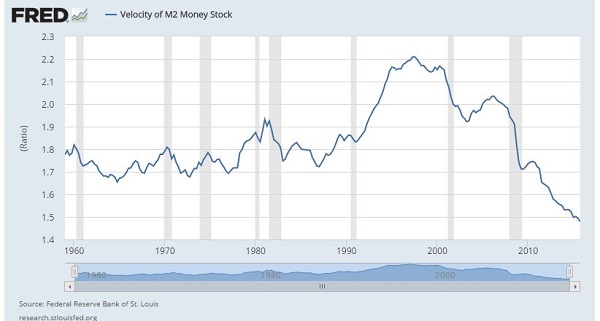
The markets are totally controlled and manipulated; every boom and bust cycle was planned in advance of the event. The chart below illustrates that the economy is far from healthy, in fact, it appears to be almost in a coma and is being forcefully kept a life through immense injections of hot money. . Take away the hot money and this illusory economic recovery crumbles; if a market is healthy the velocity of money increases and vice versa. Look at the chart below, the velocity of money is dropping like a falling dagger.
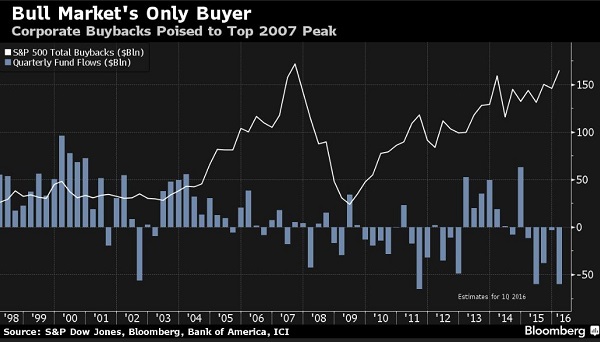
Share buybacks setting new records every year
Last year share buybacks and dividends payments surpassed the one trillion dollar mark, this year they will probably surpass that level.
Companies in the S&P 500 Index are poised to purchase over $165 billion of stock this quarter, bringing them dangerously close to taking breaking the 2007 record.
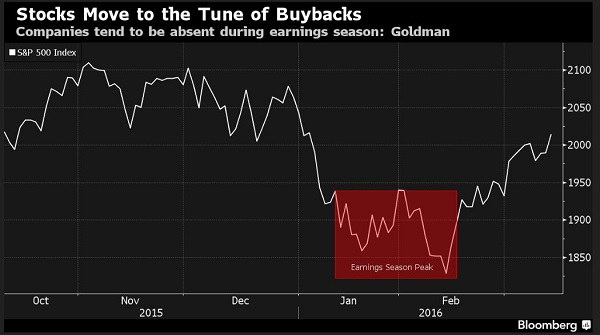
A clear illustration that stocks are moving in sync with corporate share buyback programs; when stocks pull back the corporate world tends to step in and snap up stocks. Take a look at the period from Jan to Feb, corporations stepped in and bought a boatload of shares,and the market soared.
Negative Interest rates & the “Devalue or Die Era.”
Currency wars are picking up steam; a host of nations are now joining the bandwagon, as illustrated by the chart below. Get ready for the next stage of the mighty currency wars; imagine having to pay the banks to keep your hard earned money. The worst being that the banks will lend this money out and earn interest on it; they will win on both sides.
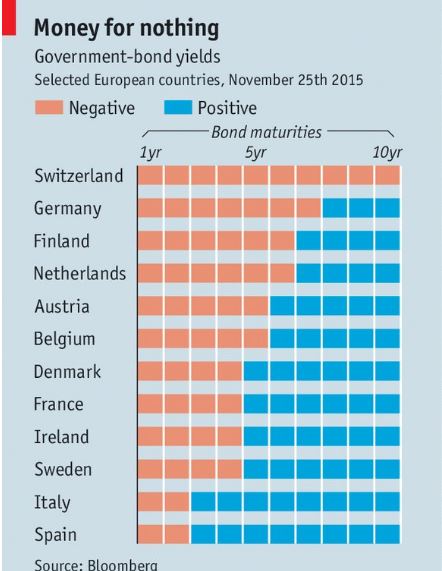
Map illustrating how central bankers worldwide are embracing the era of negative rates
Image source: The Telegraph
Record share buyback debt fuelled binge will continue and here’s why:
Low rates have forced people to speculate so imagine what effect Negative interest rates will have on the populace and the corporate world. To the corporate world, it will be a clear signal that they should continue raiding the cookie box. Buy back more shares, boost EPS, get larger bonuses, and do the same thing over and over again, until the cycle ends and then send the bill to the masses. The bottom always drops out, but it’s the average Joe that is left holding the can. Nothing has changed, and nothing will change going forward
“Anytime when you’re relying solely on one thing to happen to keep the market going is a dangerous situation,” said Andrew Hopkins, director of equity research at Wilmington Trust Co., which oversees about $70 billion. “Over time, you come to the realization, ‘Look, these companies can’t grow. Borrowing money to buy back stocks is going to come to an end.”’
“Corporate buybacks are the sole demand for corporate equities in this market,” David Kostin, the chief U.S. equity strategist at Goldman Sachs Group Inc., said in Feb. 23 Bloomberg Television interview. “It’s been a very challenging market this year regarding some of the macro rotations, concerns about China and oil, which have encouraged fund managers to reduce their exposure.” Full story
The Crowd Psychology perspective
The trend is up regarding share buybacks, and as Central bankers worldwide are gravitating towards negative rates, it is fairly safe to assume that this trend will continue for quite some time. The masses are not revolting against this dishonest behavior and until they do, the dollar amount committed to share buybacks will continue to surge.
Nothing short of rising rates will put a damper on share buybacks, and there is absolutely no chance in hell of rates rising, not when the entire world is embracing negative rates. . The second option is for Congress to pass new laws restricting companies from blatantly repurchasing their shares with the sole intention of raising the EPS. The odds are better that some alien life form will contact us then of Congress passing such a law.
Suggested Strategy
First of please do not believe the nonsense that many experts spew, when they state that the Fed is scared, it has its back to a wall, and it has to do this or that; in short anything along those lines is total rubbish. The Fed never was and will never be scared, as they have no one to answer to but themselves. When you control the money supply, you control everything. Each move has been pre-planned with precision, and the only ones that are scared are the penguins making these proclamations. Listening to that nonsense might make you feel good for a moment, but you will have nothing to show for it in terms of monetary gains. The better option is to ride on the coattails of these nefarious manipulators and in doing so protect your wealth. One day, the Federal Reserve will collapse, but that day is not today, and the odds are high that you might not be around to see that day.
Manipulation is the order of the day, and this trend will continue to gather traction; it will only end when the masses revolt. The masses are notorious for responding very slowly, so we can assume that by the time they snap out of their comas, the markets will be trading at unimaginable levels. We expect corporate debt to trade at levels that will make today’s insane levels appear sane one day. Against this backdrop you have only one option; every major pullback/correction has to be viewed as a buying opportunity. The markets will continue to be manipulated probably until the end of time, so until the trend changes, every strong pullback has to be viewed as buying opportunity.
It is well that the people of the nation do not understand our banking and monetary system, for if they did, I believe there would be a revolution before tomorrow morning. Henry Ford
Then Joseph said to Pharaoh, “The seven good cows are seven years, and the seven good heads of grain are seven years; it is one and the same dream. The seven lean, ugly cows that came up afterward are seven years, and so are the seven worthless heads of grain scorched by the east wind: They are seven years of famine.”
 When a bunch of hoary old traders sat under the buttonwood tree in New York City in 1792, they knew the point of a market.
It was a place where buyers met sellers and they traded on a mutually agreed price.
A market was a place where people took risks, overpaid, got bargains, failed, gained, and in the end pooled money to build canals, manufacturing, and international trade.
Times Change
Yesterday, we’ve discovered yet again that the stock market is a casino where the house always wins. Janet Yellen, the chief of the Federal Reserve, has yet again shown us that “price discovery” is meaningless and the advantages are for the well connected.
Kissing the Dove of Spring
Let’s just go back down memory lane. Late last year, Yellen said she would hike rates if unemployment was below 5% (it is) and inflation was stable (it is).
She stated that stocks were expensive (P/E of 17) and the economy was going to overheat. But she was robust and had a backbone. There would be no bubbles on her watch, so she raised rates in December a quarter point to 0.50%.
The market rallied in a reverse “sell the news” scenario. She went on to say that she would raise four more times this year. The market kept going up. It was 1999 all over again!
Then in the gloom and cold of February, she shuffled the point of her duckboot in the gray slush of a New York sidewalk and mumbled under her breath. Perhaps she was imprudent.
And so, with the gusty winds of late March blowing down the canyons of New York, she spied a rock dove, an omen, and said she wouldn’t raise after all. At least not until that utopian day in the stock market where growth returns, otherwise known as the second half of the year. And there might even be a QE4 if things get tough.
No Privy Here
I’m not privy to what information Yellen has or pays attention to. In her speech she talked a lot about a slowdown in China — so perhaps that’s the problem.
Or not. Who can tell? At least Greenspan carried an overstuffed briefcase on days he hiked rates, thus giving the speculators a fighting chance. This Fed gives the impression that it doesn’t know what is going on much less where it wants to go.
Your humble editor has spotted one pattern in the Fed going back to the 1990s. They talk up rate hikes, set up the shorts, and then blow them out. The market then notches higher and the whole game starts over.
Bubble and Bust
Over the long haul, every boom needs a bust to clear out the deadwood. Bailouts by definition lead to more bailouts. Failure, on the other hand, is self-correcting.
There is another dominant economy that never cleared out the deadwood and instead propped up the status quo with bailouts, low rates, and easing: Japan, the country that just announced industrial output dropped 6.2% in February.
This is what happens when you borrow and bail out repeatedly over the decades.
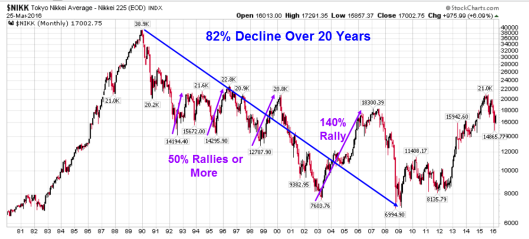
It’s worse than a market crash. It is a market crash followed by false hope after false hope. It’s 25 years of taking your money.
Buy, Hold, and Go Broke
Last week I told you the market looked like it was topping out. Forward earnings were abysmal and would have to be downgraded. You can read that here.
This week I’ll tell you the fundamentals are even worse. One of the pillars holding up this sham of a market has been stock buybacks. As you can see by this chart, that trend is also starting to reverse.
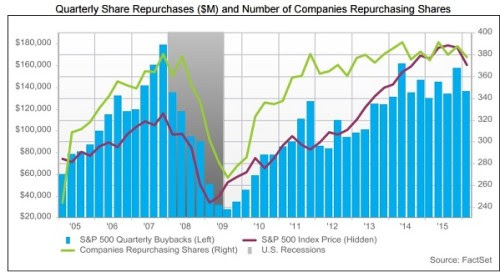
Note that the last time buybacks hit a zenith (in 2008), similar to the present,
it was right before the crash. As soon as stock buybacks ended, the stock market fell 50%.
If loans get hard to come by, buybacks are less of an option. Perhaps this is what the Fed is worried about.
Or maybe it’s the inventory-to-sales ratio:
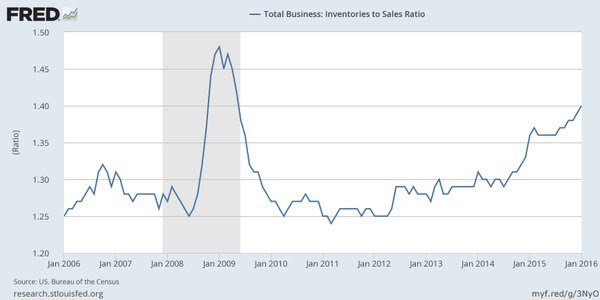
That’s a lot of product to have on the shelves. It must be worked off in one of three ways: writing it off, slashing prices, or cutting production and waiting.
And it’s not priced in. Here is the S&P 500 price-to-sales ratio.

History tells us that when the S&P 500 has a P/S ratio below 0.9, it will be up an average of 81% in five years. If the P/S is above 0.9, in five years, the market will be up only 4.7%.
As you can tell by the chart, we are now sitting at a 10-year high of 1.81 — twice the “buy” price.
That said, you can’t fight the Fed. Fundamentals no longer matter… until they do. Buy silver.
All the best,

Christian DeHaemer
Since 1995, Christian DeHaemer has specialized in frontier market opportunities. He has traveled extensively and invested in places as varied as Cuba, Mongolia, and Kenya. Chris believes the best way to make money is to get there first with the most. Christian is the founder of Crisis & Opportunity and Managing Director of Wealth Daily. He is also a contributor for Energy & Capital. For more on Christian, see his editor’s page.

-
I know Mike is a very solid investor and respect his opinions very much. So if he says pay attention to this or that - I will.
~ Dale G.
-
I've started managing my own investments so view Michael's site as a one-stop shop from which to get information and perspectives.
~ Dave E.
-
Michael offers easy reading, honest, common sense information that anyone can use in a practical manner.
~ der_al.
-
A sane voice in a scrambled investment world.
~ Ed R.
Inside Edge Pro Contributors

Greg Weldon

Josef Schachter

Tyler Bollhorn

Ryan Irvine

Paul Beattie

Martin Straith

Patrick Ceresna

Mark Leibovit

James Thorne

Victor Adair