
Stocks & Equities
 Watch as profits and dividends skyrocket this summer for these three seasonal businesses that perform best in the second and third quarter of the year. Now is the time to start accumulating a position in these stocks that could return high double-digits by late fall of this year.
You have probably noticed that gasoline prices are starting to rise and have increased quite a bit in just the last few weeks. In my area, gas is up about 60 cents per gallon and seems to be climbing every day. The stocks that see immediate profit increases from higher fuel prices are usually the refining companies. The cyclical nature of the refining business has set these stocks up for some very nice gains between now and next fall, and dividend focused investors can count on some nice quarterly payouts.
Refining is an interesting industry to analyze because the prices of both the raw material, crude oil, and end product, gasoline, diesel, heating and jet fuel, are set in the commodity markets. This means that gross refining margins, usually measured on a per barrel basis, are mostly out of control of the refining companies. The factors these businesses do control are their refining efficiencies, which drive down the expenses to refine a barrel, and their sourcing practices, where they buy and how they transport crude oil.
related:
5 Big Dividends To Sell Now (& Avoid Until 2017)

When I coach investors and traders, I’m often asked what I think are the most-common, most-ruinous mistakes that investors make. Unfortunately, there are a lot of them.
And these days, it seems like investors are making almost all of them at the same time.
There are mistakes like risking too much money on a single trade or investment … not using protective stops … not using disciplined money management … trading too often … not doing your homework … taking on too big a position in any market … not diversifying enough … and on and on.
Then there are mistakes like not knowing when to trade, and equally important, knowing when not to trade or invest, like today’s sideways markets.
Over time, I will explore each and every one of the above in greater detail, and more, to help you learn how to become a better investor and trader.
But in today’s column, I want to cover what I think is the most-dangerous mistake investors make, bar none. It’s having a set of preconceived notions about what markets can and can’t do.
Consider this weekend’s Doha meeting on oil prices. There was no agreement reached. And what happened Monday morning?
Oil prices (logically you might say) crashed, nearly 7 full percent.
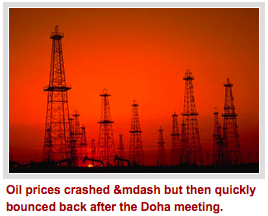 But then what happened? Oil prices roared right back, ending the day virtually unchanged.
Why did that happen?
Because longer term, oil is already back in a bull market, and savvy investors are buying the dips. That’s why.
So you see, the fact of the matter is that markets can do whatever they want to do. But they are also never wrong. Markets are never irrational.
They are what they are, and if you don’t understand a market, it’s not the market’s fault; the fault lies instead with your analysis.
For instance, have you ever heard someone say, “A market is defying all logic”?
Or that a market is “disconnected from its underlying fundamentals”?
I’m sure you have. I hear those kinds of phrases all the time on shows on Bloomberg and CNBC.
But the fact of the matter is that …
Markets NEVER defy logic.
And they never defy the fundamentals.
Only people defy logic. Only people can make such statements about fundamental forces as well, because when a market is allegedly defying fundamentals, what it’s really doing is operating on fundamental forces that the analyst or investor simply hasn’t figured out yet.
I fully realize that what I’m talking about here is hard to grasp at first. But if you take the time to think deep and hard about what I’m saying, you will elevate your trading and investing to a whole new level. Markets are never wrong. Only people are.
Especially dangerous for most traders and investors is getting caught up in the various “market myths” that are out there.
For instance, how many times have you heard that rising interest rates are bad for the stock market, and that declining rates are good for stocks?
If you’re like any average investor, you’ve heard that theory literally hundreds, if not thousands, of times. Tune into any media show today, and I’m sure you’ll hear it at least once, if not more.
Most stock brokers, and the majority of analysts and newsletter editors, espouse the same causal relationship between interest rates and stock prices.
But the fact of the matter, the plain truth, is that there is no “standard relationship” between interest rates and stock prices. Period.
Consider the period from March 2000 to October 2002, where the federal funds rate declined from 5.85% to 1.75%, and the Nasdaq plunged 78%. Put simply, stocks and interest rates went down together! Exactly the opposite of what most would expect.
Or the period from March 2003 to October 2007, where the federal funds rate more than tripled and rose from 1.25% to 4.75% …
And the Dow exploded higher, launching from 7,992 to 13,930 — a 74% gain! Stocks and interest rates went higher together!
The fact of the matter is that the relationship between interest rates and stock prices varies considerably depending upon a host of factors, including the value of the dollar, inflation and where the economy is in terms of the economic cycle.
But the bottom line is this: Never assume anything and never, ever get caught in conventional thought about a market or you will most likely lose your shirt.
Let’s consider another myth that rising oil prices are bearish for stocks. That’s a bunch of baloney, too.
The fact of the matter is that there have been plenty of times when rising oil prices were bullish for stocks … and where falling oil and energy prices were bearish. Exactly the opposite of what most conventional thought tells you.
Or consider the normal view about a country’s widening trade deficit. The common theory is that a widening trade deficit is bad for stock prices and a narrowing deficit is good.
But history proves that it is entirely wrong, and nothing more than a myth.
Fact: From 1976 to 1998, the U.S. trade deficit ballooned from $6.08 billion to $166.14 billion, and guess what? The Dow Jones Industrials went from 848.63 to 9,343.64!
In truth, the relationship between the trade deficit/surplus and stock prices is exactly the opposite of what most pundits claim.
Or consider the myth about corporate earnings that says they have to rise for stock prices to continue higher. But from 1973 to 1975, the combined earnings of the S&P 500 companies rose strongly for six consecutive quarters, yet the S&P 500 Index fell more than 24%.
Moreover, according to research conducted by analyst Paul Kedrosky, since 1960, the average annual return on the S&P 500 was greatest when earnings were falling at a clip of 10% or more … while the smallest returns on the S&P 500 occurred when earnings were growing at up to 10% per annum!
In other words, rising corporate earnings does not guarantee rising stock prices, by any means. Nor do falling corporate earnings guarantee falling stock prices!
There are lots of myths or biases out there about relationships between economic fundamentals and markets, or between markets and other markets.
But the fact of the matter is that almost all of them are exactly that: Myths, and nothing more.
The bottom line: To avoid making the biggest investing and trading blunders …
- Never assume anything when it comes to the markets …
- Question everything, and most of all …
- Think independently!
Right now, gold is trying to bounce a bit. But it won’t get far. It’s headed lower overall, probably to below $1,200 an ounce …
Before it bottoms for good, in a sort of double-bottom way. Same for mining shares.
The stock market, meanwhile, is also bouncing. But don’t be deceived: It’s headed lower, too. It has not broken out yet.
Stay tuned and best wishes,
Larry

Over the last couple of weeks, in both the daily blog and weekly newsletter, I have been laying out the technical case for a breakout above the downtrend. Such a breakout would demand a subsequent increase in equity risk in portfolios. To wit:
“As I stated last week, the markets have currently registered a very short-term buy signal which dictates that we must consider increasing equity risk in portfolios. I would be remiss in not paying attention that signal, but such signals can be a “false flag” during a larger market topping process.
The markets must break above the current downtrend line in order to increase allocations in portfolios. I have already positioned model portfolios to increase exposure back to 50% should such an event occur.”
I have updated the chart below through today’s open.

 “Few things can help an individual more than to place responsibility on him, and to let him know that you trust him.”
– Booker T. Washington
Great leaders recognize that nothing is complete within isolation, and focus on building great teams. In business, we often talk about the importance of teams, but rarely take the time to truly plan out our effective teams. There are five traits necessary to building a great team.
How to build a world-class team
- Focus on building the team before you need to accomplish the big task. By getting the right team in place before the main task is executed, people will feel that they are part of the bigger picture and be more committed.
- Attract top people to you by building a superior company. The best will come to you, rather than you going to them. This saves time, money, and they tend to bring their top colleagues with them.
- Build a team with the right people with the right skill sets that complement one another, and are necessary to achieve the task. Not a team that has skill sets that you like or your own personality traits, but have the skills and traits necessary to achieve the critical task.
- Build a team that truly supports and trusts one another, so it’s not a group of individuals but is a team with a common purpose. This process takes some time, since it requires the formation of the team, a period of time for them to get to know one another, for that knowing to turn into trust, and ultimately for that trust to turn into action.
- Assure that each person on the team knows what their areas of responsibility and accountability. Like a sports team each person plays a particular role. They are supported by one another, but at the end of the day, each person has a position. As a leader it is your responsibility to assure those roles and responsibility are clearly defined, articulated, agreed to, measured and appropriately resourced over time.
- A team needs to be rewarded for their actions. No team no person will work on any activity without some measure of reward, and I’m not necessarily talking solely about financial compensation. Because most of us are focused on doing something important something with purpose, so your reward should be consistent with a purpose for the team.

 Joseph Schachter’s powerful interview with Michael Campbell on the coming surprising move in Oil. Joseph very accurately forecast the drop in Oil from over $100 down to twenties. Then he forecast the bottom, and subsequently Crude oil prices rose from those lows during March as a hoped for production freeze by OPEC and Russia gained attention. From a low in mid-February of US$26.05/b prices charged higher in the first 3 weeks of March to US$42.49/b as shorts were under pressure and covered their positions. During this window comments by Saudi and Russian officials supporting a freeze bolstered prices. However in late March……
…..listen to Mike’s interview with Joseph below:
{mp3}grant/041616y{/mp3}


-
I know Mike is a very solid investor and respect his opinions very much. So if he says pay attention to this or that - I will.
~ Dale G.
-
I've started managing my own investments so view Michael's site as a one-stop shop from which to get information and perspectives.
~ Dave E.
-
Michael offers easy reading, honest, common sense information that anyone can use in a practical manner.
~ der_al.
-
A sane voice in a scrambled investment world.
~ Ed R.
Inside Edge Pro Contributors

Greg Weldon

Josef Schachter

Tyler Bollhorn

Ryan Irvine

Paul Beattie

Martin Straith

Patrick Ceresna

Mark Leibovit

James Thorne

Victor Adair