Energy & Commodities

Largest New Discovery of Oil in USA – Fed Raises Rates Markets Rally

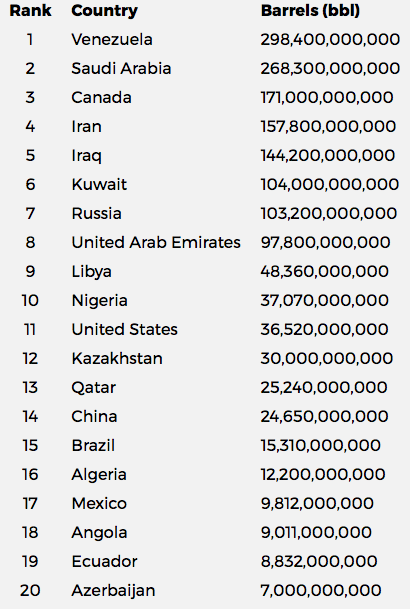
Screen Shot 2017-03-16 at 10.35.19 AMMartin: Another major discovery of oil has been made in Alaska of 1.2 billion barrels. It is the largest find of conventional oil for 30 years on US territory.

The Fed Raises Interest Rates & Markets Rally!

“The Fed’s forecasts have moved in the direction of tightening, and despite what they say publicly, the most serious stimulus is rising stock prices”

….continue reading HERE


New Oil Price War Looms As The OPEC Deal Falls Short

fff87196ef7e3e4575b54310caae969eLast November, OPEC orchestrated an impressive feat: corralling all (or nearly all) of its members to sign on to relatively aggressive production cut deal, and then actually convincing everyone to follow through on those reductions beginning in January. OPEC’s estimated 94 percent compliance rate defied the cartel’s own history of cheating and mistrust, and OPEC has taken around 1 million barrels of oil production per day off the market.
They were initially rewarded for this. Oil prices rallied more than 20 percent in the month after the deal was announced and investors and analysts have been mostly bullish on crude prices ever since. But the cuts were not all that they seemed to be for two reasons:

….continue reading HERE

….related:

Why Commodities Could Be on the Verge of a Massive Surge

Why Commodities Could Be on the Verge of a Massive Surge

After finishing 2016 up 25 percent, commodities are getting another boost from bullish investors. Investment bank Citigroup forecasts commodity prices will increase this year on strengthening demand in China and mounting inflation inspired by President Donald Trump’s “America First” policies. Commodity assets under management globally stood at $391 billion in January, up 50 percent from the same time the previous year, according to Citigroup.

CityNasdaqBoard

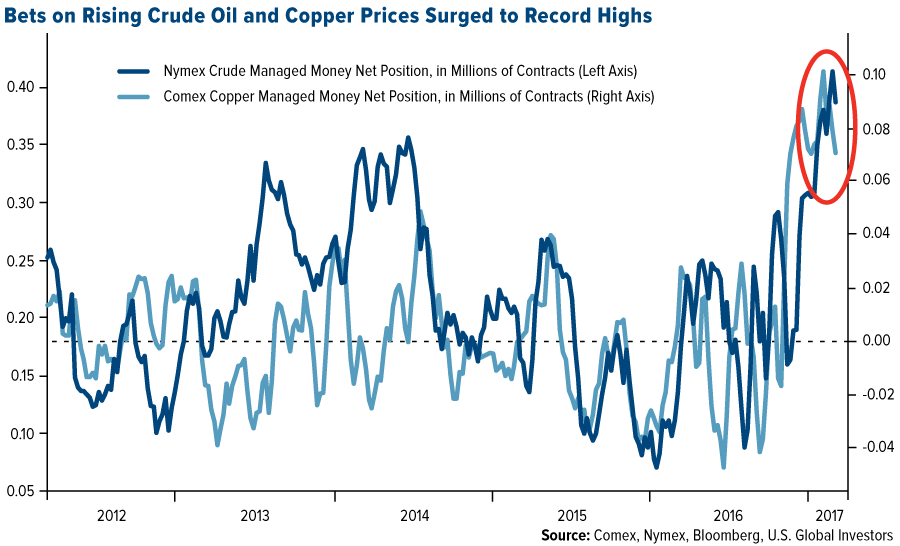
Meanwhile, hedge fund managers significantly raised their bets that copper and oil prices have much further to climb, Bloomberg reported, with net-long positions in the Comex and Nymex markets surging to all-time highs.

Bets on Rising Crude Oil and Copper Prices Surged to Record Highs
click to enlarge

In addition, global manufacturing activity has expanded for the past six straight months, a good sign for commodities demand going forward. As I shared with you earlier in the week, the global purchasing managers’ index (PMI) advanced to a 69-month high of 52.9 in February, with strong showings from the U.S. and eurozone.

JP Morgan Global Manufacturing PMI at 69-Month High in February
click to enlarge

Asia Looking for $26 Trillion: Asian Development Bank

As for China and the rest of Asia, a recent special report from the Asian Development Bank (ADB) calculates the cost to modernize the region’s infrastructure at between $22.6 trillion and $26 trillion from 2016 to 2030. This comes out to about $1.7 trillion a year in global investment that’s required to maintain Asia’s growth momentum, deliver power and safe drinking water to millions, connect towns and cities, improve sanitation and more.

As you can see in the chart below, the bulk of the infrastructure need is in East Asia, which is seeking more than $16 trillion between now and 2030.

Asia and Pacific Region Needs $26 Trillion Through 2030 for Infrastructure

Governments have devoted funds to support only some of the projects. Currently, 25 economies in the region are spending a combined $881 billion annually on such projects, leaving a substantial spending gap for global investors to fill. This is an unprecedentedly huge opportunity for commodity and materials investors.

To make investment more attractive, however, regulatory and institutional reforms will need to be made in the region.

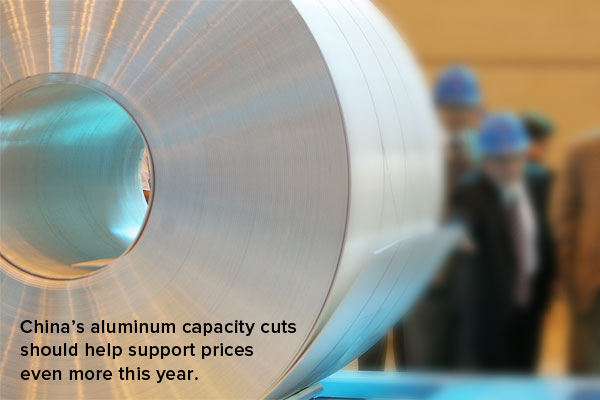
China, for instance, announced plans to curb aluminum, steel and coal production in an effort to combat air pollution. According to the Financial Times, as many as 30 northern Chinese cities are expected to cut aluminum capacity by more than 30 percent, a move that’s seen as very favorable to the rally that’s already helped the base metal gain over 11 percent so far in 2017.

Aluminum Could Benefit Even More from China Production Curb
click to enlarge

In the past five trading days, shares in leading aluminum producer Aloca have surged on the news, jumping as much as 9.8 percent on March 1 alone. Since the November election, in fact, the company has gained more than 44 percent on optimism over President Trump’s pledge to spend $1 trillion on U.S. infrastructure.

China's aluminum capacity cuts should help support prices even more this year.

$3.9 Trillion Still Needed in the U.S.

One trillion dollars sounds like a lot, but it falls remarkably short of the $3.9 trillion the U.S. needs by 2025 to rebuild its own aging infrastructure. That’s the estimate of the American Society of Civil Engineers (ASCE), which gave the nation’s overall infrastructure a D+ in 2013, with “poor” scores given to levees, roads, inland waterways, drinking water and more.

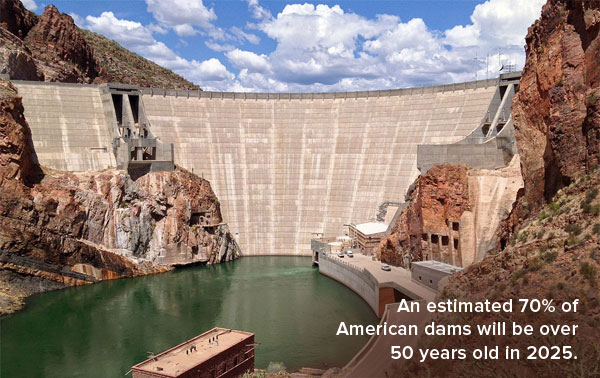
One of the most urgent areas for investment is the nation’s crumbling dams. According to energy news outlet E&E, about 70 percent of America’s 90,000 dams will be at least 50 years old by 2025, putting them near the end of their engineering lifespans. An estimated 15,500 American dams are now considered “high hazard,” meaning their failure could cause fatalities.

An estimated 70% of American dams will be over 50 years old in 2025.

The cost of repairing and upgrading these structures is estimated to be around $54 billion.

According to E&E, 80 dams failed in South Carolina in the past two years alone, causing millions of dollars’ worth of property damage.  And just last month in a high-profile case, more than 188,000 Californians had to be evacuated to avoid the collapse of the Oroville Dam, the nation’s tallest dam.

Like the ADB’s Asian infrastructure estimate, this has massive market potential. More than 80 percent of U.S. infrastructure, from schools to streets to sanitation, is in either private or municipal ownership. This means commodity and municipal bond investors will need to pick up where federal dollars leave off.

http://www.usfunds.com/ 

All opinions expressed and data provided are subject to change without notice. Some of these opinions may not be appropriate to every investor. By clicking the link(s) above, you will be directed to a third-party website(s). U.S. Global Investors does not endorse all information supplied by this/these website(s) and is not responsible for its/their content.

The J.P. Morgan Global Purchasing Manager’s Index is an indicator of the economic health of the global manufacturing sector. The PMI index is based on five major indicators: new orders, inventory levels, production, supplier deliveries and the employment environment.

Holdings may change daily. Holdings are reported as of the most recent quarter-end. None of the securities mentioned in the article were held by any accounts managed by U.S. Global Investors as of 12/31/2016.

Investors Are Becoming Bullish on Commodities

BullBearUpChart580Dow Jones reported that the S&P GSCI Index, a measure of commodity futures, was up 28% last year: “many commodities have continued to rally this year. Oil and natural-gas prices have soared more than 50% over the past 12 months. Precious metals like silver and materials like lumber have scored big gains in recent weeks.”

Citigroup noted, according to Dow Jones, that “commodity assets under management globally rose 7% in January from the previous month to $391 billion, up more than 50% compared with the previous year.”

“The Materials Price Index, which tracks oil, metals, lumber and other commodities, closed higher for a record 17 straight weeks before finally falling in the last week of February,” Dow Jones reported.

Investors are becoming more bullish on economic growth, hoping that President Donald Trump’s $1 trillion infrastructure pledge will come to fruition.

Bloomberg reported that deal-making is starting to pick up in the metals arena: “Transactions announced in the first two months of the year climbed 41 percent to $7.6 billion from a year earlier, according to data compiled by Bloomberg. That’s the best start to a year since 2013, before gold and copper entered bear markets. Premiums for the deals announced in February averaged 33 percent, the highest since August, data show.”

“Investors poured about $4.9 billion into exchange-traded funds that track materials companies in the three months through March 3, beating funds linked to technology firms, according to data compiled by Bloomberg.”

Gold, silver, platinum and palladium futures are up at least 7% this year, Bloomberg noted.

Related Articles


Want to read more Gold Report articles like this? Sign up for our free e-newsletter, and you’ll learn when new articles have been published. To see a list of recent articles and interviews with industry analysts and commentators, visit our Streetwise Interviews page.

Disclosure: 
1) Patrice Fusillo compiled this article for Streetwise Reports LLC and provides services to Streetwise Reports as an employee. 
2) Comments and opinions expressed are those of the specific experts and not of Streetwise Reports or its officers.
3) The article does not constitute investment advice. Each reader is encouraged to consult with his or her individual financial professional and any action a reader takes as a result of information presented here is his or own responsibility. By opening this page, each reader accepts and agrees to Streetwise Reports’ terms of use and full legal disclaimer. This article is not a solicitation for investment. Streetwise Reports does not render general or specific investment advice and the information on Streetwise Reports should not be considered a recommendation to buy or sell any security. Streetwise Reports does not endorse or recommend the business, products, services or securities of any company mentioned on Streetwise Reports.


 

Is A Second OPEC Cut On The Cards?

8ef58d61d17d7426e7c005994381cb80OPEC’s coordinated effort to curtail global supply has so far managed to put a floor under oil prices, which have been sitting modestly above US$50 since the deal was announced at the end of November last year. But resurging U.S. shale has been capping the upside, and Brent has not breached US$58 per barrel. Analysts and experts are now mostly predicting that oil prices will remain below US$60 this year.


The supply-cut deal has so far resulted in a surprisingly high OPEC compliance of more than 90 percent, thanks to the cartel’s leader and biggest producer, Saudi Arabia, which has been cutting deeper than pledged. But the market has already priced in this high compliance, and although oil prices jump for a few hours on every report of ‘extraordinary efforts’ and reassurance that members will strive for ‘full conformity’, they are stuck in a narrow band, kept in check by U.S. shale and record high inventories in America.

A key upside driver for prices would be an extension of the OPEC deal beyond its original expiry date at the end of June. Just over a month had passed since the beginning of the production cut deal when talk of extending the agreement started to intensify. OPEC is said to be prepared to extend the deal, and may also increase the cuts, if inventories fail to drop to a specified level, sources from the group told Reuters.

The cartel has always claimed that the primary goal of the cut was to draw down excessive supply and bring the market back into balance. According to its latest Monthly Oil Market Report published in February, total OECD commercial oil stocks fell in December 2016 (before the cuts took effect) to stand at 2.999 billion barrels. At this level, OECD commercial oil stocks were 299 million barrels above the five-year average, OPEC said.

The February Oil Market report by the International Energy Agency (IEA) said that OECD total oil stocks had already dropped nearly 800,000 bpd in the fourth quarter of 2016, the largest fall in three years. Inventories at end-December were below 3 billion barrels for the first time since December 2015. Global oil supplies plunged nearly 1.5 million bpd in January 2017, with both OPEC and non-OPEC countries producing less, the IEA noted. The agency also pointed out that the Brent contango narrowed in the first month of this year.

The contango has been steadily shrinking, and the futures curve suggests that the market is tightening, which could help to draw down excessive storage that has been kept for sale at a later date.

Although OPEC’s secondary goal may be to change the market structure to backwardation, the IEA said in its February report that stocks were still 286 million barrels above their five-year average and “by the end of 1H17 will remain significantly above average levels”.

So the end of the first half of 2017 may not be time enough to cause the oversupply to dwindle, and OPEC may decide at its meeting in May to further tighten the market by extending the period of the supply cut. The cartel and non-OPEC Russia have said that a possible extension is still too early to assess—a fact that will not keep them from talking up oil prices with hints and comments in the coming weeks and months.

On the flipside, a possible extension of the deal – assuming compliance is high and cheating is low – would give more confidence to the U.S. drillers to increase output at higher oil prices.

At the end of the day, OPEC may have to choose between giving rival higher-cost producers a reason to pump more, or cutting back its supply (and some market share) for the sake of higher prices and market balance. And of course, giving its own member states all the more reasons to cheat.

By Tsvetana Paraskova for Oilprice.com

test-php-789