
Mike's Spotlight
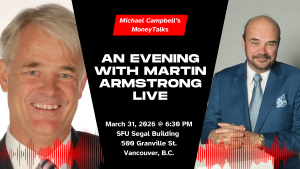
Only 100 Tickets Still Available!
Join Michael Campbell and Martin Armstrong, live in-person, as they delve into the challenges facing the Western world – confidence in governments, debt, currencies, geo-political turmoil, China, Russia and how investors can protect and profit from the market volatility to come. Plus an extended Q & A session. Martin returns to Vancouver in person for the first time in 25 years, don’t miss out!
Can’t attend in person? Subscribe to the HD video archive. Unlimited viewing, on any device within 48 hours of the event. CLICK HERE to order tickets or video archive now.
- Tuesday, March 31st, 2026 @ 6:30pm
- Simon Fraser University’s Segal Graduate Studies Building, 500 Granville Street


Ian Paterson of Plurilock Security joins Michael to share ideas to keep yourself safe, and a new approach to passwords you need to hear.
I’ve got 3 big ones but also 3 facts that shouldn’t be ignored.
I got a call last week from a distraught acquaintance who’s come to the conclusion he has to sell his house because, simply put, he can’t afford the increase in mortgage payments. His 5 yr fixed mortgage taken out in November 2017 at 2.64% is now up for renewal at just over 5%, which essentially doubles his payments.
I’ve been getting a lot of calls like that lately. People are suddenly aware of the impact of rising interest rates or the dramatic fall in crypto or their tech stocks. Some are just asking for advice about dealing with the huge rise in prices of just about everything.
The changes people are being forced to deal with are incredible. For example, on March 1st you could still get a 5 year variable rate at 0.9% but now the rate has increased to 4.75%. Over half of Canadians have reached the point where their monthly payments don’t even cover the increased interest cost, so they’re not paying down any principal at all.
Numerous polls have found that over half of Canadians are worried about making ends meet. Deloitte released a poll last week that found 76% of us have cut back spending in other areas because of rising food prices.
Canadians suffered the biggest drop in their personal net worth on record in the 2nd quarter. Down $900 billion with RBC forecasting the losses will grow to $1.6 trillion by June of next year.
I have to admit I’m not always sure of what it takes to get people’s attention, but there are no shortage of things going on that directly impact our financial lives whether we’re paying attention or not.
To borrow the old JP Morgan line – you can ignore finance and economics, the problem is that they won’t ignore you.
But the stakes are higher today than any time in the last 50 years – both personally and collectively. As I’ve been saying, if we thought 2022 was chaotic, volatile and dangerous to our financial health – 2023 will be worse. And I suspect in ways that are difficult to imagine. And hasn’t that been the case with so much of what we witnessed this year.
Like the 1500% jump in the bank rate in 7 months, gasoline hitting over $2.42 a litre on the West Coast, a diesel shortage in the US northeast that threatens shortages this winter, the collapse of the crypto market and NFTs, while former tech high flyers fell 70, 80 even 90%.
Here’s the first of 3 forecasts: The energy crisis is not close to being over. While there are a few countries like Brazil and Guyana who are looking to dramatically expand their oil production it will not be near enough to offset increasing demand from China when its Covid lockdowns end, let alone the increased demand from emerging market countries.
The implications are huge, along with the opportunities in the markets, which is why at the 2023 World Outlook Financial Conference on February 3rd & 4th in Vancouver, energy markets will be a major focus.
Forecast #2 The US Dollar will remain the “go to” currency for safety…and opportunity:
As I’ve said many times – if I could “know” the value of just one variable it would be the US dollar. Maybe not a surprise given that commodities are traded in US dollars, which means that any country that is importing oil, rice, wheat, natural gas etc is at a tremendous disadvantage. Worse still for those countries that also issued debt in US dollars.
I won’t go into details other than to say that the US is the only country that can simply print money and exchange it directly for commodities. And that’s a big advantage in a world of increasing scarcity and prices. It’s more complicated than that but that’s the gist of why China, Russia and other countries would like to see US dollar dominance decline.
But will it? My bet is no. A small percentage of trade can be denominated in other currencies but the US dollar will remain the recipient of major capital flows for years to come. Since 2014 on MoneyTalks we have recommended buying dips in the US dollar. Unless political and financial problems in the EU, Ukraine, China/Taiwan ease, economic growth prospects pick up in the EU and UK, and the energy crisis is solved, I think the probability of that changing is low.
As late as 2019 there was competition for capital flows between the US, UK, Japan and EU – that is no longer the case. Today the US is clearly the dominant destination for capital seeking safety.
Forecast #3 – Did we really think that we could add record amounts of debt without consequences?
Fact: government debt is at record highs but so is private sector debt. Consider private debt to GDP in Canada (thanks largely to real estate) is now higher than it was during Japan’s peak in the early ’90s when single parking spaces in downtown Tokyo were selling for $175,000 US or the Imperial Palace was worth more than the entire real estate market in California.
The sovereign debt crisis/defaults aren’t a matter of “if” but “when.” It’s already happening in emerging markets but will spread to the Western World. Rising interest rates and rising entitlement costs guarantee that the current system will break. The key is to understand how central banks and government respond.
So far the response to every crisis from the pandemic to record energy prices has been to “print” more money – to further devalue the purchasing power of currencies. This is why we have been forecasting that a Monetary Crisis would begin in earnest in 2022. Over 50 emerging market countries are already experiencing a dramatic decline in the purchasing power of their currencies. For example, since January versus the US dollar the Sri Lanka’s rupee is down 49%, Cuban peso down 59%, Turkish lira down 29%, Argentinian peso is down 29% …you get the idea. And it’s not just emerging market countries.
FACT: The Japanese yen is hovering around 20 year lows while the British pound hit a 37 year low in September. Canada’s oil exports have helped shield us – only a 13% drop in the last 18 months.
My point is that you can’t afford to not be prepared.
How to protect yourself from the big three – the Monetary, Sovereign debt and energy crises is the focus of the World Outlook Financial Conference, February 3rd & 4th, 2023 – not just how to survive but how to thrive. And we’re getting some of the best analysts in the English speaking world to help including, for the first time, respected analysts like Kevin Muir, the Macro Tourist – Tony Greer, The Navigator, along with Greg Weldon.
We’ll also hear from the incomparable Martin Armstrong, who the Wall Street Journal called the highest paid financial advisor in the world. Multi winner of Timer’s Digest Timer of the Year, Mark Leibovit along with one of Canada’s top oil and gas analysts, Josef Schachter will be with us.
We’ll also feature our annual World Outlook Small Cap portfolio in conjunction with Keystone Financial’s Ryan Irvine and Aaron Dunn, which has never failed to achieve double digit returns. Of course, past performance is no guaranteed of future returns but I like our chances.
Fact #3 –the biggest immediate threat financially is the Liquidity Crisis. (that’s called a teaser because I’ll wait to elaborate at the Conference and in a future letter – otherwise this note is will be way too long – and we do know how I can go on …and on)
What A Surprise
In case you haven’t guessed by now, I want you to join us at this year’s Conference. We’re excited to back live, in person.
I am absolutely sincere when I say that I’d pay to hear the recommendations of any one of our analysts – let alone the whole group. I know what some of them get paid to privately consult for mutual funds, investment firms and pension funds and I can say with 100% certainty that the World Outlook is a heck of a deal.
But you decide. After decades of broadcasting I certainly understand that a lot of people aren’t interested in economics or even their personal finances, (but enough about the media.) As the old saying goes – “change brings opportunity” but it sure as heck help to know what’s coming.
My sincere best wishes.
Mike
P.S. CLICK HERE for more information and to purchase tickets.
P.P.S. Our early bird ticket campaign ended last weekend, but I have arranged a special addition just in time for the holidays. There are only 100 available so check it out HERE

But first consider a few facts…
- Canada’s central bank rate is up 1500% since March 1st.
- The traditional 60/40 stock/bond portfolio is down 20%, worst performance since 1931
- Global Debt now tops $305 trillion – or 350% of global GDP
- The UK £ hit a 37 year low against the US dollar
- Unfunded US State pension liabilities total $8.28 trillion
- Growing geopolitical tensions include threats of nuclear weapons in the Ukrainian conflict and the Chinese takeover of Taiwan.
This is the context we are living and investing in. In short, it’s not business as usual and just like those people who wake up to find they are renewing their 5 year mortgage at over double their previous rate – not paying attention comes at a price…a big price.
Here’s the Bold Prediction I Promised
If you thought 2022 was chaotic, volatile and dangerous to your financial health – you’re right. But 2023 will be worse. I apologize, that’s an upsetting thing to read but the probabilities are very high.
The European Union energy crisis will be worse. Interest rates will be higher, which will cause major problems for individuals, companies and governments with record debt. In Canada, the Parliamentary Budget Office has already stated that interest payments on Federal debt will reach $40 billion in 2025 – doubled in just 5 years. China’s incursion into Taiwan isn’t a matter of “if” but “when” with many experts believing that the timetable has been moved up now that Xi Jinping has been elected for life.
Even with all that my big worry continues to be in the credit markets. That’s why at the World Outlook Financial Conference in February, 2020 we said that there was one more decline in interest rates coming but starting the early fall the first order of business was to lock in all borrowing rates.
And the second order of business was to protect the buying power of our paper currency, which is why we named the Conference “the Coming Commodity Boom.” This year we continue that theme with a focus on energy.
Our thesis is best explained with a straightforward question. Going forward over the next 5 years, which would you rather own – paper dollars or oil? Copper, silver, wheat or paper dollars? The bottom line is that governments can’t “print” oil, wheat, gold or any other commodity but they’ve clearly shown that they can create paper currency out of thin air. And that has consequences that we are just starting to see in terms of reduced purchasing power.
Since 2014 at the World Outlook Financial Conference and on Moneytalks we’ve consistently recommended buying US dollars on any dip. That’s still the case but it won’t always be. We’ll discuss it further at this year’s Conference because the strength of the US dollar is a huge key to our investment future.
As we stated at last year’s Conference the big move in gold and commodities like wheat, copper etc will take place once confidence leaves the US dollar but the question is where will the capital go. It’s not going to other paper currencies like the £, yen or euro. Our bet is that the answer will be commodities – especially oil.
The trigger for the decline in confidence in the US dollar could be many things but, as the UK and Japan are demonstrating, the creation of trillions of dollars to paper over pension and other pay as you go entitlement problems is likely.
That’s why I’m so pleased that both Martin Armstrong, whose model has proven uncanny in its forecasts, and Greg Weldon, whose understanding of the impact of global trends on the investment markets has made him the analyst other analysts read to understand what’s going on, will both be speaking at the 2023 World Outlook Financial Conference Feb 3rd & 4th in Vancouver.
I’m not going to keep going on and on, which I’ve been known to do, so let me finish with this. The picture for governments, its currencies and sovereign debt is bleak BUT that doesn’t mean you can’t not only survive but thrive in this environment. Our recommendation to be in the US dollar while locking in 5,000 year lows in interest rates alone would have protected you and made you money in the last two years. So would have the move to commodities.
It’s important to understand that what we are experiencing is very different from the 2008-09 subprime mortgage problems, which started in the private sector. Today the problems are centred in the massive increase in sovereign debt and underfunded entitlement programs. But that doesn’t mean that specific stocks in the private sector won’t do very well. Keep in mind that exceptional returns starts during bad times, not once stocks have doubled or tripled. That’s why we’re pleased to feature the stock picking prowess of BT Global’s Paul Beatty at the Conference who promises to give us at least 3 stock gems that have been taken down in the market decline and now offer great value.
We’re also working with Ryan Irvine and Aaron Dunn of Keystone Financial on our annual World Outlook Small Cap Portfolio, which has never failed to deliver double digit returns. Although past performance is no guarantee of future success – I like our chances.
We’ll also be welcoming new analysts and forecasters to this year’s event like Kevin Muir of the MacroTourist and Tony Greer, along with long time favourites like James Thorne, Mark Leibovit and many more.
I’m excited that we’re back live in person this year at the Westin Bayshore, Vancouver on Friday, February 3rd and Saturday February 4th. The Early Bird VIP tickets are now on sale. They sell out every year so if you are interested, my advice is to take action right away.
I look forward to seeing you there.
Sincerely
Mike
Host of Moneytalks

-
I know Mike is a very solid investor and respect his opinions very much. So if he says pay attention to this or that - I will.
~ Dale G.
-
I've started managing my own investments so view Michael's site as a one-stop shop from which to get information and perspectives.
~ Dave E.
-
Michael offers easy reading, honest, common sense information that anyone can use in a practical manner.
~ der_al.
-
A sane voice in a scrambled investment world.
~ Ed R.
Inside Edge Pro Contributors

Greg Weldon

Josef Schachter

Tyler Bollhorn

Ryan Irvine

Paul Beattie

Martin Straith

Patrick Ceresna

Mark Leibovit

James Thorne

Victor Adair
Does 2 + 2 suddenly stop equaling 4 just because a politician, pundit, or lobbyist says it doesn’t?
It sounds obvious — yet when it comes to money, investing, and the economy, an alarming number of people behave as though financial reality can be rewritten by rhetoric, wishful thinking, or whoever shouts the loudest. Unfortunately — and dangerously — finance and economics don’t work that way.
Markets don’t care about slogans. Numbers don’t bend. Financial reality doesn’t take a vacation just because the headlines are comforting or the promises sound good.
Yet too many people allow partisan spin and feel-good narratives to override basic math and sound analysis. That’s how people get financially blindsided when conditions turn — and why understanding what’s really happening in the economy and the financial world has never been more important.
That’s why I’m reaching out to you today.
For years, we’ve said that instead of getting pulled into political back and forth about where the economy should go, the smarter approach is to watch what actually happens — and let the evidence guide your investments.
Since the repo crisis in September 2019, and at every World Outlook Financial Conference since early 2020, we’ve warned that we were entering the next phase of a major debasement in the purchasing power of paper currencies. Today, more and more analysts are reaching the same conclusion.
Understanding that reality — and knowing which assets benefit from it — is no longer optional. For many people, it may determine whether they preserve their wealth or fall behind like the 10 million plus Canadians who live in food insecurity and the over 41% who are within $200 of not covering bills monthly.
Rising government debt will continue to put upward pressure on inflation and interest rates as the purchasing power of the loonie declines. The cost of living – especially for food and shelter is going to continue to rise over time.
I value your time – so I’ll simply say that your money must earn more than the rate of increase in costs. That’s where the World Outlook Financial Conference comes in. The track record is nothing short of brilliant. I’ll give you a few examples.
Simply put the goal at the Conference is to make you money and prepare you for the chaotic times ahead. I want to be clear that past performance is no guaranteed of future returns but I like our chances given that each of our speakers has been chosen on two criteria – their integrity and their track record.
The conference features some of the most respected analysts in the English speaking world including the Macro Tourist, Kevin Muir – TG Macro, Tony Greer along with one of Canada’s top oil and gas analysts, Josef Schachter who says there will be huge opportunities in 2026.
We’ll also talk Bitcoin, which has been a major winner for our audience, since James Thorne first recommended it to our audience at the February 2023 Outlook at $31,000 and repeated at the 2024 Conference at $58,000. It will be interesting to hear where he thinks it’s going this year and for the first time the Conference features the Canadian Bitcoiner, Joey Trempile.
The Conference will also feature two sessions with Martin Armstrong, who the Wall Street Journal called the highest paid financial advisor in the world. Note: a second documentary is being completed on Marty’s remarkable track record.
What A Surprise
In case you haven’t guessed by now, I want you to join us at this year’s conference.
I am absolutely sincere when I say that I’d pay to hear the recommendations of any one of our analysts – let alone the whole group. I know what some of them get paid to privately consult for mutual funds, investment firms, pension funds and I can say with 100% certainty that the World Financial Conference Outlook, Feb 6th & 7th at the Westin Bayshore and Conference Centre, is an unbelievable deal.
But you decide. After decades of broadcasting I certainly understand that a lot of people aren’t interested in economics or even their personal finances, (but enough about the media.) As the old saying goes – “change brings opportunity” but it sure as heck helps to know what’s coming.
My sincere best wishes.
Mike