
Market Opinion
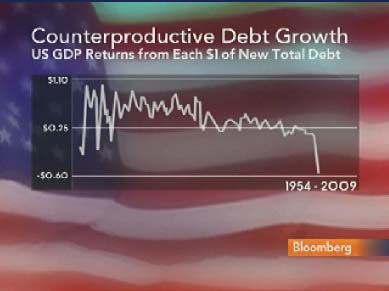
Marc Faber discusses America’s unsustainable debt load in this interview with Margaret Brennan on Bloomberg TV. An amusing observation: the GDP growth from each $1 of new total debt has dropped from $0.25 to -$0.60. Also some much deserved Bernanke and Krugman bashing. Why it is so difficult to realize that the only way out of the crisis is to cut corporate and sovereign debt, we don’t understand. Ah yes, because for that to happen, equity values across virtually all of the US economy would be wiped out… And that would destroy the myth that there is any real equity value in America.

Maybe you have too much inflation and credit creation. But that doesn’t mean there’s a bubble. A bubble is when everybody is buying everything every day, and people can hardly wait to get more.”
This is why Rogers correctly states that gold isn’t in a bubble, as the average investor hasn’t really began to invest in gold, making the idea of a bubble, as Rogers defines it above, largely irrelevant.
John Embry: Gold to hit $1,350 – $1,400 by late Spring This is a snippet of an interview by Andrew Mickey, Chief Investment Strategist of Q1 Publishing with John Embrey the chief investment strategist at Sprott Asset Management, regarded as one of the world’s leading gold experts.
Andrew Mickey: Let’s switch our gears for a moment here to gold and silver…right at this point, everyone is focusing on the long, long term, say 10 years, 15 years out.
John Embry: I’m focusing on the next two months and I think we are going to have an explosion in the price of gold.
Andrew Mickey: Do you see a specific catalyst?
John Embry: One of the great factors is sentiment right now – the sentiment that you just mentioned. There is currently considerable apathy towards gold and silver. However, demand is exploding on the investment side, for the simple reason that people can see, with each passing day, that the currencies are going to be significantly debased.
You’ve got enormous government financing requirements over the next 12 months. Where is the money going to come from? A lot will be created out of – thin air and, that’s going to result in a huge volume of new currency.
I see the demand from the investment side alone just overwhelming supply. And on the other side you’ve got diminishing supply.
The central banks are running out. And you can see this with the central bank sales each year. The European central banks can sell up to 500 tons a year, they are not selling anything near that.
And lastly, all the eastern central banks that are jammed with US dollars are talking about diversifying into other assets, one of which is gold.
Central banks have been major suppliers of gold to fill the gap in the market for years. That’s coming to an end. At the same time mine supply continues to plummet. So I will be shocked if gold is not dramatically higher in the next three or four months.
The above is a bullish view which we pretty much concur with, however the bearish view can be summed up by this snippet from Ronald Rosen of The Rosen Market Timing Letter. (Ed Note: Rosen confirms the long term bull, just expects a further correction right now on a technical basis. This differs from Embry’s who takes a fundamental viewpoint)
Sorry to remind you folks, but a bull market goes up on rising volume and rising open interest. A correction in a bull market goes down on declining volume and declining open interest. The A, B, C multi-month correction in gold and silver is being accomplished with declining volume and declining open interest. The final C wave down will begin soon.
The same data but two totally different interpretations of just where gold is headed. The next three months or so are certainly going to be interesting and most probably volatile so hang onto your core position and go gently when trying to trade the short term moves of gold prices.
FREE – The Gold Prices Newsletter HERE. Stay updated on our market commentary, which gold stocks we are buying and why, please subscribe to The Gold Prices Newsletter, completely FREE of charge. Simply click HERE and enter your email address. For those readers who are a

“What then is an investor to do? – given enough liquidity and current yields I would prefer to invest money in Canada – Bill Gross
Investment management is a privileged profession – not just for being paid by X-times what you’re really worth to society, but from the standpoint of longevity. If you’re good, and you at least give the impression that you still have most of your faculties, you can literally hang around forever. James Carville, the well-meaning but evil-lookin’ guy from the Clinton Administration once remarked that in his next life he’d like to come back as a bond manager. He had part of it right – the influence, the wealth, and even fame – but there was no need to imagine himself as some cryogenically preserved Wall Street version of Ted Williams – he was young enough at the time to make the leap and still have a 20-year career ahead of him. Other professions do not afford such opportunities – the gold watch at 65 is not only symbolic, but a statement in most professions that says you are more or less washed up. Athletes have at most 20 years and musicians seem to have that brief window of creation as well. The Beatles, for instance, were done after a decade’s time. Paul is still writing songs, but the magic clearly disappeared in the 70s and now his concerts are “garden parties” of remembrances as opposed to creation.
What I think is close to unique about investment management is that it’s really about the stewardship of capital markets, and that time weeds out the impostors, leaving the aging survivors to appear as wise and capable of guiding clients through the next crisis – whatever and whenever it might appear. That assumption has some logic behind it, but critically depends on the investor truly enjoying the game and – of course – holding on to at least a few billion brain cells that keeps him from being obviously senile or at least being accused of having “lost it.” An investment manager at 65 fears both. I remember having met John Templeton on the set of Wall Street Week nearly 20 years ago. I was a young buck and he was – well – on the downside of his career. About the only thing he could tell Rukeyser, it seemed to me, was to cite the rule of 72 and proclaim that stocks and the Dow would be at 100,000 by 2030 or something like that. Now, approaching that same age, I’m a little more understanding and a little less young-buckish. If that was his only lesson, then it was a pretty good one I suppose – Dow 5,000 and the New Normal notwithstanding. And despite the strikingly premature departure of Peter Lynch and the transition of George Soros to philanthropic pursuits, there are some great examples of longevity in this business. Warren Buffett, of course, comes immediately to mind, as does Dan Fuss of Loomis Sayles, who may wind up as the Bear Bryant or Adolph Rupp of the bond business. Peter Bernstein, who passed away but a few months ago, was a brilliant writer and commentator on the investment scene well into his 80s. So there’s hope for you still, James Carville, and, I suppose, for me as well. It’s quite a privilege to be a “steward of the capital markets,” to have done it well for so long and to still be able to walk up to the plate and face a 95-mile-an-hour fastball. Or, is it a curve? Time will tell.
There have been numerous changeups and curveballs in the financial markets over the past 15 months or so. Liquidation, reliquification, and the substituting of the government wallet for the invisible hand of the private sector describe the events from 30,000 feet. Now that a semblance of stability has been imparted to the economy and its markets, the attempted detoxification and deleveraging of the private sector is underway. Having survived due to a steady two-trillion-dollar-plus dose of government “Red Bull,” Adderall, or simply strong black coffee, the global private sector is now expected by some to detox and resume a normal cyclical schedule where animal spirits and the willingness to take risk move front and center. But there is a problem. While corporations may be heading in that direction due to steep yield curves and government check writing that have partially repaired their balance sheets, their consumer customers remain fully levered and undercapitalized with little hope of escaping rehab as long as unemployment and underemployment remain at 10-20% levels worldwide. “Build it and they will come” is an old saw more applicable to Kevin Costner’s Field of Dreams than to today’s economy. “Say’s Law” proclaiming that supply creates its own demand is hardly applicable to a modern day credit-oriented society where credit cards are maxed out, 25% of homeowners are underwater, and job and income creation are nearly invisible.
In this New Normal environment it is instructive to observe that the operative word is “new” and that the use of historical models and econometric forecasting based on the experience of the past several decades may not only be useless, but counterproductive. When leveraging and deregulating not only slow down, but move into reverse gear encompassing deleveraging and reregulating, then it pays to look at historical examples where those conditions have prevailed. Two excellent studies provide assistance in that regard – the first, a study of eight centuries of financial crisis by Carmen Reinhart and Kenneth Rogoff titled This Time is Different, and the second, a study by the McKinsey Global Institute speaking to “Debt and deleveraging: The global credit bubble and its economic consequences.”
The Reinhart/Rogoff book speaks primarily to public debt that balloons in response to financial crises. It is a voluminous, somewhat academic production but it has numerous critical conclusions gleaned from an analysis of centuries of creditor/sovereign debt cycles. It states:
- The true legacy of banking crises is greater public indebtedness, far beyond the direct headline costs of bailout packages. On average a country’s outstanding debt nearly doubles within three years following the crisis.
- The aftermath of banking crises is associated with an average increase of seven percentage points in the unemployment rate, which remains elevated for five years.
- Once a country’s public debt exceeds 90% of GDP, its economic growth rate slows by 1%.
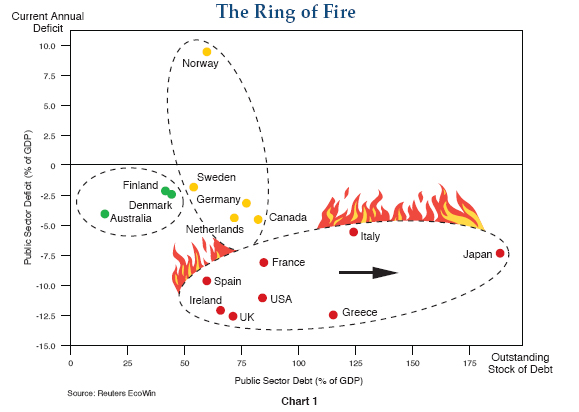
Their conclusions are eerily parallel to events of the past 12 months and suggest that PIMCO’s New Normal may as well be described as the “time-tested historical reliable.” These examples tend to confirm that banking crises are followed by a deleveraging of the private sector accompanied by a substitution and escalation of government debt, which in turn slows economic growth and (PIMCO’s thesis) lowers returns on investment and financial assets. The most vulnerable countries in 2010 are shown in PIMCO’s chart “The Ring of Fire.” These red zone countries are ones with the potential for public debt to exceed 90% of GDP within a few years’ time, which would slow GDP by 1% or more. The yellow and green areas are considered to be the most conservative and potentially most solvent, with the potential for higher growth.
A different study by the McKinsey Group analyzes current leverage in the total economy (household, corporate and government debt) and looks to history, finding 32 examples of sustained deleveraging in the aftermath of a financial crisis. It concludes:
- Typically deleveraging begins two years after the beginning of the crisis (2008 in this case) and lasts for six to seven years.
- In about 50% of the cases the deleveraging results in a prolonged period of belt-tightening exerting a significant drag on GDP growth. In the remainder, deleveraging results in a base case of outright corporate and sovereign defaults or accelerating inflation, all of which are anathema to an investor.
- Initial conditions are important. Currently the gross level of public and private debt is shown in Chart 2.
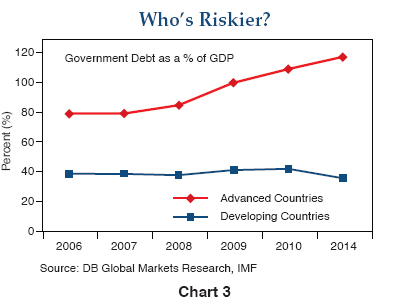
Initial conditions are important because the ability of a country to respond to a financial crisis is related to the size of its existing debt burden and because it points to future financing potential. Is it any wonder that in this New Normal, China, India, Brazil and other developing economies have fared far better than G-7 stalwarts? PIMCO’s New Normal distinguishes between emerging and developed economic growth, forecasting a much better future for the former as opposed to the latter. Chart 3 displays a startling recent historical and IMF future forecast for government debt levels of developed and developing countries. “Escalating” might be a conservative future description for advanced countries. “Stable” might now be more applicable to many emerging sovereigns.
What then is an investor to do? If, instead of econometric models founded on the past 30–40 years, an analysis must depend on centuries-old examples of deleveraging economies in the aftermath of a financial crisis, how does one select and then time an investment theme that can be expected to generate outperformance, or what professionals label “alpha?” Carefully and cautiously with regard to timing, I suppose, but rather aggressively in the selection process under the assumption that it’s never “different this time” and that history repeats as well as rhymes. Reinhart and Rogoff’s book, if anything, points to the inescapable conclusion that human nature is the one defining constant in history and that the cycles of greed, fear and their economic consequences paint an indelible landscape for investors to observe. If so, then investors should focus on the following 30,000-foot observations in the selection of global assets:
- Risk/growth-oriented assets (as well as currencies) should be directed towards Asian/developing countries less levered and less easily prone to bubbling and therefore the negative deleveraging aspects of bubble popping. When the price is right, go where the growth is, where the consumer sector is still in its infancy, where national debt levels are low, where reserves are high, and where trade surpluses promise to generate additional reserves for years to come. Look, in other words, for a savings-oriented economy which should gradually evolve into a consumer-focused economy. China, India, Brazil and more miniature-sized examples of each would be excellent examples. The old established G-7 and their lookalikes as they delever have lost their position as drivers of the global economy.
- Invest less risky, fixed income assets in many of these same countries if possible. Because of their reduced liquidity and less developed financial markets, however, most bond money must still look to the “old” as opposed to the new world for returns. It is true as well, that the “old” offer a more favorable environment from the standpoint of property rights and “willingness” to make interest payments under duress. Therefore, see #3 below.
- Interest rate trends in developed markets may not follow the same historical conditions observed during the recent Great Moderation. The downward path of yields for many G-7 economies was remarkably similar over the past several decades with exception for the West German/East German amalgamation and the Japanese experience which still places their yields in relative isolation. Should an investor expect a similarly correlated upward wave in future years? Not as much. Not only have credit default expectations begun to widen sovereign spreads, but initial condition debt levels as mentioned in the McKinsey study will be important as they influence inflation and real interest rates in respective countries in future years. Each of several distinct developed economy bond markets presents interesting aspects that bear watching: 1) Japan with its aging demographics and need for external financing, 2) the U.S. with its large deficits and exploding entitlements, 3) Euroland with its disparate members – Germany the extreme saver and productive producer, Spain and Greece with their excessive reliance on debt and 4) the U.K., with the highest debt levels and a finance-oriented economy – exposed like London to the cold dark winter nights of deleveraging.
Of all of the developed countries, three broad fixed-income observations stand out: 1) given enough liquidity and current yields I would prefer to invest money in Canada. Its conservative banks never did participate in the housing crisis and it moved toward and stayed closer to fiscal balance than any other country, 2) Germany is the safest, most liquid sovereign alternative, although its leadership and the EU’s potential stance toward bailouts of Greece and Ireland must be watched. Think AIG and GMAC and you have a similar comparative predicament, and 3) the U.K. is a must to avoid. Its Gilts are resting on a bed of nitroglycerine. High debt with the potential to devalue its currency present high risks for bond investors. In addition, its interest rates are already artificially influenced by accounting standards that at one point last year produced long-term real interest rates of 1/2 % and lower.
The last decade – the “aughts” – were remarkable in a number of areas: jobless recoveries in major economies, negative equity returns in U.S. and other developed markets, and of course the financial crisis and its aftermath. If an investment manager and an investment management firm proved to be good stewards of capital markets during the turbulent but vapid “aughts,” they may be granted a license to navigate the rapids of the “teens,” a decade likely to be fed by the melting snows of debt deleveraging, offering life for unlevered emerging and developed economies, but risk and uncertainty for those overfed on a diet of financed-based consumption. Beware the ring of fire!
William H. Gross
Managing Director
Pimco – Your Global Investment Authority
Last week when I touched upon the US dollar’s technical pattern, and the near-term potential for it to roll over a bit, I made mention of the lingering debt problem in the US. Especially when it comes to the US dollar, US debts are a growing concern that keep many analysts US dollar-bearish.
Most all reasonable analysts can accept the fact that, as we believe, the US dollar can rally based on money flow as its driven by risk – capital leaving risky assets in search of safety, i.e. the US dollar.
But, as one Currency Currents reader responded on Friday by asking: WHAT IS YOUR RATIONALE FOR WHY OUR DEBT WILL NOT CAUSE THE USD TO WEAKEN?
…..read the answer HERE.

The 45.52 carats deep-blue Hope Diamond, housed in the Smithsonian Natural History Museum in Washington, D.C.Hope Diamond is placed on a mirror at the Smithsonian’s Natural History Museum in Washington. Estimated value $300–$350 million USD
The lustre is quickly returning to the global diamond business as the economic recovery helps put more rocks on fingers and a supply crunch drives up prices.
Some diamond sellers also report more people buying the shiny stones as investments, after having lost millions in stocks in the recent market meltdown.
Expectations are that diamond prices will keep climbing this year, on the back of a steady recovery that began in the last half of 2009.
That followed a sharp drop of about 50 per cent a year ago, as consumers cut back on the ultimate luxury item during the recent recession.
While prices aren’t expected to surpass pre-recession levels until 2011, the comeback has also kick started sales and consolidation activity in the industry.
It’s also expected to be a boon for regions such as the Northwest Territories, whose economy relies heavily on the industry.
Today’s prices are about 20 per cent below their peak in August, 2008, said BMO Capital Markets analyst Edward Sterck.
Higher prices have more to do with lack of supply after production was cut back in the economic downturn.
“Rough diamonds have recovered extremely strongly because the diamond traders and cutters and polishers are speculating there will be a pick-up in demand for polished diamonds as the economy recovers,” Mr. Sterck said.
“That has been driven slightly by an artificial shortage of rough diamonds that was created in 2009,” when production was cut.
Giant diamond firm De Beers sold about $500-million (U.S.) of gems during its first sale this year at market premiums, while companies such as Gem Diamonds, Petra Diamonds and Namakwa Diamonds saw price hikes, according to a recent report from RBC Capital Markets.
“Conditions are improving for diamond miners as the cutting centres gear up modestly to sell more diamonds to the jewellery trade in 2010,” RBC analysts Des Kilalea and Patrick Morton wrote.
“Prospects for rough diamond prices are better than they have been for some time with jewellers reporting better sales and thus likely to start increasing inventory if the healthier demand conditions appear to be sustained.”
Alfredo J. Molina, owner of Black, Starr & Frost in California – America’s first jeweller dating back to 1810 – and Molina Fine Jewelers in New York and Phoenix, said he has seen a number of people turning to high-quality gems as an investment.
“The problem now isn’t finding buyers, but finding the product itself,” said Mr. Molina, who had three customers in particular who lost $780-million combined in the Bernie Madoff scandal.
“They have a new investment philosophy: ‘If we can’t see it or touch it, we don’t want it,’ ” he said.
John Bristow, president and CEO of Vancouver-based producer Rockwell Diamonds Inc., which has operations in South Africa, has noticed a “good resilience” in the diamond market compared with this time last year.
“Good quality, large stones are moving again,” Mr. Bristow said. “Demand has picked up.”
While Americans still represent just under half of the world’s diamond consumers, Mr. Bristow said there’s a noticeable increase in demand in places such as China and India.
Mr. Bristow also said he thinks the industry is healthier now that it has been forced to recalibrate.
“The fly-by-nights and wannabes have cleared out. We are back to about a dozen players, committed people.”
The size of the industry is also getting smaller through consolidations.
Last week, Toronto-based junior miner Tiomin Resources Inc. said it’s buying Vaaldiam Resources Ltd. More consolidation is expected among junior players, RBC said in its report.
From the Globe and Mail
Article suggested by:

-
I know Mike is a very solid investor and respect his opinions very much. So if he says pay attention to this or that - I will.
~ Dale G.
-
I've started managing my own investments so view Michael's site as a one-stop shop from which to get information and perspectives.
~ Dave E.
-
Michael offers easy reading, honest, common sense information that anyone can use in a practical manner.
~ der_al.
-
A sane voice in a scrambled investment world.
~ Ed R.
Inside Edge Pro Contributors

Greg Weldon

Josef Schachter

Tyler Bollhorn

Ryan Irvine

Paul Beattie

Martin Straith

Patrick Ceresna

Mark Leibovit

James Thorne

Victor Adair