
Investment/Finances
In this week’s issue:

You cannot expect to do well in the market if you look at investing in a normal way. By definition, being average is doing what most other people do and since investing is largely a psychological game, doing what other people do is only natural. Average results come from normal people acting in normal ways.
To beat the market, you have to be different.
Not necessarily in a straight jacket bouncing off padded walls different, just a little off.
Here are 10 things that may help you be a better investor, some ways to think differently from the crowd in that pursuit to achieve market dominance.
1. Do not think about making money, think about losing money – the first step toward success is accepting that losing is part of trading. You will not be right all of the time, you cannot always trade your way out of a bad situation. There will be times when you simply have to walk away with a loss. The key is to keeping the losses small and manageable. When the market proves you wrong, take the loss.
2. Do not think you can average down to win – it is a logical idea, add more to a losing position with the expectation that the market must eventually go your way. Many times this strategy will work but, when it does not work, the loss may be insurmountable. The market does not eventually have to go your way.
3. Do not think that your success is entitled – you may make a great trade, pick a really great stock and have a feeling like you really have the market figured out. Forget your gloating, no one ever has the market figured out. We must always remember that we have to work as smart for the next trade as we did for the last.
4. Do not think that talent is required – making money in any trading endeavor is a small part technical skill and a big part emotional management. Learn to limit losses, let winners run and be selective with what you trade. Emotional mastery is more important than stock picking skill.
5. Do not think that you can tell the market what to do – the market does not care about you, it does not know that you want to make a profit. You are the slave, the market is your master. Be obedient and do what the market tells you to.
6. Do not think you are competing against other traders – trading success comes to those who overcome themselves, it is you and your persistent desire to break trading rules that is the ultimate adversary. What others are doing is of little consequence, only you can react to the market and achieve your success.
7. Do not think that Fear and Greed can ever be positive – in life, fear can keep us from harm, greed can give us the motivation to work hard. In the market, these two emotional forces will lead to losses. If your decisions are governed by either or both you will most certainly find that your money escapes you.
8. Do not think you will remember everything you learn – every trade provides a lesson, some valuable education on what to do and what not to do. However, it is likely that your lessons will contradict one another and lead you to forget many of them. Write down the knowledge that you accumulate, return to this trading journal so that you can retain some value from the lessons taught by the market. Remember, the market is cruel, it gives the test first and the lesson after.
9. Do not think that being right will lead to profits – you may be exactly right about what the fundamentals are and what they are worth. However, timing is everything, if your expectations for the future are ill timed, you may find yourself losing more than you can tolerate. Remember, the market can be wrong longer than you can be liquid.
10. Do not think you can overcome the laws of probability – traders tend to be gamblers when they face a loss and risk averse when the have a potential for gain. They would rather lock in a sure profit and gamble against a probable loss even if the expected value of doing so is irrational. Trading is a probability game, each decision should be made on the basis of the best expected value and not what feels best.

The best Stockscores Market Scan strategy for finding position trading opportunities is the Stockscores Simple. Over the past few months, with a weak market, not too many opportunities have appeared but conditions are beginning to improve. Last week, my pick on STAA was found with this strategy and it made a good move this week, up 18% this week (RIMM moved higher this week as well but that was not found with the Stockscores Simple).
I ran this strategy again this week and found one stock out of those that the Market Scan highlighted. It is a stock that I featured in my daily newsletter earlier in the week, but the chart still looks good now so I discuss here as well.

1. T.PRU
T.PRU is breaking out to new highs and through long term resistance. Volume picked up this week as buyers start to take notice of the stock. While most stocks are pretty beat up, this one is showing optimism and looks more likely to go higher than lower. Support at $3.15.

References
This is not an investment advisory, and should not be used to make investment decisions. Information in Stockscores Perspectives is often opinionated and should be considered for information purposes only. No stock exchange anywhere has approved or disapproved of the information contained herein. There is no express or implied solicitation to buy or sell securities. The writers and editors of Perspectives may have positions in the stocks discussed above and may trade in the stocks mentioned. Don’t consider buying or selling any stock without conducting your own due diligence.
Back To Top
“Gold has gone too far to fast“ says Market verteran Peter Grandich who has been aggressively net long from near $300 an ounce.
“Notice overbought readings and one of my biggest concerns, the spread between current prices and the 200-Day M.A.“
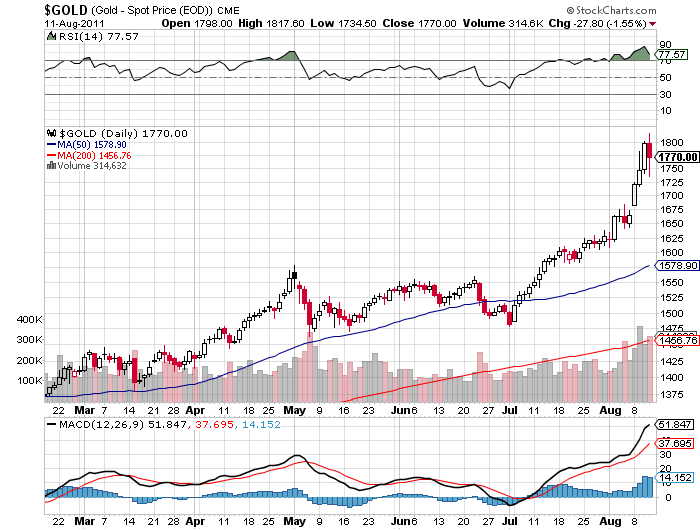
Peter is concerned that the empty boat he has ridden in on the way up is suddenly overcrowed. Also that some sentiment indicators and sudden near parabolic move has set up a “major correction or worse” in what he calls The Mother of All Bull Markets. “I find it quite easy to accept a full participation from $300 to now and still “half-in” until further notice”. Long-term Peter maintains his target of $2,350.
Another Long Term Gold Bull Mark Leibovit, started selling late in the trading day Friday August 5th when he urged his readers to sell all their mining stocks. After the close on August 11th he noted in a bulletin that his cycle work, forecast model and technical expertise is in volume analysis have all intersected and expects at a minimum a corrective pullback into the $1,600’s. While Mark is not selling his core holdings in gold, he does think its time traders made a decision whether to hold, sell with intention of buying back lower, or even shorting using an inverse ETF.
Long Term Gold Bull and go-to Analyst for Mining Companies in Vancouver, Dr. Martin Murenbeeld wrote on July 15th that he had “I have never been this bullish on gold”. Clearly Martin was dead right as gold rose $300 from when he made that commment. Intertestingly, Martin also notes that “It is very possible we will get a little bit of a pullback in gold prices”. Martin goes on to say that when gold falls the equity markets tend to get a bid.
Well if getting a bid in Equity Markets will remove focus from gold prices you’d better watch out. One of the earliest and most consistent gold bull’s, the legendary 87 year old Richard Russell of Dow Theory Letters declared in bold print today that “the bottom of the (stock market) correction is IN, and that the secondary trend of the market has finally turned bullish”. Be clear, Richard is not selling his gold but he is saying:
” gold is becoming extended and overbought. I expect gold to be erratic an unstable like the rest of the market, and it will takes guts to sit with gold over coming weeks.“
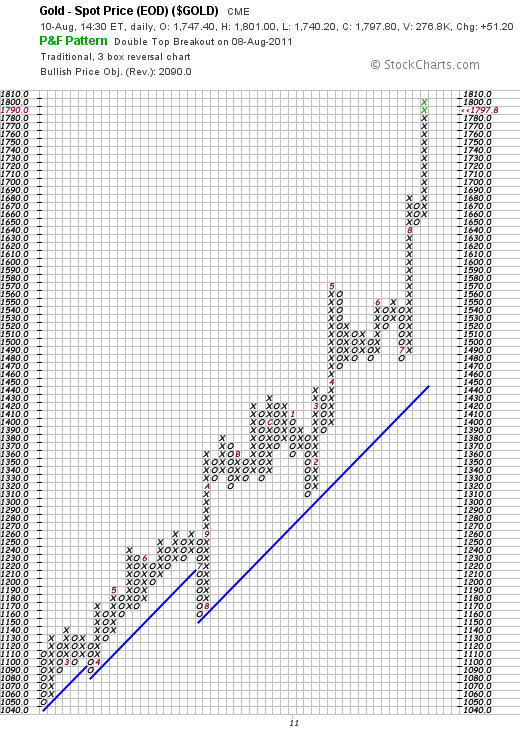
All in all some of these wisest minds in trading and markets who have been bullish gold since the low $300’s or less are sensing a pullback. A good time to review your exposure and take action if required.
Jim Rogers is good at what he does. Really good. This masterful investor co-founded with George Soros the Quantum Fund. A fund that posted astonishing returns of 4200% in 10 years, over the same period the S&P gained a mere 47%. Rogers retired 31 years ago in 1980 at the age of 37 but is still active as a private investor.
Clearly one of the most successful investors of all-time, Rogers buys value. Accordingly in 1999, he predicted a “Supercycle” commodity bull market, raw material prices advancing for longer than in any previous uptrend led by gold and silver. At that time gold was trading near is low at $252, the lowest real price in nearly a 100 years, and silver at $4 the lowest real price in 5000 years.
Click on the Chart “The real price of gold 1344-1988” for a larger image.

With gold up 650% from its lows and silver with an even greater gain….. obviously Rogers was right.
Rogers has stopped buying gold now. “I wouldn’t buy more gold and silver right now” “I don’t like to jump on a moving bus”. That doesn’t mean Rogers is selling, he still believes that “gold is certainly going to go to $2,000 over the years; it looks like it’s going to go much higher during the course of the bull market,”. Even after soaring to an all-time high of $1678.25 on August 4th/2011, Rogers thinks “gold prices are not in a bubble because not everyone is buying yet”. Right now Rogers is moving towards a greater commodity opportunity that he thinks offers the same kind of values that gold and silver did a decade ago.
Agriculture: The Next Big Bull Market
Consistent with his devotion to buying undervalued assets, he now sees the same quality of values in agriculture that he saw in gold and silver. No, he’s not selling his gold and silver but he is predicting that “Agriculture prices are still, on a historic basis, extremely depressed, and in my view I’ll probably make more money in agriculture than other things”.
Rogers thinks that the current commodities supercycle will last for 20 to 25 years, a view supported by the research of Chris Watling of Longview Economics. Whatling traced secular bull cycles back to 1750 and identified that commodity super cycles last 20 to 25 years. As this commodity bull started in 2000, if Whatling and Rogers are correct this bull will run higher until 2020-2025.
In short, if you missed buying gold and silver at extremely depressed levels, if you missed participating in what Peter Grandich calls The Mother of all Bull Markets, Rogers thinks you have another great chance to buy into an imminent bull market at great value:
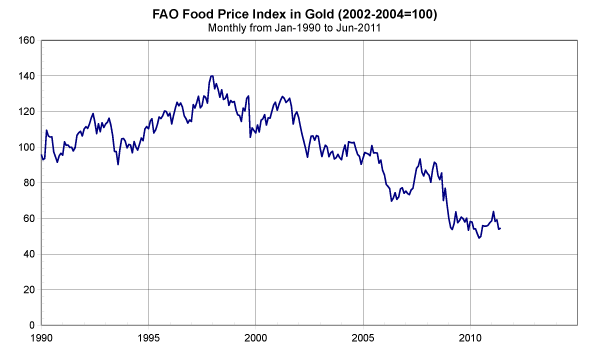
Its about demand and low historical prices. “If the fundamentals weren’t right the price would not go up. Many people invested in commodities in the 1980s and 90s and didn’t make any money because the fundamentals were bad, now people are investing and making money because the fundamentals are good” Rogers Said. There is a powerful underlying demand for food. When food prices surged in 2007 millions went hungry, and there were riots from Egypt to Haiti and Cameroon to Bangladesh. Rioting calmed down in 2008 prices when prices dropped but starting at the beginning of 2009 they’ve been going up and Rogers expects “more turmoil, but I didn’t expect it to happen this quickly because food prices are somewhat depressed”. Clearly a bull market rise from current levels will cause even more starvation, riots and urgent demand.
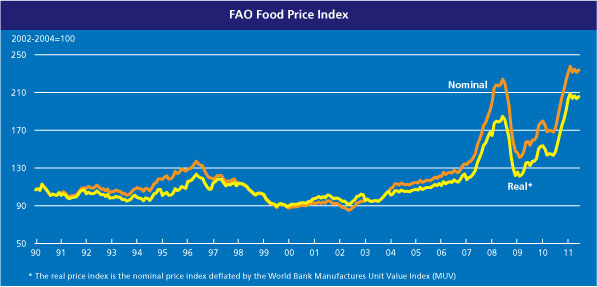
The FAO Food Price Index measures the prices of Dairy, Oils & Fats, Cereals Sugar & Meat
On the longer term chart real food prices were more expensive in 1917 than they are here today. Demand is there. Agriculture will be “wildly exciting” as global food shortages worsen, according to Rogers. “You pick an agriculture product and I’ll say buy it,” he said. Shortages are showing up right now as the world population has more than doubled from 3 billion in 1960 while the amount of arable farmland has been decreasing. If world population rises from its current 6.8 billion to 9.1 billion by 2050 as the United Nations forecasts, a lot of people are going to be scrambling for food.
Click on the 1900-2008 FAO Food Chart for a Larger Image

What to Invest In to Take Advantage
Good advice from Daniel Keirnan in his article “Farmland Investment, the next big Portfolio“
The question is what are the best ways for making money from the agricultural sector? One way is to invest directly into agriculture stocks such as farm equipment maker John Deere (DE), global seed giant Monsanto (MON) or fertilizer company Potash Corp of Saskatchewan (POT).
Another method is to invest in agricultural futures through Exchange Traded Funds (ETFs) such as AIGA on the London Stock Exchange or DBC in the US which tracks an entire basket of agricultural commodities including corn, soybeans, wheat, cotton, sugar, coffee, cattle and pigs. These commodities ETFs try to track the spot price of the various commodities they include.
The advantage of these stocks or ETFs is that they are easily trade-able by anyone who has an online brokerage account. The disadvantage, however, is that they are still financial instruments, and as such can fluctuate widely in price.
One option most individual investors tend to overlook is direct investment in farmland. In many ways, a farmland investment is more secure, stable and tangible then putting money into stocks.
Farmland investments for individuals will pay a regular yearly dividend from the sale of crops, and also provide the opportunity for long-term capital gains as farmland increases in value during a bull market in Food.
Don’t buy Gold now. Rogers says food and agriculture are great values and will be the next big demand driven bull market.
08/03/11 Paris, France – It doesn’t look good, dear reader.
The Dow lost 171 points yesterday. Oil slipped closer to $90. And what’s this…gold, up $22.
The debt deal is done. And the Great Correction intensifies…as expected.
“Another bear market has begun,” says our old friend Marc Faber.
“After debt deal: economy in deeper peril,” says MSNBC.
Why would the economy be in deeper peril? Actually, it’s in the same peril. But most people didn’t know what peril it was in. They had swallowed the “recession…recovery” story. They believed it was just a matter of time before the economy got back on its feet.
But it’s not a recession. And there will be no recovery. Never.
It’s a correction. And it has to do its work. It has to reduce debt levels. And that takes time…and pain. Here’s Bloomberg, on the case:
Consumer Spending in U.S. Unexpectedly Falls as Hiring Slumps
Aug. 2 (Bloomberg) — U.S. consumer spending unexpectedly dropped in June for the first time in almost two years and savings climbed, adding to evidence that the slump in hiring is hurting household confidence.
Purchases declined 0.2 percent after a 0.1 percent gain the prior month, Commerce Department figures showed today in Washington. The median estimate of 77 economists surveyed by Bloomberg News called for a 0.1 percent increase. Incomes grew at the slowest pace since November.
The lack of jobs combined with wage gains that have failed to keep pace with inflation raise the risk of further cuts in consumer spending, which accounts for 70 percent of the world’s largest economy. Companies like Newell Rubbermaid Inc. are among those cutting forecasts for the year.
“Wages are very stagnant and that’s affecting consumer spending and consumer confidence,” Fed Chairman Ben S. Bernanke said in semi-annual testimony to Congress on July 13. “There is also ongoing uncertainty about the durability of the recovery.”
Friday’s news on GDP shows the double dip has arrived — an expansion of only 1.3 percent and consumer spending up 0.1 percent in the second quarter. Astonishingly low by any account. The debt ceiling trouble and lack of a longer term resolution to the deficit will make it worse.
Yes, dear reader, so far, so good. Things are not looking up. They’re looking down. Which is fine with us. This correction needs to speed up…so we can get it over with.
Where are we so far? Houses in Florida, California, Nevada and Arizona are down about 50%. Banks have about 2 million foreclosed houses in stock…and about 11 million more are underwater. Prices will probably fall another 25% or so before bottoming out.
Unemployment, depending on how you measure it, is near depression levels. About 14 million people are jobless…with nearly half of them out of work for more than 6 months.
A quarter of the people asked by Gallup pollsters said they thought the economy really is in a depression.
Are we back in a recession? No! The correction never ended…and it has a lot further to go.
Before it is over, stock prices will be cut in half. Food stamp rolls will hit 50 million. Houses will have lost 60% of their value. And more than 20 million people will be out of a job.
Then, our problems will be over, right? Then, things can begin looking up, right? Then, the worst will be behind us, correct?
Wrong!
Then, the feds will really get to work. Private citizens can make mistakes. They can get themselves into deep trouble. But if you really want to make a mess of things, you need government support. Stay tuned.
Regards,
Bill Bonner
for The Daily Reckoning
About Bill Bonner
Since founding Agora Inc. in 1979, Bill Bonner has found success and garnered camaraderie in numerous communities and industries. A man of many talents, his entrepreneurial savvy, unique writings, philanthropic undertakings, and preservationist activities have all been recognized and awarded by some of America’s most respected authorities. Along with Addison Wiggin, his friend and colleague, Bill has written two New York Times best-selling books, Financial Reckoning Day and Empire of Debt. Both works have been critically acclaimed internationally. With political journalist Lila Rajiva, he wrote his third New York Times best-selling book, Mobs, Messiahs and Markets, which offers concrete advice on how to avoid the public spectacle of modern finance. Since 1999, Bill has been a daily contributor and the driving force behind The Daily Reckoning
Dice Have No Memory: Big Bets & Bad Economics from Paris to the Pampas, the new book from Bill Bonner, is now available for purchase. It is the definitive compendium of Bill’s daily reckonings from more than a decade: 1999-2010. Whether your new to these Daily Reckonings, or one of Bill’s “long suffering” readers, this is one you surely won’t want to miss.
Special Report: Shattered Bank Vaults, Empty ATMs, and No Milk in the Store– Do you know just how drastically your life could be set to change if the U.S. gov’t can’t borrow another dollar? Services you take for granted today could disappear overnight. Don’t risk your future – watch this urgent briefing right now. There’s no time to lose… Don’t wait, watch now.

A SPECIAL OFFER FOR MONEY TALKS’ READERS AND LISTENERS …
In honor of BLACKSWAN’s ongoing relationship with Michael Campbell’s MONEY TALKS, we want to offer YOU a special report that we’ve just released …
China: Danger, Red Dragon! DANGER!
Until now this special report could only be had by paying $19.95 or by becoming one of our Global Investor subscribers. But we are giving it to you for FREE! Click on the banner below or HERE to get the report

China is Staring down a major contraction. They’re trying their best to prevent it. But their best won’t be enough. A hard landing is coming. The coming implosion of Chinese economic growth will exacerbate investor fears and shake markets.
PLUS
As a Special Bonus you will be invited to a Members Only Webinar Jack will be presenting on August 9, 2011
In this webinar Jack will:
1) Explain the major reasons why he expects a financial bust in China
2) Why and how a China bust will ripple through the global economy
3) Examine my three favorite trading ideas and explain why they could be huge winners if my scenario comes to fruition.
July’s poor Chinese manufacturing and export numbers suggest the slowdown is already starting to bite.
He will also take your questions live during the webinar.
-
I know Mike is a very solid investor and respect his opinions very much. So if he says pay attention to this or that - I will.
~ Dale G.
-
I've started managing my own investments so view Michael's site as a one-stop shop from which to get information and perspectives.
~ Dave E.
-
Michael offers easy reading, honest, common sense information that anyone can use in a practical manner.
~ der_al.
-
A sane voice in a scrambled investment world.
~ Ed R.
Inside Edge Pro Contributors

Greg Weldon

Josef Schachter

Tyler Bollhorn

Ryan Irvine

Paul Beattie

Martin Straith

Patrick Ceresna

Mark Leibovit

James Thorne

Victor Adair