
Investment/Finances
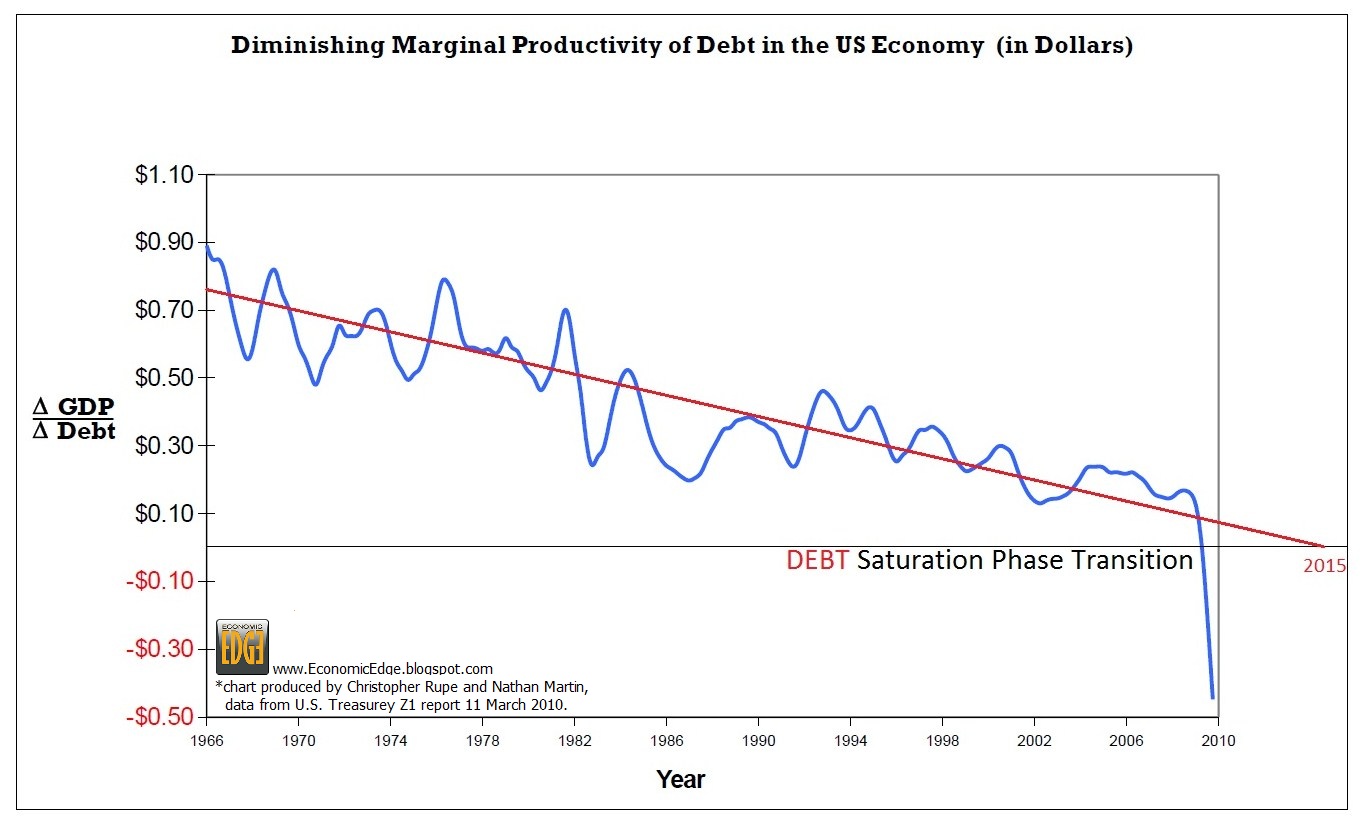
Nathan’s Economic Edge says that this is The Most Important Chart of the Century, I’m not sure I would say it’s the most important chart but it is pretty scary. The chart illustrates how much economic productivity is created by one dollar of additional debt. Back in the early 1960s a dollar of new debt added almost a dollar to the nation’s output of goods and services but by the end of 2009 a new dollar of debt produced a negative 45 cents of economic output. The author calls this situation “debt saturation”. We have a big problem in America, and the end result is going to be a devaluation of the US dollar or potentially a default. – Lou Scatigna (larger chart HERE)
On Major Moves, Peter Grandich has been very right and not only saved many investors fortunes, but expanded them dramatically. On November 3, 2007 at the MoneyTalks Survival Conference, Peter Grandich of the Grandich Letter warned that “an unprecedented economic tsunami will hit American beginning in 2008”. Peter advised publicly to short the US market two days from the top in October, 2007 and stayed short until the last week of October, 2008. He began to buy stocks in March 7th, 2009. He also bought oil and oil related investments near the lows after the dive from $147.
….go to visit Peter’s Website.
“I thought the piece below (thank you, GoldEagle) was so interesting that I wanted to include it. I can’t imagine why the US is so stupid as to give its largest creditor, China, the middle finger. The tension between China and the US is heating up. The goofs who run the US had better get it into their collective heads that China is going to do what’s best for China, and nothing else. Is the yuan too cheap or, as China claims, is the US dollar overvalued? Depends on who’s side your on.” Richard Russell – Dow Theory Letters
Paul Krugman Versus Reality
In his latest weekly New York Times column, Nobel Prize-winning economist Paul Krugman put forward arguments that were so nonsensical that the award committee should ask for its medal back.
Recent rhetoric from Washington has put the economic relationship between the U.S. and China squarely on the front burner, and Krugman is demanding that we crank up the flame. This week 130 members of Congress sent a letter to Treasury Secretary Timothy Geithner demanding that the Obama administration designate China as a “currency manipulator”. Following that, a bipartisan group of senators introduced a bill that looks to force the Obama administration’s hand. For its own part, Beijing invites criticism by continuing to deny its utterly obvious currency agenda.
As these tensions escalate, most economists urge Washington to tread lightly because of the negative fallout for America if China were to begin selling its enormous cache of U.S. Treasury bonds. Krugman pushes back, asserting that the U.S. risks little by playing hardball, and that China has more to lose. He asserts that a Chinese decision to end its purchases of U.S. Treasury debt would make only a marginal impact on long-term interest rates. Did you hear that Stockholm?
According to Krugman, our secret weapon of economic invincibility is the Fed’s ability to print dollars endlessly. If China were to foolishly decide to attack us by selling our debt, the Fed could simply step in and buy the excess with newly printed greenbacks. (In other words, Krugman sees no difference between funding the debt and monetizing it. See my latest video blog on the subject.). For Krugman, China would gain little from such an attack, but would lose the ability to export to its best customer and suffer severe losses in the value of its dollar holdings. Krugman’s worldview is reassuring – but it has absolutely nothing to do with reality.
There is a huge difference between selling your debt to another and “selling” it to yourself. When China buys our debt, it uses its own savings. In order to purchase a trillion dollars of U.S. Treasuries, the Fed would have to expand our money supply by a corresponding amount. Even Krugman acknowledges that this would cause the dollar to lose value; however, he feels that a weaker dollar is good for America and bad for China.
Krugman does not believe that a tanking dollar will translate into higher interest rates or higher consumer prices at home. No matter how many dollars the Fed creates, or how much value those dollars lose relative to other currencies, he is confident that as long as unemployment remains high, rates will stay low and inflation will remain under control. This is absurd.
If the dollar were to nosedive, the Fed would normally look to protect the currency by raising interest rates, thereby increasing foreign demand for the currency. But with an economy currently on crutches, the Fed will ignore a weakening dollar and continue to try to boost employment with near-zero rates.
But keeping the Fed Funds rate low only holds rates down for U.S. government debt. If the dollar weakens substantially, other rates offered to other borrowers will rise as investors demand greater returns to compensate for inflation. To keep rates low for homeowners, credit card borrowers, corporations, municipalities, and state governments, the Fed would be forced to buy, or guarantee, all forms of dollar-denominated debt. The Fed would become the lender of only resort.
Once the Fed shows that its commitment to low rates is limitless (the value of the dollar be damned), private creditors will quit the game. Even average Americans would hit the Fed’s bid. It would be a race for the exits, with no one wanting to be left holding a bag of worthless paper dollars.
Most economists, Krugman included, see cheap money as a panacea for all ills. And while it’s true that a falling dollar, by lowering the real value of U.S. wages, would help make U.S. goods more competitive, it would also lead to skyrocketing consumer prices, rapidly rising interest rates, and a collapse in American living standards. Make no mistake: this is the end game of Krugman’s “get tough on China” policy.
This apocalyptic scenario can only be avoided if Washington jealously guards the status quo, avoiding confrontation with China at all costs. Yet, even that is an outcome that no one can rationally expect. Given exploding U.S. government deficits and the inability of U.S. citizens and corporations to repair their balance sheets, the United States faces financing needs that even China’s gargantuan savings stockpile will be unable to cover.
Krugman is right about one thing – China’s currency peg is destabilizing the global economy and must end. But he fails utterly to understand the implications for the U.S. and China. If China were to reverse its role in the U.S. Treasury market, both economies would be destabilized in the short-term. But in the medium- and long-term, China would clearly emerge as the winner.
Absent Treasury-bond purchases, the value of the Chinese currency would rise sharply, causing goods prices to tumble in China. This long-delayed increase in purchasing power for everyday Chinese will unleash pent-up demand in what is already the largest middle class in the world. Chinese factories would retool in order to produce goods for their own citizens to consume. In RMB terms, commodity prices would plunge, making it easier for China to produce all kinds of stuff, such as automobiles, while also making it cheaper for the Chinese to buy gas. Millions will trade in bikes for cars, and Chinese oil imports will swell.
The opposite would occur in America, where an artificial, consumer-based economy, supported by Chinese lending, will come tumbling down. Without the ability to import cheap goods from overseas, Americans will pay more and get less. While gas and food become cheaper for the Chinese, they will simultaneously become much more expensive for Americans – so too will automobiles, consumer electronics, furniture, and just about every other product we want or need (even those few we still make ourselves).
Washington’s best option is to recognize that the current relationship is unsustainable and to plan, as best as possible, for a more viable future. We Americans also must be honest with ourselves and recognize that we have been living beyond our means and that our lifestyle has been largely financed by austerity in China. We must conceive of a plan that weans us from this dependence without provoking China to pull the rug out from under us before we have a firm footing. To construct a policy around Krugman’s ridiculous assumption that we benefit China more than they benefit us is to invite catastrophe on an unimaginable scale.
Peter Schiff, the Euro Pacific firm’s president, and a renowned pioneer in the field of international investing for individual investors, leads a team of investment professionals and support staff dedicated to the highest levels of customer service, a team literally searching the world over for valuable investment opportunities.
Founded in 1980 and headquartered in Westport, Connecticut, Euro Pacific is a full service, FINRA-registered broker/dealer that has historically been recognized for its expertise in foreign markets and securities. Through its direct relationships with countless foreign trading desks, the firm’s clients are able to avoid the large spreads often imposed by domestic market makers of foreign securities, thereby substantially reducing overall transaction costs. See The Euro Pacific Advantage
Though we offer access to all U.S. stocks and bonds, and are certainly knowledgeable in domestic investments, we specialize in international securities. By trading foreign stocks and bonds through Euro Pacific Capital, individual investors can benefit from our extensive experience in this highly specialized area. Euro Pacific Capital’s clients gain access to foreign markets which are out of reach for most individual investors trading through traditional brokerage firms. With Euro Pacific’s guidance, buying foreign stocks and bonds, and building a truly global portfolio, has never been easier. Let us put our experience to work for you.
Euro Pacific Capital does not engage in any market making activities, thus the firm’s individual and corporate clients can be assured that any recommendations given are free from the various conflicts of interest so prevalent among Wall Street brokerage firms.
And how should the typical Canadian investor react?
Sino–American Financial Olympics
People love athletic competition: there’s something exhilarating about winning. We seem to get a high from Olympic victories.
But there is another international competition going on this year. It’s a friendly competition between two great super powers, China and The United States. It involves currency. Right now, the Yuan is pegged to the US Dollar: it’s a dead heat. But, unlike the Olympics, the goal in a currency race is to lose. America wants to come in second. America wants the Chinese Yuan to become a free-floating currency like the Canadian Dollar. Their feeling is that, if allowed to float freely in the international currency arena, the Chinese Yuan would float upwards. That opinion is shared by most currency analysts. It’s as if the Chinese monetary athletes are taking performance-inhibiting drugs to keep the level of the Yuan low. If the Yuan were allowed to rise against US Dollar, Chinese goods would become more expensive for American consumers, and American goods would become cheaper for Chinese purchasers. A higher Yuan would favour America: the Americans want their currency to finish second. In the international currency Olympics, the winners or losers are the average working people of China and America.
US President Obama has alluded to this problem in some of his recent speeches. He is renewing his pressure on the Chinese to allow the Yuan to appreciate. And if the Chinese do not cooperate, America’s veiled threat is protectionist trade regulations. America could erect artificial barriers to Chinese imports into the USA.
But there’s another way to look at this race. Is America really talking about devaluing her own currency? That’s how it looks to the Chinese.
Right now China holds about 10% of America’s public debt; about $790 billion. Some analysts estimate that China owns approximately double that if they include non- Federal government securities. If these estimates are accurate, and the US Dollar was devalued by 10% vs. the Yuan, the Chinese would lose about $158 billion. Ouch!
And right now our American cousins are running massive government deficits – their country is going even further into debt. In order to finance that debt, they borrow. They sell treasury bonds and bills. And, so far, the Chinese have been willing buyers.
And now the Americans are rocking the boat so their consumers will lose [Americans would pay more for cheap Chinese imports.] and their workers will win [American exports would become cheaper for Chinese buyers.]. They talk about a more level playing field. They want the Yuan to win and the US Dollar to be devalued.
And how should the typical Canadian investor react to the Sino-American Currency Olympics?
As usual, our advice is to be over-cautious. An unnamed Chinese philosopher is credited uttering the curse: “May you live in interesting times.” “Interesting times” means challenging, disruptive times. You can see that his curse has come true: we do live in financially interesting times. In the past ten years, the stock market has dropped in half twice. We’ve had an international banking crisis. The prices of oil and gold have sky-rocketed. American house prices have dropped sharply. We’ve had two recessions. The world’s biggest manufacturer, bank, brokerage firm, mortgage company and insurance company all had to be bailed out by the American government. People have had to re-think their retirement plans. In the same way that the 1980s and 1990s were times of economic growth and stability, the 2000s have been times of instability and economic chaos. And now the Americans and Chinese are squaring off for a currency contest. These seem like good times to be over-cautious.
If financial instability increases this spring, it would be a good time to sell your higher risk investments [stocks, investment real estate] and purchase less risky securities. [Bonds, treasury bills] And how can we tell if instability increases? The stock market will drop. A stock market drop of 13% or more from last week’s market highs could indicate that the current 54 week rally has reversed. The risk is that the decline that began in 2007/2008 could begin again. In the financial Olympics, it’s sometimes best to not enter the race rather than lose.
Ken Norquay, CMT.
Financial Philosopher
President
Market Street Investment House
ken@CastleMoore.com
My book, Beyond the Bull, can be purchased on these sites:
Canada
http://www.amazon.ca/Beyond-Bull-Taking-Market-Wisdom/dp/0980923182/ref=sr_1_1?ie=UTF8&s=books&qid=1228246016&sr=8-1
US
http://www.amazon.com/Beyond-Bull-Taking-Market-Wisdom/dp/0980923182/ref=sr_1_1?ie=UTF8&s=books&qid=1228246055&sr=8-1
UK
http://www.amazon.co.uk/Beyond-Bull-Taking-Market-Wisdom/dp/0980923182/ref=sr_1_1?ie=UTF8&s=books&qid=1228245979&sr=8-1
Stockscores.com Perspectives for the week ending March 21, 2010
In this week’s issue:
Weekly Commentary
Strategy of the Week
Stocks That Meet The Featured Strategy

When you think of the best run companies in the world, what names come to mind? Wal-Mart? Proctor and Gamble? Perhaps Apple? Think of the worst run companies and you might think of a company like Enron, which is now out of business because it was run so poorly.
What makes these large companies good or bad? If you believe the highly paid bankers of Wall Street, running a company well requires the best leadership. Of course, the best people also come at the highest price.
If we compare Wal-Mart, the world’s largest retailer and a model of incredible cost efficiency, with Enron, the once high flying energy firm that ultimately burned out on bad deals, we see that the price paid for leadership meant little. Wal-Mart executives, by Enron standards, are poorly paid. Enron sought the brightest and best and paid them very well. Wal-Mart grows their leadership internally and pays their highest earners with modest salaries. Enron went bankrupt despite their smart and talented people.
What is the difference, does money not buy quality?
With my very limited knowledge of either company, one thing that stands out to me is the difference in systems and processes that each employ. Every task that a Wal-Mart employee is clearly defined and modelled for success. Employees at Enron were allowed to sort of do what ever they thought would help the company succeed. A noble idea, but the lack of standards allowed for individual goals to take priority to the detriment of the company.
From this example, it seems that plan and process take precedence over talent. A disciplined, highly calculated and planned business is able to do well even though it may not have the smartest people running the business. Talent is over rated.
And so it goes for trading.
I have taught aspiring traders from every possible background. The well educated and the drop outs, Mensa level IQs and those who might be referred to as not the brightest bulb on the tree. I have taught those who have already achieved financial success and those who are in pursuit of that dream.
And what stands out, after teaching a few thousand people, is that there is nothing about a person’s background that predicts trading success. When trading, anyone can succeed or fail.
So what does matter? At the very top of my list would be process. Having a detailed, well tested and constructed plan for making money in the market is a must. Every aspect of the plan must be well thought out and based on experience. The more steps in the trader’s plan that are left to human judgement, the greater the chance that the plan will achieve a poor result.
With a good plan, can anyone get the job done? If you ask Wal-Mart, the answer is probably yes. They hire thousands of people to do the various jobs that they employ and could not possibly expect that talent will allow each employee to get the job done. Their people succeed because their jobs are well defined.
What is important is how the tasks are defined. Wal-Mart succeeds in part because they have so much retailing experience. Their employees and management use their experience and resources to develop the very best processes. With those processes, even people who lack experience or talent are able to succeed.
This is exactly how it works for traders. I have seen so many successful and bright people fail in the stock market simply because they did not have the experience to develop the right plan.
Think about what you do in your career. Is your job hard?
Most people would answer no to this question since doing their job is what they are experts at. To the surgeon who has performed 1000 surgeries, the 1001st surgery is not particularly difficult. For the person who has never done one, it is a great and dangerous challenge, no matter how smart they are.
Does this mean that anyone can succeed as a trader if given a good trading plan? No, at least no better than anyone could succeed at removing your wisdom teeth if given a step by step process for doing it. You still need to practice the plan before you can achieve success.
Having a planned process helps us shorten the time it takes to learn something. The Wal-Mart employee or the surgeon can each do their job well by combining a good plan with some time for practice. The Enron employee might have had better success if they had a good plan to work from.
If you do not have a trading plan, stop trading. You might argue that you have done really well in the market over the past couple of months and you therefore do not need a plan. I would respond with some of the examples of people who gave back all their profits and more when the stock market was not working in their favour. A trending market can make the inexperienced look like they know what they are doing.
You can either create your own plan or you can buy one from someone who has put in the time to create a good one. I think that everyone should try to create their own plan because you learn a lot by doing so but, in the interest of time and money, buying a plan is a pretty good investment and a cheaper way to find success.
Your plan must be written down. It must be tested. It must be practiced. All trading plans should evolve with the market and as you gain experience. They need not be complex, simplicity in a plan usually works best. Plan the trade and trade the plan.

The word Alpha is something that gets a lot of attention among traders. If you want to beat the market, you have to trade Alpha. This week, I was asked what that really means. Let me explain what it means to trade Alpha and then offer a way to do so.
Every stock’s performance has some correlation to the overall market. If the S&P 500 is going up, most stocks will also go up. The relationship between an individual stock’s performance and the overall market can be defined using linear regression. From this analysis, the stock’s Beta and Alpha components are calculated. The Beta is the correlation that the stock has to the market index. A stock with a Beta of 1 is expected to move at the same pace and direction as the market index. With a Beta of 2, the stock should move in the same direction but with twice the intensity as the market.
Alpha is the part of a stock’s performance that is not correlated to the overall market. A stock with a Beta of 1 that returns 10% when the market returns 1% has made an abnormal return of 9%. This abnormal return is the Alpha since the stock was expected to return only 1% based on its historic correlation to the overall market.
I have found that the easiest way to trade Alpha is to find abnormal price and volume action. If price change is greater than normal for the stock and it is accompanied by higher trading volumes than normal, then there is likely something driving the company to trade on its own story.
The Stockscores Market Scan has two filters to help us find abnormal trading activity. Under the Price Filters section of the tool is a filter for Abnormal Activity and under Volume Filters is one for Abnormal Volume. Use these to find the stocks that are trading abnormally.
This week, I ran a scan with Abnormal Price set to Abnormal Day Up and Abnormal Volume set to Abnormal Volume. So that I would only get stocks that trade with some liquidity, I set the Number of Trades filter to >= 200. With this scan, I found the following trading opportunities:

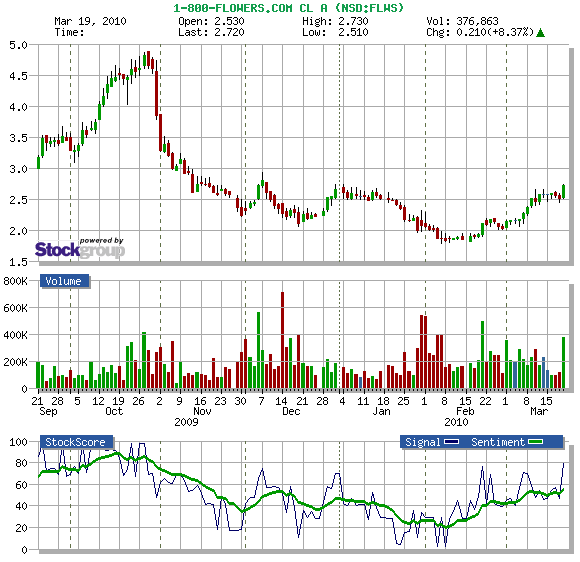
1. FLWS
There was buying late in the day on Friday in FLWS and that took the stock through some resistance and out of a cup and handle pattern. Looks good so long as it can hold above support at $2.52.
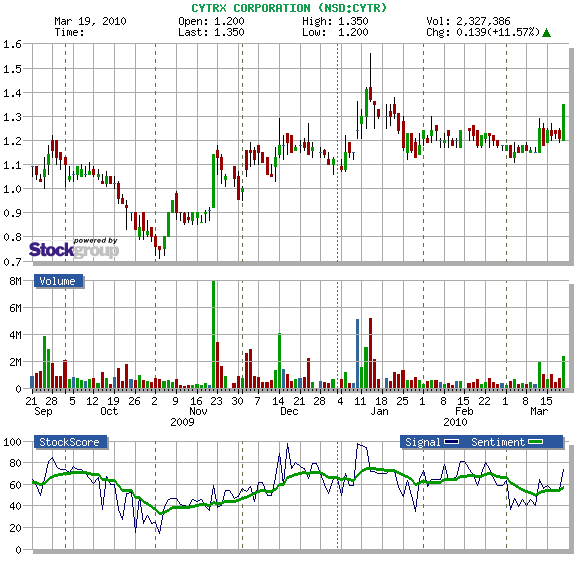
2. CYTR
Most of the buying pressure came in the last half an hour on CYTR and that took the stock up through resistance to close near the high of the day. Support is at $1.19.
Click HERE if you want to learn from some of the timeless advice from some of worlds best traders including the very successful Tyler Bollhorn.

References
Get the Stockscore on any of over 20,000 North American stocks.
Background on the theories used by Stockscores.
Strategies that can help you find new opportunities.
Scan the market using extensive filter criteria.
Build a portfolio of stocks and view a slide show of their charts.
See which sectors are leading the market, and their components.
Tyler Bollhorn started trading the stock market with $3,000 in capital, some borrowed from his credit card, when he was just 19 years old. As he worked through the Business program at the University of Calgary, he constantly followed the market and traded stocks. Upon graduation, he could not shake his addiction to the market, and so he continued to trade and study the market by day, while working as a DJ at night. From his 600 square foot basement suite that he shared with his brother, Mr. Bollhorn pursued his dream of making his living buying and selling stocks.
Slowly, he began to learn how the market works, and more importantly, how to consistently make money from it. He realized that the stock market is not fair, and that a small group of people make most of the money while the general public suffers. Eventually, he found some of the key ingredients to success, and turned $30,000 in to half a million dollars in only 3 months. His career as a stock trader had finally flourished.
Much of Mr Bollhorn’s work was pioneering, so he had to create his own tools to identify opportunities. With a vision of making the research process simpler and more effective, he created the Stockscores Approach to trading, and partnered with Stockgroup in the creation of the Stockscores.com web site. He found that he enjoyed teaching others how the market works almost as much as trading it, and he has since taught hundreds of traders how to apply the Stockscores Approach to the market.
Disclaimer
This is not an investment advisory, and should not be used to make investment decisions. Information in Stockscores Perspectives is often opinionated and should be considered for information purposes only. No stock exchange anywhere has approved or disapproved of the information contained herein. There is no express or implied solicitation to buy or sell securities. The writers and editors of Perspectives may have positions in the stocks discussed above and may trade in the stocks mentioned. Don’t consider buying or selling any stock without conducting your own due diligence.
Disclaimer
This is not an investment advisory, and should not be used to make investment decisions. Information in Stockscores Perspectives is often opinionated and should be considered for information purposes only. No stock exchange anywhere has approved or disapproved of the information contained herein. There is no express or implied solicitation to buy or sell securities. The writers and editors of Perspectives may have positions in the stocks discussed above and may trade in the stocks mentioned. Don’t consider buying or selling any stock without conducting your own due diligence.
“There are a lot of arguments regarding gold’s true value. How can anyone justify that an ounce of gold is worth over $1100/oz?”
“Last year, the world’s central banks became net gold buyers for the first time in two decades and according to CPM Group, this trend could continue. Right now, central banks hold approximately 18 percent of the total gold ever produced. “
Comment by Mark Leibovit: “Gold finished a disappointing week with another loss on Friday.
I am still very much a bull on Gold because we’re in a broad twenty-year up cycle and though there will be detours along the way, we’re headed dramatically higher. Shorter-term, time cycles point to the strong positive seasonality now into summer and the fact the U.S. Dollar Index is declining (despite negative inverse action on Friday) should soon reinstate Gold’s uptrend. The hoped-for signal would be broad-based Positive Volume Reversals ™. Perhaps we may have to wait and see if the broad stock market corrects here to find a more suitable launching pad for Gold and Gold equities as they have tracked together more often than not tracking together.” Special Offer from Mark Leibovit for Money Talks only: Go HERE and use the Money Talks promo code CBC12210
Back to:
What is gold really worth?
by Equedia
Gold, like the pieces of paper in our wallets we call money, is something that people can put value to. But there’s one big difference: You can print as much money as you want. But you can’t with gold. There’s only so much.
The fact is gold really does nothing but sit around and look pretty. And believe us, because of this, there are many anti-gold bugs out there who have been shooting darts at our faces for our continued belief in gold-related plays.
So let’s clear the air once again. We are not gold bugs. But we do take advantage of the obvious. And the obvious is simple:
Gold is worth a lot of money right now
And everyone wants a piece…especially the banks.
Last year, the world’s central banks became net gold buyers for the first time in two decades and according to CPM Group, this trend could continue. Right now, central banks hold approximately 18 percent of the total gold ever produced.
A recent Bloomberg survey reported 15 of 22 analysts forecasting that gold would make further gains this year, with Goldman Sachs predicting $1,380/oz in the next 12 months and HSBC predicting a peak of $1,300/oz in 2010 and as high as $5000/oz in the next five years.
During the past decade, precious metals were the best-performing asset class, beating property and shares with returns of nearly 250 per cent. People who invested money in precious metals, such as gold, silver and platinum, during the ten years to December 2009 made returns of 242 per cent, the equivalent of a gain of 13.1 per cent a year.
It’s no secret that gold, the most recognized of the precious metals, has taken center stage.
In past newsletters we told our readers to follow where the smart money goes (see Where the Billionaires Invest).
And it’s still going into gold
….read more HERE (scroll down to the title “And it’s still going into gold” above.
-
I know Mike is a very solid investor and respect his opinions very much. So if he says pay attention to this or that - I will.
~ Dale G.
-
I've started managing my own investments so view Michael's site as a one-stop shop from which to get information and perspectives.
~ Dave E.
-
Michael offers easy reading, honest, common sense information that anyone can use in a practical manner.
~ der_al.
-
A sane voice in a scrambled investment world.
~ Ed R.
Inside Edge Pro Contributors

Greg Weldon

Josef Schachter

Tyler Bollhorn

Ryan Irvine

Paul Beattie

Martin Straith

Patrick Ceresna

Mark Leibovit

James Thorne

Victor Adair