
Investment/Finances
Life doesn’t just persist in the same state. It changes constantly. Nature produces an immense variety of life. The forms best adapted for the conditions which exist survive and reproduce. The rest don’t. Entropy – the tendency of things to fall from order into disorder – is only defeated by life’s relentless effort, through DNA, to replicate itself in as many different survivable forms as possible.
–What does any of this have to do with Kondratieff and the share market?
–An economy is not a closed system, either. It does not behave in a linear way. That means you can’t really predict how it’s going to turn out. And importing a linear or cyclical theory into a complex adaptive system like the economy means you are going to be confounded in your understanding and your forecast. You will not predict what you can’t know. The unknown unknowns will get you every time.
–The key variables that we do know about in any economy – land, labour, energy, and innovation – are always changing and changing the way they interact and producing new possibilities (not always good, of course). For example the role of technology in the Kondratieff cycles is, as far as we know, unexplored. When Kondratieff wrote, the industrial revolution was increasing crop yields. Human population was on the verge on productivity explosion – both physically and economically.
–As people moved out of the country and into the city, labour and capital were freed up to harness the power of coal and oil to make entirely new systems of transportation and. It really was a new frontier in terms of productive possibilities. You went from cows and washing boards to refrigerated milk and milkshakes.
–By the way, these new frontiers (space, the final) always make some people nervous. These nervous people are the ones who could have the most to lose from a change in the status quo. Or, they could be genuinely and quite negatively affected by the change – the proverbial buggy whip maker watching a Model T roll down the street. Or they could be type of conservative person, psychologically and emotionally speaking, who reacts to a changing world by pining for the “old days” when things were more certain and didn’t change.
–This is why far right conservatives and the Greens will find they have more and more in common in coming years – both pine for a world that doesn’t change much. The traditional Right defines that world in moral and religious terms. The new Left defines it in environmental and resource terms. But both are essentially backward looking and want the State to interfere in private life to keep things as they were, or as they should be again.
–What the Kondratieff cycle may not accommodate is what you can never predict: the future. But at the risk of making a major ass of ourselves we’ll make a prediction: the current system has been fatally compromised by the world improvers and the backward lookers. Three hundred years of improvement in the general living conditions of man are at risk.
–The first major improvement in standards of living came with an increase in calories. When hunter gatherers became settled farmers, excess calories became a kind of credit humanity could spend on other things, like developing technology.
–With the development of industrial technology, powered by coal-fired steam engines, the next great leap came in the amount of time people had to spend growing food and the number of people required to grow it. Industrialisation meant fewer people had to be employed growing food. More could be employed making things. The variety of technology and durable and finished goods exploded in the 19th and 20th centuries.
–The further concentration of labour in cities made more and subtler variety possible, this time in the form of leisure and entertainment. You got the Jazz Age, Sinclair Lewis, George Bernard Shaw, the Charleston, and the Blitzkrieg.
–But then – and we think it started to happen in about 1914 but really picked up pace in the 1970s – we hit the limits of the frontier of this previously stable system. With the advantage of creating money from nothing – fiat money and fractional reserve lending – a huge global credit boom accelerated the use and abuse of scarce real resources (land, labour, and capital). It also accelerated the use of energy.
–More importantly, an already-complex system produced by a few simples rules – private property, sound money, low taxes, and free trade, the rule of law – became even more complex and fragile and stagnant as those rules were tinkered with to produce designed outcomes cherished by the political class.
–Here we are today. Our prediction is that that great complexity and prosperity produced by the 19th and early 20th century is being destroyed by the tinkering and the tinkerers. They have created something that cannot sustain itself – a model of asset-based private and corporate wealth creation that is not based on sound money or honest work or the rule of law (the corporations and the financiers and the politicians make the law to protect their interests now).
–Nature punishes the inefficient and destroys the wasteful. And so do markets, when we let them. We take the amount of surplus in the world – calories, time, leisure – for granted. In fact, we even begin to call it a right.
–What we forget is that all those calories and all that time and all that leisure were the by-products of a system based on simple rules. With those rules being broken, twisted, and disfigured to meet other ends, we shouldn’t expect the system to produce the same kind of surplus we are used to. And now we see, it’s not.
–Of course without all the theory most people know intuitively that things aren’t working anymore. That’s because most people have already begun to adapt to a world where big institutions have trouble delivering on promises they’ve made and where the rules constantly change. Some people prefer not to think about this and would rather eat Cheesy Puffs instead. Woe unto them!
–What we think the Kondratieff cycle doesn’t show is that the history of the natural world is punctuated by extinction events – events which so radically changed the landscape or the habitat that most species didn’t survive. And in the financial world?
–We have seen a series of minor extinction events in the finacial world beginning with the Mexican devaluation in 1995. The Asian Tigers, Russia, LTCM, the tech bubble, and then Bear Stearns, Lehman, Greece and beyond. And beyond?
–All of these financial events are steadily concentrating risk in a smaller and smaller number of assets into which a greater and greater number of people are congregating: namely bonds and especially U.S. bonds. This concentration is made of refugees from other bubbles that have faith that central bankers can keep a few bubbles going.
–But oh ye of little faith, ye reckoners, what do you reckon? Will the counterfeiters running the world’s central banks pull of the greatest confidence trick of all time that you can create wealth by printing money and solve a debt problem with more debt? Or will they fail?
–They’ll probably fail. Will it be before September 7th? Will it be in a few years? Stay tuned. And in the meantime, adapt or perish!
The Daily Reckoning has turned Australian!
Sign up to The Daily Reckoning HERE – for FREE!
Dan Denning: Dan Denning is the author of 2005’s best-selling The Bull Hunter (John Wiley & Sons). He began his financial publishing career in 1997 and has covered financial markets form Baltimore, Paris, London and, beginning in 2005 Melbourne. He’s the editor of The Daily Reckoning Australia and the Publisher of Port Phillip Publishing.
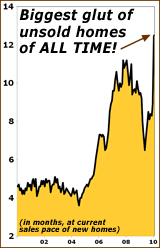
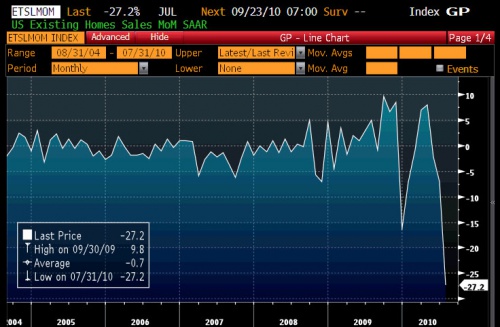
Previous 5.37 million revised to 5.26. The chart says it all: lowest sales since May 1995, months supply largest since 1999.
In my book, today was a very significant and important bearish day. Following the recent 90% down day, the stock market did not have the strength to rally the usual 2 to 7 days – Richard Russell Dow Theory Letters
US Stocks Tumble After Existing Home Sales Drop Sharply
U.S. stocks tumbled after a report on home sales last month came in much worse than expected, falling to its lowest level in 15 years, sending an already down market reeling Tuesday.
The Dow Jones Industrial Average fell 147 points, or 1.4%, to 10027 after the data, when it had been down about 115 points heading into the release. It briefly dipped below 10000 and all 30 of its components remained in the red. The Standard & Poor’s 500 index declined 1.6% to 1050 while the Nasdaq Composite fell 1.7% to 2122.
The yield on the 10-year Treasury fell to 2.47%.
Investors have grown more and more fearful with every bit of disappointing data that economy could be headed for more trouble. The market had already priced in low expectations for the housing data Tuesday morning, before falling further when it was even worse than thought.
Home resales dropped a record 27.2%–nearly twice as much as analysts had expected–to an annual rate of 3.83 million in July, the National Association of Realtors said Tuesday. Meanwhile, inventories rose to 12.5 months from 8.9 months in June, pressuring already depressed home prices. Inventories are at their highest level in more than a decade.
Economists surveyed by Dow Jones Newswires had expected existing home sales to fall by 14.3% to an annual rate of 4.6 million.
-By David Benoit, Dow Jones Newswires; 212-416-2458; david.benoit@dowjones.com

Fueled by the ever-increasing production from the Bakken Formation, North Dakota has surpassed Oklahoma to become the third-busiest state for oil drilling… …. according to Baker Hughes Inc., a company that tracks oil activity.
It’s quite a feat, considering North Dakota wasn’t on the list of major players in the energy industry until two years ago. The report said North Dakota has 128 rigs actively drilling for oil or natural gas, trailing only Texas (675) and Louisiana (187).
And the industry is projected to keep growing in the state, with the possibility of breaking the record of 148 active rigs set in 1981. North Dakota is currently producing about 300,000 barrels of crude oil per day, double the state’s production from two years ago.
With the increasing oil activity comes other issues, though. Roads in parts of North Dakota are taking a pounding from the additional truck traffic, and cities like Stanley are experiencing growing pains like never before. The North Dakota Legislature will be busy with oil issues when it convenes in January 2011, including how to best utilize the state’s growing budget surplus.
In the meantime, there’s no reason to expect that the Bakken won’t keep rockin’ in northwest North Dakota.
by the Jamestown Sun
“We draw everyone’s attention to the chart this page of the production of crude oil in N. Dakota, which we “stole” from our friend, Dr. Mark Perry of the University of Michigan’s business school. Is it not amazing that in six years, oil production from N. Dakota and the Bakken field has gone from 80,000 bpd to just under 320,000 bpd! This is the perfect example of high prices creating its own “new crop.” Production from this field is years from peaking.” – Dennis Gartman – The Gartman Letter)
Over the last few weeks, foreign countries have been threatening to ban Research in Motion’s (RIM) (TSX: RIM) (NASDAQ:RIMM) blackberry services such as encrypted email and blackberry messenger (BBM) because the technology made messages too difficult for their governments to monitor.
If you haven’t already heard, India just gave RIM until August 31 to comply with a request to gain access to encrypted corporate email and messaging services or those services will be shut off.
Not long before that, United Arab Emirates, where RIM has 500,000 users, proposed a ban starting Oct. 11 targeting BlackBerry Messenger as well as e-mail and Web browsing. If this happens, don’t expect your blackberry to work when on vacation in Dubai because this ban will also apply to visitors.
The list of countries threatening to ban blackberry services are beginning to pile up. Indonesia, Lebanon, Saudi Arabia, and China have all had issues regarding the tight security behind RIM’s services.
The Blackberry Ban?
RIM made its mark on the smart phone world by offering something that no other smart phone providers could: Security.
In fact, most of the world’s major corporations and governments heavily rely on the BlackBerry’s unbeatable email privacy and messaging system. In addition to that, RIM’s software compresses messages so that they use only about 5 per cent as much bandwidth as an iPhone uses. It is this shrinking that encrypts the message, ensures secure delivery, and saves on bandwidth costs.’
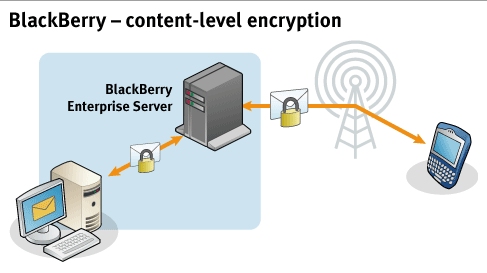
For years, corporations have purchased blackberries in droves because of its ability to make messages extremely difficult for outside parties to monitor due to its strong encryption. But now it seems that RIM has done too good of a job of protecting its users privacy that foreign countries are threatening to ban its services. And we don’t blame them.
You see, unfortunately for RIM, the BlackBerry’s ironclad security has also attracted cohorts of criminals, drug dealers, and terrorists. This makes it near impossible for governments around the world to effectively monitor the messages of these villains.
Remember the Mumbai Terror Attack? It was later found that the terrorists involved in the attack were communicating with Blackberries and the terrorist mastermind controlled events via a BlackBerry server in Pakistan. Regardless, can the governments blame RIM for that?
It’s not impossible for authorities to crack the blackberry messages. Governments can still access the decrypted emails and messages that are being sent. They just have to find the server, as they did with the terrorists from the Mumbai attack. The problem is the servers may be hidden overseas and gaining access is difficult due to legal and political issues.
What does this mean for RIM and its shareholders?
Despite the controversy of its secure services, the market seems to be ignoring the fact that Canada’s leading technology company saw a 40-per-cent rise in BlackBerry sales over the past 12 months and remains one of the top phone makers in the world, topping Motorola earlier this year. Yet, shares of RIM have dropped close to 30% in less than 6 months.
RIM also boasts net profit margins of 16.5%. This is significantly higher than other mobile phone manufacturers who have net profit margins of around 5%.
Even with the introduction of competing smart phone solutions, RIM’s BlackBerry remains prominent amongst large business customers due to its track record of security and reliability. Just ask President Obama.
When the dust settles and the blackberry ban controversy is over, look for RIM to rebound.
Over the last few weeks, foreign countries have been threatening to ban Research in Motion’s (RIM) (TSX: RIM) (NASDAQ:RIMM) blackberry services such as encrypted email and blackberry messenger (BBM) because the technology made messages too difficult for their governments to monitor…read more HERE
If you haven’t already heard, India just gave RIM until August 31 to comply with a request to gain access to encrypted corporate email and messaging services or those services will be shut off.
Not long before that, United Arab Emirates, where RIM has 500,000 users, proposed a ban starting Oct. 11 targeting BlackBerry Messenger as well as e-mail and Web browsing. If this happens, don’t expect your blackberry to work when on vacation in Dubai because this ban will also apply to visitors.
The list of countries threatening to ban blackberry services are beginning to pile up. Indonesia, Lebanon, Saudi Arabia, and China have all had issues regarding the tight security behind RIM’s services.
The Blackberry Ban?
RIM made its mark on the smart phone world by offering something that no other smart phone providers could: Security.
In fact, most of the world’s major corporations and governments heavily rely on the BlackBerry’s unbeatable email privacy and messaging system. In addition to that, RIM’s software compresses messages so that they use only about 5 per cent as much bandwidth as an iPhone uses. It is this shrinking that encrypts the message, ensures secure delivery, and saves on bandwidth costs.’
For years, corporations have purchased blackberries in droves because of its ability to make messages extremely difficult for outside parties to monitor due to its strong encryption. But now it seems that RIM has done too good of a job of protecting its users privacy that foreign countries are threatening to ban its services. And we don’t blame them.
You see, unfortunately for RIM, the BlackBerry’s ironclad security has also attracted cohorts of criminals, drug dealers, and terrorists. This makes it near impossible for governments around the world to effectively monitor the messages of these villains.
Remember the Mumbai Terror Attack? It was later found that the terrorists involved in the attack were communicating with Blackberries and the terrorist mastermind controlled events via a BlackBerry server in Pakistan. Regardless, can the governments blame RIM for that?
It’s not impossible for authorities to crack the blackberry messages. Governments can still access the decrypted emails and messages that are being sent. They just have to find the server, as they did with the terrorists from the Mumbai attack. The problem is the servers may be hidden overseas and gaining access is difficult due to legal and political issues.
What does this mean for RIM and its shareholders?
Despite the controversy of its secure services, the market seems to be ignoring the fact that Canada’s leading technology company saw a 40-per-cent rise in BlackBerry sales over the past 12 months and remains one of the top phone makers in the world, topping Motorola earlier this year. Yet, shares of RIM have dropped close to 30% in less than 6 months.
RIM also boasts net profit margins of 16.5%. This is significantly higher than other mobile phone manufacturers who have net profit margins of around 5%.
Even with the introduction of competing smart phone solutions, RIM’s BlackBerry remains prominent amongst large business customers due to its track record of security and reliability. Just ask President Obama.
When the dust settles and the blackberry ban controversy is over, look for RIM to rebound.
-
I know Mike is a very solid investor and respect his opinions very much. So if he says pay attention to this or that - I will.
~ Dale G.
-
I've started managing my own investments so view Michael's site as a one-stop shop from which to get information and perspectives.
~ Dave E.
-
Michael offers easy reading, honest, common sense information that anyone can use in a practical manner.
~ der_al.
-
A sane voice in a scrambled investment world.
~ Ed R.
Inside Edge Pro Contributors

Greg Weldon

Josef Schachter

Tyler Bollhorn

Ryan Irvine

Paul Beattie

Martin Straith

Patrick Ceresna

Mark Leibovit

James Thorne

Victor Adair