
Daily Updates
James Grant argues the latest gloomy forecasts ignore an important lesson of history: The deeper the slump, the zippier the recovery.

As if they really knew, leading economists predict that recovery from our Great Recession will be plodding, gray and jobless. But they don’t know, and can’t. The future is unfathomable.
Not famously a glass half-full kind of fellow, I am about to propose that the recovery will be a bit of a barn burner.
…..read full article HERE.
Juxtaposition: Whose Right James Grant or David Rosenberg
James Grant argues the latest gloomy forecasts ignore an important lesson of history: The deeper the slump, the zippier the recovery.
As if they really knew, leading economists predict that recovery from our Great Recession will be plodding, gray and jobless. But they don’t know, and can’t. The future is unfathomable.
Not famously a glass half-full kind of fellow, I am about to propose that the recovery will be a bit of a barn burner.
…..read full article HERE.
David Rosenberg highly recommends one reads James Grant’s article to understand the other side of the debate. But he has some major problems with the points being
made…….read full article HERE. (Ed Note: begin bottom of page 4 or 8).
Ed Note: Below is a small excerpt from Mark Leibovit’s tremendous 12 page VR Gold Letter. The VR Gold Letter is published WEEKLY. This excerpt from 9/06/09.
Spot Gold, Silver, Platinum and Palladium all traded at new recovery highs this past week at 1025.10, 17.69, 1358.00 and 310, respectively. Much of the strength could be attributed to weakness in the U.S. Dollar Index which touched 76.010 on Thursday. Ultimately, however, I feel the direction of the U.S. Dollar will have lesser impact on the price of Gold and other commodities as the U.S. Dollar diminishes in its role as theworld’s exchange currency. Short-term, however, rallies in the U.S. Dollar could shake the trees and scare out weak holders. We may be approaching such a position at this time as a Positive Volume Reversal ™ was formed in the U.S. Dollar Index ETF (UUP) and many Gold shares (listed below) formed Negative Volume Reversals ™ late last week.
Subscribers to my VRtrader.com intra-day Platinum service know that I sold out all of my equity positions on Wednesday, September 16 ahead of Friday’s option expiration, the Rosh Hashanah holiday and this coming Tuesday’s Autumnal Equinox. Though I am overall on a ‘Buy’ signal for Gold, as a trader I saw some risk and decided to stand aside. We took handsome profits in the majority of our positions.
The Annual Forecast Model has been ‘right-on’ in calling for strength during the current time period, but is also calling for a correction.
Though I would like to tell you the Annual Forecast Model can pick exact top and bottom dates, that is not the case and you have use some common sense investing or trading using it. For now, I would assume we’re in or approaching a period where a pullback is in order, so please act accordingly, especially as my volume work is generating some Negative Volume Reversals ™ here. I am very pleased with the outcome of the Annual Forecast Model projection. Who else would have told you that you would see a high for the year in Gold in September when that forecast was published in January? If you know of that forecast, I sure would like to see it, but I assure you they didn’t draw you a picture. A picture is worth a 1000 words! If you sell Gold here and your gold shares, you have made money. I have done my job and the cost of this subscription was earned many times over. This Model is the closest I have to a crystal ball and the ball has not gone fuzzy – yet!
The VR Gold Letter is available to Platinum subscribers for only an additional $20 per month, while for Silver subscribers the price is only an additional $70.00 per month. Prices are going up very shortl, so act now! Separately, the VR Gold Letter retails for $1500 a year! The VR Gold Letter is published WEEKLY. It is 10 to 16 pages jam-packed with commentary and charts. Please call or email us right away. Tel: 928-282-1275. Email: mark.vrtrader@gmail.com .

Marks VRTrader Silver Newletter covers Stock, TSE Stocks, Bonds, Gold, Base Metals, Uranium, Oil and the US Dollar.
More kudos – Mark Leibovit was named the #1 Intermediate Market Timer for the 10 year period ending in 2007; the #1 Intermediate Market Timer for the 3 year period ending in 2007; the #1 Intermediate Market Timer for the 8 year period ending in 2007; and the #8 Intermediate Market Timer for the 5 year period ending in 2007. NO OTHER ANALYST SURVEYED APPEARED IN ALL FOUR CATEGORIES FOR INTERMEDIATE MARKET TIMING AS PUBLISHED IN TIMER DIGEST JANUARY 28, 2008!
For a trial Subscription of The VR Silver Newsletter covering Stocks, Bonds, Gold, US Dollar, Oil CLICK HERE
“We are standing on the precipice of a new era in global-social-economics. How we enter this new age is of critical importance. Government is incapable to doing anything for any reform of its own abuse of power is not up for negotiation. We must weather the storm, and to do so we need to understand its nature. Just as the 1930s Great Depression set in motion profound changes that were even manifest in geopolitical confrontations, we have now reached such a crossroads. A debt crisis has its tentacles deeply embedded into-every sector right into government. This is the distinction from a mere stock market crash that never alters the economy long-term. We are seriously still over-leveraged and some banks are still trying to be hedge funds and have to speculate to make a profit. That is a key warning sign that the worse is yet to come.
The 8.6 Year Cycle and the Forces of Nature:
 San Andreas Fault
My discovery came in two parts. FIRST I like Darwan and Adam Smith, “observed” what was a “contagion” that seemed to spread from one market to another as if it were a disease. This is what I began with, not the vision of cycles. However, because I began to work in. a gold bullion/rare coin store when I was about 13, I was exposed to the collapse of the Bretton Woods accord and had a front row seat to the collapse of the fixed ratecurrency system and the cherished gold standard. Thus, I knew what things were in value in the 1960s. So when my history teacher put on in class one day an old film in black & white named – Toast of the Town about the attempt to corner the market on gold in 1869 that led to a Panic and the dragging of bankers out to the streets and hangingthem, they were forced to send in the troops. That is what “Black Friday” had truly meant -death on Wall Street.
Therefore, the SEOOMD phase was now understanding that gold was $35 and watching that movie with Carry Grant quoting gold to James Fisk from the ticker tape saying $162, this hit me that prices were not linear progressions of always stepping higher as if they were ascending a staircase. Combining this realization with the observation of the “contagion” is what led me to the field of cycles.
These realizations merged with my love of history. I then explored the rise and fall of civilization and tried to under- stand what was going on. This exposed me to understand that natural events also played a role. Where perhaps others did not think about their study from CyCiical views, I at least accepted the possibility.
Looking at history, I saw waves of trends and dark ages like those between the Greek Heroic period where there was the battle of Troy, and the second period in which Homer lived to write about the first age. This was the period of Athens & Sparta wars, the age of Alexander the Great – the Hellenistic age. What happened between the two? This was a dark age that seems to have been created by natural events of weather. It appears this was a decline in the energy output of the sun that wiped out agriculture and their economy. This was the driving force behind migrations.
~
Go to Belize, formerly British Honduras, and you will discover cities intact, that were just abandoned. There is no sign of war or even an earthquake. There is only the curious explanation that if the weather changed and crops failed, they too may have just picked up
and migrated.
Instead of being a flat model, we were dealing with a multitude of variables that combine to create the Economic Confidence Model. What we have today was set in motion by the 1906 San Francisco Earthquake that led to the 1907 Panic. Insurance companies were on the east coast and the claims were on the west. The capital flowed west arid banks failed because there was a shortage of cash in the east.
The Congressional hearings that began to investigate the causes, led them to understand the cash flow problem. That gave birth to die Federal Reserve in 1913. Our monetary system today was set in motion by the earthquake in San Francisco in 1906. We cannot extract that event from the data. It is part of us today.
….to read more go HERE. (Ed Note: it is a pdf so you an enlarge the document if you find it hard to read)
ACKNOWLEDGEMENTS
I would like to thank the many people who have been writing from around the world. It is encouraging to know that there are so many people who are interested in uncovering the truth. I have also special thanks for so many providing valuable insight into trends around the world from China, Soviet Republics, South Africa, Brazil, Australian, and India. I believe we can survive the folly of governments even if they refuse to listen.
The key is understanding the nature of events, and that allows us to correctly make the decision to be on the opposite side. I would like to also thank all my old friend and former clients for their support and to know that they have continued to gather information that serves us all in times of crisis.
We are standing on the precipice of a new era in global-social-economics. How we enter this new age is of critical importance. Government is incapable to doing anything for any reform of its own abuse of power is not up for negotiation. We must weather the storm, and to do so we need to understand its nature. Just as the 1930s Great Depression set in motion profound changes that were even manifest in geopolitical confrontations, we have now reached such a crossroads. A debt crisis has its tentacles deeply embedded into-every sector right into government. This is the distinction from a mere stock market crash that never alters the economy long-term. We are seriously still over-leveraged and some banks are still trying to be hedge funds and have to speculate to make a profit. That is a key warning sign that the worse is yet to come.
“But rest assured, carry trades have been the graveyard of many investors over the years, and this time is unlikely to prove different. After falling victim to a powerful short-squeeze in the second half of last year, pity the dollar short that gets bitten by the same dog twice.”
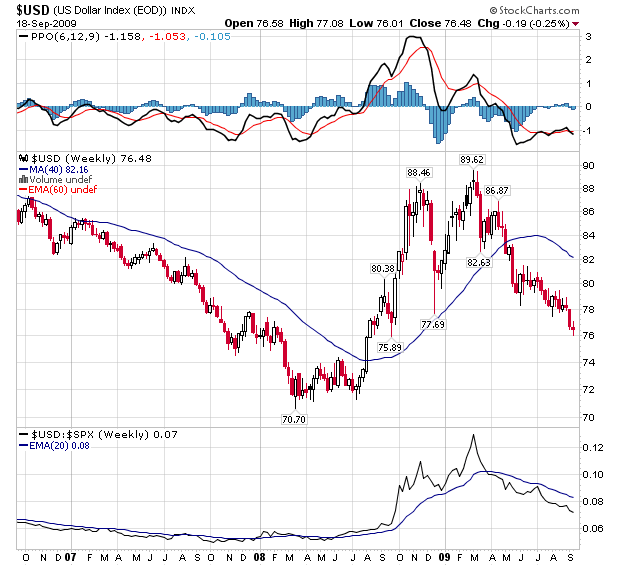
Dollar Shorts Should Look Out
As the third quarter draws to a close, the U.S. dollar is under pressure, falling to the lowest level in a year against a wide swathe of major and emerging market currencies alike. After putting in a strong performance from the middle of 2008 through the first quarter of 2009, the greenback has surrendered a significant proportion of those gains.
Structures
At first many attributed the dollar’s decline to structural forces. Numerous observers emphasized diversification of reserves. There is little factual evidence this is actually taking place. The dollar’s share of reserves has remained amazingly steady and, if anything, has increased slightly in recent quarters.
China, the most vocal in advocating an alternative to the dollar, holds the most reserves, twice as much as second place Japan. In June of last year, U.S. Treasuries accounted for 29.6% of Chinese reserves (Treasury holdings of $535 billion on total reserves of $1.808 trillion). In June of this year, U.S. Treasuries accounted for 36.4% of China’s reserves (Treasury holdings of $776 billion on total reserves of $2.132 trillion).
While there still are those observers who talk about the diversification of reserves as a major weight on the dollar, lack of evidence is spurring many to offer another explanatory model.
The second attempt at a structural explanation for the dollar’s decline focused on the indisputable fact that the U.S. government is taking on a great deal of debt and the Federal Reserve is creating reserves. The debate about U.S. health care reform and the skepticism greeting the Obama Administration’s claim of ‘will not increase the deficit’ plays into these fears. Inflation is seen as politically expeditious to lighten the debt burden. A depreciating dollar is at once and simultaneously a cause and effect of perceived inflation risks.
Omission
Yet, inflation would seem to be more a sin of omission (failing to bring spending back under control, for example) than a sin of commission (intentional actions to spur inflation). Also, various market-based measures of inflation, the absolute level of long-term interest rates, the break-even in Treasury Inflation Protected Securities (TIPS), and the 5-year/5-year forward suggest inflation expectations, are what the ECB’s Trichet would call anchored. Surveys of economists and the public, such as the University of Michigan’s survey, which the Fed has sometimes cited, also suggest inflation expectations are innocuous. Moreover, inflation expectations appear higher in the euro zone and the U.K. than the U.S.
Cycles
If such structural explanations for the dollar’s weakness fail, why is it falling? Market participants often seem inclined to exaggerate structural variables and under-estimate the saliency of cyclical variables.
Indeed, even articles in the Financial Times, which often has argued that the structural current account deficit is the main source of the dollar’s decline, seem to suggest a more cyclical factor—low interest rates in the United States—with the dollar becoming the dominant funding currency.
The Federal Reserve has in the past and will likely repeat at the September 23rd FOMC meeting that the Fed funds target will likely remain at “exceptionally low levels” for an “extended period of time”. A substantive change in this wording may very well trigger a sharp short-covering rally in the dollar.
And that is the point. The main weight on the dollar is not the U.S. debt. It is not the diversification of reserves. It is not the end of the so-called U.S. model of capitalism. It is not because the reform of health care seems beyond the capability of the factious political system. The dollar is falling because U.S. interest rates are low.
Data Mining
Some reporters and analysts who recently have recognized the superiority of this explanatory narrative for the dollar’s decline seem to be exaggerating it, perhaps like the observation that often it is the convert that sings loudest in choir. A number of recent press reports have noted that the London Interbank Offered Rate (LIBOR) for the dollar is below what it is for the Japanese yen.
What they are referring to is the LIBOR fixings, not to real market rates. Specifically, this is what it means. The forward currency rate is a function of interest rate differentials. If dollar rates were below Japan’s, like they are for the euro zone, then we would say that the [forward] points are at a premium. But the fact of the matter is that they are not. As far as I can tell, market makers continue to quote the forward rates as if U.S. rates remain slightly higher than Japan’s.
In addition, such analysis, as it were, is cherry-picking the evidence in another way. LIBOR fixings cover periods of one week to one year. Dollar LIBOR fixings are below Japan’s for 2, 3, and 4 month tenors, but the rest of the curve is above Japan’s, let alone that the entire TIBOR (Tokyo Interbank Offered Rate) term structure is below the U.S.
A more compelling explanation for the yen’s recent gains is that Japanese investors were repatriating earnings and window-dressing their books ahead of the fiscal half year end at the end of the month, encouraged by a Japanese version of the U.S. Homeland Investment Act, which allows companies to repatriate earnings without paying the customary 40% tax.
In addition, the new DPJ-led government seems more relaxed about the strength of the yen than prior LDP governments. Even BOJ Governor Masaaki Shirakwa has recently seen some virtues in a strong yen.
This explanation also suggests the conditions under which the dollar will stabilize and recover against the yen. It will happen before U.S. rates rise. It will happen as the fiscal year end machinations cease. We may already be seeing the early signs of this.
In the most recent weekly Ministry of Finance portfolio flow report, in the week ending September 12th, Japanese investors bought the most foreign bonds (~$18 billion) in four years. The dollar appears tentatively to be finding a floor just above JPY90 and the euro near JPY131-JPY132. And the new Japanese government is likely to learn how to communicate with the markets better. After all there has been no official intervention on dollar-yen for more than 5-years. It need not encourage long yen positions.
Liquidity
Low U.S. interest rates are a necessity, but are insufficient to fully explain the dollar’s decline. Two other conditions seem to combine with the low interest rates to encourage the dollar’s use as a funding currency.
First is liquidity. The greenback remains the most liquid currency in the world and the priority given to liquidity since the economic and financial crisis is difficult to over-estimate. Moreover, a number of central banks continue to auction dollars. Demand at the long-dated (84 day) dollar auction by the ECB, for example, has dried up, but there is still strong (~$40 billion+) demand for the short-dated (7-day) dollar auctions.
Second is the appetite for risk, those often unquantifiable “animal spirits”. Over the last six months, the pendulum of market psychology has swung from capital preservation to rates of return—from risk-off to risk-on.
Therein lays an under-appreciated irony. If the U.S. is as flawed as many of its critics suggest and that the U.S. is quickly going down the path blazed by Argentina, then why are dollar sales associated with taking on risk?
The dollar’s role as a funding currency will not last for a decade or more, as has been the case for Japan. The consensus has emerged on news wire surveys of various banks and research groups that the first Fed rate hike is likely near the middle of next year. This view seems to be reflected as well in the Fed funds futures strip.
In our explanation of the dollar’s decline, we would emphasize cyclical influences over structural considerations. It means the dollar’s decline is not terminal. The role of the dollar as the go-to funding currency will cease when the incentives shift.
But rest assured, carry trades have been the graveyard of many investors over the years, and this time is unlikely to prove different. After falling victim to a powerful short-squeeze in the second half of last year, pity the dollar short that gets bitten by the same dog twice.
Marc Chandler joined Brown Brothers Harriman (http://www.bbh.com/) in October 2005 as the global head of currency strategy. Previously he was the chief currency strategist for HSBC Bank USA and Mellon Bank. Marc is a prolific writer and speaker. In addition to being frequently called up to by the newspapers and news wires to provide insight into the developments of the day, Chandler’s essays have been published in the Financial Times, Barron’s, Euromoney, Corporate Finance, and Foreign Affairs. He is also the contributing economic editor for Active Trader Magazine and to TheStreet.Com. Marc appears often on business television and is a regular guest on CNBC. He frequently presents to business groups and investors.
His current research projects include global imbalances, Islamic finance, and the relationship between savings, investment and growth. Marc has been analyzing the foreign exchange market for more than 20 years. He holds a Master’s degree in American history (1982) from Northern Illinois University and a Master’s in International Political Economy from the University of Pittsburgh (1984). He has taught classes on International Political Economy at New York University since the early 1990s.
Marc Chandler’s Company
-
I know Mike is a very solid investor and respect his opinions very much. So if he says pay attention to this or that - I will.
~ Dale G.
-
I've started managing my own investments so view Michael's site as a one-stop shop from which to get information and perspectives.
~ Dave E.
-
Michael offers easy reading, honest, common sense information that anyone can use in a practical manner.
~ der_al.
-
A sane voice in a scrambled investment world.
~ Ed R.
Inside Edge Pro Contributors

Greg Weldon

Josef Schachter

Tyler Bollhorn

Ryan Irvine

Paul Beattie

Martin Straith

Patrick Ceresna

Mark Leibovit

James Thorne

Victor Adair