
Daily Updates
Ed Note: Conclusions moved from the bottom of this article to the top.
Conclusions
While risk assets remain overbought (see stocks and commodities sections above) and the USD appears well oversold, we await a catalyst to start the countermove. For the USD, the best prospects are an overall pullback in stocks, and possible central bank intervention.
Other Conclusions
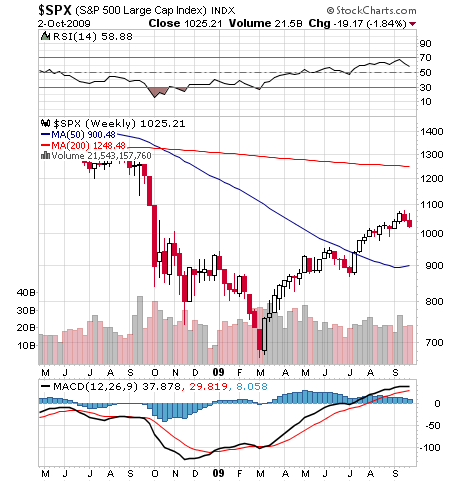
With no real resistance on the S&P 500 before another 5%, momentum from profit taking alone could carry it down to around 980, with other risk assets likely to follow. There’s little influential news on the calendar for the coming week, so the likely bias is to tight range-bound trading with a bias down a few percentage points.
The overall theme this past week was a distinct reversal in risk appetite, as global equities, commodities, and related risk currencies pulled back while safe haven assets gained. A disappointing US employment report justified the pullback, though minor losses suggest it was mostly priced in already.
STOCKS
Because global currency and commodity markets follow global stocks, which in turn tend to follow the S&P 500, we open with a quick look at it. Key points:
Closed lower for the second straight week as markets correctly anticipated disappointing jobs results.
A light news week ahead suggests no huge moves until Q3 earnings, unless sentiment has already turned negative enough for equities to continue to pullback on profit taking.
Will “bad results beating even worse expectations” allow stocks to rise again as they did in Q2, despite their further gains since then? Common sense says no, but it said the same thing last time.
Recovery sentiment & news over past months was heavily dependent on temporary stimulus and inventory restocking. As such, further gains will depend on genuine self sustaining recovery in fundamentals, but we don’t see that yet. Instead, much of the news is of the “slowing decline” theme.
COMMODITIES
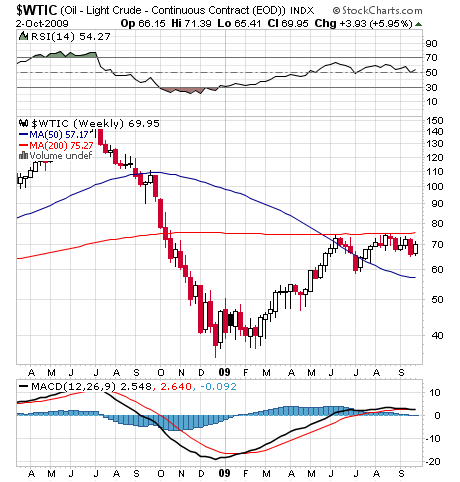
They continue to follow equities, though not necessarily day by day or by the same magnitude. For the most popularly watched commodities like crude oil and gold, speculators, including the small, least informed ones, remain overwhelmingly long, and the reputedly more reliable commercial traders tend to be short. That suggests more risk to the downside, as does the past week’s moves in stocks combined with their already extended rally.
CURRENCIES
USD
US Dollar Recovery Depends on Continued Stock Pull Back, Central Banks Might Help
Summary
Fundamental Outlook for US Dollar: Bullish
Friday’s NFP disappointment will likely dampen risk appetite and help the USD, which mostly moves in the opposite direction of stocks.
USD may have set an important bottom against the Euro.
US Unemployment Rate hits 26-year high on NFP disappointment.
US ISM Non-Manufacturing, 80% of US GDP, is a key barometer on domestic economic activity and the main US news for this week.
Analysis
The US Dollar finished the week higher against the Euro and other key counterparts, but a sharply disappointing Nonfarm Payrolls report nearly derailed the nascent USD recovery through Friday’s close. The trade-weighted US Dollar Index hit fresh monthly highs near 77.50 just ahead of the release.
Immediate declines in the US S&P 500 initially sent the dollar higher, but markets clearly expressed their displeasure with the worse-than-expected payrolls release and sold USD through in subsequent trading on poorer US fundamentals. The risk aversion the NFP created is likely to provide a longer lasting boost for the USD, which trades up mostly on risk aversion and is heavily shorted already.
US CFTC Commitment of Traders data shows that Non-Commercial traders—a group mostly comprised of hedge funds and other large speculators—remained the most net-long the Euro/US Dollar since it traded near 1.6000 in early 2008.
The sentiment generated by the coming Q3 earnings season is the likely catalyst for the next big move in risk sentiment and the USD.
Events
US Dollar traders should be alert for abrupt shifts in risk sentiment, but a relatively light US economic calendar leaves limited chance for major daily volatility. The notable exception is Monday’s US ISM Non-Manufacturing report, which will shed further light on the state of the domestic services industry. According to 2008 estimates, the Services industry accounts for nearly 80 percent of US GDP. Suffice it to say, any noteworthy surprises in the highly-anticipated report could force major moves in the US Dollar and broader financial markets. Indeed, the ISM Non-Manufacturing survey tends to be one of the most market-moving events on release. Pay particular attention to its employment component, which could worsen or soften the impact of Friday’s NFP let down.
Outside of the ISM report, forex traders should keep a look out for a number of important global central bank interest rate decisions. Uncertainty surrounding Australian, British, and European central bank announcements may create some movements across key forex pairs. However, these tend to be unpredictable, so traders must focus on cutting risk on trades in the hours before and after these announcements.
While there are early signs of a sustained US Dollar reversal, recent price action has shown markets were not yet willing to push the Greenback materially higher versus key counterparts. The coming week may prove especially important to overall trends in major US Dollar pairs. Traders should watch the S&P carefully for signs of how risk and safety currencies could behave.

EUR
Its Fate Depends on Risk Appetite, ECB Might Help
Summary
Fundamental Forecast for Euro: Neutral
EU receives the results of its own financial stress test: the prognosis is promising, but is it credible?
Euro Zone Unemployment is now at a 10-year high of 9.6%.
German and regional inflation gauges still pitched into negative territory.
Moving with overall risk sentiment as shown by the S&P 500 pullback, thus falling against the USD, gaining against riskier forex like the AUD.
Euro-zone growth projected below that of US and Japan, along with ECB pro-USD comments, making EUR more vulnerable.
Analysis
Just this past week, the EU completed a five-month long stress test of its financial markets. In the end, none of those institutions surveyed were expected to see their tier one capital ratios fall below 6 percent (the Basel minimum is 4 percent) even in the worst of conditions. However, skepticism is likely to develop just as surely as it did after the US test. It is reasonable to question why there were only 22 banks for such a broad region and with what methodology they measure risk; but the real concern is in the 400 billion euros of additional losses the market could sustain under the most extreme conditions. We have already seen 489 billion in losses so far. The IMF suggests European banks have disclosed only 40 percent of their losses.
Maintaining the pace of production after inventories build up and facilitating consumer spending will be the keys to sustainable growth. Recently, Trichet stated that a healthy dollar was “extremely important.” This can be interpreted to mean he is very concerned about the high level of his own currency, and that bodes badly for the EUR/USD.
Events
Monday brings Euro-zone Sentix Investor Confidence, and Retail Sales m/m, Wednesday EZ GDP q/q and Geman factory orders, and Thursday brings an ECB rate announcement and German trade balance. With the central bank already announcing it was culling its unlimited fund auctions, we already have the first steps towards hikes, so we will have to absorb everything said after this week’s rate decision.
JPY
Testing Major Resistance, Movement Follows Overall Risk Sentiment
Summary
Fundamental Forecast for Japanese Yen: Bullish
Japan’s Jobless Rate Unexpectedly Falls, Household Spending Surges.
Business Outlook Improves But Capital Investment Falls Most in 10 Years.
Housing Starts Fall Most in Two Years, Industrial Production as Expected.
The Japanese Yen will begin the week ahead at a crossroads, with the behavior of risk appetite likely to set the direction. Global equity markets slumped for the second consecutive week amid increasingly mixed economic data capped by September’s disappointing US jobs report. If we are indeed at the brink of another downturn for equities, as suggested in the above stocks section, the spectrum of risk-correlated investments (commodities, carry trades) are very likely to follow, with the Japanese unit rising as traders unwind short-Yen yield-seeking positions, threatening to send USD/JPY below the 80.00 mark for the first time since 1995.
Events
The economic calendar is fairly tame compared to last week’s overload of significant releases, and much is already priced in, making these unlikely to move markets.
GBP
Data and BoE Pressuring the Pound
Summary
Fundamental Forecast for British Pound: Bearish
Last week’s reversal looks more like a temporary relief bounce, occurs without underlying economic improvement
UK GDP was revised to -0.6% in Q2 from -0.7%, annual rate at record low of -5.5%.
Mortgage approvals in the UK eased down to 52,300 in August, indicating lingering pressures in the housing market.
However, Nationwide Building Society said UK house prices rose for the fifth straight month in September.
Analysis
While a handful of fundamental reports from the nation have been slightly better than expected, such as the 0.9 percent rise in Nationwide house prices, more often than not, they are countered by contradicting data, such as the drop in the purchasing managers’ index (PMI) for the construction sector to 46.7 in September from 47.7.
Events
The services sector is improving. PMI for the UK’s services sector has consistently held above 50 since May, indicating an expansion in activity, and data due to be released on Monday is likely to show a continuation of the trend in September as PMI is projected to rise to a two-year high of 54.5 from 54.1. However, with the unemployment rate in the UK also steadily rising, there are some downside risks for the sector, and consumption as a whole.
The main event risk for the British pound will be Thursday’s BoE rate decision. It’s the BOE’s accompanying policy statement, not the rate announcement itself, which has consistently been the prime “news event” of recent rate decisions. If it suggests no additional stimulus that should support the GBP, and the opposite would do the opposite.
CHF
Support Likely Despite SNB Intervention Threat
Summary
Fundamental Forecast for Swiss Franc: Bearish
The KOF leading index for September rose to 0.85, its highest level in a year.
UBS Consumption Indicator Fell to 0.658 from 0.747, the lowest since December 2003.
The SVME- PMI Jumped to 54.3 from 50.2, the highest in 15 months.
SNB demonstrated again its willingness to keep CHF low against the EUR
Jobs and spending expected to remain depressed
Analysis
The USDCHF ended the week erasing gains from a mid-week spike that was rumored to be intervention from the Swiss National Bank. The synthetic price swing was much more evident in the EUR/CHF giving credibility to the theory. The central bank had no comment following the sudden Franc deprecation which wasn’t as obvious as the actions taken in June and March but may have been a mere reminder to markets that they stand ready to prevent further appreciation. On the week there were a number of significant fundamental indicators that gave a conflicting picture for growth.
Events
Risk sentiment continues to have influence on price action for the pair as the dollar has been strongly correlated with demand for high yielding assets. Traders should keep an eye on this week’s releases which include unemployment and consumer prices.
CAD
Tracking Crude Oil First, Stocks Second
Summary
Fundamental Forecast for Canadian Dollar: Neutral
Canadian Finance Minister Flaherty says currencies will be brought up at the G7 meeting.
Canadian Prime Minister Harper avoids a “non-confidence” vote to maintain power.
Continues to trade with oil, stock movements, suggesting more downside
Analysis
Fundamentals and sentiment have been long been out of alignment; and the patterns that we have seen develop in key currencies, equities, bond funds and other market areas may signal that we may find resolution soon, more likely to the downside as risk assets are still in an extended rally beyond apparent justification by fundamentals.
Events
Despite how the underlying current of risk appetite develops over the days and weeks ahead, we should also keep our eye on key economic data to cross the wires. This is important not only for short-term bursts of volatility but for the outlook for growth and interest rates as well as the currency’s ultimate standing in the risk spectrum.
There are more than a few significant economic releases due over the coming week; but topping the docket is Friday’s labor data. As with most economies, domestic consumption is vital to Canada. However, the jobs outlook isn’t bright. Given the considerable influence consumer spending will have, expect sensitivity to significant surprises in the jobs numbers. Exports could help, but most are to the equally stagnant US, rather than faster growing Asia.
AUD
Is the AUD Consolidating or Reversing? Likely to Continue to Follow Risk Sentiment as Represented by the S&P 500 Index
Summary
Fundamental Forecast for Australian Dollar: Bearish
Australian retail sales rose for the first time in 3 months during August.
The TD Securities’ inflation index fell to 1.3%, the lowest since records began 6+ years ago.
Unemployment data and rate decisions likely to show Australia in relatively good shape – but isn’t that already priced in?
Analysis
The Australian dollar was the weakest of the major currencies last week, and a bearish engulfing candle on the daily AUD/USD charts on October 1 suggests further declines could be in store. Since the Australian dollar still tends to move with other risky assets, traders should look for any fallout from the release of the G7 statement over the weekend regarding a coordinated intervention effort to boost the USD.
Events
Later in the week, the Australian dollar is going to encounter two of its most market-moving reports: a rate decision from the Reserve Bank of Australia and the net employment change.
On Wednesday, the net employment change for the nation is anticipated to fall, and the Australian unemployment rate is projected to edge up to a 6-year high of 6.0 percent, which still seems sunny when compared with other regions like the US, the UK, and the Euro-zone.
NZD
May Weaken as Growth Rate and Trade Falter, Vulnerable to Profit Taking
Summary
Fundamental Outlook for New Zealand Dollar: Bearish
New Zealand Business Confidence surges to decade high
New Zealand Dollar sentiment at clear bullish extremes – top is near
Analysis
The New Zealand Dollar finished the week almost squarely unchanged against its US namesake, as a noteworthy pullback in global risk sentiment offset several bullish NZD data releases. Yet we cannot deny that overall survey data points to a return to economic growth—however moderate—in the foreseeable future. Limited economic event risk in the week ahead means traders should instead keep a close eye on broader financial market risk appetite as seen through the US S&P 500.
The combination of the deterioration in global financial risk sentiment and overextended NZDUSD positioning leads us to believe that New Zealand Dollar risks remain to the downside. Whether or not the NZD turns lower will very much depend on the trajectory in the S&P 500 and broader risky asset classes.
Events
No major events.
Conclusions
While risk assets remain overbought (see stocks and commodities sections above) and the USD appears well oversold, we await a catalyst to start the countermove. For the USD, the best prospects are an overall pullback in stocks, and possible central bank intervention.
Conclusions for the Above Instruments
With no real resistance on the S&P 500 before another 5%, momentum from profit taking alone could carry it down to around 980, with other risk assets likely to follow. There’s little influential news on the calendar for the coming week, so the likely bias is to tight range-bound trading with a bias down a few percentage points.
For the best high dividend stocks: http://highdividendstocksguide.blogspot.com
Cliff Wachtel, CPA, is the Chief Analyst for AVAFX, a leading online trading site for global currency,commodity, and stock index trading, at www.avafx.com. He is also listed in the Who’s Who of Financial Bloggers. He has served as investor, writer, and advisor on stocks for many years. In addition to forex, commodities, and stock indexes, he writes on quality high dividend stocks — those with high, sustainable dividends backed by sound businesses with solid fundamentals. The goal is to provide high, reliable income through down markets and have better long term appreciation potential than bonds, and also better liquidity and lower, more transparent trading costs. Cliff is married with 5 children and too many pets to count.
To get fastest access to posts:
for Global Forex, Commodities & Stocks go to: http://worldmarketsguide.blogspot.com
Gold Alert!!!
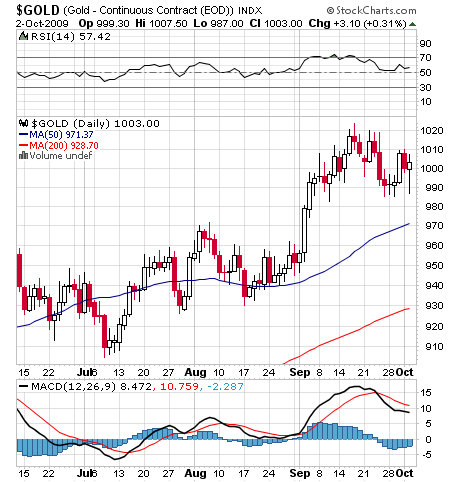
The ever-growing camp of gold bears and weak-knee bulls had every reason to cave in gold today with the big short Commercial hedgers/long specs on the Comex. Yet as I type, gold has come roaring back. If you’re a bear you’ve to start asking yourself what else will it take to take gold down? Better yet, are you about to get your shorts squeezed?
Special Alert – U.S. Dollar At Key Point
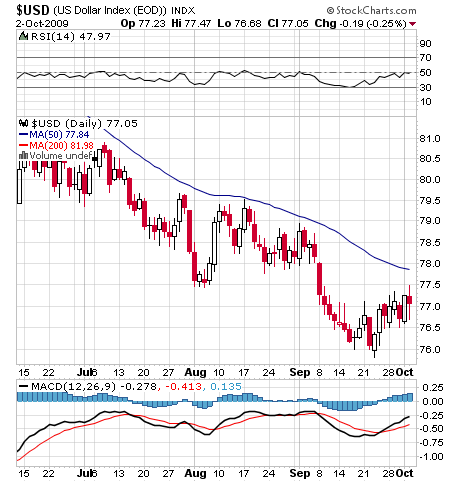
The terminally ill U.S. Dollar is trying to remove itself from its respirator for a while. Record low bullish sentiment in the Forex pits combined with it brushing up against the top of a clearly defined downtrend suggests it needs careful watching for the short term at least. A close above the 50-Day M.A. around 78 would be the first real sign a counter-trend rally is underway. Any such rally should be held around the 200-Day M.A. in the 82 area.
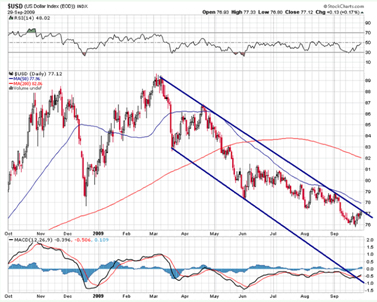
Tomorrow’s employment number could be the ignition so stay tuned.
Ed Note: Unemployment story HERE. US Dollar down on the news:
On Major Moves, Grandich has been very right and not only saved many investors fortunes, but expanded them dramatically. On November 3, 2007 at the MoneyTalks Survival Conference, Peter Grandich of the Grandich Letter warned that “an unprecedented economic tsunami will hit American beginning in 2008”. Peter advised publicly to short the US market two days from the top in October, 2007 and stayed short until the last week of October, 2008. He began to buy stocks in March 7th, 2009. He also bought oil and oil related investments near the lows after the dive from $147.
….go to visit Peter’s Website.
Those who read the contrarian and alternative financial commentators may well be forgiven for wondering why the financial doomsday oft predicted hasn’t quite materialized. The financial crisis heralded by the crash in October 2008, preceded by the demise of Bear Stearns and Lehman Brothers, among others, by all accounts was the tip of the iceberg and the advent of the Great Depression of our age.
Exuberant markets and slap-happy finance ministers, combined with record profits at the investment banks of Mordor, or Wall Street, are supposed to convince us that the worst is over, calamity has been averted, and with sober and moist eyes we roll up our sleeves to prevent the ghosts in the machine from re-emerging. A more masterful symphony of optical delusion has never been conducted, and the invisible puppeteers manipulating the strings of marionettes Ben Bernanke and Timmy Geithner are smug in their continued anonymity.
Meanwhile, unemployment continues to rise, foreclosures and delinquencies ditto, and but for select industries, decline and bankruptcy are the measure of balance sheets, not growth.
The principle tool of deception for this motley crew of G7 finance ministers and the Invisible Hands that control them is currency. With these key economies now flush with capital in the uppermost layers, victory can be claimed by pointing to the balance sheets of those institutions who have averted disaster by capturing the lion’s share of this manna from heaven. That the capital is not filtering down meaningfully into the broader economy in the form of investment and lending is the clearest sign that the worst is yet to come, and we now merely pause in the eye of this economic hurricane.
Keep in mind, if the Great Depression that started in 1929 is a fair analogy, then we are in the autumn of 1930, and the peak of contraction globally did not manifest itself until 1933, when unemployment in the United States reached as high as 25% in some areas. Within that four year overall plunge were several mini-bull rallies that lent solace to the fearful, albeit temporarily.
The major difference between the period from 29-33 and now is that the governments of that era did not have either the ability or the willingness to print money with abandon, because they knew that the outcome of such policy would certainly be future inflation, which would itself handicap any chances of recovery.
Since we now live in an era where its only what is happening right now that matters, the financial overseers seek solutions that immediately repair the illusion of prosperity in perpetuity, even if it means a smaller and smaller percentage of the population is fooled.
The act of printing currency with abandon equates to deferring the financial reconciliation required to achieve balanced budgets into future generations. As long as we print money, and agree to value that money as legal tender, the illusion can go on ad infinitum.
But what happens if, from the bottom up, people start saying “Hey wait a second…this cash is counterfeit!”?
Well that’s what is happening with the price of gold. Even the government of China is hedging its bets that its own currency will suffer devaluation in lock-step with the excess of U.S. currency afloat. After all, China’s foreign reserves are the largest collection of American funny money there is outside of America.
So despite the glad-handing and cheerful sentiment echoed by the mass media controlled by about 7 men, the financial disaster continues to unfold, and the only reason the masks are still on the players in the ersatz performance is to pick clean the pockets of those susceptible to such disingenuity.
For the rest of us, preparations must be made for the next leg down.
There are two things to own going forward. Precious metals and the companies that mine them. The very worst tsunami is a boon only to the surfers crazy enough to catch the wave, and that will exactly be the situation when the fragrant chile hits the fan part 2. Instead of a thrill though, the owners of shares in mines that produce gold will be rewarded with financial security in perpetuity, barring unforeseen acts of foolishness.
Gold producing operations will soon see their valuations increase dramatically. Lifted on that rising tide will certainly be soon-to-be-producers and to a lesser extent, explorers of advanced economic deposits.
The long term deterioration of the U.S. Dollar has been underway for decades. Its days as a viable currency are numbered. History proves this. Buying gold and gold related assets will soon also reveal itself to be the only sound investment of the next 10 years.
….read the article HERE.
GET MIDAS LETTER FREE EDITION
Sign up for the Midas Letter Free Edition and get the just published report “The Top Ten Emerging Gold Companies To Own in 2009”. (Ed Note: go to the front page HERE top left
Here are the top 10 reasons investors subscribe to MidasLetter.com. Subscribe HERE.
Advance copies of recommendations delivered to your inbox at least once a month;
Advance notification of private placement opportunities for accredited investors;
Personal direct responses to your email queries and questions about the companies I feature;
Free reports generated throughout the year on specific developments within the resource industry;
No conflict of interest – I don’t accept any compensation from the companies I feature in the Midas Letter;
Weekly summary of changes in the Featured Company Portfolio;
Notifications of major sales of stock by any insiders of any companies in the Featured Company Portfolio;
Advance notice of new company listings and IPO’s in the resource sector;
Notification of appearances of any Featured Company Portfolio senior management at any investment or resource trade show internationally;
Advance notification when other financial analysts issue reports on Feature Company Portfolio memebers.

Johan Dippenaar, Petra’s CEO, with the 507.55-carat diamond
Exciting discoveries and improving demand are bringing the shine back to diamonds, a sector that was almost left for dead only six months ago.
The startling recovery has even revived Canada’s dormant junior mining sector, which is being led back to prominence by Vancouver-based Peregrine Diamonds Ltd.
But the talk on Tuesday centred on Africa-focused miner Petra Diamonds Ltd., which said it recovered a spectacular 507-carat white diamond from its Cullinan mine in South Africa.
“It looks like it’s for sure in the top 20 largest high-value stones ever found in the world,” Johann Dippenaar, Petra’s chief executive, said in an interview.
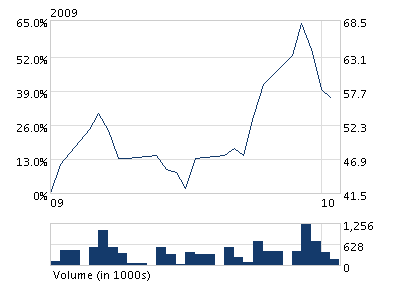
Ed Note: Price in Pence
He would have been a lot less excited about it a few months ago, when the outlook for diamonds was extremely grim.
When the financial system was on the verge of collapse last year, credit for diamond polishers and wholesalers vanished overnight. Consumer demand also disappeared as recession-wary people simply stopped buying luxury goods.
As a result, wholesalers were forced into a major de-stocking phase and stopped buying rough diamonds. Prices plummeted between 50% and 60%, according to experts.
The market is now well into recovery, with prices bouncing back and optimism that a new wave of demand from Asia will propel the market in the future.
“We’re looking east towards those markets,” Mr. Dippenaar said. “Traditionally they are not big consumers of diamonds, but they will eventually become big consumers of diamonds.”
In Canada, investors have started to wade back into the long-neglected junior space over the past month because of some positive announcements.
The most notable is from Peregrine, which controls the Chidliak project on Baffin Island.
Last week, the company said that a 399-kg sample from Chidliak recovered many large diamonds, including 131 that were bigger than the 0.6-mm sieve size.
The project is still at an extremely early stage. But the results to date are raising comparisons to the Ekati and Diavik diamond mines, which were discovered in Canada’s far north in the 1990s.
“There haven’t been diamond results like this since the early-to-mid 1990s,” said Peregrine president Brooke Clements.
Peregrine shares are up more than 250% since early last week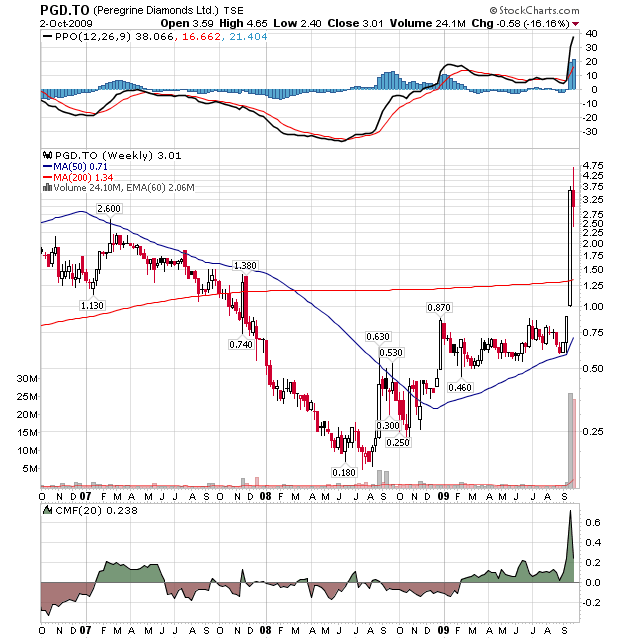
John Kaiser, publisher of the Bottom Fish Online stocks report and one of the only analysts left covering Canada’s diamond sector, said each new disclosure from Peregrine adds to the likelihood that the company is sitting on something very significant. But the story has been largely overlooked by investors, who have lost a fortune on diamond plays over the last decade.
They are not ignoring it anymore, as Peregrine shares are up more than 250% since early last week.
“There is a possibility that this is Ekati and Diavik all rolled into one,” Mr. Kaiser said.
A couple of other Canadian diamond juniors are brushing themselves off from last year’s crash and catching the eye of investors again.
Shore Gold Inc. is back on the radar after completing a positive pre-feasibility study on its Star diamond project in Saskatchewan. That is providing confidence that the long-dormant project might finally get built, although the proposed US$1.6-billion capital cost is a concern.
Another junior, Mountain Province Diamonds Inc., struck a new joint venture agreement with partner De Beers Canada on their Gaucho Kué project in the Northwest Territories. The project was going nowhere under their previous deal, and Mountain Province has now finally started a feasibility study.
Earlier this month, Harry Winston Diamond Corp. cancelled a planned winter shutdown of the Diavik mine due to an improving market. And yesterday, De Beers Canada cancelled a similar shutdown at its Snap Lake mine.
Excerpts from Is This a Real Bull or “Red Bull” Market?
After the caffeine rush of the third quarter, stocks and Treasuries give way to less stimulating market action.
Richard Russell, the dean of market newsletter writers, removed the picture of a bull from Thursday’s edition of Richard’s Remarks. “With the Industrials, Transports, Utilities and S&P all ‘rolling over,’ I’m thinking that the counter-trend rally from the March low is in the process of topping out.”
Another eminent market technician, Martin J. Pring, saw similar trends, notably a violation of the upward sloping trendline in S&P 500 tracing back to the early March lows. Moreover, he noted declining momentum in the S&P as well.
….read full article HERE.
-
I know Mike is a very solid investor and respect his opinions very much. So if he says pay attention to this or that - I will.
~ Dale G.
-
I've started managing my own investments so view Michael's site as a one-stop shop from which to get information and perspectives.
~ Dave E.
-
Michael offers easy reading, honest, common sense information that anyone can use in a practical manner.
~ der_al.
-
A sane voice in a scrambled investment world.
~ Ed R.
Inside Edge Pro Contributors

Greg Weldon

Josef Schachter

Tyler Bollhorn

Ryan Irvine

Paul Beattie

Martin Straith

Patrick Ceresna

Mark Leibovit

James Thorne

Victor Adair