
Daily Updates
Ed Note: Money Taks is honored to have Dennis Gartman explain his trading technique at:
The Money Talks All Star Trading Super Summit
Saturday, October 24, 2009 -The Sheraton Vancouver Wall Centre
Click HERE for the Speaker Lineup and to REGISTER if you want to take advantage of this Event.
THE US DOLLAR HAS TRIED TO
RALLY but the major trend remains toward a weak US$ and until such time as it
is clear that the 50, 100 and even the 200 day moving averages for the dollar are turning higher… and clearly they are not… we have to view every period of strength in the dollar as ephemeral in nature and an opportunity to sell it rather than to be a buyer.
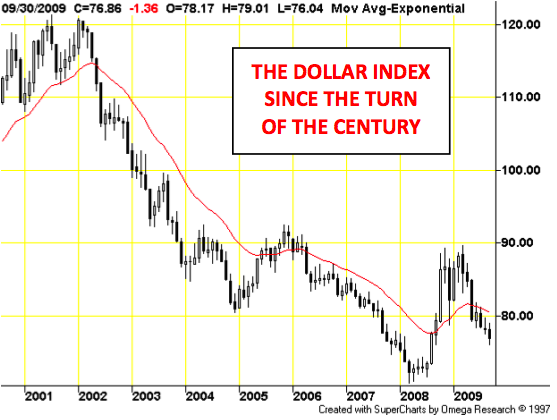
The only… and indeed the major… problem with that stance is that far too many
others believe the same thing, having been conditioned to do so by the dollar’s long, protracted slide over the course of the past several years, through both the Bush and the Obama Administration, and most notably since the inauguration of Mr. Obama that ended a short, violent but pleasant period of pro-American and pro-US dollar feelings.
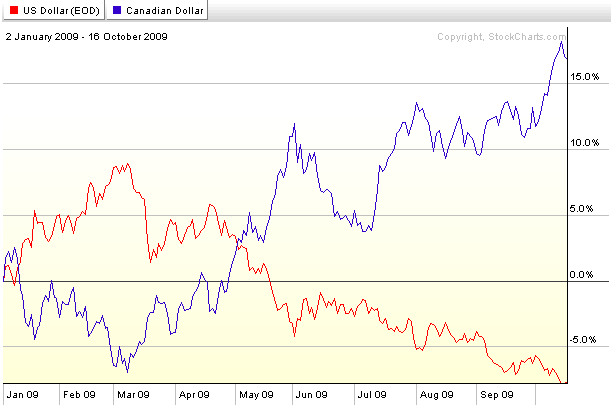
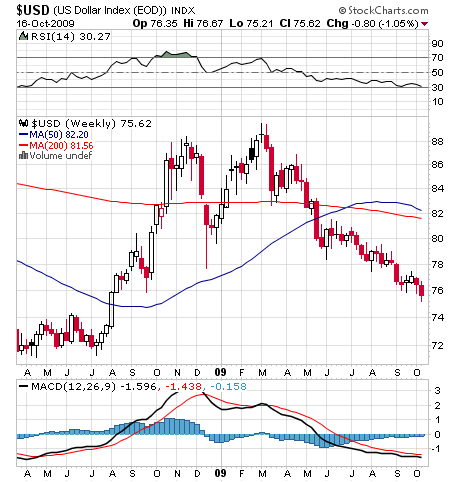

This brief comment from the Legendary Trader Dennis Gartman. For subscription information for the 5 page plus Daily Gartman Letter L.C. contact – Tel: 757 238 9346 Fax: 757 238 9546 or E-mail:dennis@thegartmanletter.com HERE to subscribe at his website.
Mr. Gartman has been in the markets since August of 1974, upon finishing his graduate work from the North Carolina State University. He was an economist for Cotton, Inc. in the early 1970’s analyzing cotton supply/demand in the US textile industry. From there he went to NCNB in Charlotte, N. Carolina where he traded foreign exchange and money market instruments. In 1977, Mr. Gartman became the Chief Financial Futures Analyst for A.G. Becker & Company in Chicago, Illinois. Mr. Gartman was an independent member of the Chicago Board of Trade until 1985, trading in treasury bond, treasury note and GNMA futures contracts. In 1985, Mr. Gartman moved to Virginia to run the futures brokerage operation for the Virginia National Bank, and in 1987 Mr. Gartman began producing The Gartman Letter on a full time basis and continues to do so to this day.
Mr. Gartman has lectured on capital market creation to central banks and finance ministries around the world, and has taught classes for the Federal Reserve Bank’s School for Bank Examiners on derivatives since the early 1990’s. Mr. Gartman makes speeches on global economic and political concerns around the world.
Ed Note: Money Talks is honored to have Tyler Bollhorn illuminate his favorite technique at:
The Money Talks All Star Trading Super Summit
Saturday, October 24, 2009 -The Sheraton Vancouver Wall Centre
Click HERE for the Speaker Lineup and to REGISTER if you want to take advantage of this Event.
Chase or Choke?
Stockscores.com Perspectives for the week beginning Oct. 19th, 2009

I think that I might sometimes confuse people. Without knowing the context from which I speak (or write), it would be easy to be confused by a recommendation to buy a stock that has just moved up 20% but my advice to ignore a stock that is up only 10% because entry would be “chasing it higher” is confusing. Let me explain, and in doing so, outline a very important concept for traders.
There are two situations that I like to buy; stocks that are starting upward trends and those that are well in to upward trends. However, the circumstances for buying each are quite different.
Stocks that are starting upward trends are typically breaking with abnormal activity out of a lengthy period of sideways trading. I liken this sort of trade set up to a person yelling in a quiet room. It is easy to get the message.
If a stock has been trading around the same price for a lengthy time, you can assume that the market has a good comfort level with the price it has given to the stock. Investors have priced in all available fundamental information and come to a conclusion on price. There is usually a significant change in fundamental information when a stock breaks with abnormal volume from low price volatility.
- Get the StockSchool Pro Free

- DisnatDirect named the number one Canadian brokerage for Traders by Surviscor! Open and Fund a brokerage account with DisnatDirect and receive the StockSchool Pro home study course free, including special Pro level access through the DisnatDirect client website. Offer only available to Canadian residents. For information, click here
I find that this situation is how the majority of upward trends begin. Don’t take my word for it, check the charts of stocks that have been in strong, multi month upward trends and go back to when those trends began. You will usually see the break with abnormal volume that I look for.
As an example, check a two year chart of AMZN. Two months of sideways trading in December and January, abnormal activity with a break higher to start February. GOOG is another example, showing abnormal activity on a break through resistance in April.
Now, let’s talk about the second type of buying opportunity that I like to play. This trade set up is different from the first because it seeks stocks that are already well in to upward trends but which are showing short term weakness. This is the situation where we don’t want to chase stocks higher but, instead, buy them on weakness.
Go back to the chart of GOOG, print out a one year chart and grab a pencil and ruler. Draw a line across the bottoms, starting at the low of March and cutting past the July low.
What you should notice is that, right now, the stock is far above that line. To enter this stock on Monday would be to chase the stock higher, a real no-no for traders. Instead, when buying strong stocks, you want to buy them on pull backs to the trend line. The lows of August, early September and early October are good examples of this. At these times, GOOG prices had come back to the trend line. You were buying a strong stock on sale.
I heard an analyst say that he thought GOOG was going to $700 a share but that it was not a good time to buy it now, to instead wait for weakness. The interviewer asked a very obvious question, “If the stock is going to $700 and is only at $550 now, why would you not buy it now?”
The analyst did not have a very good answer to that question. As a trader, he knew that it was bad to chase stocks that were running away; he just did not know how to explain it.
The problem with buying GOOG now is that the reward potential is not worth the risk. All good traders know that they might be wrong on any trade, no matter how compelling the trade idea might be. Since we know being wrong is part of trading, we want to mitigate the risk as much as possible. When you buy a strong stock on weakness you are really limiting your downside risk and increasing your upside potential.
When you chase a stock higher, you are doing the opposite and that is a fast way to go broke.
Hopefully this helps to explain the difference between buying a stock that had a big up day and chasing a stock higher. It is ok to enter a stock on a breakout from low price volatility because that is how upward trends begin. However, buying a stock that is running away from its upward trend line usually leads the trader to having to endure a painful pull back.

There is a daily version of the Stockscores newsletter that I send out each evening after the market closes. Last week in that newsletter I featured six position trading opportunities using the same strategies and techniques that I use in the weekly edition. Here are two of those stock picks, two that have not yet run away and are still worth considering

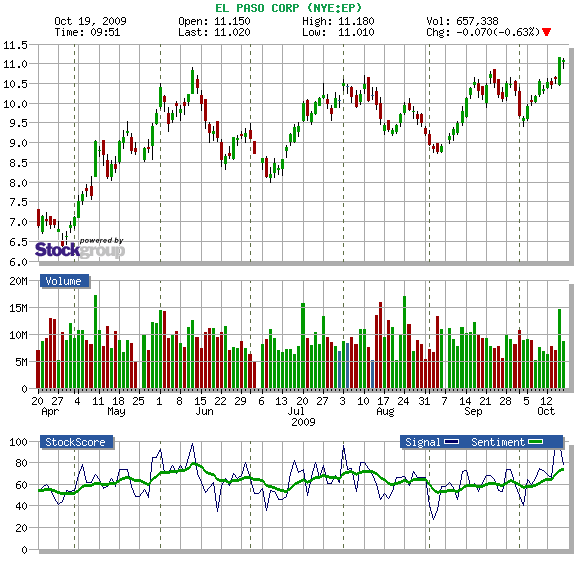
1. EP
EP broke out on Thursday from an ascending triangle pattern that had been building over the past six months. It looks like the stock wants to get back to the $17.50 range that it occupied in early 2008 which it should be able to do so long as it does not break support at $10.35.
2. V.CNE
V.CNE broke from a pennant pattern on Wednesday on stronger than normal volume, signaling to us that something positive is happening at the company. Support at $0.28.

Tyler Bollhorn will be speaking at the:

The Money Talks All Star Trading Super Summit
Saturday, October 24, 2009 -The Sheraton Vancouver Wall Centre
Click HERE for the Speaker Lineup and to REGISTER if you want to take advantage of this Event.
Tyler Bollhorn started trading the stock market with $3,000 in capital, some borrowed from his credit card, when he was just 19 years old. As he worked through the Business program at the University of Calgary, he constantly followed the market and traded stocks. Upon graduation, he could not shake his addiction to the market, and so he continued to trade and study the market by day, while working as a DJ at night. From his 600 square foot basement suite that he shared with his brother, Mr. Bollhorn pursued his dream of making his living buying and selling stocks.
Slowly, he began to learn how the market works, and more importantly, how to consistently make money from it. He realized that the stock market is not fair, and that a small group of people make most of the money while the general public suffers. Eventually, he found some of the key ingredients to success, and turned $30,000 in to half a million dollars in only 3 months. His career as a stock trader had finally flourished.
Much of Mr Bollhorn’s work was pioneering, so he had to create his own tools to identify opportunities. With a vision of making the research process simpler and more effective, he created the Stockscores Approach to trading, and partnered with Stockgroup in the creation of the Stockscores.com web site. He found that he enjoyed teaching others how the market works almost as much as trading it, and he has since taught hundreds of traders how to apply the Stockscores Approach to the market.
References
Get the Stockscore on any of over 20,000 North American stocks.
Background on the theories used by Stockscores.
Strategies that can help you find new opportunities.
Scan the market using extensive filter criteria.
Build a portfolio of stocks and view a slide show of their charts.
See which sectors are leading the market, and their components.
Disclaimer
This is not an investment advisory, and should not be used to make investment decisions. Information in Stockscores Perspectives is often opinionated and should be considered for information purposes only. No stock exchange anywhere has approved or disapproved of the information contained herein. There is no express or implied solicitation to buy or sell securities. The writers and editors of Perspectives may have positions in the stocks discussed above and may trade in the stocks mentioned. Don’t consider buying or selling any stock without conducting your own due diligence.
Ed Note: Money Talks was honored to have Jack Crooks give his trading techniques at:
All Star Trading Super Summit
Click on the banner above for the video.
Quotable – Trying to do business in China? Good luck!
 “The promise—and frequent disappointment—of doing business in China has been a common theme since at least the 19th century, when weavers in Manchester were said to dream of adding a few inches to every shirttail in China. Thanks to recession at home, foreign firms are keener than ever to capitalise on China’s growth. But Europe and America’s exports to China have remained broadly flat over the past year and amount to less than 7% of the total, even though shrinking exports to other countries flatter the figure. Even if the Chinese economy grows by the official target of 8% this year, the impact on Western firms’ total sales would be little more than a rounding error, says Ronald Schramm, a visiting professor at the Chinese European International Business School.
“Many foreign firms, of course, are doing well in China, especially at the two extremes of the value chain: things like luxury goods, fibre-optic cable and big aeroplanes on the one hand, and oil, ores and recyclable waste on the other. But in between, both explicit legal impediments and hidden obstacles continue to hamper access to Chinese customers, despite China’s promises of reform when it joined the World Trade Organisation (WTO) in 2001. Publishing, telecommunications, oil exploration, marketing, pharmaceuticals, banking and insurance all remain either fiercely protected or off-limits to foreigners altogether. Corruption, protectionism and red tape hamper foreigners in all fields.
“Recent reports from three lobbies for foreign businesses, the American Chamber of Commerce in Shanghai, the European Chamber of Commerce in China and the US-China Business Council, bear out this gloomy view. Their biggest gripes have nothing to do with typical business concerns, such as the availability of good staff or high costs. Instead, they complain about subsidised competition, restricted access, conflicting regulations, a lack of protection for intellectual property and opaque and arbitrary bureaucracy.
“To operate in China, the Council itself must provide documents from America’s State Department, the Chinese Embassy in America, the cities of Washington and Shanghai, the local tax authorities and the local branch of the State Administration for Industry and Commerce. It takes six months to obtain a one-year licence. At least there is an established procedure, albeit a costly and cumbersome one. Others are not so lucky: upon joining the WTO, China agreed to allow foreign firms to compete to offer booking systems to local airlines, but according to the European Chamber it has not yet produced the necessary regulations.
“Local officials go to great lengths to protect companies on their patch, often by giving them preferential access to land or credit, or by easing bureaucratic constraints for them. All the red tape would at least provide plenty of work for multinational law firms, were they permitted to employ Chinese lawyers—which they are not. The government, by dint of its control of the media, also controls advertising rates. That makes the cost of reaching a consumer in China higher than in many Western countries, although the potential rewards are much lower since most Chinese are so much poorer, says Tom Doctoroff, the boss of JWT, an advertising firm. There is little reliable business news.”
 FX Trading – So crowed for so many good reasons, silly ones too…
It’s starting to remind me of queue of people trying to squeeze past one another, pushing toward the window to buy those last few concert tickets on sale. But in the $’s case, they ain’t pushing up to the window to buy.
To say the dollar trade is crowded is probably an understatement. Measured by the US Dollar index, the buck continues to channel down nicely…a tight orderly decline so far:
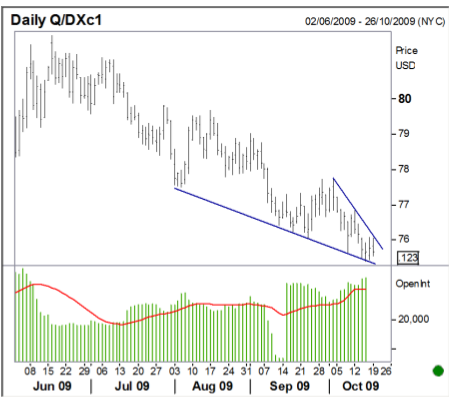
There really are solid rationales supporting the dollar’s decline, despite the size of the crowd. I think you know the story by now:
· interest rates
· relative growth
· budget deficit
· quantitative easing
I’m sure there are plenty more reasons too. That’s just the thing. If you have sold the dollar and are riding this trade, you are probably fairly confident by now that “your” particular rationale makes the most sense. Or, as a trend follower, you don’t give a darn about the rationales. Price validates the reasons and trend; therefore more money is heaped on board.
No matter that everyone “knows” the reasons for the decline; discounting be damned when self-reinforcing moves materialize.
How long? No one knows. How far? No one knows. But if you believe the US will continue to dominate the global economy far into the future, as we do, there will come a point when you start to say—the buck just looks cheap. Apologies to the newsletter nuts that say the dollar will disappear entirely.
But, it seems the self-reinforcing crowd is still in the driver’s seat—and the value crowd wants to see at least a couple of the good rationales for selling Mr. Greenie to start looking stale (and the silly rationales to gain even more traction).
Maybe as long as the decline is “orderly” in the tight channel lower, there is no reason for the US Treasury to worry—dollar liquidity is spiking the global punch bowl again.
But in this environment, the probability of a spike down in Mr. Greenie seem to be rising by the day i.e. the orderly decline could turn disorderly fast.
That’s why we think the probability is also rising the Treasury (through the Fed) may do something to put a little risk into this very crowded trade.
Jack Crooks
Black Swan Capital

Equity Trends: The ratio of S&P 500 stocks in an uptrend versus a downtrend (i.e. the Up/Down ratio) rose last week from an adjusted 8.00 to (408/45=) 9.07. Number of stocksbreaking resistance last week totaled 145 and number of stocks breaking support totaled 4 (including six stocks breaking resistance on Friday and one stock breaking support). The ratio is intermediate overbought, but continues to move higher.
Bullish Percent Index for S&P 500 stocks increased last week from 81.00% to 84.80%. The Index also moved above its 15 day moving average again. The Index peaked four weeks ago and remains intermediate overbought. However, trend remains up.
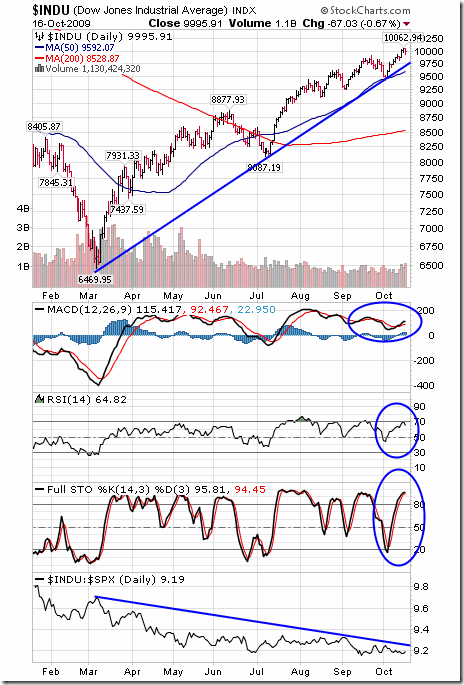
The Dow Jones Industrial Average added 130.97 points (1.33%) last week. Intermediate trend is up. The Average remains above its 50 and 200 day moving averages. The Average broke short term resistance at 9917.99 implying a short term technical target of 10,430. Strength relative to the S&P 500 Index remains negative. Short term momentum indicators are overbought. An early warning sign occurred on Friday when RSI retreated below the 70% level.
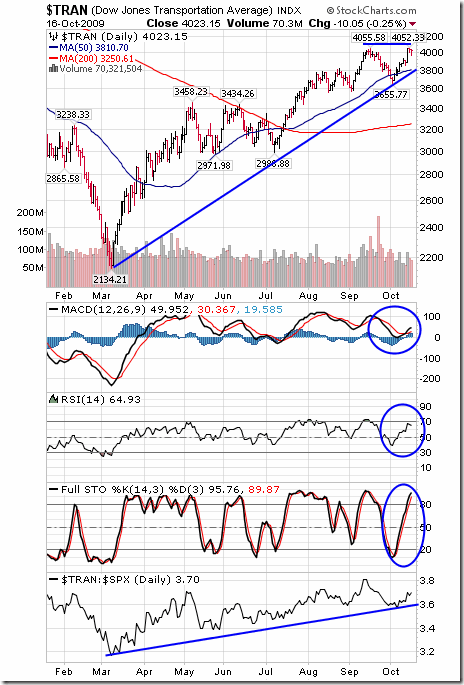
The Dow Jones Transportation Average improved 147.43 points (3.80%) last week despite the spike in energy prices. Intermediate trend is up. The Average remains above its 50 and 200 day moving averages. Strength relative to the S&P 500 Index has been positive since March. Resistance at 4,055.58 set four weeks ago was tested unsuccessfully. Support is at 3,655.77. Strength relative to the S&P 500 Index remains positive. Short term momentum indicators are overbought. Seasonal influences currently are positive.
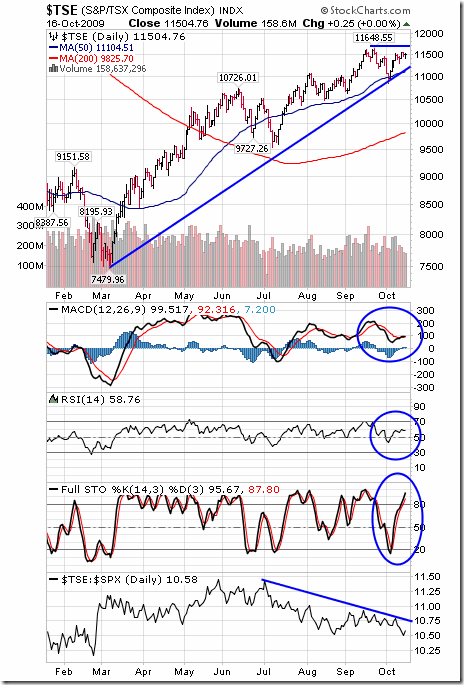
The TSX Composite Index gained 67.84 points (0.59%) last week. Intermediate trend is up. The Index trades above its 50 and 200 day moving averages. Resistance set four weeks ago at 11,684.55 was tested unsuccessfully. Support is at 10,855.16. Strength relative to the S&P 500 Index remains negative. Short term momentum indicators remain overbought.
…..40 more Stocks, Commodities and Indexed HERE.
Editor Note: Highly recommend that you take a monday morning visit to this Don Vailoux monday report where he analyses an astonishing 40 plus Stocks, Commodities and Indexes.
Don Vialoux has 37 years of experience in the Investment Industry. He is a past president of the Canadian Society of Technical Analysts (www.csta.org) and a former technical analyst at RBC Investments. Now he is the author of a daily letter on equity markets available free on the internet. The reports can be accessed daily right here at www.dvtechtalk.com.
Impossible! That’s what institutional investors say about “Timing the Market”. Mr. Vialoux will explain that, indeed, it can be done with the appropriate analysis. He also will explain why timing the market will be important during the next decade. Buy and Hold strategies are not working anymore; Investors are looking for alternatives. Mr. Vialoux will demonstrate four techniques that can be used to time intermediate stock market swings lasting 5-15 months. The preferred investment vehicles for investing in intermediate stock market swings are Exchange Traded Funds.
Comments in Tech Talk reports are the opinion of Mr. Vialoux. They are based on technical, fundamental and/or seasonal data that is believed to be accurate. The comments are free. Mr. Vialoux receives no remuneration from any source for these services. Comments should not be considered as advice to buy or to sell a security. Investors, who respond to comments in Tech Talk, are financially responsible for their own transactions.
Commentary: Technically, the dollar is ripe for a rally…
Last March, the safe haven that was the U.S. dollar peaked in price at $89.50, as represented by the cash Dollar Index (DXY), as fear of a stock market collapse subsided.
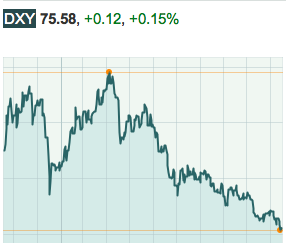
Today, with the Standard & Poor’s 500 Index (SPX 1,088, -8.88, -0.81%) nearly 60% off of its March low, the DXY (DXY 75.58, +0.12, +0.15%) is trading at $75.80/85, down 15% in seven months, and a clear reflection of the 180-degree shift of capital from safety to considerably riskier assets.
The relentless, multi-month slide in the value of the U.S. dollar has garnered a lot of attention of late, particularly as some nations, perhaps China in the Far East and purportedly Saudi Arabia in the Middle East, have diversified out of dollars in the past year and, more significantly, not-so-secretly have discussed replacing the dollar as the world’s reserve currency.
Upping the ante, last week, while the dollar continued to sink, the three top U.S. monetary officials — Treasury Secretary Timothy Geithner, White House economics adviser Larry Summers and Federal Reserve Chairman Ben Bernanke — took to the airwaves to remind investors and would-be detractors that they want, and the international community needs, a strong U.S. dollar.
In reaction to the trio’s comments, the dollar stabilized and even rallied a touch (less than 1%) last Friday, but on Monday and Tuesday it once again retreated to new multi-month lows at $75.73.
Traders and investors have to be wondering what did The Big Three U.S. monetary officials hope to accomplish with their jawboning support of the dollar? Plainly, and perhaps embarrassingly, they did not (apparently) dissuade many dollar detractors from remaining in their short positions. In fact, the lack of a sustained positive reaction may have encouraged the establishment of more and larger dollar short positions!
If Messrs. Geithner, Summers, and Bernanke wanted to avert an exodus from the greenback, then “mission definitely not accomplished.” On the other hand, if the U.S. officials merely wanted to slow the rate of decline of the dollar (the Obama Administration really does not care if the dollar depreciates, only how fast), then maybe, maybe, they accomplished something for a day or two, or, at most, a week.
….read more HERE.
-
I know Mike is a very solid investor and respect his opinions very much. So if he says pay attention to this or that - I will.
~ Dale G.
-
I've started managing my own investments so view Michael's site as a one-stop shop from which to get information and perspectives.
~ Dave E.
-
Michael offers easy reading, honest, common sense information that anyone can use in a practical manner.
~ der_al.
-
A sane voice in a scrambled investment world.
~ Ed R.
Inside Edge Pro Contributors

Greg Weldon

Josef Schachter

Tyler Bollhorn

Ryan Irvine

Paul Beattie

Martin Straith

Patrick Ceresna

Mark Leibovit

James Thorne

Victor Adair