
Daily Updates

It’s a small chunk of land, about half the size of Rhode Island, located in a part of the world most people know nothing about.
Today, the heads of Toyota, Honda, and the Pentagon all share a common interest.
But they’re not the only ones watching. Venture capitalists, hedge fund managers, and resource companies from all over the globe are also watching and waiting. . . ready to pour billions into Greenland once they get the green light.
Why?
This coming January, when the Kingdom of Denmark relinquishes sovereign control over Greenland’s natural resources, the world’s biggest deposit of Rare Earth Metals (or REEs), will fall into private hands. . . for the first time ever.
This single site boasts deposits valued at an estimated $1.3 trillion. . . and yet, REEs are worth more than just money.
Which is why the world’s leading manufacturers of hybrid cars, wind turbines, batteries, and yes — even the guidance systems to our most sophisticated air and ground defense missiles systems, are watching the events in Greenland unfold with baited breath.
The elements that fall into the category of Rare Earths include:
- Lanthanum – essential in the production of electric car batteries;
- Terbium – without this element, high-strength magnets would not exist;
- Erbium – makes possible a wide range of light-weight, high-strength metal alloys;
- Thulium – makes high-frequency lasers a reality.
- And once Greenland takes control of its mineral wealth, this land — totaling barely 800 square miles — is projected to supply 25% of the world’s entire REE market. . . for half a century.
To companies like Toyota and Honda, that have virtually staked their futures on the rapidly expanding hybrid/plug-in car market, and to our own defense industry, which cannot perform even the simplest task without highly-involved electronic assistance, this news could not have come at a better time.
Because for the last decade and a half, our greatest and most populous modern rival has been hard at work to corner the market on these vital elements.
And on April 17 of this year, with the signing of a single contract, the Chinese reached a record 96.7% global market share.
China’s “Dragon Metals”
…..read more HERE.
To subscribe to the FREE Wealth Daily Newsletter go HERE.
Brian Hicks is the managing editor and chief investment analyst of the $20 Trillion Report, a weekly investment advisory that covers the energy sector. Since its inception in 2004, the $20 Trillion Report (TTR) portfolio has returned an average gain of 37% per annum.
In addition to running the TTR, Brian also contributes to Wealth Daily and Energy & Capital, two investment dailies that are free to the public.
Gold Starship: Family Reunion On Pluto?
1. Ladies and gentlemen, we have liftoff. The gold bullion rocket has taken off. I warned those standing under the gold rocket trying to pick the next $50 move in gold, they would be vaporized. A huge contest in the gold community emerged to see who could totally ignore the Michaelangelic head and shoulders pattern, while making the greatest prediction on how low gold would go. 1000, 980, 950 were all popular predictions of the micro men. Many went short, with a genius play to make money on the way to their imaginary targets.
2. Do you really think people so focused on gold’s decline really owned gold themselves? No. They blew out their core positions to play ‘gold hamburger flipper.’ The burger landed on the floor and the banksters just stomped on it. The flippers are dead.
3. As I write this at 4am, gold has surged to almost 1100, and the gold top callers are nothing but a pile of charcoal, buried with their systems, micro charts, and golden tiddly wink forecasting kits. They’ve been calling the top from 905! That’s almost $200 of total failure.
….read points 4 – 23 HERE.
The severe problems that the world economy and financial system have experienced in the last couple of years will seem like a walk in the park compared to what will happen in the next couple of years.
For the investors who haven’t yet protected themselves, let us tell you that you are very lucky. You are lucky that you have been given yet one more chance to protect yourself. But let us be very clear, you have a very short time to put your house in order. Because during the month of November the events that we outlined in our Newsletter “A Shocking Fall” are going to start to unfold.
Dollar down and Gold up
Starting in November, we are likely to see the dollar falling precipitously and stockmarkets turning down after this bear market correction. We will see the bond market falling and especially long term interest rates going up. And most importantly gold will start to move up very strongly.
We have since 2002 advised our investors to protect themselves by buying physical gold and store it outside the banking system. Gold has since gained more than 250%. Also, in the last ten years the Dow Jones has moved down 80% against gold. Most world stockmarkets have had similar falls against gold. So in real terms the stockmarket has been a very poor investment. We expect the Dow to fall another 90% against gold in the next few years.
The party is over
Earlier this year we said that a 50% correction is totally normal in a bear market and that would take the Dow to 10,300 which could happen by early November. Stockmarket investors have been given an incredible gift in the last seven months but the party is now over. Most investors will not realise this until it is too late. They will hang on to their shares for a long time yet and follow the market most of the way down. In our view, the only stocks worth holding are precious metals stocks which are grossly undervalued and will benefit from a very strong rise in gold.
The next few years will be devastating for the world economy, for the financial system and for private lives. We have outlined this scenario in our newsletters and commentaries for a long time.
The majority of people are short sighted and believe the economy has improved because governments have printed trillions of Dollars, Pounds, Euros etc that they call money. But let us be very clear, you can’t abolish poverty by printing paper and you can’t solve the world’s enormous debt problem by exacerbating it. These debts will never be repaid with normal money, not today and not tomorrow – NEVER!
Still time for protection
In the next few weeks until some time in November, investors can still protect themselves by selling their stockmarket investments and buying gold at reasonable prices. Gold at $1,050-60 will be seen as the bargain of a lifetime in the next 12-24 months. But remember that the main reason for buying gold is to protect yourself from the destruction of paper money and assets that will take place in the next few years. Many countries, including the US and the UK will have a hyperinflationary depression which will change the face of the world as we know it today.
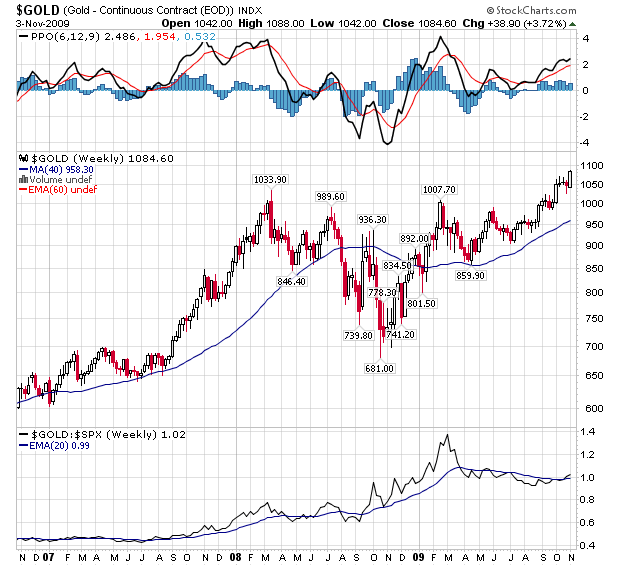
So physical gold (and silver) stored outside the banking system is your best protection.
Matterhorn Asset Management has set up a separate Gold Division called GoldSwitzerland (www.goldswitzerland.com) in order for investors to purchase physical gold at very competitive prices and store it in their own name in Zurich, Switzerland outside the banking system and with personal access to their own gold bars.
GoldSwitzerland is the gold investment division of Matterhorn Asset Management AG, a Swiss asset management company specialising in wealth preservation with particular emphasis on precious metals. MAM is part of the Aquila Group which is the largest independent asset management group in Switzerland. The parent company, Aquila Investment AG, is regulated by the Swiss Federal Banking Commission.
Max Cotting is Chairman of Matterhorn and also CEO of the Aquila group which he founded in 1999. Previously he was CEO of Bank Heusser in Basel and a member of the executive committee of Clariden Bank Group in Zurich.
Egon von Greyerz (EvG) is the Founder and Managing Partner of Matterhorn Asset Management AG and Gold Switzerland. EvG started his working life in Geneva as a banker and thereafter spent 17 years as Finance Director and Vice-Chairman of Dixons Group (DSG International Plc) , the UK’s largest electronic and electrical retailer.
Since the 1990s Egon von Greyerz has been actively involved with financial investment activities including Mergers and Acquisitions and Asset allocation consultancy for private family funds. This led to the creation of Matterhorn Asset Management as the primary verhicle for asset management based on wealth preservation principles. The Gold Switzerland division was created to facilitate the buying and storage of physical gold for both private and business investors.
Pricewaterhouse Coopers are the auditors of Matterhorn and Goldswitzerland.
Quotable
“You never change things by fighting the existing reality. To change something, build a new model that makes the existing model obsolete.” – Buckminster Fuller
FX Trading – Who leads and who follows…
I recently downloaded Caesar’s Confessions on to my I-pod so I could listen while doing my strenuous exercise, which consists of a walk around the neighborhood once the US session is finished. Its great stuff, though not exactly easy listening. It’s more like homework. But the depth of the logic and insight into human nature that Caesar display’s is astounding, not to mention his diction and overall writing skills.
To me, it goes to the point that the educated classes were likely a lot more educated in 50 BC then the so-called educated classes today (technological tends to obscure this difference I believe). While listening to Caesar’s writing’s, one thing stands out the most–human nature hasn’t changed. [Jesse Livermore said the same when he uttered the phrase, “There is nothing new on Wall Street.”]
As I was thinking about this, I started thinking about the market—human action drives it now, just as it always has, despite flash trading and reams of algorithms. Fear, greed, rationality, and irrationality are all on display in the market everyday to varying degrees. The same is on display on the battlefield, as Caesar so eloquently portrays in his Confessions.
Ultimately those most prepared, which helps create luck, prove to be the winners over time in battle and in trading.
I imagined Caesar grilling one of the Centurions on why he decided to move troops in a particular direction during the heat of battle, and the Centurion replying something like this:
Well Caesar, as you know, there has been a tight correlation between the color of the enemies cavalry horses and their ability to outflank us. Today we noticed most were on black horses, so that meant we needed to shift our defenses to end of our lines.
Would that make any more sense than saying I sold stocks because the dollar was going up, but later in the day I bought stocks because the dollar was going down; the correlation between the two is very tight.
I believe a moderate amount of time in chains to rethink such logic would have been quickly doled out by Caesar had a Centurion utter such a response. Yet, correlation seems to pass for logic at the moment in the market.
Logic based on pure correlation, based on any sample size you choose is the type of inductive reasoning Karl Popper warned us about (this in an essay in 1959, well before Nassim Taleb became a self-proclaimed superstar of all things logical after ripping off the Black Swan and seeming to often forget it wasn’t his original idea; and for the record, Black Swan Capital was so before said superstar arrived to enlighten all. Yes, a bit of a chip on the shoulder there indeed…LOL).
Are there logical correlations? Yes. But these are usually found in the physical sciences, not in the social variety in which we operate as traders and investors.
It’s not that we can’t trade on such seeming correlations if they help, and they can at times, but when we do, without some modicum of cause and effect or deductive reasoning, can we have any confidence in our ability to know which of the price series in a particular correlation leads or follows? It seems many seers that have been showing up on CNBC do know exactly who is leading at any given point in time. Scary!
For example, if we said we sold stocks because the dollar was going up, why would the dollar stop going up and stocks stop going down? Meaning, if the dollar was leading then everyone in the market would likely keep buying dollars and selling stocks in a never-ending feedback loop, I think. But that doesn’t happen. It happens for segments of time (fractal maybe), but it can never be the underlying driver because logically it should never end, except when either stocks or the dollar go to zero, depending on who is leading.
So where does this leave us? I think it should leave us thinking about the fact that at some point this correlation will end for a very good reason. Thus, we can escape this maddening risk appetite vs. risk aversion world. For those who are new to this game, and only remember the dollar doing one way—down—as stocks and other asset classes have gone one way—up—it wasn’t always this way.
If you take a look at the dollar bull market (yes there really were a couple of those in the past since 1971) from last 1992 low through 2002, you can see that most of that time stocks (red line) and the dollar index (black line) moved together:

The logic behind this relationship was lots of hot money and foreign direct investment wanting to get involved in the tech market boom during those years—short-term portfolio flow targeting quick returns and long-term capital investment buying real assets. Based on current rationales, it is surprising America could have every survived—a weak dollar according to many learned economists of repute is the panacea for US progress—sadly! But I digress!
Will we use this correlation to our best advantage going forward? Absolutely, but with the understanding, which comes with betting big on correlations that have quickly broken down in the past and severely dented my rather already small personal wealth, the stock-dollar correlation could breakdown at any time, and we will only know the reasons with the gift of hindsight.
Unlikely when the gift of hindsight is bestowed upon us all it will deter the savvy traders on the afternoon CNBC trading show—the one with the ugly green background–from glibly declaring they knew it all along. Sometimes right but never in doubt are they. I on the other hand am sometimes right but always in doubt.
I think it was Soros who said all traders should be a bit paranoid all the time. Bingo!
Okay, so what is our prediction for a change in correlation? I laid that out in Monday’s Currency Currents in case you missed it, “A potential premise for a big time surprise.” The key word in the above sentence is “prediction,” even though I attempted the use of logic and reason. (Jack say’s the dollar put in a long-term bottom in March of 2008!)
Here we are, right back to the beginning. I guess all we can do is the best we can do, and find comfort in one of Mark Douglas’ confessions, I’m paraphrasing:
We don’t have to know what will happen next in the market to make money.
I feel better now. The dollar is down and, you guessed it, stocks are higher. And so it goes.
Black Swan Capital LLC
www.blackswantrading.com
Trade the corrections … buy the dips … position for the long-haul.
We do it all in our Currency Investor newsletter that’s geared toward newcomers and
experienced investors who are looking for a conservative approach to the foreign
exchange market.
In plain language we deliver global macroeconomic analysis and actionable ideas geared
toward exchange rate fluctuations.
Our analysis is comprehensible and our recommendations consist of ETFs, so don’t get
turned off by buzz words like “exchange rates” or “foreign exchange” – this investing
strategy is as easy to implement as buying and selling stocks.
Plus, at $39 per year it’s a deal you’d be hard-pressed to find anywhere else.
Thorough global analysis plus complete investment guidance … and all for only $39 per
year? You can’t beat that with a stick. Click here to read more …

Register HERE for the FREE Daily Currency Currents Newsletter.
Black Swan Capital is an independent minded currency advisory firm established to provide subscription-based services to help retail and institutional clients consistently attain above average profits trading and investing in both forex and currency futures markets. We tell our Members when to enter and exit and why. HERE for more information.
Our commitment is to deliver well researched trading recommendations that our clients understand and can efficiently execute through their brokers. We outline the reasons to enter a trade and define the risk. But our Members must understand there is a substantial risk of loss trading in forex (off-exchange retail foreign currency) and currency futures markets.
Register HERE for the FREE Daily Currency Currents Newsletter.As a subscriber to Currency Currents you stay tuned-in to our current global-macro view and our analysis of key investment themes driving currency prices. Nothing is off limits to us in this free-wheeling look at the markets. Some days you’ll receive ramblings on trading psychology, while other days we may take an academic approach in explaining esoteric economic issues. Ultimately we have one goal in mind: to help you get a handle on the key investment themes driving global capital flow. Because if you know where the money is going, it increases the probability that yourposition in the market will be a profitable one.
A brief excerpt of the lengthy daily internet comment by Richard Russell of Dow theory Letters a man who has made his subriber’s fortunes (at least those that follow his advice). One of the best values anywhere in the financial world at only a $300 subscription to get his report daily for a year. HERE to subscribe.
Is it too late to buy gold?
Answer — For those of us who, years ago, were buying one-ounce gold coins at $350 a piece, the current record gold price probably seems dangerously high. But to India and China the current price of gold doesn’t appear high. I can’t tell whether gold has entered its speculative third phase yet, but often buyers in the third phase make greater profits in a shorter time than the early buyers made while accumulating gold during the first and second “bargain” phases. With US national debt climbing into the trillions of dollars, who knows where gold is going? – Richard Russell
Cash for Gold – are you kidding?
In the US, “nobody” (and this includes most funds) owns gold. Somewhere ahead it will be considered mandatory to own some gold. When that happens, “Katie bar the door.” I’ve often said that one of the most difficult things to do in investing is to sit through the greatest part of a primary bull market. To subscribers who bought gold early and still have their gold — my congratulations.
For thebetter part of a year Americans have been besieged with television, radio and print ads imploring us to sell our gold coins and jewelry for cash. Aside from helping a poor soul in need of immediate cash, the concept is flawed and needs to be analyzed and exposed.
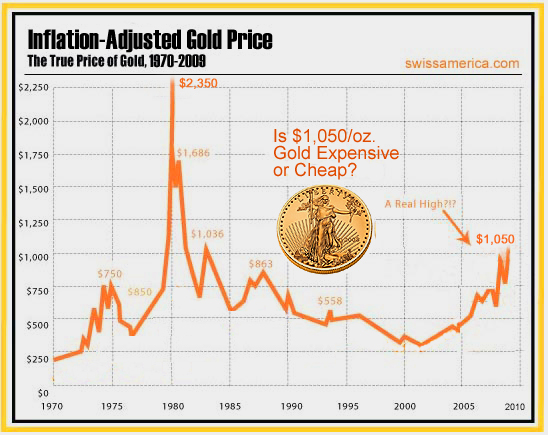
The ads usually say the gold price is near or at all time highs. 2009 marked the ninth year in a row the price of gold rose, up nearly $200/oz. since January 2009. Anyone who sold their gold earlier has left a good amount of money on the table.
These ads also never disclose that while the nominal price of gold is at an all time high, if adjusted for inflation gold is less than half of an inflation-adjusted price of $2,350/oz. I am not critical of companies making profits, but I am critical when ads mislead consumers and prey on the uninformed.
…..read more HERE.
-
I know Mike is a very solid investor and respect his opinions very much. So if he says pay attention to this or that - I will.
~ Dale G.
-
I've started managing my own investments so view Michael's site as a one-stop shop from which to get information and perspectives.
~ Dave E.
-
Michael offers easy reading, honest, common sense information that anyone can use in a practical manner.
~ der_al.
-
A sane voice in a scrambled investment world.
~ Ed R.
Inside Edge Pro Contributors

Greg Weldon

Josef Schachter

Tyler Bollhorn

Ryan Irvine

Paul Beattie

Martin Straith

Patrick Ceresna

Mark Leibovit

James Thorne

Victor Adair