
Daily Updates
Quotable
“If you look at GDP growth, then China looks like a new engine driving the global economy, but if you look at how growth is being created here by so much wasteful investment you wouldn’t be so optimistic.” – Zhang Xin, quoted in the Financial Times
FX Trading – Your recommended daily allowance of skepticism
For the past year – since November 4, 2008, actually – I’ve thought about walking around wearing a T-shirt that reads:
Where’s your skepticism?
That way I could maybe get the majority’s brains turning a little bit. (I’ve thought about using “Got skepticism?” but figure milk is probably tired of getting ripped off over and over again.)
…..read more HERE.

Much like Hugh Hendry, I can watch to Marc Faber videos all day, even if I did not agree with a thing either fellow said. They just have an entertaining spectacle about them. Hence we must devote 1 post a month to Mr. Faber. I am not sure what to make of today’s video – the contrarian deep inside my soul is searching for a Gisele Bundchen moment that would mark at least a counter trend rally in the dollar – ala “I refuse to be paid in dollars” circa late 2007. Gisele almost nailed the dollar bottom to the month [Jul 20, 2008: World Currencies in the Recession] As I wrote in July 08
Many don’t remember now, but right around when the recession “officially” began (we did not admit to it until nearly a year later) in December 2007 the dollar was the scourge of the Earth. Reports of supermodel Gisele Bundchen (speaking of nice graphics) not accepting dollars (Nov 07) but only wanting to be paid in euros marked the near term bottom in the dollar.
Gisele Bundchen wants to remain the world’s richest model and is insisting that she be paid in almost any currency but the U.S. dollar. Like billionaire investors Warren Buffett and Bill Gross, the Brazilian supermodel, who Forbes magazine says earns more than anyone in her industry, is at the top of a growing list of rich people who have concluded that the currency can only depreciate because Americans are living beyond their means.
While I want to find things that say “this marks at least a short term bottom in the dollar”, in the long run – the utter disrepect our leadership has for fiscal responsibility can make the case that Marc is correct about gold. As always… we’ll see.
Faber believes there is no way we revisit stock market lows of early 2009 because of the markets ever fall again, the “money printer” will print even faster to create even more “prosperity” for us all.
Mark is a self taught private investor who operates the website Fund My Mutual Fund (http://fundmymutualfund.com/); a daily mix of market, economic, and stock specific commentary. Fascinated by the market since an early age, he discovered mutual funds as a teenager in the 80s and moved to equities by the mid 90s. The origin of the website is to leverage the power of the internet in developing a transparent track record to attract investors for his potential “long/short” mutual fund. His equity focus is identifying secular growth trends and the companies most likely to benefit from these macro trends. Stocks are identified through fundamental analysis, although basic technical analysis is used in determining entry and exit points. You can receive Trader Mark’s latest posts daily by subscribing free via RSS reader (http://feeds.feedburner.com/FundMyMutualFund) or subscribing free via email (http://www.feedburner.com/fb/a/emailverifySubmit?feedId=1109639). With a degree in economics from the University of Michigan, a broader understanding of the economy as a whole, along with interpreting investor psychology, is also a major interest for Mark. His career background has focused on financial analysis in corporate America. Visit his site: Fund My Mutual Fund (http://fundmymutualfund.com/)
“(Some) Commodities Are a Buy
The newspapers are a-buzz with stories of Obama’s trip to China. The Financial Times tells us what “he should have said.” According to the FT, the American president should have told the Chinese that he wasn’t going to put the US into depression just to protect the value of China’s dollar holdings.
‘We didn’t ask you to stock up all those dollars,’ as Obama might have put it. ‘It’s not our fault if the dollar goes down and you lose money.’
Perhaps Mr. Obama should have quoted the immortal words of a former US Secretary of the Treasury, John Connolly. “It may be our dollar, but it’s your problem.”
Over at USA Today, the editors are more concerned about human rights. The paper must imagine itself back in the days of Woodrow Wilson or George W. Bush, when the US nobly embarked on a mission to raise all of mankind out of sin and error. In effect, Mr. Obama said that all people have ‘universal rights,’ including the right to a free press. China figured this was just the sort of opinion that its people didn’t need to hear. So, it killed the story in its own press. The American president might as well have been talking to himself.
China is today’s big story. Throughout the world’s media there is much buzz and blather about the “romance”…the “historic relationship”…between the two titans. Some reporters see love. Some see jealousy. Some see rivalry.
Here at The Daily Reckoning we are suckers for romance. Give us some “a cigarette that bears a lipstick’s traces…an airline ticket to romantic places…” and we are moonstruck. But we don’t see much romance in the US and China hook up. What we see is the sort of things that delight psychologists and bore everyone else – perversion, co- dependency, and enabling.
On the surface, the two giants bicker over money like any other couple. The US accuses China of being a tightwad…holding its currency down and saving too much. China accuses the US of being a spendthrift, destroying its own purchasing power by wanton and reckless expenditures.
“US president’s currency call breaks with script,” says a headline in The Financial Times today. US economists think China should raise the value of the yuan. This would immediately lower the value, domestically, of the trillion(s?) worth of US-dollar assets China holds as reserves. It would also make Chinese products less competitive on the world market.
Mr. Obama wasn’t supposed to say anything about it on his trip. It would be like bringing up your husband’s drinking problem on your wedding anniversary; it would spoil the occasion.
Apparently, Obama couldn’t help himself. Or maybe he just thought the folks back home would like to hear him give the Chinese a piece of his mind.
But how does the American president know what price to put on the yuan? A sinking dollar is good for the goose over in the US. Why isn’t it okay for the gander in the Middle Kingdom?
A strong yuan would help the world economy “rebalance,” say economists who think they know what they are talking about. In a nutshell, the Chinese produce too much; Americans consume too much. A higher yuan would come down on the high side of the scale – giving the Chinese more purchasing power (thus increasing consumption in the Peoples’ Republic)…and making Chinese exports more expensive (thus decreasing consumption across the Pacific). With a stronger yuan, the Anglo-Saxon economies would be able to produce and sell more things to the Chinese…thus tilting the US economy more towards capital formation and production.
Chinese authorities are no dopes. They know they have a “floating” population of some 150,000 million people who are looking for work. They know that if they don’t find some way to keep these people occupied they are likely to cause trouble. Trouble is the thing China’s leaders most don’t want.
“You think you’ve got trouble,” Premier Hu Jintao might have replied to Mr. Obama. “Did you know that there are something like 200 million Chinese who still get by on as little as a dollar a day? Let’s face facts. You’re sitting there in Washington, comfortably talking about how much free health care and unemployment benefits to give the American people. We don’t have the time…or the money for those kinds of things. Too many Chinese people. They don’t earn enough to afford the kind of cradle-to-grave bribes you give your people. We have to keep them working; there’s no other way.
“Besides, we don’t quite see why we should pay for your mistakes. It wasn’t our economy that blew up. It wasn’t our financial industry that sold houses to people who couldn’t afford them. It wasn’t our consumers who spent more than they had and went too deeply into debt.
“It’s the debtor who’s supposed to pay, not the lender. We’re the lender!”
Behind all the superficial arguing, accusing and kvetching, however, is a sick relationship. It has give and take. But the US is all take. China is all give. And now, on both sides, public authorities make the same mistake. In the US, they try desperately to prod Americans to take more…to continue doing what they were doing wrong. They offer incentives of every sort to lure consumers to consume even more. And their solution to the debt overhang is to hang on even more debt.
In China, meanwhile, the authorities desperately prod their people to give more…to produce more. Or, at least to build more plant and equipment with which to turn out more goods.
In the US, consumer spending is about 70% of the economy. In China, fixed capital formation is estimated to have made up 70% of China’s growth in 2008 and as much as 90% in the first half of this year.
Is this a formula for a happy marriage? Over the last two years, this co-dependent relationship has broken down. Paul Krugman wrote in The New York Times that we’ve seen “the greatest collapse in world trade in history.”
But neither side has learned a thing. The taker now proposes to take more. The giver now proposes to give more.
They don’t need counseling. They need a divorce.
What if we are are wrong – (posted 7.22am today)
Gold hit a new record yesterday.
And today we take up a foul and disagreeable task. We ask ourselves: what if we are wrong?
If you bought gold when we first recommended it, ten years ago, you are in a very comfortable position. Gold sells for more than 4 times as much today. But what should you do now? And what if you didn’t go for broke on gold in the early ’00s? Is it too late to get in on the bull market?
To give you a warning, in the following windy ambulation we come to no conclusion we haven’t come to before. We say gold is going to the moon. If we are wrong about when…we will be delighted sooner than expected…self-satisfied…and insufferable for years. If we are right, we may have to wait a long time before saying “I told you so.”
First, the press has certainly noticed the bull market in gold. How could it not? Most reporters say gold is going up simply because the dollar is going down. In the popular press, we found no other explanation. In fact, much of the notice of gold seems to occur within articles about the dollar. We found, for example, that the dollar is at a 15 month low…and, coincidentally, gold has just hit an all-time high.
There’s something lopsided about this account of things. If the yellow metal has hit a record high, how come the dollar is down for only 15 months and not since the Flood? Makes you wonder if the dollar isn’t the whole story.
Elsewhere, we find that the dollar is trading at $1.49 per euro. Wait a minute. We remember the dollar at the exact same level…was it a a year ago…more…? And it’s been at that same level, more or less, all the while gold has gone up more than 10%.
It’s not the fall of the dollar that is driving the gold market, in other words, it’s something else…it’s the fall of ALL paper currencies. For when the dollar goes down, so do the rest of them – more or less. No nation wants its currency to rise too much against the greenback. Americans are still the world’s biggest spenders. They spend dollars…not rubles…not euros…not zloties. A nation whose currency rises against the dollar is in a competitively weaker position. Its costs – in local currency – go up while its sales – in dollars – go down (it has to charge higher prices). Typically, central banks buy up dollars with money created for that purpose…thus increasing their own money supply and thus decreasing the value of their own local currencies relative to the dollar.
Since all the world’s central banks, more or less, are doing this, all paper currencies are going down together – compared to gold.
But wait, wouldn’t they be going down together against everything else too? If currencies are getting weaker…shouldn’t they be getting weaker against oil…and McDonalds’ hamburgers…and woolen underwear? The oil price is at $78 – where it’s been stuck for a while. Oil is a special case, but almost all consumer prices are stuck too. Take out energy and food, and consumer prices are deflating in the US. Put back in the energy and food and they’re just stuck. There is no sign of generalized consumer inflation – not in the USA and not in Europe either.
The only thing that is going up is gold. There is a bull market in gold and gold alone. But why?
According to the law of supply and demand, you expect the price of a thing to fall when its supply increases faster than the demand for it. In today’s news are two reports on gold production. One, from South Africa, tells that a scientist says the nation’s residual gold in-the-ground is much less than expected. It has been overstated by 900%, he says. Another report shows the output of from the gold mining industry clearly topping out. Gold supply, in other words, is increasing, but not as fast as it used to.
The supply of paper money, on the other hand, needs no new discoveries. Since there have been huge increases in the monetary base of paper money all over the world, it is reasonable to expect the price of paper money to go down. Gold, traditionally the thing that paper money is priced in, should go up. Speculators are buying it now in anticipation. Even central banks are buying again. And nearly everyone expects the price to continue going up.
As near as we can tell, gold is properly priced already. Comparisons are rough, but an ounce of it appears to buy about as much stuff as it did 2,000 years ago. You can buy a suit of clothes for an ounce of gold – no problem. Go to Wal-Mart; you can buy 4 suits.
As Roy W. Jastram wrote in his 1977 book, The Golden Constant, gold’s “price has been remarkably similar for centuries at a time. Its purchasing power in the middle of the twentieth century was very nearly the same as in the midst of the seventeenth century.”
Gold…or the people who speculate in it…may be looking ahead. Or, they are dreaming. If gold is already about where it should be why would you pay more? You must expect paper currencies to go down…to buy less stuff. In other words, you’d have to be anticipating a fall-off in the value of the paper currency.
It may come to pass exactly as they imagine it. Gold may rise and rise and rise…as paper currencies fall and fall and fall some more. In that case, we here at The Daily Reckoning headquarters as well as all of our dear readers who followed our advice 10 years ago will be delighted. Gold may hit $1,500 by the end of the year. By the end of next year it may be $3,000. By the year after, well…who knows…? “We told you so,” we will say.
But there is almost always more under Heaven than speculators think. When we look into it, we see gaudy increases in the monetary base…but only very modest increases in M2, the money that buys stuff. What’s more the rate of increase for M2 has fallen in half over the last 8 months. It’s now only about 7% annually in the US. And when we look at the CPI we see no increase at all. And despite the ‘recovery,’ unemployment is still rising and house prices are still falling. So, if speculators see the price of stuff going up in paper currency terms, they must be looking way over our heads.
To more fully describe our own state of mind, we don’t doubt that all the liquidity added to the world’s monetary system will eventually be soaked up by paper currencies. But it could take a long time; we might be dead before it actually happens.
But since we are entertaining the possibility that we might be wrong; let us look at what is going on in more detail. If there were a real recovery – as announced in the world’s newspapers and proclaimed by its stock markets – you’d expect a rising increase in demand…leading to higher prices…leading to a higher gold price.
Yesterday’s news brought word of greater retail spending than anticipated. This was greeted as more evidence that a recovery is actually underway. But upon examination, we discover that the evidence comes almost all from auto sales. We also find that the number crunchers contributed to the lift by revising figures for September. These are month to month movement numbers. So you can raise October’s number simply by lowering the number for September.
What’s more, while sales went up…auto prices actually went down – in paper dollar terms. This doesn’t sound inflationary to us.
Meanwhile, news reports said that fewer people are defaulting on credit card debt. The reports also tell us that delinquencies on credit card debt are up. So, we’d have to call that a draw.
And then there’s the news from GM. The giant, government-owned auto company says it will repay its loans from the feds earlier than expected. But wait…we also find that the company continues to lose money. How then will it repay debt? Perhaps by refinancing!
Other reports are similarly confusing and inconclusive. Profits are up on Wall Street. But wait…sales are down. You can increase profits by cutting expenses (getting rid of employees, mainly). But you can’t increase sales. And as long as sales are falling you have to expect lower profits in the future. (Stock market buyers…take note.)
Our colleagues over at The 5-Min. Forecast sent through this chart, illustrating the “recovery that wasn’t.”
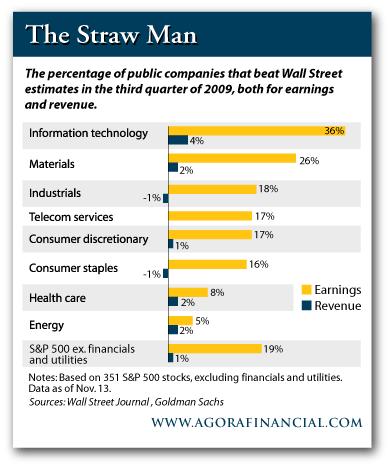
“With the majority of publicly traded companies done reporting third quarter earnings,” writes 5 editor, Ian Mathias, “the trend is clear: Profits were way better than expected, revenue was flat at best.
“Of what little we recall from freshman year, Finance 101 insists that profit equals revenue minus costs. Thus there really can’t be any questions left as to how the market pulled off this quarter…companies are simply trimming the fat at an incredible clip. Not exactly a long-term plan for growth.”
The New York Times reports that job losses continue to be “deep and enduring.” Mortgage applications are running lower than they were 9 years ago. “More households report food shortages,” says a Wall Street Journal headline. And insiders are still selling their own companies.
So, it still looks to us as if we are in a depression…one that will take many years to sort out. It is unlikely that the bull market in gold will reach its final blow-off top while the depression continues. But stranger things have happened. Eventually, gold will reach the apogee of its bull market. And when it does, we want to be ready for it. We will celebrate with champagne and sparklers.
Still, we wouldn’t get out the party hats…not just yet.
Until tomorrow,
Bill Bonner
The Daily Reckoning
Bill Bonner
Since founding Agora Inc. in 1979, Bill Bonner has found success and garnered camaraderie in numerous communities and industries. A man of many talents, his entrepreneurial savvy, unique writings, philanthropic undertakings, and preservationist activities have all been recognized and awarded by some of America’s most respected authorities. Along with Addison Wiggin, his friend and colleague, Bill has written two New York Times best-selling books, Financial Reckoning Day and Empire of Debt . Both works have been critically acclaimed internationally. With political journalist Lila Rajiva, he wrote his third New York Times best-selling book, Mobs, Messiahs and Markets, which offers concrete advice on how to avoid the public spectacle of modern finance. Since 1999, Bill has been a daily contributor and the driving force behind The Daily Reckoning .
Special Report:The Endless PAYCHECK PORTFOLIO: In three simple steps, unleash a steady flow of work-free income… starting with up to 75 automatic “paychecks” deposited directly into your account.
Don Vailoux’s full report today analyses17 more Stocks, Commodities and Index Charts HERE.
Tech Talk’s Weekly Column in the Financial Post
The column was published yesterday after a two day delay from our regular schedule. Since writing the column last Thursday, several favourable events have occurred including a breakout by copper above resistance at $3.06 per lb. and breakouts above resistance by several key stocks in the sector. ETFs in the sector also have recorded exceptional gains.
Seasonality in the Base Metal Sector
The base metal sector has two periods of seasonality each year. According to Thackray’s 2010 Investor’s Guide, the sector has a short period of seasonal strength from November 19th to the end of the year. It also has a medium term period of seasonal strength from November 19th to May 5th. What is the outlook for the sector this year?
Seasonal influences
‘The base metal sector’s performance is tied to the performance of equity markets, but with greater risk/potential return. The seasonal trade has been profitable in 13 of the past 19 periods from November 19th to May 5th. Average return per period was 13.8% In contrast, the S&P 500 Index recorded an average gain of only 5.9% during these periods.
Favourable seasonal influences during these periods can be attributed partially to strength in base metal prices. Copper has advanced in nine of the past 10 periods from the end of October to the end of March for an average gain per period of 17.8%. Aluminum also has moved higher in eight of the past 10 periods from the end of September to the end of February.

Technical influences
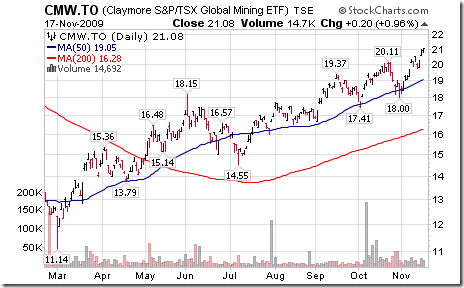
Base metal prices such as aluminum and copper have improving intermediate technical profiles. They bottomed at the end of December last year and established intermediate uptrends. They currently trade above 200 day moving averages. Copper has traded between $2.64 and $3.07 U.S. per lb. during the past three months. A break above its range implies upside potential to $3.55 per lb.
The S&P/TSX Global Mining Index at 946 also has a positive intermediate technical profile. Intermediate trend is up. The Index trades above its 200 day moving average and recently bounced for the fifth time this year from its 50 day moving average. Resistance exists at 1,009.17. A break above resistance implies upside potential to 1,180. Short term momentum indicators (Moving Average Convergence Divergence, Relative Strength Index and Stochastics) currently are overbought.

Chart courtesy of StockCharts.com www.stockcharts.com
Fundamental influences
Fundamental prospects are mixed. World inventory levels of base metals currently are high and rising. Copper inventories declined significantly from January to July when the Chinese were accumulating an inventory position. However, their buying has been notable by its absence recently and world inventories have risen. Weakness in the U.S. Dollar has helped base metal prices in recent weeks. However, a key component for seasonal strength this year is an expected rise in demand triggered by a recovery from recessionary economic conditions in developed nations including Canada, the U.S. and Europe. The recovery will coincide with previously announced economic stimulation programs that will start to have a significant impact by next spring.
What to do
Proof of a recovery from recessionary conditions in developed nations is less than convincing to date. Preferred strategy is either to accumulate on weakness between now and January or to wait for an entry point near the end of January for a seasonal trade into May. Participating Exchange Traded Funds, that track the sector, include the Claymore S&P/TSX Global Metals and Mining Index ETF (Symbol: CMW), the BMO S&P/TSX Global Base Metals Hedged to Canadian Dollars Index (Symbol: ZMT) and the Horizon Beta Pro S&P/TSX Global Mining Bull+ ETF (Symbol: HMU). The Horizon Beta Pro ETF is a double leveraged ETF that is rebalanced daily.
Editor Note: Money Talks highly recommends that you make a regular trip to this monday morning site to this Don Vailoux monday report where he analyses an astonishing 48 Stocks, Commodities and Ind
Don Vialoux has 37 years of experience in the Investment Industry. He is a past president of the Canadian Society of Technical Analysts (www.csta.org) and a former technical analyst at RBC Investments. Now he is the author of a daily letter on equity markets available free on the internet. The reports can be accessed daily right here at www.dvtechtalk.com.
Impossible! That’s what institutional investors say about “Timing the Market”. Mr. Vialoux will explain that, indeed, it can be done with the appropriate analysis. He also will explain why timing the market will be important during the next decade. Buy and Hold strategies are not working anymore; Investors are looking for alternatives. Mr. Vialoux will demonstrate four techniques that can be used to time intermediate stock market swings lasting 5-15 months. The preferred investment vehicles for investing in intermediate stock market swings are Exchange Traded Funds.
Disclaimer: Comments in Tech Talk reports are the opinion of Mr. Vialoux. They are based on technical, fundamental and/or seasonal data that is believed to be accurate. The comments are free. Mr. Vialoux receives no remuneration from any source for these services. Comments should not be considered as advice to buy or to sell a security. Investors, who respond to comments in Tech Talk, are financially responsible for their own transactions.
Disclaimer: Comments and opinions offered in this report at www.timingthemarket.ca are for information only. They should not be considered as advice to purchase or to sell mentioned securities. Data offered in this report is believed to be accurate, but is not guaranteed.
-
I know Mike is a very solid investor and respect his opinions very much. So if he says pay attention to this or that - I will.
~ Dale G.
-
I've started managing my own investments so view Michael's site as a one-stop shop from which to get information and perspectives.
~ Dave E.
-
Michael offers easy reading, honest, common sense information that anyone can use in a practical manner.
~ der_al.
-
A sane voice in a scrambled investment world.
~ Ed R.
Inside Edge Pro Contributors

Greg Weldon

Josef Schachter

Tyler Bollhorn

Ryan Irvine

Paul Beattie

Martin Straith

Patrick Ceresna

Mark Leibovit

James Thorne

Victor Adair