
Daily Updates
If for some reason you were unable to attend the live webinar: Harnessing the Power of Emerging Market Currencies, you may view the recording by clicking HERE
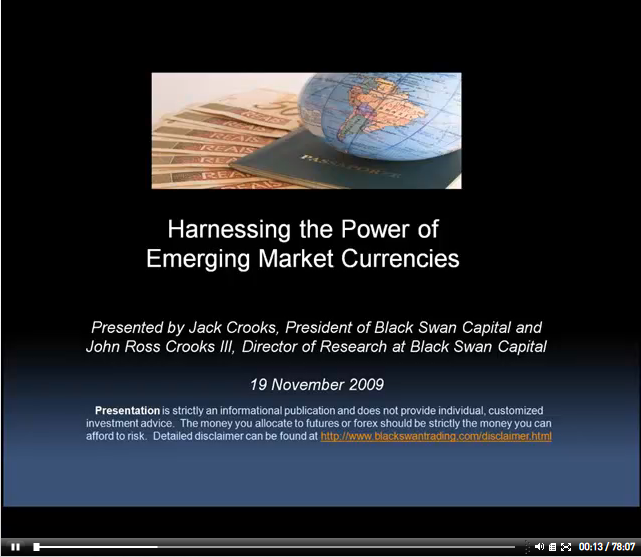
If you are interested in becoming a Member of our service-and we hope you are-you can subscribe at the following promotional link.
Thanks again for your interest in Black Swan Capital webinars and services-we sincerely appreciate it.
Regards,
Jack, John Ross, and David
P.S. You have one more day to subscribe to our service at a 48% discount off the regular price. Should you have any questions about the service, please do not hesitate to contact David Newman at dnewman@blackswantrading.com or calling us at 866-846-2672.
Revisiting a Breakthrough – The Original Gold Super Hero
With investors hurdling toward gold as our Government prints more money, I am reminded of astory that many gold enthusiasts may already know. It’s a story about a real life gold super hero whose deviance of conventional wisdom turned a failing corporation into one of the world’s largest gold producers.
Many of you who have been a part of Equedia Weekly for a long time will have already heard this story before. But with gold hitting yet another all time high and our many references to the Gold Super Hero in the past few weeks, its only fitting for us to revisit this incredible story one more time.
Rob McEwen wasn’t a miner. He was a young man following his father’s footsteps into the business world. Like his dad, he had a fascination for gold.
After years of growing up hearing stories around the dinner table of miners and prospectors, he finally got his shot.
One day, he stepped into a takeover battle as a white knight and emerged triumphantly as majority owner of a mine in Red Lake, Ontario. Here he stood at the head of the boardroom table filled with a room full of experienced senior geologists, all of whom doubted his ability to lead this company. Who could blame them? He was a mutual fund manager turned CEO of a gold corporation overnight.
This company was: Goldcorp

But it was hardly a dream come true. The company he had taken over was plagued with negative news and on the brink of failure. The miners were on strike and they were overwhelmed by lingering debts. The gold market was contracting and the mine’s operating costs were exceedingly high, forcing them to cease mining operations. Unless they found evidence of new gold deposits, the fifty-year old mine was about to be shut down along with the company.
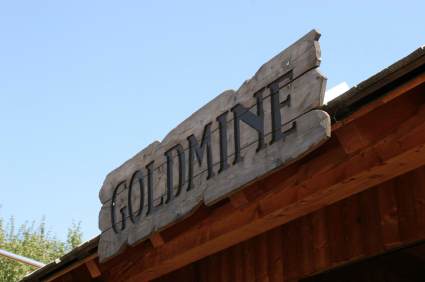
McEwen knew that the mine had potential. “The Red Lake gold district had 2 operating gold mines and 13 former mines that had produced more than 18 million ounces combined,” he says. “The mine next door had produced about 10 million ounces. Ours had produced only 3 million.” So he sent his geologists packing with $10 million dollars and a plan to drill in the most remote and deepest parts of the mine.
A few weeks later the geologists returned. With smiles on their faces, they broke the news to McEwen that would save Goldcorp – at least for another few years. They had found results signalling new deposits of gold as much as thirty times the amount they had been mining at the company. But that wasn’t enough.
The senior staff continued years of further exploration in attempts to find a more accurate depiction of the gold’s value and location. Despite the expertise and experience among the staff of senior geologists, their efforts proved stagnant. It had become obvious that something critical needed to change if they were to secure a future for Goldcorp. They needed to act faster.
Exhausted and uncertain about Goldcorp’s future, McEwen decided to take a break for some personal development. He attended a MIT conference in 1999, where corporate presidents from around the world had come to learn about advances in information technology. Perched up in his chair, he listened as the lecturer talked about how Linus Torvalds built a masterpiece computer operating system by revealing his code to anonymous programmers all around the world on the internet.
Without the help of thousands of anonymous participants, the Linux system would have cost millions of dollars to produce and would have taken years. But it didn’t.
Then it hit him. If his senior geologists couldn’t find the gold in Red Lake, maybe someone else could.
McEwen wasn’t a miner. He didn’t think like one either. But that was his strength. So he rushed back to his corporate head office in Toronto to share his idea of “open sourced” mining.
McEwen wanted to take all of the data the company has spent creating in the last fifty years and he wanted to share it openly with the world by posting it on the internet: “Then we’ll ask the world to tell us where we’re going to find the next six million ounces of gold.”
At first, Goldcorp’s geologists were appalled at the idea of exposing their fifty years of secret data to the world. And they had good reasons to be. The mining industry is an intensely guarded business and geological data is to miners what treasure is to pirates. Giving this sort of data away could not only subject you to takeover risks, but can also imply that your company no longer has the ability to move forward on its own.
Despite the inherent risks, McEwen decided to push forward and in March 2000, he launched the “Goldcorp Challenge.” They posted every bit of information they could on their 55,000-acre property through their website and setup a contest offering $575,000 worth of prize money to the participants that could show Goldcorp the best methods and estimates on their property.
McEwen knew this strategy entailed big risks. But the risks of continuing to do things the old way were even greater.
“Mining is one of humanity’s oldest industrial pursuits,” McEwen says. “This is old economy. But a mineral discovery is like a technological discovery. There’s the same rapid creation of wealth as rising expectations improve profitability. If we could find gold faster, we could really improve the value of the company.”
And improve the value they did. Within weeks, submissions from over one thousand virtual prospectors in over fifty countries crunched the data. But geologists weren’t the only participants.
Mathematicians, graduate students, consultants, and military officers all submitted entries. They had, “applied math, advanced physics, intelligent systems, computer graphics, and organic solutions to inorganic problems.”
Not only had the contestants identified new targets on the Red Lake property, they introduced Goldcorp to state-of-the-art technologies and exploration methodologies, including new drilling techniques and data-collection procedures, and more advance approaches to geological modeling.
McEwen had harnessed a technological trend that most in the industry would have shunned. As a result, he turned his destined-for-failure $100 million company into a company today worth over $27 billion – even in our currently depressed market.
In a recent newsletter, we announced the discovery of a gold junior play: Trueclaim Exploration Inc. (TSX-V: TRM). If you have not already read the report, you can find it by clicking HERE.
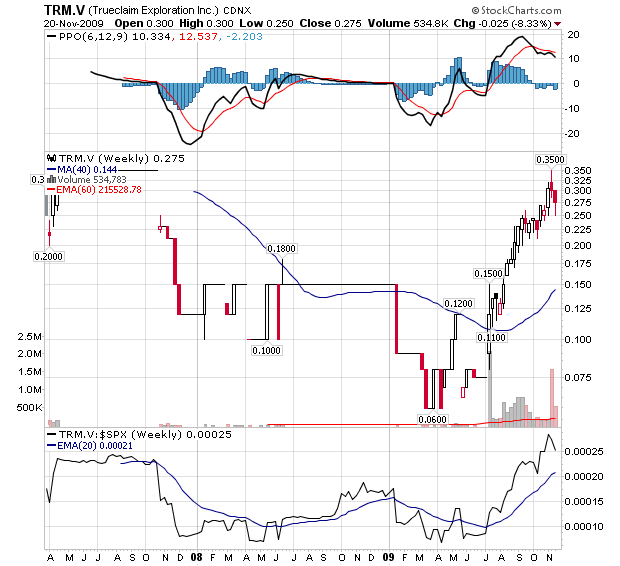
In that report, we talked about Trueclaim’s (TSX-V: TRM) Scadding Gold Property and their drill program (which has now begun – see news release by clicking HERE) to define and increase the known non-NI 43-101-compliant resource on the Property as well as seek other mineralization discoveries within the targeted areas.
To date, the Phase I plan consists of a minimum of fourteen (14) defined targets distributed around three mined regions identified as the North, South and East-West zones. Each of these zones has had prior limited drilling that produced high gold assay values. At the same time, however, the Company has noted that from the analysis of past drilling data, and detailed modelling, potential new targets and zones appear to exist and may extend off the immediate mine area.
With gold prices hovering over $1150/ounce, we are eagerly anticipating their first drill results. With a low market cap, strong news combined with positive results from this drill program could surely have an impact on their share value.
McEwen’s courage to challenge the mining industry’s safe-keeping of geological data reveals to us that change can lead to astonishing results.
With today’s change in technology and commodities price rally, this may be the opportunity of a lifetime for many investors and mining and resource juniors. New technologies and high prices are allowing historically great projects to resurrect themselves from the grave.
And it will be the juniors that dig them out and breathe life back into the markets. Don’t miss this run.
Article provided by:
Where the Wild Things Are
It Is Not Just Japan
The Euro-Yen Cross and the Dollar Carry Trade
New York, London, and Switzerland
From ghoulies and ghosties
And long-leggedy beasties
And things that go bump in the night,
Good Lord, deliver us!
–Old Scottish Prayer
Where the Wild Things Are is a beloved children’s book and now a beautiful movie. But in the investment world there are really scary wild things lurking about in the hidden recesses of the economic landscape. Today we look at one of the unintended consequences of the Federal Reserve’s low interest rate policy.
For quite some time, I have been arguing that we are faced with no good choices, not just in the US but in the entire “developed” world. I see a low-growth, Muddle Through world over the next years (with a double-dip recession just to liven things up). However, that does not mean that we will lack for volatility. Things could get volatile rather quickly. Let’s quickly set the background.
It Is Not Just Japan
Let’s look at today’s interest rate picture. Yesterday, we had the bizarre occurrence of banks actually paying the government to hold their cash. Three-month treasuries yield a miniscule 0.01% in interest. If you opt to buy a one-year bill you get all of 0.26%. You can see the entire spectrum below.
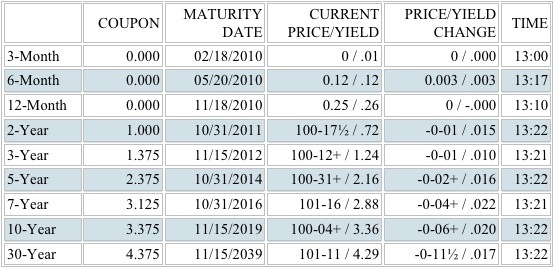
Look at the graph of the yield curve below. It is as steep as we have seen it in a long time. But that is almost the point. Banks are essentially getting free money. If you are a banker and can’t make money in this environment, you need to quit and find meaningful employment.
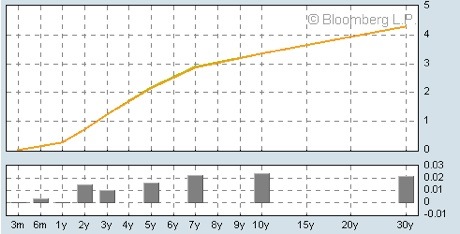
And that is part of the rationale that the Fed espouses with its low interest rate regime. Not only does it allow banks to repair their balance sheets, it also encourages investors to put money into riskier assets in order to get some return on their investments. Over $260 billion has gone into bond funds this year, and just $2.6 billion into stock funds. However, you have to balance that with the fact that some $400 billion has left money market funds paying less than 0.2%. So there is some movement to capture yield.
But is it just banks that are getting cheap money? And is encouraging investors to find riskier assets a sound policy? Maybe not.
The Euro-Yen Cross and the Dollar Carry Trade
I wrote a great deal in the past few years about the strong correlation of the euro-yen cross to stock markets all over the world in general. (The euro-yen cross is the exchange rate of the euro and the Japanese yen.) This was a proxy for the Japanese carry trade. The stock markets of the world rose and fell in synchronization with the yen versus the euro.
A currency carry trade is a strategy in which an investor sells a certain currency with a relatively low interest rate and uses the funds to purchase a different currency yielding a higher interest rate. A trader using this strategy attempts to capture the difference between the rates, which can often be substantial, depending on the amount of leverage used.
The Japanese drove their rates down to essentially zero in the 1990s. By early 2007, it was estimated that the yen carry trade was over $1 trillion. But when the world credit crisis hit, the world wanted dollars. They paid back the yen and bought dollars, driving the yen higher and killing the yen carry trade. Who wants to borrow in a currency that continues to rise, even if the costs are low? And often, large leverage was used, so small movements in the currency could destroy outsized amounts of capital.
But now, there are some who are beginning to ask whether there is a dollar carry trade. In the last nine months, the correlation between the dollar and the stock market has gone to about 90%. If the dollar rises, the stock markets and other risk assets tend to fall, and vice-versa. It would appear that investors and funds are borrowing cheap dollars on a short-term basis and investing in all sorts of risk assets. Not only have stock markets risen, but so have high-yield bonds, commodities, and so on.
We have seen the steepest rise in US stock markets coming out of a recession since the end of the last world war. The market is “discounting” a 5% GDP next year and a profit rebound beyond anything in past experience. Depending on the quarter, operating earnings are expected to rise by anywhere from 30-40%. P/E ratios are back at 23, well above the 17 we saw in the summer of 2007 (I am using 4th quarter 2009 estimates so as to not have to take into account the disastrous 4th quarter of last year.)
Worrying about a dollar carry trade is not just a preoccupation of my friends Nouriel Roubini or David Rosenberg or Frank Veneroso. Look as this story from Bloomberg:
“China’s Liu Says U.S. Rates Cause Dollar Speculation
“Nov. 15 (Bloomberg) — The decline of the dollar and decisions in the U.S. not to raise interest rates have caused “huge” speculation in foreign exchange trading and seriously affected global asset prices, said Liu Mingkang, chairman of the China Banking Regulatory Commission.”
“The continuous depreciation in the dollar, and the U.S. government’s indication, that in order to resume growth and maintain public confidence, it basically won’t raise interest rates for the coming 12 to 18 months, has led to massive dollar arbitrage speculation,” he told reporters in Beijing today at the International Finance Forum.
“Liu said this has ‘seriously affected global asset prices, fuelled speculation in stock and property markets, and created new, real and insurmountable risks to the recovery of the global economy, especially emerging-market economies.’
“His view echoes that of Donald Tsang, the chief executive of Hong Kong, who said the Federal Reserve’s policy of keeping interest rates near zero is fueling a wave of speculative capital that may cause the next global crisis.”
“‘I’m scared and leaders should look out,’ Tsang said in Singapore Nov. 13. ‘America is doing exactly what Japan did last time,’ he said, adding that Japan’s zero interest rate policy contributed to the 1997 Asian financial crisis and U.S. mortgage meltdown.”
It is not just China. Brazil has moved to impose a tax (or tariff) on investment money coming into the country on a shorter-term basis, as they are worried about both a bubble in their markets and in their currency. Russia is openly considering similar policies.
I have been doing a lot of speaking in the last month. In almost every speech, I warn of the significant imbalance in the dollar. I walk to the very end of the stage to help illustrate that the world now has on a massive ABD trade. By that I mean Anything But Dollars. Everyone is now on the same side of the boat. They have borrowed dollars to buy other risk assets, assuming that the dollar, like the yen in the glory days of the yen carry trade, will continue to fall. Dollar bears are everywhere.
Explanations abound for why the dollar is a trash currency. It is Fed policy, or the Obama administration’s willingness to run massive deficits, or the trade deficit or our health-care policy or (pick any number of issues). But I wonder.
Global trade collapsed last year and well into this year. Global trade was essentially done in dollars. If global trade is down 20% or more, then there is less need for companies in various countries to hold dollars and more need for local currency because of the crisis. Thus, after a rush to safety in the credit crisis, there is a rational selling of dollars by business.
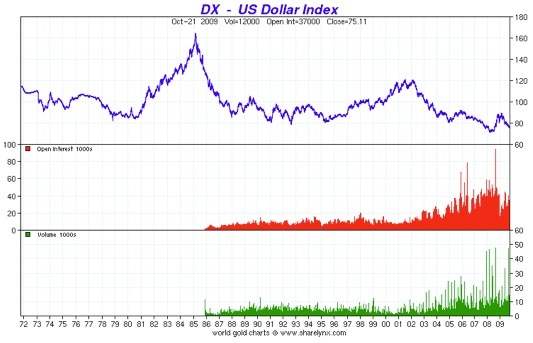
Look at the above chart. Notice that the dollar is roughly where it was 20 years ago. And notice the recent jump during the credit crisis. We are not even back to where we were before the crisis.
What happens if world trade picks back up, as it appears to be doing? Admittedly, it is not a robust recovery as yet, but it is rising. That means more need for dollars. And dollars which are being borrowed (and probably leveraged!) on the assumption the dollar will continue to fall.
And I agree that, over time, the case for the dollar is not as good as I would like. But in the meantime, we could have one very vicious dollar rally, which would take equity markets down worldwide, along with other risk assets. Why? Because it would be a major short squeeze.
Barron’s just did a survey. It revealed that the bullish sentiment on stocks is quite high and almost everyone hates US treasuries (graph courtesy of David Rosenberg of Gluskin, Sheff)
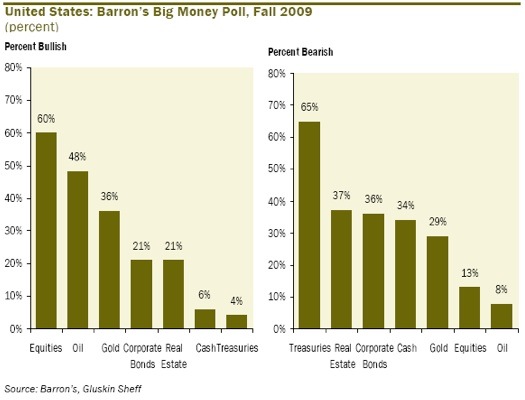
Whenever sentiment gets too strong in one way or the other, it is usually setting up the markets for a rally in the despised asset. Mr. Market like to do whatever he can to cause the most pain to the largest number of people.
I am not predicting a near-term crash or imminent precipitous bear, although in this environment anything can happen. I am merely noting that there is an imbalance in the system. The longer this imbalance goes on, the more likely it is that it will end in tears. And the irony is that a recovering world economy could be the catalyst.
The Wild Things? They may be hiding in a portfolio near you. Just food for thought. Stay nimble.
New York, London, and Switzerland
I am going to hit the send button on what may be the shortest e-letter I have ever done. The travel is catching up with me and I need some rest.
I am looking forward to Thanksgiving next week. It may be my favorite holiday. Family, friends, food, and football. My usual pattern is to get up very early Thursday and start the prime slow-cooking, and then turn to the side dishes. It will be no different this year. My brother will bring the smoked turkeys, which he has down to an art form. And then there are the over-the-top wines I was so graciously given this past birthday by so many friends. I will bring a few of those bottles out.
The next weekend I am in New York for Festivus with the crowd from Minyanville, and then I am home for over a month before I go to London and Switzerland in late January. Then not much is currently scheduled until April, although it always does seem to change. After the recent hectic schedule (15 cities and even more speeches in just a little over three weeks), I look forward to some home time.
I wish those of you in the US the best of Thanksgivings, and the rest of you a great week. And thanks for all the very kind words of late about Tiffani. She seems to be doing better. She is due in a month, so she is still moving slowly, but you can sense the excitement in her and Ryan. I find it all very pleasant.
Your “there’s no place like home” analyst,
John Mauldin
John@FrontlineThoughts.com
Marc Faber, the Swiss fund manager and Gloom Boom & Doom editor, said eventually there will be a big bust and then the whole credit expansion will come to an end. Before that happens, governments will continue printing money which in time will lead to a very high inflation rate, and the economy will not respond to continued stimulus.
Speaking at a conference in Singapore on Wednesday, Faber said: “The crisis has not solved anything. On the contrary there is less transparency today than there was before. The government’s balance sheet is expanding, and the abuses that have led to the one cause of the crisis have continued”.
“I think eventually there will be a big bust and then the whole credit expansion will come to an end,” Faber added.
“Before that happens, governments will continue printing money which in time will lead to a very high inflation rate, and the economy will not respond to stimulus”.
In one of his Gloomiest predictions, Faber, referred to as Dr Doom, said “the average family will be hurt by that, and then in order to distract the attention of the people, the governments will go to war”.
“People ask me against whom? Well, they will invent an enemy,” Faber said.
“At some stage, somewhere in future, we will have a war – that you have to be prepared for. And during war times, commodities go up strongly,” said Faber.
“If you want to hedge against war, you don’t want to own derivatives in UBS and AIG, but you have to own them physically, like farmland and agricultural commodities. That is something to consider for you as a personal safety and hedge. You have to own some commodities,” he added.
In a Bloomberg Television interview in Singapore Wednesday, Faber said “What will continue to happen is that the S&P 500 and the Dow Jones will go down relative to gold.
“I think gold will go up more,” he added.
“Will it go US$2,000, US$200,000 or US$2 trillion? I don’t know,” Faber said. “But if you have money printing in the world, then the price will over time rise. It will go up more for things that you just can’t increase the supply, and the supply of precious metals is very limited.”
Faber expects the US government to increase its stimulus spending should the Standard & Poor’s 500 Index fall toward 900. The US budget deficit under President Barack Obama’s administration reached a record US$1.4 trillion in the fiscal year that ended Sept. 30. Debt amounted to 9.9% of the nation’s economy, triple the size of the 2008 shortfall.
“I don’t think the S&P will drop below 800 or 900, and eventually will go higher in nominal terms, but not necessary in real terms,” he said, predicting a correction in the measure in the “near term.”
Faber has been warning about a collapse of the capitalistic system ‘as we know it today,’ massive government debt defaults and the impoverishment of large segments of Western society.
In a May interview with CNBC, he said central banks will continue to print money at full speed, but long-term this strategy will lead to a fall in purchasing power and living standards, especially in developed countries.
The years 2006 and 2007 were “the peak of prosperity” and the world economy is not likely to return soon to that level, he added.
Unless the system is cleaned out of losses, “the way communism collapsed, capitalism will collapse,” according to Faber. “The best way to deal with any economic problem is to let the market work it through.”
“I repeat what I have said in the past,” Faber said. “No decent citizen should trust the Federal Reserve for one second. It’s very important that everyone own some gold because the government will make the dollar (in the long term) useless.”
Below, an article of great interest from today’s Wall Street Journal John Paulson is a brilliant investor. He made billions by betting on the housing collapse last year. For those who distrust GLD, I note that Paulson has a big position in GLD. It’s hard to believe that he would have taken this position without thoroughly investigating GLD, the largest of the gold ETFs. -via Richard Russell
One of the biggest investors is placing a huge new bet on gold. – WSJ
John Paulson, who scored about $20 billion of profits between 2007 and early 2009 wagering against the housing market and financial companies, is launching a hedge fund dedicated to buying up shares of gold miners and other bullion-related investments, according to investors.
Mr. Paulson told his investors he personally would invest between $200 million and $250 million in the new fund, which he said will begin on Jan. 1, according to an investor at the meeting.
Paulson & Co. already is a major holder of gold shares including AngloGold Ashanti Ltd. and Kinross Gold, doing most of its buying early this year. Mr. Paulson currently has more than 10% of his $30 billion or so under management in gold-related investments, according to his investors.
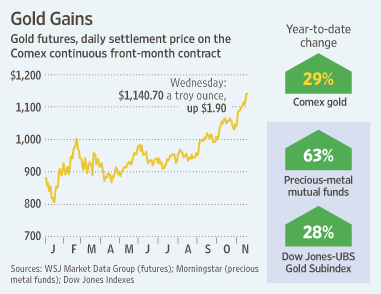
Because I think this development is so important, I’m running the Financial Time’s article that appeared today. I think that many funds will be copying Paulson on gold — Russell.
Paulson starts gold fund amid record prices
By Gregory Meyer and Henny Sender in New York
Funds run by the company now have more than a tenth of their assets in gold, a person familiar with its investments said. John Paulson, its billionaire founder, is seeding the new fund with $250m of his own money to offer investors a more concentrated exposure to gold. It will focus on shares and derivatives of mining companies rather than the physical commodity, the person said.
Mr Paulson has offered investors an option to have a gold share class for the past year and is a heavy user of gold exchange-traded funds to hedge.
As of September 30, the company was the largest single holder of the $40.6bn SPDR Gold ETF, with 8.6 per cent of outstanding shares, according to Bloomberg data. It also owned shares in the gold miners AngloGold Ashanti and Kinross Gold.
The move comes as central banks have kept interest rates near zero, luring investors into riskier assets such as emerging-market stocks and weakening the dollar. Investors worried about currency risks have bought gold as a stable store of value. Gold hit an all-time high yesterday, above $1,150 an ounce.
Other hedge fund managers attracted to gold have included David Einhorn, founder of the hedge fund Greenlight Capital who came under the spotlight last year for the short-selling of shares in Lehman Brothers after arguing the bank did not have enough capital to offset exposure to falling property prices.
The fund manager Tudor Investment said in a letter last month that a “Great Liquidity Race” could benefit gold. Paul Tudor Jones, its chairman, wrote: “I have never been a gold bug. It is just an asset that, like everything else in life, has its time and place. And now is that time.”
Central banks have also been buying gold as the value of their dollar reserves dwindles. India, Sri Lanka and Mauritius have been purchasing gold. China revealed that its gold reserves had nearly doubled over the past five years.
“The fact that the dollar keeps stumbling, and also, more importantly, that there are concerns about the long-term impact of quantitative easing and a general commodities rally, all paint a picture that is pretty supportive of gold prices,” said James Steel, precious metals analyst at HSBC in New York. “Waiting for a substantial correction in this market is like waiting for Godot.”
The new Paulson fund was first reported by the Wall Street Journal.
-
I know Mike is a very solid investor and respect his opinions very much. So if he says pay attention to this or that - I will.
~ Dale G.
-
I've started managing my own investments so view Michael's site as a one-stop shop from which to get information and perspectives.
~ Dave E.
-
Michael offers easy reading, honest, common sense information that anyone can use in a practical manner.
~ der_al.
-
A sane voice in a scrambled investment world.
~ Ed R.
Inside Edge Pro Contributors

Greg Weldon

Josef Schachter

Tyler Bollhorn

Ryan Irvine

Paul Beattie

Martin Straith

Patrick Ceresna

Mark Leibovit

James Thorne

Victor Adair