
Daily Updates
It requires only a relatively small perturbance to initiate a market waterfall. For months now gold and silver have been screaming ahead – along with the US equity markets. The MSNBC talking heads and every hopeful and aspiring fund manager on Bloomberg has trumpeted the good news.
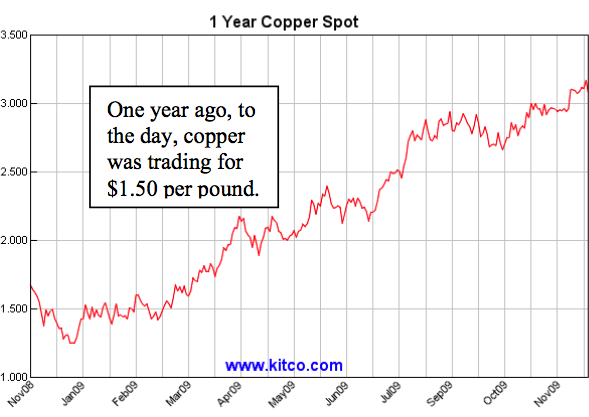
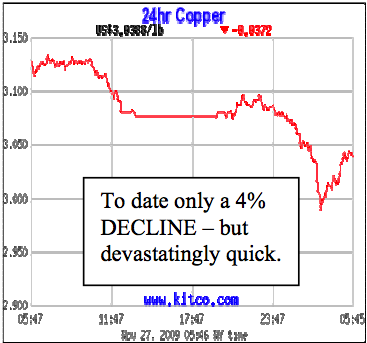
Within the past year, till yesterday, gold had risen 44% – within the past 30 days 14%. From this point last year copper had appreciated over 100% – closing Wednesday at $3.13 per pound. Yet in a very short time period (24 hours) gold has fallen $37 per ounce, silver $.88 and venerable copper has fallen from its 52 week high point high point, 12% to $3.03.
……read more HERE.
Market Buzz – Jobless Recovery?
After a sharp week of losses, on Friday, Toronto’s main index ended higher for a fourth straight session as gold miners rallied around record high bullion prices. The four day rally flew in the face of poor job data, which indicated that the Canadian economy is still feeling the aftershock of the deep recession that erupted a year ago.
The unexpectedly large loss of 43,000 jobs came against expectations of a 10,000 job gain and pushed Canada’s unemployment rate up two-tenths of a point to 8.6 per cent and reverses much of the previous two months’ jobs rebound.
Combine the October jobs figure with gross domestic product readings of zero growth in July and a 0.1 per cent shrinkage in August, and you now have a trio of rather stinky economic data points, since the Bank of Canada declared the recession over in July.
This left many analysts wondering if the coming September quarterly GDP data may show that Canada did not emerge from the recession at all.
Again, the hard data certainly suggests we are not out of the woods yet and a prudent approach to your portfolio continues to be in order.
Alas, all is not lost. Despite the lack of broader GDP growth, there are still some individual companies producing strong growth. In fact, we look no further than Bridgewater Systems (BWC:TSX), a mobile personalization company, and a stock we ranked as our top Canadian software selection in 2009, for evidence that growth still exists in specific pockets of the market.
This past week, Bridgewater announced its financial results for the three and nine months ended September 30, 2009. Q3 2009 revenue increased 53 per cent to $15.8 million compared with $10.3 million for the same period last year. Net earnings jumped to $1.7 million, or $0.07 per share fully diluted, from $0.5 million, or $0.02 per share fully diluted, in the prior year period. The company’s cash position increased to $61.5 million, $50.4 million at December 31, 2008, with no debt.
Bridgewater Systems Corporation raised fiscal 2009 guidance and expects revenues of $62-$64 million and net earnings of $9.5-$10.0 million. Prior to this, analysts were expecting the company to report revenues of $61 million and net income of $9.5 million for the period.
Looniversity – It’s All About Earnings – Part 2
Why Do Investors Care About Earnings?
Earnings drive stock prices; it’s as simple as that. Bottom line, higher earnings generally result in higher stock prices (and vice versa). At times, a company with a rocketing stock price might not currently be making much money, but the rising price means that investors are hoping that the company will be profitable in the future–of course, however, there are no guarantees that the company will fulfill current expectations of investors.
When a company is making money, it has two options. First, it can improve its products and develop new ones. Second, it can pass the money onto shareholders in the form of a dividend or a share buyback. It really is quite this simple! In the first case, you entrust the management to re-invest profits in hopes of making more profits. In the second case, you get your money right away.
When is “Earnings Season”?
Earnings Season is Bay Street’s equivalent to schoolchildren getting sent home with their report cards. It happens four times a year as publicly traded companies in Canada are required by law to report their financial results on a quarterly basis. Most companies follow the calendar year for reporting, but they do have the option of reporting based on their own fiscal calendars.
Put it to Us?
Q. I’m new to investing and would like to know if I can sell or buy stock by myself?
– Rene Larmer; Calgary, Alberta
A. In order to buy stocks, you need the assistance of a stock broker since you cannot just phone up a public company and ask to buy their shares yourself (in most cases). For inexperienced investors, there are two basic categories of brokers to choose from; a full-service broker or an online/discount broker.
The latter is better suited for investors who feel comfortable participating, either through their own or other independent source research, in their specific investment decisions. The online broker is a great choice for the “DIY” or do-it-yourself investors. However, if you have no experience or knowledge in the market, a full service brokerage or advisor may be a safer bet. The full service brokerage is designed for the novice investor or those who do not feel comfortable participating in their own investment decisions. The commissions may be higher, but you’ll have the safety of professional guidance. Having said this, be sure to shop around because commissions can vary significantly from firm to firm.
KeyStone’s Latest Reports Section (must be a premium member)
- Canadian Small-Cap with Dominant Position in a Fragmented Market Ripe for Consolidation, Trading with Solid Fundamentals – Slow & Steady (New Buy Report)
- Strong Q1 2010 Revenue Growth, Aggressive Growth Plan, & Attractive Valuations Allow Us to Maintain Our BUY Rating on Alternative Financial Services Provider Despite 40% Plus Gain in 4 Months (Flash Update)
- Emerging Australian Alternative Financial Stock Posts Encouraging Q1, Narrowing Losses on 200%+ Increase in Revenues – Maintain Rating (Flash Update)
- China-based Organic Fertilizer Producer Posts Strong Q2, Graduates to NASDAQ & Sets Stage for Growth Phase – Rating Upgraded (Flash Update)
- Profit Taking in Order for our Top Canadian Wireless Software Pick After Shares Jump over 250% in 2009 – SELL HALF (Flash Update)
KeyStone -Why Subscribe?
- First coverage on high growth, profitable stocks, trading at low prices
- Independent and updated BUY/SELL/HOLD Stock Reports
- Unsurpassed 9-year track record of uncovering great small caps with strong fundamentals
- About Keystone Financial HERE – Go HERE to subscribe
Ed Note: Highly recommend you read:
THE CASTLEMOORE INVESTMENT COMMENTARY
….it has great commentary and charts in it examples below. Even some 10 Rodney Dangerfield humor “My wife had her drivers test the other day. She got 8 out of 10. The other 2 guys jumped clear.”
….and serious
Bob Farrell’s 10 Rules of Trading
Mr. Farrell, Merrill Lynch’s chief market strategist from 1967-1992 penned
some pretty decent “Rules to Remember”…
1) Markets tend to return to the mean over time.
2) Excesses in one direction will lead to an opposite excess in the
other direction.
3) There are no new eras – excesses are never permanent.
4) Exponential rapidly rising or falling markets usually go further
than you think, but they do not correct by going sideways.
5) The public buys the most at the top and the least at the bottom.
6) Fear and greed are stronger than long-term resolve.
7) Markets are strongest when they are broad and weakest when
they narrow to a handful of blue chip names.
8) Bear markets have three stages – sharp down – reflexive rebound –
a drawn-out fundamental downtrend.
9) When all the experts and forecasts agree – something else is going
to happen.
10) Bull markets are more fun than bear markets
Rodney Dangerfield quotes:
1. I have some very interesting information about the gold juniors today. Better have your heart medicine on standby.
2. Gold hit 1180 this morning. The dollar bulls continue their crazed focus on the intermediate trend, and at best their technical analysis gets a C rating. They called their pivot point correctly in timing the gold market. The only minor problem was they got the direction wrong. Gold top call number 1000 bites the dust. Only 1000 more top calls to go before they say “buy now, gold is a bargain at $5000, it’s here to stay!”
3. Flying Five. I had to give this a lot of thought and needed extra time. What I’m talking about is the GDX Juniors. How do you boost possible reward by concentrating some risk capital into some of the issues? (Ed Note: Emphasis Mine) There are some systems that exist to play the Dow that way. To repeat: You take the Dow 30 stocks, and there are a couple of approaches from there. One is to take the 10 highest yielding of the 30, then buy the 5 of those with the lowest price.
4. That is essentially how I bought Alcoa and General Electric into Dow 6500 while most of the gold community madly shorted the stock market into the exact bottom. Where the value players got smoked is they looked at the price/earnings ratio for the whole Dow, and concluded it was still overvalued at Dow 6500.
5. Alcoa controls a lot of the world’s aluminum markets. At a price of $10,9,8,7,6, 5 dollars a share, I want to be a buyer, particularly when I see the price/earnings ratio in the 6 or 8 area, while the MACD and TRIX indicators for the Dow are at arguably the most oversold conditions in 50 years. And so l was a buyer into the Dow 6500 bloodbath.
6. This week’s revelation by the banksters that bear market funds were “inundated” by retail investors all through 2009 is a knockout blow to those in gold community who shorted the Dow into 6500 and as it rallied with huge money. You now realize you did so in partnership with the public investor, who has the worst investment track record in the universe.
7. Junior gold stocks are not Dow Industrial component monster corporations deemed “too big to fail”. Many are more likely to be deemed “too small to be allowed to succeed.” There are many in the gold community who seriously believe that their junior stock is a stronger deal than the Dow is. A coming sure rise in the price of a stock does not correlate with the underlying risk of the situation.
8. Assuming you accept the endless risks associated with a junior play, I think buying just 5 juniors out of the GDXJ is really just far too risky a play. But if you want to proceed, the play would be to simply look at the 10 largest market cap/revenues plays, meaning either the 10 largest market cap stocks OR the ten with the smallest market cap to revenues ratios (but this eliminates explorers). Or price per share to revenues per share ratio. Forget about earnings with juniors. Then buy the 5 of those ten with the lowest price. If you get into mining projections, you are starting to get away from simplicity and into complexity. I firmly believe the simple-minded investor will beat the one who over-complicates things. If you did a thousand pages of analysis, but your stock is down 10% or more from your buy price, you are not acting professionally in the market. You must be prepared 100% of the time to respond to price weakness. The investor with the weaker analysis but the stronger tactics will win over the strong analysis, weak tactics player, nearly every time.
9. I’m personally not confident that there is enough safety in that flying 5 juniors play. I prefer a simply “J 10”, buying the top ten stocks with the lowest price. The 2nd approach would be to take the 20 with the highest market cap, and buy the 10 with the lowest price.
10. Remember, there is a monitoring issue. You may own a business or have other time-constraint factors. That is an argument to consider the simple price-based model. You simply own the 5 or 10 lowest-priced stocks and flip one out when a new one comes in.
….read points 11- 24 HERE
-
I know Mike is a very solid investor and respect his opinions very much. So if he says pay attention to this or that - I will.
~ Dale G.
-
I've started managing my own investments so view Michael's site as a one-stop shop from which to get information and perspectives.
~ Dave E.
-
Michael offers easy reading, honest, common sense information that anyone can use in a practical manner.
~ der_al.
-
A sane voice in a scrambled investment world.
~ Ed R.
Inside Edge Pro Contributors

Greg Weldon

Josef Schachter

Tyler Bollhorn

Ryan Irvine

Paul Beattie

Martin Straith

Patrick Ceresna

Mark Leibovit

James Thorne

Victor Adair