
Daily Updates
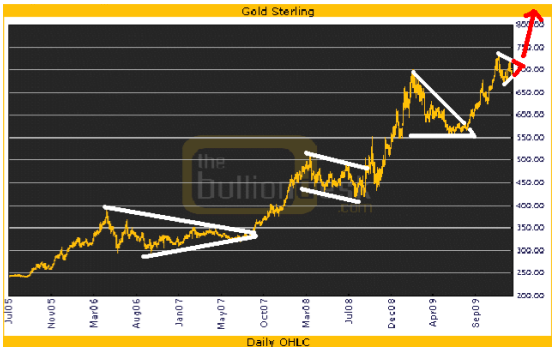
GOLD IN STERLING TERMS: Advance; Consolidate; Rinse and Repeat: The trend really is rather clear here, is it not? We are long and we hope to become longer still once £725 is taken out from below. Patience, please; patience!
Why the ‘Bull’ Market is Far from Over
by the Gold Forecaster
Some talk of the end of the credit crunch. Some say that the gold bull market has suffered severe damage, which will affect its long-term prospects. If we were to accept these statements then it would appear that the gold ‘bull’ market is over. But are these statements acceptable and do they reflect the true picture underlying the gold [and silver] markets?
To get the proper perspective let’s stand back
and look at the ‘BIG’ picture.
Ed Note: the following topics, detailed analysis are in the following topics in the article:
Weekly Gold Bull Market Updates…
Ed Note: The article Concludes:
The Impact on Gold and Silver Prices
While monetary authorities may not be happy to see a resurgence of global demand for gold and silver, those who are able to, will see these mounting controls as a threat to the true measurement of value, which currencies have provided since the last world war. As the dangers become more apparent, the $: € exchange rate will not serve as a determinant of the gold and silver prices, but the falling macro-confidence, fear of more instability, doubts about the value of global currencies, both ‘hard’ and ‘soft’ and uncertainty on a broad global front, will prompt a broadening of the type of global investors attracted to these metals to reflect these fears over time, to ensure that the gold and silver prices reflect global values and counter those measured against controlled values [managed currencies] in other markets.
Certainly, the ‘bull’ market in gold and silver is far from over. The market is metamorphosizing into a new phase promising far higher prices than we even contemplate now.
What prices will gold and silver have then?
“The actual prices of gold and silver will become simply academic.”
Subscribe to the Gold Forecaster HERE
Howard Ruff, who has observed the markets, the economy and government through three serious recessions and witnessed the rise and fall of the dot-com and real estate bubbles, entered the world of precious metals when Robert Preston’s How to Prepare for the Coming Crash caught his eye in the early ’70s. Shortly thereafter, he founded The Ruff Times (a financial newsletter that has served some 600,000 subscribers over the years) and came out with his first book (a blockbuster that sold 2.6 million copies and made his name a household word). The Ruff Times and How to Prosper During the Coming Bad Years advocated silver and gold as a hedge against an inflation-induced economic crash before the metals took off on their great bull runs of that era. When the times started getting rough again a couple of years ago, he resurrected, revised and re-released his book in 2008, and then followed up with How to Prosper in the Age of Obamanomics: A Ruff Plan for Hard Times Ahead. In this exclusive Gold Report interview, Howard talks about what he sees down the road and what people can do to prepare themselves.
The Gold Report: You have written quite a bit about the U.S. government’s growing debt and unfunded liabilities, heading toward an even more aggressive printing of money and inflation. How convinced are you that this is the only outcome?
Howard Ruff: I am basically staking my reputation on it. I guess I can’t do any more than that. I am convinced that we’re moving into a socialist age, and the Obama Administration is deliberately trying to create European socialism here in America. All of their objectives require creating money. Until we have a new administration with a new philosophy—which isn’t going to be printing all this money—I think inflation is in our future.
TGR: Could a new administration even change the course? Is it as easy as that?
HR: One of the problems is that many of the things that Obama’s managing to ram through Congress are irreversible, and it will be very difficult. Once you’ve voted in something like our big healthcare plan and people start depending on it, it’s next to impossible to eliminate. Consequently, for the first time in my 34 years of publishing, I’m worried that we may not be able to recover the momentum we had before, and I’m very much worried that maybe we’re facing an irreversible phenomenon.
TGR: Do you see this phenomenon is unique to the United States?
HR: I frankly think it’s a worldwide phenomenon. The United States is a little late coming to the party, but has joined the party big time and has now assumed leadership.
TGR: If you’re convinced that momentum is carrying us down the road to socialism and that it’s happening around the world, project that out 10 to 20 years for us. What ultimately happens?
HR: First, I’m not assuming that reversing this momentum is impossible; I’m just saying it’s unlikely, and historically once you start building momentum of spending money and paying people to join government programs and get all kinds of gifts from Santa Claus in Washington, it is unlikely to be reversed. As a financial advisor, my job is to help my constituents make money, and my constituents are not on Wall Street or Pennsylvania Avenue. They’re on Main Street. And so my job is to help them figure out what to do with their money in these difficult times. Because I am an optimist, I am convinced that no matter how bad things look, some opportunities are out there somewhere. There’s a silver lining in all these clouds.
I know I can’t tell the government what to do, even if we changed the administration in the next elections. But in the meantime I can help people know what to do with their resources so that they will suffer the least damage or even prosper and make a lot of money from the environment around us by becoming mavericks. A maverick is a bovine that’s left the herd and is probably lonely out there by himself for a while, but the herd will be turned to hamburger, and the maverick will make big money if he knows what to do.
TGR: Let’s talk a little bit about knowing what to do and some of your advice. In How to Prosper in the Age of Obamanomics, your recently published book, you are pretty enthusiastic for gold as a hedge against the devaluing U.S. dollar.
HR: Will Rogers said, “Invest in inflation; it’s the only thing that’s going up.” As we move into an inflationary socialist environment, bear in mind that there’s never been an example when the end result of socialism was not inflation. I remember being in Russia during the Gorbachev years, when using price controls to try to stamp out inflation merely created shortages. We were on a bus going to a museum, and all of a sudden we had to stop because people were blocking the road, rushing across the street. A rumor was out that a store had some goods, and everybody was carrying an empty gunny sack. They didn’t know what they might find, but they wanted it. They knew that they could use it or trade it or sell it.
TGR: So what do you recommend for the Main Street maverick who wants to prosper?
HR: First I have to make sure that I’m recommending things that the average person can do. And aren’t full of pitfalls. For example, I like gold very much, but I don’t like gold futures, because the average person can lose in that game. For example, once when I decided to buy some gold futures, I got caught in a downdraft. Gold dropped around 30% in a few days. It was a temporary phenomenon, but it wiped out everything I had in the futures market. So I don’t want people to do that; I want them to buy the actual bullion or coins and take them home and hold them. That’s the first thing that I recommend.
Then there are derivatives of gold and silver, which are mostly mining shares. I like them as a category. I like some better than others, especially if they’re based in North America, because they’re not as vulnerable to expropriation. So I concentrate my investments in mining stocks on companies that are based in the U.S. and Canada.
TGR: You recommend buying gold bullion and coins. How about silver?
HR: I like silver a lot better than gold. I think you will make two or three times more money in silver than gold.
TGR: Is that because of the price today or is it a general phenomenon?
HR: It’s general. The first time I recommended gold and silver was back in the ’70s, and we made twice or three times more money in silver than in gold. I want people to buy silver for several reasons. When people start trying to beat inflation by investing in precious metals, it’s a lot easier to buy silver because it’s a lot cheaper. The average investor can buy some of that rather than buying gold. Also, because gold is so much more expensive, it doesn’t have a lot of utility. It’s like buying $1,000 bills. So as a hedge against inflation, I think people are a lot better off in silver.
TGR: Do you follow the gold/silver ratio?
HR: I follow it as it’s an important measurement of relative money, but I am basing my decisions on history, and history tells me that silver will outperform gold. That may not be the case from day to day or over a particular short time period, but that’s where the money will be made over the long haul.
TGR: Do you worry about the government confiscating gold as it did in the past?
HR: A little bit, but not much. When Roosevelt confiscated gold, we were on the gold standard and gold was considered real money. The government confiscated the gold and then promptly raised the price once they felt they had all the gold they could get. But for some years now, they have been telling us that gold is not money, merely another commodity, and consequently they don’t have the same interest in it they had back then.
So I don’t think it’s likely that they would confiscate it, but if you’re worried about that, the best way to deal with it would be to buy semi-numismatic coins, where most of the value is based on bullion but they also have some numismatic value and scarcity value. The government cannot seize numismatic coins, so they would be immune to that sort of thing.
TGR: Let’s talk a little bit about the mining shares. You focus on North America companies, but within that sphere you have producer, explorer and developer segments. Can you give us some idea which of these categories you prefer or how should investors view these three categories?
HR: I think you ought to have a little bit of each of them. The more conservative is the big producers, and they will be outperformed by the development companies, and they will be outperformed by the exploration companies. Finally, the one that will outperform them last is probably the holes in the ground surrounded by liars. That happened last time when people started looking for big returns. That’s not what I would do, but that’s what I think a lot of people will do and the marketplace will reflect it.
But mainly, I want to make sure I am diversified across that spectrum. It would be silly to say I think that the producing companies will be the best way to make money because I don’t know if that’s true. One thing I’ve learned is how little I really know, and I’ve been doing this for 34 years. But every day I seem to find something that surprises me. And there’s a whole lot I don’t know, so I’m just making sure I’ve covered the waterfront.
TGR: Is it true that you’re also somewhat enthusiastic about uranium?
HR: I am very much. Uranium mining interests me because there’s going to be demand. There are enough nuclear plants either under construction or on the drawing boards that there’s only half enough uranium above ground to service their needs. Again, the most conservative uranium investment will be the big producers, followed by the development companies that have found some uranium and are making deals with companies to finance their operations, followed—again—by the exploration companies and then the holes in the ground surrounded by liars.
TGR: Except for the liars, can you give us some examples of some uranium companies that fall into the producer, developer and explorer categories?
HR: Cameco Corp. (TSX:CCO) is one that comes to mind. Incidentally, whether it’s uranium, gold or silver mining, there is always resistance to mining because it requires a lot of water, and it’s hard on the environment.
TGR: That brings up an interesting point. You like to focus on North American mining companies. Are you concerned that environmentalists or the government could reverse some of the mining opportunities?
HR: Yes, but eventually, the public will realize we need those resources. And my opinion is that the public will prevail.
TGR: So you recommend diversification among producers, explorers and developers?
HR: Not just that. There are some other things I like. Another area that is viable is oil. I like oil very much, but so many oil companies are in foreign areas where they can be expropriated. If you remember reading about the Gold Rush in California, a lot of prospectors lost everything they had, but those who manufactured picks and shovels and pans did very well. So I think the way to prosper and benefit risk-free from the rising price of oil is investing in the companies that make and service the oil rigs, because they are American companies for the most part and are not as vulnerable to expropriation. Schlumberger Ltd. (NYSE:SLB) would be one example.
I think inflation will drive up the price of oil again, and inflation is already a problem. My personal opinion is that two to three years ago, when oil was up to $145 a barrel, it ran up in an exaggerated reaction to the weakening of the dollar. It wasn’t scarcity of oil or increasing demand, but shrinking value of the unit of account—the dollar.
TGR: So you see gold and perhaps oil equipment suppliers as hedges against inflation?
HR: Whether they buy gold or silver or oil or oil service companies, I think one of the most important things the average American household can do with its money is prepare for the day when inflation will be generalized. If the store sells any commodity that you buy on a regular basis, and you find it on sale, buy a case and store it. Stock up on commodities that you use and get a storage unit or make sure you have a storage room for important commodities.
I’d like to have about six months worth of whatever I need, and I am not just talking about food. I’m talking about diapers or soap or whatever, and do everything you can to be self-sufficient. I think one day one of my prized possessions will be the garden in my backyard. That way you can buy at today’s relatively lower prices and consume at tomorrow’s higher prices. It’s not only a way to ensure you will have whatever commodity it is that you know you’re going to need, but it’s also a form of investment. So, that’s one of the first things to do.
TGR: And what else?
HR: Another thing is to get out of debt. Even though it’s theoretically a good idea to have debt and pay it off with a cheap dollars; that’s theory. Then the next thing to do is buy gold and silver coins because someday they might be used as currency. There’s a very good possibility of that, because it’s happened so many times throughout history. That’s one reason why I like coins— bullion type coins—very much.
TGR: You mention in your book a possibility of getting into hyperinflation in the U.S.
HR: We’re on course for it. Once inflation starts, sometimes it does not stop short of destruction of the currency. The world is littered with dead paper currencies; you can be up to your knees in dead paper currencies. There is a possibility that we could destroy the currency by making so many demands on it and increasing the amount of currency we’ve created, which this administration seems to be doing.
I never thought I would be talking about dollars in terms of trillions. By creating these trillions of dollars, they’re beginning to show us what has happened in every major inflation since the invention of the printing press. So my personal opinion—and it’s only an opinion, not a forecast—is that inflation will get totally out of control. When it does, we’ll have something like what we found in the ’70s, when some prices were increasing two or three times a day as inflation picked up. That was darned near hyperinflation, but fortunately, Reagan and Volcker were able to reverse it without totally tubing the economy.
TGR: Some people who are thinking we’re going to run into hyperinflation project one of two scenarios. One, that the U.S. dollar will no longer be the world reserve currency and two, that we will return to the gold standard. Do you agree with either of those projections?
HR: The only way we’re going to get to the gold standard is when the current currency collapses and no longer is useful and we’re searching around for some kind of gold-backed currency. But darned if I know what form it will take.
Howard Ruff, who has been publishing The Ruff Times (www.rufftimes.com) since 1975, is the author of How to Prosper During the Coming Bad Years (1979), Survive and Win in the Inflationary Eighties (1981), Making Money (1984), How to Prosper During the Coming Bad Years in the 21st Century (2008) and most recently, How to Prosper in the Age of Obamanomics: A Ruff Plan for Hard Times Ahead. Less renowned than his work as a financial adviser and market commentator but probably equally rewarding is Howard’s lifelong interest and involvement in music. At age 9, he already knew what he wanted to do when he grew up – sing on Broadway or at the Met. He never made it specifically to those destinations and his voice matured from boy soprano to mellow baritone, but Howard has managed to find ample expression for his musical gifts. Among them, performing in, conducting or directing hundreds of Gilbert & Sullivan operas; singing with the Mormon Tabernacle Choir, the National Symphony and four years as soloist and announcer for the Air Force Band and Singing Sergeants (among others); selling 100,000 copies of an album (Howard Ruff Sings, released in 1981, with the Osmond Brothers and the Brigham Young University Philharmonic and A Cappella Choir as his backup groups). When he was a young man, rather than take advantage of a full-ride scholarship to the prestigious Curtis School of Music in Philadelphia that might have led to the Broadway career he’d imagined, Howard volunteered for a Mormon church mission that took him to Washington D.C. That sparked his interest in government, economics and politics and led, over the many years that followed to fame and fortune —plus a measure of notoriety and financial failure to keep him humble.
Want to read more exclusive Gold Report interviews like this? Sign up for our free e-newsletter, and you’ll learn when new articles have been published. To see a list of recent interviews with industry analysts and commentators, visit our Expert Insights page.
Quotable
“China will maintain reasonable growth in money supply and credit, focus on optimizing the credit structure and carefully manage the pace of lending to reduce financial risks.” – Wen Jiabao, Chinese Premier and Juggling Extraordinaire
FX Trading – Somebody give the Chinese a US talk show slot
With all the controversy surrounding Jay Leno, Conan O’Brien and mama bird NBC … perhaps China would like to slip in and host a show, regardless of whether they get pushed back by half an hour.
It seems Chinese officials like to talk. Ok, maybe they’ve earned it; China has quickly become the make-or-brake(-or-break) for the global economy. So why not soak up the spotlight while you’ve got it, right?
It’s clear the latest public juggling act for Chinese officials is stemming the “overheating” critics while appeasing the “choke-off-the-economy” critics. In other words, their rhetoric is balancing a tightening policy with an accommodative policy.
….read more HERE
Commodity Price Review
Recovery Placing Commodities on Higher Trajectory
BMO Research has updated its commodity price outlook for 2010E and beyond.
1. The industrial commodity price outlook has been upgraded due to the
return of double-digit growth in China, aggressive restocking and a
stronger-than-expected recovery in the U.S. A weak U.S. dollar, supply
concerns and growing interest in commodities as a bona fide asset class
are additional positive factors.
2. Gold and other precious metals projections have also been upgraded
materially amid U.S. dollar concerns, an eventual move toward higher
inflation, rising U.S. debt, central bank buying and improvements in
jewellery and industrial demand.
3. Copper, platinum, silver, iron ore and metallurgical coal are our top
commodity picks, driven by tighter fundamentals. Long-term copper has
been increased to US$2.50/lb, reflecting high project costs.
…..read more HERE.
Don Vialoux, a speaker at the World Outlook Conference has produced this monday report packed with so much analysis, far more than appears here this morning. We strongly recommend you go directly there and scan his full site HERE.
The Bottom Line
‘Tis the season to adjust equity portfolios! Sectors reaching the end of their period of seasonal strength include gold, natural gas, agriculture, Canadian Financial Services and Information Technology. All have been profitable. Other sectors either have entered or are approaching their period of seasonal strength including small caps, silver, platinum, mines and metals, basic materials and energy (later this month). The following comment offers additional insight:
Be sure to hear Don Vialoux at the
Tis the Season to take profits
January frequently is a pivotal month for investors using seasonal investment strategies. Many sectors are reaching the end of their period of seasonal strength and other sectors are entering their period of seasonal strength.
Our June 20th column recommended the Agriculture sector for a seasonal trade from near the end of July to the end of December. The column noted that, “Preferred strategy is to defer purchases until technical parameters show signs of bottoming”.
Short term momentum indicators gave a buy signal on July 14th on the two most actively traded Agriculture Exchange Traded Funds, the Claymore Global Agriculture Exchange Traded Fund (COW/TSE) and Market Vectors Agribusiness ETF (MOO/NYSE). Since then, the Claymore ETF has gained 42.3% and the Market Vectors ETF has improved 42.6%. Short term technical parameters for both exchange-traded funds are rolling over from overbought levels. Now is the time to take seasonal profits.
Our October 10th column note that, “The preferred strategy is to own exchange-traded funds (ETFs) in the information technology sector for a seasonal trade until mid-January”. Technology SPDRs (XLK/NYSE) are the most actively traded exchange-traded fund in the sector. Historically, the sector has reached a seasonal peak just before or just after the Las Vegas Consumer Electronics show. This year, the show concluded on January 10th. Since October 10th, Technology SPDRs have gained 9.6%. Short term momentum indicators for the ETF recently rolled over from overbought levels. Now is the time to takes seasonal profits.
Our October 17th column noted that, “Preferred strategy is to purchase an equity interest in the semi-conductor sector on weakness for a seasonal trade lasting until mid-January”. The most actively traded exchange-traded fund in the sector is Semi-conductor HOLDRs (SMH/NYSE). This sector also has a history of reaching a seasonal peak just before or after the Las Vegas Consumer Electronic Show. Since October 17th Semi-conductor HOLDRs have gained 11.3%. Short term momentum indicators for the ETF recently rolled over from overbought levels. Now is the time to take seasonal profits.
The November 7th column noted that, “The seasonal trade in the Canadian Financial Services sector from the end of October to the end of December looks okay, but not great”. The most actively traded financial services exchange-traded fund in Canada is iShares Canadian S&P/TSX Capped Financial Fund (XFN/TSE). Since November 7th iShares units have added 2.5% (plus a dividend). Short term momentum indicators recently rolled over from overbought levels. Now is the time to take seasonal profits.
Several sectors recently have entered into their period of seasonal strength include small caps, mines and metals and platinum. Preferred strategy is to add to exchange-traded funds and equities in these sectors on weakness when technical parameters offer a second entry point.
Several sectors are on the radar screen for possible seasonal trade into spring. They include Canadian and U.S. energy, oil services and materials. Technical parameters for entry into these trades have yet to appear.
Thoughts on Seasonality in the U.S. Financial Services Sector
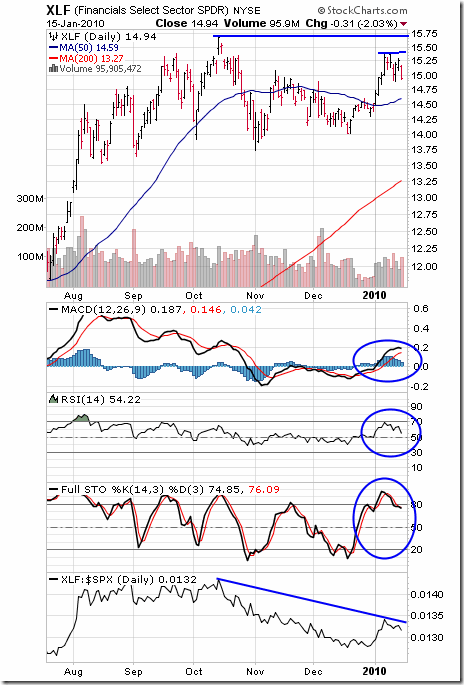
According to a recent seasonality study on the U.S. Financial Services sector completed by Brooke Thackray, the best time to own the U.S. Financial Services sector is from January 19th to April 13th. Average return per period from 1990 to 2008 was 4.1% versus a gain of 1.3% for the S&P 500 Index. The annual recurring reasons for the trade include the reporting of encouraging fourth quarter earnings and favourable outlooks offered in annual reports and annual meetings about first quarter and 2010 results.
The seasonal trade is not recommended this year:
- Favourable annual recurring events are less likely to happen this year. The sector clearly is under attack by Washington. Threats of higher taxation have placed a pall over the sector at a critical time. Major U.S. banks do not have an incentive to announce good news or offer positive guidance when they announce fourth quarter results or when they release annual reports. The negative response to JP Morgan’s fourth quarter report released on Friday despite better than consensus earnings was an early warning sign for the sector.
- Technical parameters for the sector are turning negative. Unlike most sector SPDRs in recent months, Financial SPDRs was unable to move to a new high. Short term momentum indicators are rolling over from an overbought level. Strength relative to the S&P 500 Index continues to deteriorate.
Thoughts on the Seasonality in the Energy Sector
According to Thackray’s 2010 Investor’s Guide, seasonal influence on the U.S. Energy sector is from February 25th to May 9th. Brooke also has completed other studies in the sector and has found that seasonality in the Canadian energy sector, U.S. Oil Services sector and the U.S. Oil Exploration and Production sub-sector are slightly different. Their period of seasonal strength is from January 30th to May 9th. In addition, returns offered by the Canadian energy sector, U.S. Oil Services sector and the U.S. Oil and Exploration and Production sub-sector are significantly higher than the U.S. energy sector. Probable reason: the over all sector contains a heavy weight in large companies (e.g. Exxon Mobil, Chevron) that are involved in the refining industry. More information on energy seasonality studies will be released as the period of seasonal strength approaches. Technically and fundamentally, the seasonal trade is lining up nicely this year, but it’s not there yet.
Thoughts on the Seasonality of the U.S. Retail Sector
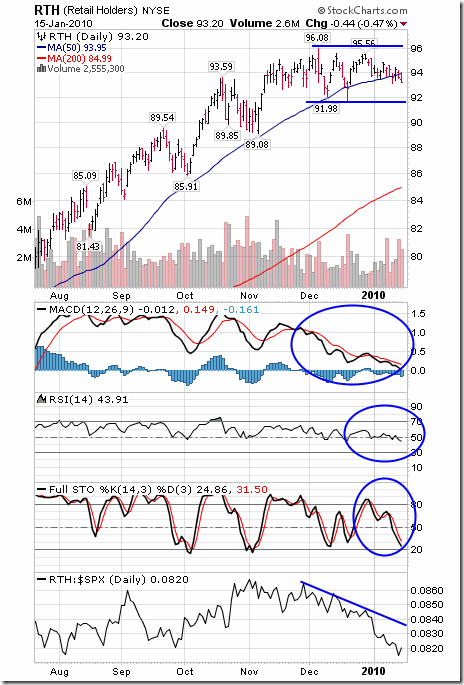
Thackray’s 2010 Investor’s Guide notes that the U.S. Retail Sector has a period of seasonal strength from January 21st to April 12th. The trade has been profitable in 16 of the past 20 periods for an average return per period of 8.5%. Annual recurring reasons for the period include growing sales during the traditional spring buying seasonal and (more recently) the spending of gift cards received during Christmas.
The seasonal trade is not recommended this year:
§ Retail sales have been hampered by weather conditions this winter. December 2009 retail sales declined mainly due to weather, the first decline during the Christmas buying season in several decades. Long term weather forecasts are predicting more of the same until spring.
§ Technical parameters for the sector are deteriorating. Retail HOLDRs, the most actively traded ETF in the sector peaked early in December and will form a double top pattern on a break below support at $91.57. Last week units fell below their 50 day moving average. Short term momentum indicators are trending down. Strength relative to the S&P 500 Index has been negative since November.
Don Vialoux has 37 years of experience in the Investment Industry. He is a past president of the Canadian Society of Technical Analysts (www.csta.org) and a former technical analyst at RBC Investments. Now he is the author of a daily letter on equity markets available free on the internet. The reports can be accessed daily right here at www.dvtechtalk.com.
Impossible! That’s what institutional investors say about “Timing the Market”. Mr. Vialoux will explain that, indeed, it can be done with the appropriate analysis. He also will explain why timing the market will be important during the next decade. Buy and Hold strategies are not working anymore; Investors are looking for alternatives. Mr. Vialoux will demonstrate four techniques that can be used to time intermediate stock market swings lasting 5-15 months. The preferred investment vehicles for investing in intermediate stock market swings are Exchange Traded Funds.
Comments in Tech Talk reports are the opinion of Mr. Vialoux. They are based on technical, fundamental and/or seasonal data that is believed to be accurate. The comments are free. Mr. Vialoux receives no remuneration from any source for these services. Comments should not be considered as advice to buy or to sell a security. Investors, who respond to comments in Tech Talk, are financially responsible for their own transactions.
-
I know Mike is a very solid investor and respect his opinions very much. So if he says pay attention to this or that - I will.
~ Dale G.
-
I've started managing my own investments so view Michael's site as a one-stop shop from which to get information and perspectives.
~ Dave E.
-
Michael offers easy reading, honest, common sense information that anyone can use in a practical manner.
~ der_al.
-
A sane voice in a scrambled investment world.
~ Ed R.
Inside Edge Pro Contributors

Greg Weldon

Josef Schachter

Tyler Bollhorn

Ryan Irvine

Paul Beattie

Martin Straith

Patrick Ceresna

Mark Leibovit

James Thorne

Victor Adair