
Daily Updates
Market Buzz – Building a Fortress
In a week in which we learned that the U.S. Reserve had decided to raise the rate it charges banks for emergency loans, known as the discount rate.
The Fed said the step should not be seen as a signal that it will soon boost interest rates for consumers and businesses, but investors’ initial reactions were one of worry that the days of ultra-low interest rates are coming to an end sooner than thought.
However, on Friday, stocks turned higher in late morning trading as investors (after further reflection) saw the Fed’s move as a vote of confidence that the financial system was recovering and that banks no longer need as much support.
In the U.S., the latter remains to be seen.
From our Canadian Small-Cap Universe (www.keystocks.com), this past week brought an unexpectedly strong fourth quarter from Fortress Paper Ltd. (FTP:TSX).
Fortress Paper is an international producer of security and other specialty papers. The company owns and operates two paper mills, the Landqart mill located in Switzerland and the Dresden mill located in Germany. Fortress’ security papers include banknote, passport, and visa papers.
This past week, the company announced that its revenues for the three months ended December 31, 2009, rose 10.16 per cent to $51.04 million from $46.33 million in the same period of the prior year. Fortress reported net income of $3.7 million for the fourth quarter of 2009, or diluted earnings per share of $0.35. For the fourth quarter of 2008, the company reported net income of $2.8 million, or basic and diluted earnings per share of $0.27.
Perhaps more importantly however, adjusted net income (excluding a loss on foreign exchange translation) for the fourth quarter of 2009 was $0.47 per share, well ahead of the consensus estimate of $0.29.
As the year progressed, the company’s mills have weathered the economic crisis and continually produced improving results, culminating for a record Q4.
We are happy to report that the stock is now up over 20 per cent in the past month and over 50 per cent in the past four months to new all time highs.
Looniversity – Avoid Fear and Greed
Volatility is inherent in the stock market. When investors lose their comfort level due to losses or market instability, they become vulnerable to the emotions of fear and/or greed, often resulting in very costly mistakes.
Try your best to avoid getting swept up in the dominant market sentiment of the day, which can be driven by either of these emotions, and stick to the basic fundamentals of investing. It is also important to choose a suitable asset-allocation mix. For example, if you are an extremely risk-averse person, you are likely to be more susceptible to being overrun by the fear dominating the market and therefore your exposure to equity securities should not be as great as those who can tolerate more risk.
One of the world’s most successful investors, Warren Buffett was once quoted as saying, “Unless you can watch your stock holding decline by 50 per cent without becoming panic-stricken, you should not be in the stock market.”
Mr. Buffett also showed us just how important and beneficial it is to stick to a plan in times like the dotcom boom. Buffett was once heavily criticized for refusing to invest in high-flying tech stocks. He stuck with what he was comfortable with: his long-term plan. By avoiding the dominant market emotion of the time – greed – he was able to avoid the losses felt by those hit by the bust.
Put it to Us?
Q. Can you give me an overview of a company’s balance sheet?
– Arthur Leung; Calgary, Alberta
A. A firm’s balance sheet is a snapshot of its financial picture on a given day. One side of the balance sheet totes up assets, moving from most liquid (cash) to least liquid (plant and equipment or goodwill). The other side of the balance sheet lists liabilities in order of immediacy.
Assets and liabilities are listed in order of liquidity (relative ease of convertibility to cash), from most liquid to least liquid, and are sectioned such that assets are on the left hand side and liabilities on the right hand side. For simplicity’s sake, think of a B/S as an indicator of net worth; that is, how much a company is worth “on the books.”
The balance sheet gives investors a general overlook of a company’s financial situation. That is, it tells investors exactly what a company owns (assets) and who they owe (liabilities). Essentially, the balance sheet is a report card of a company’s financial health at one point in time.
KeyStone’s Latest Reports Section
China-based Fertilizer Stock Produces Better-than-Expected Q3 and Ups Fiscal 2010 Revenue Guidance – Rating Maintained (Flash Update)
Strong Q2 2010 Revenue & EPS Growth, Aggressive Growth Plan, & Attractive Valuations Allow Us to Maintain Our BUY Rating on Alternative Financial Services Provider Despite 57% Gain in Six Months. (Flash Update)
Reiterate our SELL HALF Recommendation, HOLD Remaining Position for our Top 2009 Canadian Wireless Software Pick After Shares Jump over 250% (Flash Update)
Pure Play Chinese Construction Company, Strong EPS Growth, Growing Backlog, PE of under 8 – Initiate Coverage with BUY (New Buy Report)
Specialty Paper Manufacturer Posts Solid Q3, Announced Significant Production Expansion Plans & Inaugural ePassport Contract – Rating Upgraded (Flash Update)
The Money Talks Trading Challenge
Stockscores.com Perspectives for the week ending February 21, 2010
In this week’s issue:
- Weekly Commentary
- Strategy of the Week
- Stocks That Meet The Featured Strategy

I want to give you a little bit of incentive to read this week’s commentary.
You could win attendance to one of my upcoming Stockscores three day live trading classes. Or how about five ounces of gold, a 1.22 carat emerald, 75 ounces of silver or a $28,000 fishing trip provided by West Coast Fishing Lodge and VIH Helicopters?
Stockscores has partnered with the Money Talks radio show and Disnat to present the Money Talks Trading Challenge. Using the new Stockscores Trading Desk, this trading game is a way for you to improve your trading skills while competing for valuable prizes. And all proceeds from the game go to benefit the Special Olympics!
Just be entering, you will be eligible for a random draw that gives away a seat at one of my three-day trading classes in Toronto, Calgary or Vancouver. We do this draw on Mar 13th so make sure you sign up for the game soon.
For the other prizes, you will have to prove your trading prowess, here is how the game works.
Very simply, you earn points in this game based on the performance of the trades that you make. This is not a portfolio challenge so there is no set amount of cash to work with. You buy and short sell stocks and earn a TradeScore for each trade you make.
You are ranked in the game based on your average TradeScore. The ranking is based on a minimum of 10 trades so if you have done less than 10 trades, your ranking will suffer.
How are the TradeScores calculated? The calculation is based on three factors important to determining your trading success:
- Percentage Gain/Loss – how much the stock goes up or down from the time you enter till you exit. A higher, positive gain is better.
- Hold Period – how many days you hold the position. Since time is money, it is better to get a good return in a short time period.
- Reward for Risk – how much capital you risked to earn the return you achieved.
- Risk Multiple – you can choose to put more risk on some trades than others up to a maximum of give times your risk tolerance.
The Reward for Risk component requires that we know the downside risk you are willing to take on any trade. This is based on where you place a stop loss point when you make your trade. If you buy a stock at $10 with a stop loss point at $9, your risk is $1. If you end up exiting that trade at $12, you have earned $2 of reward for $1 of risk, or a 2 for 1 reward for risk ratio. If you get stopped out at $9, you have earned a reward for risk ratio of minus 1.
Every trade requires you enter a stop loss order so that we can calculate this Reward for Risk ratio. With a buy order, you can choose to set your stop as low as $0 but that will hurt your TradeScore since you will end up getting a low Reward for Risk ratio. The trader that buys a stock at $10 with a stop loss at $0 and exits at $12 has $10 of risk for $2 of gain for a 0.2 Reward for Risk Ratio.
A higher Reward for Risk ratio will improve your TradeScore. We calculate the TradeScore based on the following formula:
Absolute Value of the Percentage Gain or Loss times 252/Hold Period in Day (with a minimum of 5 days) times Reward Score times 100 times the Risk Multiple.
The Reward Score ranges from – 8 to + 8 and is awarded based on the Reward for Risk ratio. It is explained in the Measuring Performance area of the How to Play document which you should read here.
Let’s show how the TradeScore is calculated with an example.
If you enter a stock at $5 with a stop loss at $4.50 with a Risk Multiple of 2 and 8 days later you exit that stock at $7.20, what TradeScore would you earn?
Your risk is $0.50 and your reward is $2.20 making your Reward for Risk ratio 4.40. This gives you a Reward Score of 3.
The percentage gain on the trade is 44% ($2.20 gain on a $5 stock)
The hold period is 8 days.
The Risk Multiple is 2.
So, the TradeScore is .44 times 252/8 times 3 times 100 times 2 = 8316
This is an excellent TradeScore because the trade earned a very high percentage return in a very short time and also had a good reward for risk ratio.
What if the trade had been exited at $6 instead of $7.20? Then the percentage gain would only be 20% and the reward for risk 2, giving a TradeScore of 2520.
Of course, losing money on a trade will give a negative TradeScore and that will hurt the overall ranking. When we calculate your average TradeScore, we add up all Tradescores from your individual trades and divide by the number of trades you have made, using a minimum of 10 for the average.
At the end of the game, the people with the highest average TradeScores will win the prizes.
Why play a game like this? There are many reasons, here are some that I can think of:
- it is better to learn good trading techniques in a game than using real money. If you can do well in the game then you may be ready to trade the real market.
- playing in the game allows you to see what other players are doing and you may learn something from those leading in the game.
- be part of a community of traders. As the number of players grows there will be a community of traders to share trading ideas with. Any time you make a trade, you can post a comment on why you are doing the trade and others who are trading the same stock can do the same. You can only make a comment on a stock if you have a position in it, allowing for accountability on the trades you make.
- it is fun!
- it is for a good cause! The proceeds from your $19 entry fee goes to the Special Olympics.
Registering to Play
Signing up to play the Money Talks Trading Challenge is easy. Simply click on this link to get started. Then click on the Register Here button near the top of the page.
You will be prompted to set up an account for the Challenge. If you already have a Stockscores.com account, you will go through a process to convert your Stockscores Username to your email address. You must go through this process before you can log in to the Challenge using your email address. From that point on, you will log in to the Challenge and Stockscores.com using your email address as your Username.
I recommend you go through the How To Play document that can be found on the Trading Challenge tab once your account is set up. There are a few videos in that document to help get you started.
While it would be great to win a few thousand dollars worth of Gold for winning the game, the benefit of improving your trading skills could have a far greater impact on your long term success in the market. We want to help make you a better trader so you can pull more profits out of the market, the Money Talks Trading Challenge is a good way to get started!

Let’s look at how the TradeScores would be calculated on two trades from the Stockscores Daily Newsletter. We’ll compare a winner and a loser. What you should notice is that the TradeScore for the winner is very large but the loser relatively small. This is because the use of stop loss points limits the downside risk while patience with a winner allows the profits to grow.

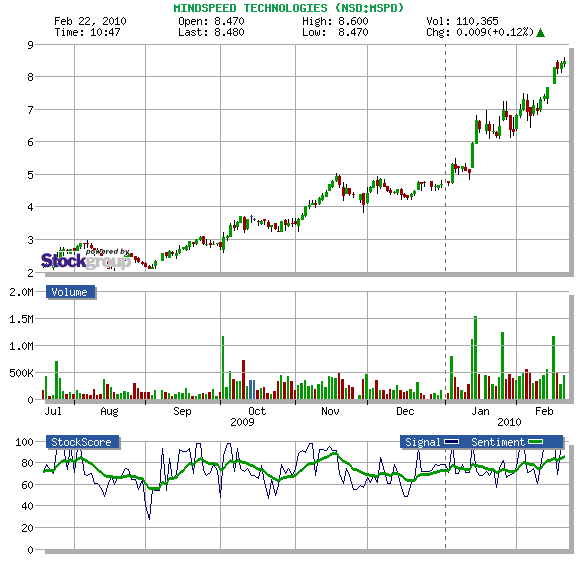
1. MSPD
MSPD was selected on July 29th at $2.69. The stop loss was at $2.07 so the risk on the trade was $0.62. On Friday, about 155 trading days later, the stock closed at $8.47. That is a 215% gain. Still no reason to exit, but because the trend has gone parabolic, it should be watched closely for an exit signal. The resulting TradeScores, assuming a risk multiple of 1, is 2800.
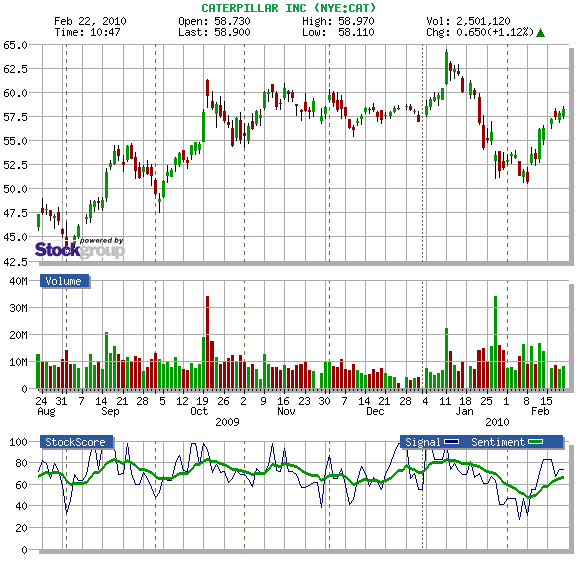
2. CAT
CAT was featured on January 11th at $64.13. Seven days later it was stopped out at $56.99 for an 11% loss. Since it was stopped out at the original stop loss point, it earned a minus 1 reward for risk. The resulting TradeScore is about 400.
Click HERE if you want to learn from some of the timeless advice from some of worlds best traders including the very successful Tyler Bollhorn.

Tyler Bollhorn started trading the stock market with $3,000 in capital, some borrowed from his credit card, when he was just 19 years old. As he worked through the Business program at the University of Calgary, he constantly followed the market and traded stocks. Upon graduation, he could not shake his addiction to the market, and so he continued to trade and study the market by day, while working as a DJ at night. From his 600 square foot basement suite that he shared with his brother, Mr. Bollhorn pursued his dream of making his living buying and selling stocks.
Slowly, he began to learn how the market works, and more importantly, how to consistently make money from it. He realized that the stock market is not fair, and that a small group of people make most of the money while the general public suffers. Eventually, he found some of the key ingredients to success, and turned $30,000 in to half a million dollars in only 3 months. His career as a stock trader had finally flourished.
Much of Mr Bollhorn’s work was pioneering, so he had to create his own tools to identify opportunities. With a vision of making the research process simpler and more effective, he created the Stockscores Approach to trading, and partnered with Stockgroup in the creation of the Stockscores.com web site. He found that he enjoyed teaching others how the market works almost as much as trading it, and he has since taught hundreds of traders how to apply the Stockscores Approach to the market.
References
Get the Stockscore on any of over 20,000 North American stocks.
Background on the theories used by Stockscores.
Strategies that can help you find new opportunities.
Scan the market using extensive filter criteria.
Build a portfolio of stocks and view a slide show of their charts.
See which sectors are leading the market, and their components.
Disclaimer
This is not an investment advisory, and should not be used to make investment decisions. Information in Stockscores Perspectives is often opinionated and should be considered for information purposes only. No stock exchange anywhere has approved or disapproved of the information contained herein. There is no express or implied solicitation to buy or sell securities. The writers and editors of Perspectives may have positions in the stocks discussed above and may trade in the stocks mentioned. Don’t consider buying or selling any stock without conducting your own due diligence.
Ed Note: a small selection of the 41 Charts Analysed on Don Vialoux’s Tuesday Morning comment HERE.
The Bottom Line
The recent recovery is a start of an intermediate move by North American equity markets that is expected to last until May. However, equity markets quickly have become short term overbought. Preferred strategy is to purchase equities and Exchange Traded Funds on weakness in sectors with favourable seasonality including silver, platinum, mines & metals, oil services, energy and materials.
….read more and view the 40+ charts HERE.
Don Vialoux has 37 years of experience in the Investment Industry. He is a past president of the Canadian Society of Technical Analysts (www.csta.org) and a former technical analyst at RBC Investments. Don earned his Chartered Market Technician (CMT) designation from the Market Technician Association in 1995. His CMT paper entitled “Seasonality in Canadian Equity Markets” was published in the Spring-Summer 1996 edition of the MTA Journal. Don also has extensive experience with Exchange Traded Funds (also know as Index Participation Units) as well as conservative option strategies. In 1990 he wrote a report that was released in the International Federation of Technical Analyst Journal entitled “Profiting from a Combination of Technical and Fundamental Analysis”. The report introduced ” The Eight Phases of the Stock Market Cycle”, an investment concept that continues to identify profitable entry and exit points for North American equity markets. He is currently a member of the Toronto Society of Fundamental Analyst’s Derivatives Committee. Now he is the author of a daily letter on equity markets available free on the internet. The reports can be accessed daily right here at www.dvtechtalk.com.

Update:
If a picture is worth a thousand words than this 33-year chart on the U.S. Treasury 30-year bond is a “book” load of information. There’s really no doubt that declining interest rates were the driving force behind the growth in financial assets. A generation of investors have been weaned on this but now face what I believe can be a “once-in-a-lifetime” epic reversal of fortune. One of the last things anyone should do (besides bet on the gold perma bears who are set to be crushed yet again) is to look to buy U.S. debt instrumentals here with maturities past 1-2 years.
….read Peter’s opinion on Gold and Equities HERE.
On Major Moves, Grandich has been very right and not only saved many investors fortunes, but expanded them dramatically. On November 3, 2007 at the MoneyTalks Survival Conference, Peter Grandich of the Grandich Letter warned that “an unprecedented economic tsunami will hit American beginning in 2008”. Peter advised publicly to short the US market two days from the top in October, 2007 and stayed short until the last week of October, 2008. He began to buy stocks in March 7th, 2009. He also bought oil and oil related investments near the lows after the dive from $147.
….go to visit Peter’s Website.
Quotable
If all we talk about is money, nothing will be funny, honey
And now that everyone’s a critic, it’s makin’ my mascara runny
If we only talk about the heavens, makin’ it together is crazy
If we don’t get a new situation for our destination we’re lazy
But it’s gonna be, it’s gonna be
Please make it be, it’s gonna be
Now if a princess becomes human, stoner on the talk show you’re ruined
Cause there’s a fine line between a skewer and a decent sense of humor…
It’s Gonna Be, Norah Jones
FX Trading – Keeping it simple! Euro versus the US dollar…
Winston Churchill once said: “Nowhere is more nonsense talked than by currency experts about foreign exchange.” We are in total agreement, and unfortunately guilty as charged, even though we do our best to spew a minimum of nonsense.
…..read more HERE.
-
I know Mike is a very solid investor and respect his opinions very much. So if he says pay attention to this or that - I will.
~ Dale G.
-
I've started managing my own investments so view Michael's site as a one-stop shop from which to get information and perspectives.
~ Dave E.
-
Michael offers easy reading, honest, common sense information that anyone can use in a practical manner.
~ der_al.
-
A sane voice in a scrambled investment world.
~ Ed R.
Inside Edge Pro Contributors

Greg Weldon

Josef Schachter

Tyler Bollhorn

Ryan Irvine

Paul Beattie

Martin Straith

Patrick Ceresna

Mark Leibovit

James Thorne

Victor Adair