
Daily Updates
THE CASTLEMOORE INVESTMENT COMMENTARY
You beta believe.
A stock’s beta (β) is a measure of its sensitivity to movements in the market on which it trades. For instance, if the TSX rises (declines) by 1%, a stock that trades on that market that has a beta of, say, 1.1 would be expected to rise (fall) by 1.1%. If it rises (falls) by more than this, the excess is considered to be its alpha, or extra-market return. The pursuit of alpha is the target of any actively-managed equity portfolio.
Interesting aspects of beta:
– beta is not a stock’s coefficient of correlation, as some believe. A stock can (theoretically) have a correlation of a 1, the highest value possible, and still have a low beta.
– beta is used as a measure risk of a particular security. For instance, a security’s or portfolio’s nominal return divided by its beta is its risk-adjusted rate of return. Just because a particular stock outperformed or underperformed the market on which it trades doesn’t mean it did so on a risk-adjusted basis. This is a fundamental mistake many investors make when using an index like the TSX as a benchmark.
– the average beta for every stock that trades on the market must equal 1.
– portfolio managers whose mandate is to be invested in stocks but who expect a market decline can lessen the impact of the decline—reduce risk if you will—by lowering the beta of the managed portfolio. This is done by either swapping out high beta stocks and swapping in low beta stocks, or, if the option is available to them, using the exchange-traded options that are available to them.
– beta is generally calculated using linear regression. This is done one of two ways: allowing for alpha (and a y-intercept for the regression line) or under the assumption of no alpha. The average alpha for all stocks that trade on a market is zero, therefore the second approach is generally the better one. If you need to know more about it, contact us.
At CastleMoore we like to know the betas of all stock we are considering investing in. For instance, if two stocks have similar betas but one offers more liquidity than the other, then we would consider this in our deliberation (and almost always results in opting for the liquidity).
Fortunately, we have the advantage of not being required to have any level of exposure to the market.
The problem with using beta is that that the value you get depends on the period and frequency of the data used, i.e monthly prices or weekly? Two years or five years? As long as both parameters are kept constant for all securities measured, the results should have more or less the same level of usefulness. The larger issue stems from the fact that a recent measure of beta may differ significantly from the longer term one. We might expect that betas decline over time as the underlying company matures and its expected growth rate tapers off. But rising betas should be investigated.
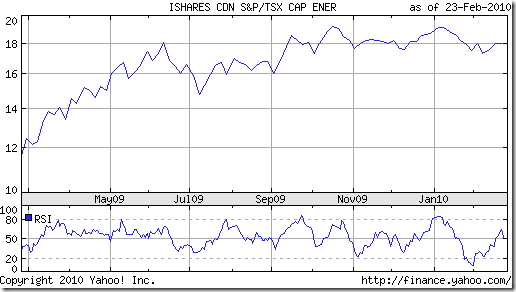
The energy sector has been showing relative strength of late, compared both other sectors, as determined by our weekly momentum tables and versus its own trading pattern (see below). Two ways of playing this—and we have done both—is to buy shares of the XEG ETF, which is comprised of oil producers, and/or shares of an attractive oil services company.
WEBINAR ANNOUNCEMENT WEBINAR SERIES – Beyond Bullmanship Presenation #2 (of 3)
Monday, March 1 at 7PM est & at 6PM pst
SIGN UP http://www.castlemoore.com/investorcentre/signup.php.
CastleMoore helps people manage their life savings. We are not stock brokers or mutual fund salesmen. We are discretionary investment managers specializing in “buy low, sell high” strategies instead of “buy and hold” strategies like all the others.
Our competition is the stock brokerage industry, the mutual fund industry and the “value” or “growth” money managers like, RBC Private Counsel, BMO Harris Private Banking, TD Asset Management or CIBC Wood Gundy Consulting.
At CastleMoore we manage our clients’ investments through a methodical and disciplined set of systems that removes individual bias and emotion from the investment process. What we do works. We rely heavily on loss avoidance techniques based firstly on supply and demand analysis; secondly, on the traditional approach.
Our clients are investors that have little tolerance for investment losses. They expect to get their money’s worth, and appreciate CastleMoore’s all-inclusive and comprehensive fee schedule. If we are required, because of dangerous markets, to be more active, CastleMoore bears the extra cost of the more frequent transactions.
Special offer from Mark Leibovit for Money Talks only: The intense analysis of Gold in the 10-12 page The VR Gold Letter is right now 75% off for the first month or $29.95 (regularly $125.00 a month). The weekly VR Gold Letter focuses on Gold and Gold shares.Go HERE and use the Money Talks promo code CBC12210

Stock Action Alert:
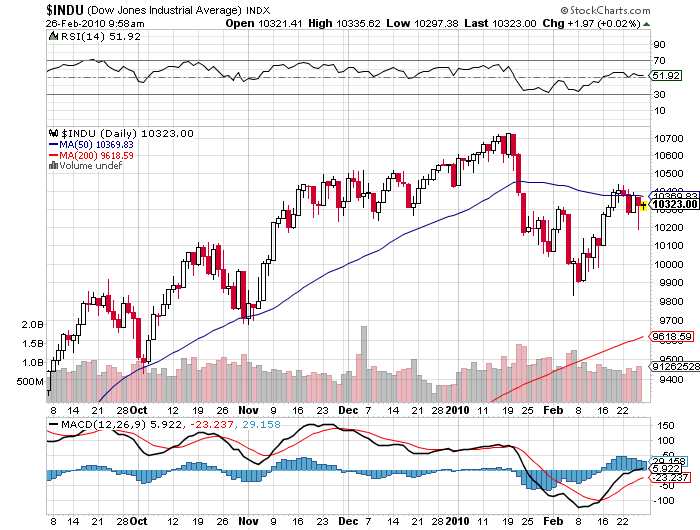
The stock market fell sharply yesterday morning after more dismal economic news, including a 0.6% decline in durable goods orders excluding the volatile transportation sector and another rise in jobless claims. But the market slowly worked its way back at the same time as the US Dollar fell, which helped commodity stocks and the rest of the market recover from deep losses. By the end of the day, the Dow Industrials, which had been down as much as 188.33, fell just 53.13 to 10321.03. The S&P was down just 2.31 to 1102.93 and the NASDAQ fell an even smaller 1.68 to close at 2234.22.
Tuesday’s Negative Volume Reversals (r) are the still most important short-term directional indicator. Though I sold SDS (the double-inverse ETF for the S&P 500) yesterday near market lows, we still be well-advised to look for another entry point with the thought that my often mentioned mid-March low is still looming out there. Today and Monday intersects a short-term ‘cycle change point’ in my work, so the market could easily reverse right back to the downside, despite yesterday’s sharp intra-day rally. Where is the positive upside volume to confirm a bottom? I am awaiting a sign.
The more time that passes and the more the February 5 lows hold, the more bullish the markets! That’s the bottom line.
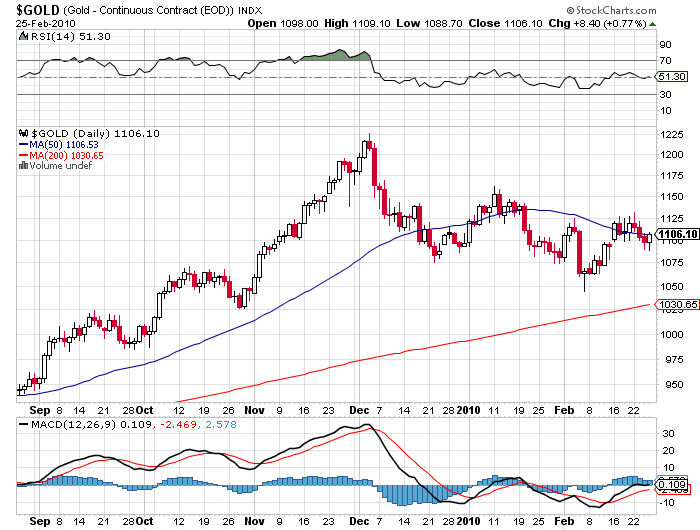
Interestingly, it was Gold that led the market off its lows yesterday, confirming once again that those who believe Gold and stocks move in opposite directions need to go back to trading and investing school. What is good for the goose is also good for the gander. Basically, the same factors that influence a strong stock market are the same factors that influence a strong commodity market and Gold market.
Charts via MoneyTalks
The weekly VR Gold Letter focuses on Gold and Gold shares. The letter is available to Platinum subscribers for only an additional $50 per month and to Silver subscribers for only $70 per month. Email me at mark.vrtrader@gmail.com.
Special offer from Mark Leibovit for Money Talks only: The intense analysis of Gold in the 10-12 page The VR Gold Letter is right now 75% off for the first month or $29.95 (regularly $125.00 a month). Go HERE and use the Money Talks promo code CBC12210
Marks VRTrader Silver Newletter covers Stock, TSE Stocks, Bonds, Gold, Base Metals, Uranium, Oil and the US Dollar.
More kudos – Mark Leibovit was named the #1 Intermediate Market Timer for the 10 year period ending in 2007; the #1 Intermediate Market Timer for the 3 year period ending in 2007; the #1 Intermediate Market Timer for the 8 year period ending in 2007; and the #8 Intermediate Market Timer for the 5 year period ending in 2007. NO OTHER ANALYST SURVEYED APPEARED IN ALL FOUR CATEGORIES FOR INTERMEDIATE MARKET TIMING AS PUBLISHED IN TIMER DIGEST JANUARY 28, 2008!
For a trial Subscription of The VR Silver Newsletter covering Stocks, Bonds, Gold, US Dollar, Oil CLICK HERE
The VR Gold Letter is available to Platinum subscribers for only an additional $20 per month, while for Silver subscribers the price is only an additional $70.00 per month. Prices are going up very shortl, so act now! Separately, the VR Gold Letter retails for $1500 a year! The VR Gold Letter is published WEEKLY. It is 10 to 16 pages jam-packed with commentary and charts. Please call or email us right away. Tel: 928-282-1275. Email: mark.vrtrader@gmail.com .
What do contrarian investment advisor Marc Faber, billionaire George Soros and super investor Jim Rogers have in common? Well, all of them are bullish on either one or more classes of commodities.
Prices of many commodities, especially metals, energy and bullion have been on an upward trend despite the global financial downturn.
On the Dubai Gold and Commodities Exchange (DGCE), the total trade volume jumped 300 per cent year-on-year to reach 153,747 contracts last month.
Commodities in general are currently being influenced by outside macro-economic factors and not necessarily by supply and demand fundamentals.
….read more HERE
On Jan 28, just last month, George Soros, in an interview with Davos Man, said that gold is due for a fall. At the World Economic Forum in Switzerland he said, “When interest rates are low we have conditions for asset bubbles to develop and they are developing at the moment. The ultimate asset bubble is gold.” His quote immediately hit the headlines and people believed.
George Soros made over one billion dollars in 1992 from short-selling the UK pound sterling, outwitting the UK government. When Soros speaks people listen. The moment George Soros said that gold is now the current and ultimate asset bubble, inept fund managers and inexperienced investors went crazy and traded down their gold within a week to a very low level. The gold price went down to almost the same level as in October 2009, which is $1,050 an ounce.
I have been writing posts about gold and encouraged friends and families to start buying gold here and there whenever they can but many have been very skeptic and even ignorant as, unlike Asians, many fail to see the real money value of this precious metal. Others just don’t understand what to do with physical gold once they buy it. When they read of George Soros quote, it not only gave them great confidence of not buying gold, some even sold the gold that they had already had and was proud about it.
But despite all the gold bubble talk, there was one shrewd investor who still bought gold and in fact even doubled his gold investment – George Soros!
….read more HERE.
nvestment guru Marc Faber says there’s a 30 percent chance that China’s “soft landing” will turn into a crash-and-burn, taking most commodities with it.
“I think to some extent (China) is a bubble,” said Faber, the editor of “The Gloom Boom & Doom Report.”
“Last year, total loans by banks have increased by a quarter of GDP. In addition to this they have large excess capacities across industrie,” he told the Smart Investor.
Faber says he expects the Chinese economy will slow down considerably.
“The bigger question is that, ‘Will It Crash?’” he asks. “To that, my answer is: ‘Yes, That Is Also Possible.'”
….read more HERE
-
I know Mike is a very solid investor and respect his opinions very much. So if he says pay attention to this or that - I will.
~ Dale G.
-
I've started managing my own investments so view Michael's site as a one-stop shop from which to get information and perspectives.
~ Dave E.
-
Michael offers easy reading, honest, common sense information that anyone can use in a practical manner.
~ der_al.
-
A sane voice in a scrambled investment world.
~ Ed R.
Inside Edge Pro Contributors

Greg Weldon

Josef Schachter

Tyler Bollhorn

Ryan Irvine

Paul Beattie

Martin Straith

Patrick Ceresna

Mark Leibovit

James Thorne

Victor Adair