
Daily Updates
Ed Note:
Is it the right time to buy gold?
20 Reasons spelled out why it might be time HERE :
Got Gold Report – Big Gold Shorts Covering Again
This week’s Radar Screen
The purpose of the Radar Screen is to briefly summarize our positioning for the gold and silver markets, and also to highlight one, two or maybe even three of the dozens of indicators, ratios and graphs we keep in constant touch with at Got Gold Report. Long-time readers know we update most of the Got Gold Report linked charts each week, even the weekends when we don’t publish the full report.
For a little while longer, readers need only pull up the last full report and click on the chart links on “off weeks” to see any updated comments. Changes are almost always completed by 6:00pm EDT on Sunday evening and occasionally during the week itself as events unfold.
At some point in the near future, however, all of the chart links will have to change as we transition to a new permanent web home for the Got Gold Report, which should allow for a lot more of our analysis to be available for our valued readers. And, in a more timely, more immediate fashion. We’ll have more about that soon, hopefully, so stay tuned!
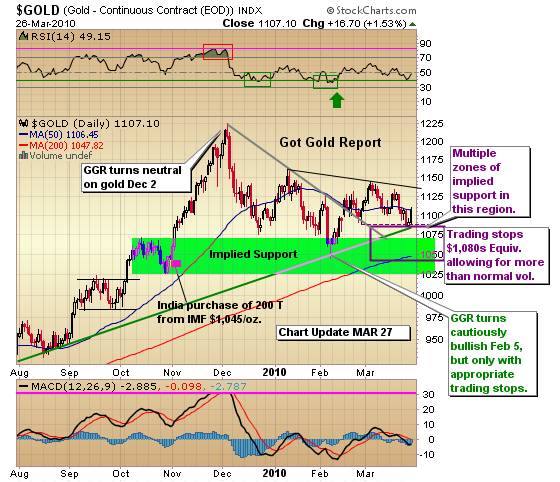
Back to this week’s Radar Screen: Having returned to the gold bullish camp on February 5, with gold then in the $1,050s, we began the last full report two weeks ago with: “We remain long gold and silver, currently with trading stops equivalent to the minor-profit low $1,080s for gold and the no-loss $15.90s-equivalent for silver. We are still of the mindset to allow for more than normal volatility with these fledgling trades, but we are unwilling to allow our “winners” to become losers and will step to the sidelines if stopped.”
That’s where we remain positioned as of March 26, but we will likely be raising stops for the silver portion of the trade later this week – if and only if silver regains and holds the $17s. The particulars are in the linked graphs below.
Otherwise we are comfortable with our positioning, which allows us to participate should gold and silver advance, but gets us out with minor profits or at least no loss if the Trading Gods are not yet with us.
This week we first want to call attention to what we see as interesting changes in one of the most important indicators in our gold arsenal, the positioning of the largest of the largest gold futures traders in North America. Then, we’ll take a look at the latest move higher for the U.S. dollar in a longer-term context. Then, finally we have a few comments on the Commodities Futures Trading Commission (CFTC) open meeting held Thursday, March 25, but first, here’s the short-term gold graph:
….view bigger chart and read more HERE
The Investing Secrets of Warren Buffett
Investing icon Warren Buffett is known for the market-beating returns that his company, Berkshire Hathaway Inc. (NYSE: BRK.A, BRK.B), has returned over the past few decades. His success is due to some very simple investing strategies that he adheres to religiously.
10 of his best HERE
Also Check Out:
Playing ‘Follow the Guru’ Can Be Fun – and Profitable
If you wanted to distill all the world’s best investment advice down into a single sentence, the result would actually be fairly simple:
- Just do what Warren Buffett does.
- Or what George Soros doess
- Or what Peter Lynch does (or did).
In short: Follow the guru. That’s not just a clever phrase. In fact, if you picked any of the investment world’s living legends and copied what they did, odds are you’d be pretty successful over time, regardless of the general market environment during any given short-term period.
….read more HERE
Comment from Chris Vermulen
I think many of you will find this article interesting as I show several different indicators which point to an imminent correction for stocks and precious metals.
….read it all HERE
Comment from Richard Russell Dow Theory Letters – Interesting — The Dow has been higher 14 out of the last 18 days. I’d say it was overbought.
Comment from Mark Leibovit week of March 22-26
Gold is oversold and some positive upside volume has materialized (as noted below in GLD). Traders should now be long with stops under last week’s lows (on a closing basis only). Cyclical work still calls for the potential of a huge upward spike in Gold over the next several weeks which could carry Gold back to or through the December highs. Realize, however, that it will take more evidence to confirm such a move, i.e. a breakout in Spot Gold above 1146.20, so stay tuned!
Special offer from Mark Leibovit for Money Talks only: The intense analysis of Gold in the 10-12 page The VR Gold Letter is right now 75% off for the first month or $29.95 (regularly $125.00 a month). The weekly VR Gold Letter focuses on Gold and Gold shares.Go HERE and use the Money Talks promo code CBC12210

Up More Than 100% In Just Over A Year!
A little over a year ago, famed newspaper columnist Dan Dorfman of The Huffington Post phoned to ask me what other Asian economy I would invest in besides my favorite, China.
My response: “It’s a no-brainer Dan, India!”
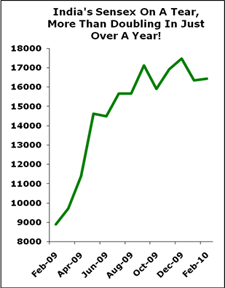
At the time, India’s Sensex, the equivalent of our Dow Jones Industrials, was gyrating between 8,300 and 9,300. And the world was frighteningly worried that both China and India were going to collapse as a result of the financial crisis.
I wasn’t concerned. After all, I told Dan, India had already proven itself to be one of the hottest economies on the planet and still held tremendous longer-term profit potential for investors.
Today, as I pen this column, India’s Sensex is trading at 17,451 — up more than 100% since the low end of its range just over a year ago.
Many analysts and investors are still worried about India. Not me.
A. India’s economy is growing at about 7.2%. True, that’s down from the 9% growth of a couple of years ago, and India’s central bank is a bit worried about inflation, which is why it recently raised interest rates.
But 7.2% growth is still pretty torrid, more than eight times faster than the U.S. and just behind China’s still blistering growth.
The Indian economy is not merely outgrowing the U.S. by leaps and bounds; along with China, it’s one of the two major demand forces at the epicenter of the natural resource markets.
The economic growth, and the country’s influence in the natural resource markets should hardly be surprising when you consider …
B. India has the fastest-growing population in the world. Its population is adding 16 million new people per year. At that rate, India’s population will exceed 1.4 billion people and be larger than China’s by 2030.
What’s more, per-capita income in India has risen steadily and dramatically over the past five years, from roughly $285 in 2003 to about $1,000 today.
That’s a per-capita increase of more than 250% in seven years, for an average gain in incomes of about 35% per annum!
True, India’s per-capita income is still way below China’s urban per- capita income of $2,525, but incomes in India are growing faster than they are in China.
Moreover, many longer-term studies suggest that India’s per-capita income can eventually reach as much as six times that of China.
The chief reason, in my opinion: More than 21% of India’s population is English-speaking, whereas in China, less than 0.80% of the population speaks English.
Imagine what the world will be like ten or twenty years from now when the size of China’s economy is on the verge of surpassing the U.S. — AND there are 1.4 billion people in India who on average earn six times more than their industrious neighbors in China!
C. India is investing huge amounts of capital in the country’s infrastructure. India’s infrastructure is years, if not decades behind the rest of Asia, not to mention the West. And it’s the main impediment to India’s growth — today, and for the future.
But India isn’t sitting still. It’s pouring hundreds of billions of dollars into fixing dilapidated roads and highways, building new ones, erecting new power plants, shipping ports, high-speed railroads, as many as six new airports, 12 new industrial centers, and more, much more.
Indeed, just last week, India’s Prime Minister Manmohan Singh announced the government intends to more than double its $500 billion commitment to infrastructure investments — to a whopping $1 TRILLION — over the next five years.
D. India’s manufacturing sector now accounts for almost 30% of its economy. When most analysts and investors think of India, they think of agriculture, textiles, and usually its famed information technology service industry, which handles the outsourcing for hundreds of U.S.-based computer hardware and software manufacturers and telecoms.
But in fact, India is emerging as a global, diversified manufacturing hub.
Indeed, the single largest employer in India is not the commonly mentioned service sector, but the manufacturing sector, which now employs more than 100 million people, more than 25% of the total employed in India.
And according to the United Nations Industrial Development Organization (UNIDO), on a global basis India is …
- Now ranked fourth after China, the U.S. and Italy in textile manufacturing …
- Fifth in the world in manufacturing electrical machinery and apparatus ….
- Sixth in basic metals … seventh in chemicals and chemical products … and tenth in leather, leather products, refined petroleum products and nuclear fuel.
Moreover, according to recent data from India’s Central Statistical Organization, India’s manufacturing output reached $46.42 billion in the July-September 2009 quarter, a gain of 9.4% over the same period a year earlier.
Indeed …
E. India’s corporate earnings this year are projected to grow an astounding 27%. Corporate earnings growth does not always guarantee higher stock prices. But it sure can help. And 27% corporate earnings growth, even if it turns out to be half that, is terrific, given all the other long-term fundamental forces converging to drive India’s economy forward.
Growth in India? It’s here to stay. India is a country to invest in, long-term. Just in its own right.
But there’s another reason I like India …
Like China, India’s Need
For Natural Resources Is Huge
India does have some essential natural resources of its own, but not much and certainly not enough to keep pace with rapidly escalating demand driven by its vigorous economic growth.
For instance …
- India’s steel industry is averaging growth of about 8% a year as demand nearly doubles from the current level of 36 million tons of steel per year to 65 million tons by 2012. That means huge consumption of iron ore.
- India’s copper consumption stands at about 2.5% of world consumption and even less than China’s per capita consumption. But India has already had to rely on copper imports to meet demand.
- As India’s emerging middle class rises, copper will meet much the same fate as it has in China. Huge demand that can push copper prices to the moon.
- Coal dominates India’s energy supply, providing more than half of its power. India’s coal consumption is expected to increase 20% in just the next two years.
- India’s per-capita consumption of aluminum is less than one kilogram per year. India’s aluminum consumption can be expected to climb sharply, perhaps even more than copper.
- And then there’s oil demand. Oil provides about 30% of India’s total energy consumption, and the country’s net oil imports already run at more than 2 million barrels a day.
- Oil consumption in India is expected to rise sharply, effectively DOUBLING over the next two years to 4 million barrels a day.
Everyone talks about the China factor when it comes to oil prices. But once Indian demand starts to really press on oil, watch what happens to the price of black gold.
My view: India, like China, is one heck of an economy to bet on going forward. Not only for its growth potential, but also because of its impact on the natural resource markets.
So even though in the short term, India’s Sensex is vulnerable to pullbacks, I’d be a long-term buyer on dips.
My favorite longer-term ways to own a piece of India …
1. Morgan Stanley India Investment Fund (IIF), a closed-end fund with an objective of long-term capital appreciation, and holdings that run the gamut from energy to agriculture, to mining, pharmaceuticals, telecommunications, building materials, and more.
This is a no-load fund, and its overall fees run about 1.4% per annum, less than the sector’s 1.9% average.
2. India Fund (IFN), another closed-end fund that is diversified across various industry sectors, and that seeks long-term capital appreciation. Total fees about 1.33%.
3. WisdomTree India Earnings Fund (EPI), an Exchange Traded Fund that tracks the performance of 187 of India’s top companies.
Best wishes,
Larry
P.S. If you’re not yet a Real Wealth Report subscriber, you can pick up an annual subscription — with 12 hard-hitting monthly issues … all flash alerts … and special reports for a mere $99 a year. That’s just 27 cents a day!
This investment news is brought to you by Uncommon Wisdom. Uncommon Wisdom is a free daily investment newsletter from Weiss Research analysts offering the latest investing news and financial insights for the stock market, precious metals, natural resources, Asian and South American markets. From time to time, the authors of Uncommon Wisdom also cover other topics they feel can contribute to making you healthy, wealthy and wise. To view archives or subscribe, visit http://www.uncommonwisdomdaily.com.
Trade of the Decade: Sell Everything
03/29/10 Laguna Beach, California – In the January 4th edition of The Daily Reckoning, Bill Bonner offered his new Trade of the Decade: Sell long-dated Treasury bonds, buy deep-value Japanese stocks. Your California editor agrees wholeheartedly with the first half of this trade, but has a different suggestion for the second half…and he shared these views in a recent presentation to the Investment University Conference in San Diego, California, which occurred on St. Patrick’s Day.
What follows is a lightly edited transcript of that presentation…
Happy St. Patrick’s Day to everybody. I have only one clean Irish joke to share with you, and here it is: What’s Irish and sits on your lawn? Patty O’Furniture.
That’s all I got.
Anyway, I wish the Luck of the Irish to everyone here today…as well as the luck of the French…the Swedish…the Latvians…the Brazilians…and the luck of every other nation on the planet…because I think we might need it.
As regular Daily Reckoning readers may know, I just rejoined the crew about five months ago. I originally wrote The Daily Reckoning with Bill Bonner near its inception. He started it in 2000; I joined him in 2001. I wrote it with him until 2005 and then I split off for a few years and wrote The Rude Awakening, and then rejoined him a few months ago.
So about 10 years ago, when I first started working with Bill, he came up with this idea for a Trade of the Decade. It was really just a literary device. But it ended up being a brilliant investment call. Everyone loved stocks at the time; and everyone hated gold. So Bill just took the other side of both trades: Sell stocks and buy gold.
This Trade of the Decade provided a great thematic backdrop for everything we would write about during the ensuing 10 years. We would write about the coming housing bust, about runaway government deficits and about lots of other things that provided absolutely no reason whatsoever to buy stocks, but plenty of reasons to buy gold.
For good measure, we would also write about the scoundrels on Wall Street and about the hazards of leverage. And every once in a while, we would write about the hazards of leverage in the hands of the scoundrels on Wall Street. And that was yet one more reason not to buy stocks.
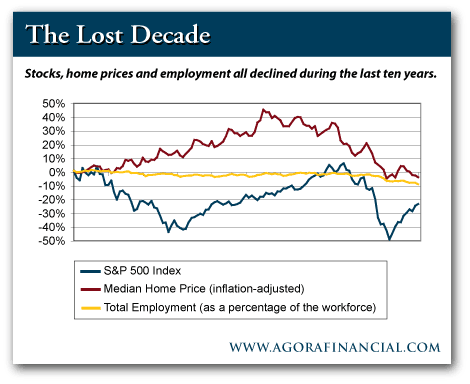
So here’s a picture of the last 10 years in a nutshell: you can see that gold performed very well and that stocks did not. In fact, stocks delivered a negative return.
….read the other 3/4 commentary HERE
-
I know Mike is a very solid investor and respect his opinions very much. So if he says pay attention to this or that - I will.
~ Dale G.
-
I've started managing my own investments so view Michael's site as a one-stop shop from which to get information and perspectives.
~ Dave E.
-
Michael offers easy reading, honest, common sense information that anyone can use in a practical manner.
~ der_al.
-
A sane voice in a scrambled investment world.
~ Ed R.
Inside Edge Pro Contributors

Greg Weldon

Josef Schachter

Tyler Bollhorn

Ryan Irvine

Paul Beattie

Martin Straith

Patrick Ceresna

Mark Leibovit

James Thorne

Victor Adair