
Daily Updates
Mark has “not flashed a TIMER DIGEST ‘Sell’ signal, but it’s awfully tempting”.
Ed Note: The timing is good to take a trial subscription ( CLICK HERE) to be in position when the signal comes.
STOCKS – ACTION ALERT –
Thursday was a very interesting day. It was tax day in the U.S. and despite that the Dow Transports exploded again to new highs and other indexes rallied in sympathy, ‘teapartyers’ were out there in mass demonstrating against a “gangster government”, European airflights were grounded due to volcanic dust out of Iceland, Senator McCain called for quick military action against Iran, Barrack Hussein Obama is leaning towards ‘Appeasement’ with regard to the Middle East which is threatening Israel’s right to exist, and traders were eyeing today’s options expiration and deciding to either run for cover or join the party (not the tea party).
That’s a mouthful!
VRtrader.com Platinum subscribers, except for one position, are essentially in cash this morning. I have not flashed a TIMER DIGEST ‘Sell’ signal, but it’s awfully tempting considering how far the market has gone, how close it is to my pre-published targets for the S&P 500 and Dow Industrials, and the fact we’re fast approaching the critical May ‘change point’ timeframe. At the same time, we’re still in an uptrend and I’m still inclined to buy the dips while keeping my foot in the door just in case. I would look for a 100 point decline here in the Dow Industrials and take it from there before we, hopefully, resume higher.
I would encourage you not to chase the market here and at least wait for a retracement The other risk is that a correction once it begins could get nasty.
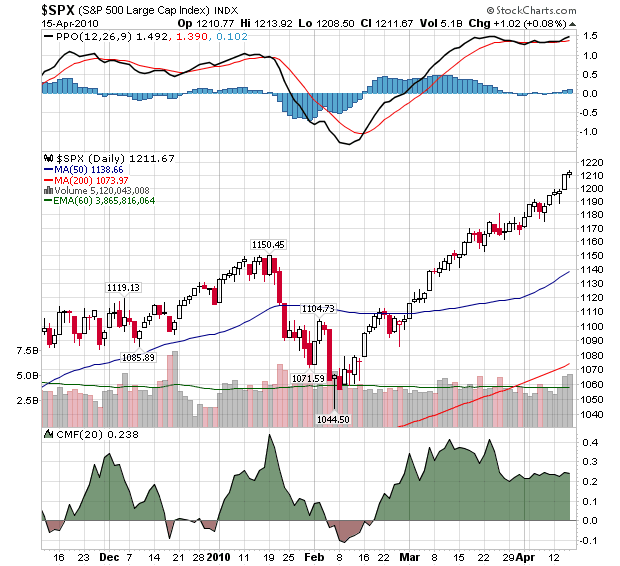
Take a look at the relationship with the very basic 50 day moving average and the S&P 500. Though it is rising it currently stands are around 1138 and the S&P 500 closed yesterday at 1211.65. That’s quite a distance should price meet the moving average – sometimes referred to as ‘reverting to the mean’.
Chart posted by Money Talks
Today is options expiration and at the moment it appears it is going to open on a sour note as GOOD and ISRG are apparently gapping down in the morning. How the day will end is anyone’s guess.
Looking back, stocks rose for the sixth consecutive day, setting more bull market highs on the way, after a stronger earnings forecast from UPS and improved reports on manufacturing raised expectations for the economy. The Standard & Poor’s 500 Index increased 1.02 or 0.08 percent to 1,211.67 and is poised for a seventh straight weekly advance, its longest weekly winning streak since 2007. The Dow Jones Industrial Average rose 21.46 points, or 0.19 percent, to 11,144.57, trading at a new bull market high of 11,154.55. The NASDAQ outperformed, rallying 10.83 or 0.43% to close at 2515.69, hitting a bull market high of 2517.82 yesterday.
The Industrial sector was the top performer (XLI +0.96%), hitting yet another bull market high, led by UPS and First Solar Inc. Consumer Discretionary (XLY +0.43%), Financials (XLF -0.41%), and Technology (XLK +0.46%) also hit new bull market highs, though Financials finished with a loss.
Healthcare stocks fell yet again (XLF -0.28%) and is the worst performing sector since healthcare reform was passed by Congress and signed by the President.
REITs posted the five biggest losses in the S&P 500, with Kimco Realty Corp., Health Care REIT Inc., Simon Property Group Inc., Apartment Investment & Management Co. and Vornado Realty Trust retreating at least 3.5 percent.
Special offer from Mark Leibovit for Money Talks only: The intense analysis of Gold in the 10-12 page The VR Gold Letter is right now 75% off for the first month or $29.95 (regularly $125.00 a month). The weekly VR Gold Letter focuses on Gold and Gold shares.Go HERE and use the Money Talks promo code CBC12210

Mark Leibovit was also named the #1 Gold Timer for the one-year period ending March 25, 2008. Most recently, from: 12/26/08 to: 03/27/2009, he is ranked in the #5 position for 3 month return.
The exchange traded fund (ETF) menu is getting bigger all the time. Many of the new ETFs you hear about are just “me-too” clones of existing funds. But every once in a while something truly innovative comes along. When it does, I try to tell you about it.
Today I’m excited about the potential for PowerShares Small Cap Sector ETFs. Finally, two great ETF flavors come in the same package. And finally, we can go deeper into the sectors with other than just a handful of large, well-known stocks.
To understand how significant this is, you need to be aware of how the Standard & Poor’s index family works. So let’s start there …
You’ve probably heard about the S&P 500 Stock Index — the well-known benchmark widely used as a proxy for the U.S. stock market.
This particular group of 500 companies is selected by a committee at S&P to represent the U.S. large cap stock universe.
However, the S&P 500 is just one capitalization component of any significance in the U.S. equity markets.
There is also the:
- S&P MidCap 400 Index, and the
- S&P SmallCap 600 Index
Each of the three capitalization-based indexes can be further broken down by industry sector. And S&P publishes index data for all these niches: S&P 500 Health Care Index, S&P SmallCap 600 Technology Index, and so forth.
As I wrote last year in my Money and Markets column Unbundle the Stock Market with Sector ETFs, the Select Sector SPDR ETFs allow investors to customize their sector allocations within the S&P 500 index. With those ETFs you can overweight, underweight, concentrate on, or omit completely any large cap stock sector you wish.
Unfortunately, there was no way to do the same for the S&P 600 small caps or the S&P 400 mid caps. Until now …
PowerShares Fills the Void
Thanks to PowerShares, now at least part of the gap is filled. On April 7 the company launched a suite of nine small-cap sector ETFs based on the S&P 600 indexes. Here are the new ETFs and their ticker symbols …
- PowerShares S&P SmallCap Consumer Discretionary (XLYS)
- PowerShares S&P SmallCap Consumer Staples (XLPS)
- PowerShares S&P SmallCap Energy (XLES)
- PowerShares S&P SmallCap Financials (XLFS)
- PowerShares S&P SmallCap Health Care (XLVS)
- PowerShares S&P SmallCap Industrials (XLIS)
- PowerShares S&P SmallCap Information Technology (XLKS)
- PowerShares S&P SmallCap Materials (XLBS)
- PowerShares S&P SmallCap Utilities (XLUS)
Observant readers will notice that the ticker symbols for these funds are the same as those for the large cap sector SPDR ETFs, with an “S” added at the end of each. This is handy, and also amusing because PowerShares and SPDR are not related to each other. In fact, they’re competitors for ETF market share!
These new ETFs open up a whole new frontier for investors who like to rotate between industry sectors. And because there is no overlap between the S&P 500 stocks and the S&P 600 stocks, these new PowerShares can be expected to perform differently than their big brothers.
This gives astute investors more ways to diversify — and more profit opportunities since small cap stocks usually outperform bigger stocks over long time periods.
Consider the Consumer Staples sector …
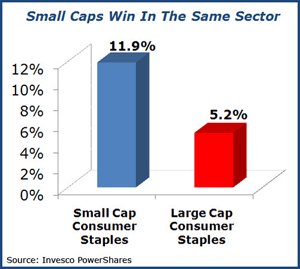
For the ten-year period ending December 2009, the small cap index covering this sector had an annual average return of 11.9 percent. Meanwhile the equivalent large cap index averaged only 5.2 percent.
In other words, small cap stocks earned more than twice as much per year as large caps within the same industry sector. Comparing cumulative performance it was 207 percent versus just 66 percent. Wow!
It’s not just consumer staples, either. Small caps outperformed in all nine sectors over this ten-year period.
So whether you’re a buy-and-hold investor or a short-term trader, you now have a great new tool to hang on your investment tool belt.
Should you use this tool?
Just like screwdrivers and wrenches, not every tool is right in every situation. Small caps may have more growth potential, but they’re also more volatile …
Know the risks and use these ETFs wisely. As with all new ETFs, it will take some time for liquidity to develop, so be sure to use limit orders in the meantime.
Best wishes,
Ron
P.S. Are you following me on Twitter? Check out http://www.twitter.com/ron_rowland for frequent updates, personal insights and observations about the world of ETFs.
If you don’t have a Twitter account, you can sign up today at http://www.twitter.com/signup and then click on the ‘Follow’ button from http://www.twitter.com/ron_rowland to receive updates on either your cell phone or Twitter page.
This investment news is brought to you by Money and Markets. Money and Markets is a free daily investment newsletter from Martin D. Weiss and Weiss Research analysts offering the latest investing news and financial insights for the stock market, including tips and advice on investing in gold, energy and oil. Dr. Weiss is a leader in the fields of investing, interest rates, financial safety and economic forecasting. To view archives or subscribe, visit http://www.moneyandmarkets.com.
Mid-Week Gold & Oil Trading Report
In my last report I showed some cycles for the price of gold and how they were starting to roll over which would in turn put some selling pressure on both gold and silver this week.
Last Monday we saw gold and silver open higher but both were met with selling for the entire trading session. Since then gold and silver have been drifting higher on light volume with some occasional waves of selling on higher volume. It looks as though gold and silver have started a 5-14 day pause or pullback.
GLD – Gold Exchange Traded Fund
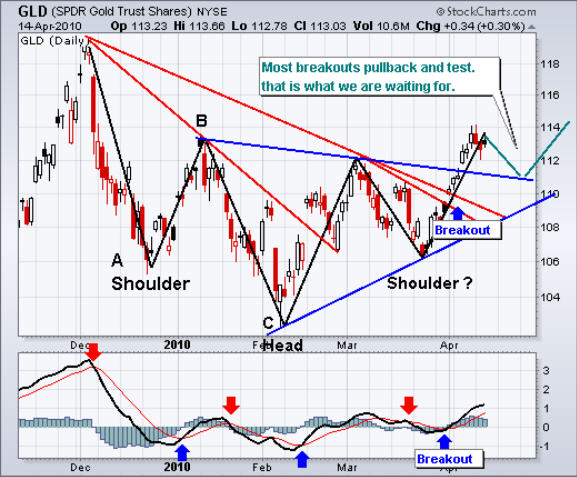
You can see from the chart below that the price of GLD looks to have bottomed after completing several typical price patterns from the breakdown we saw in December. The recent 4 months have provided a solid looking chart which should help gold take another run at the $1500 mark in the coming months.
USO Oil Fund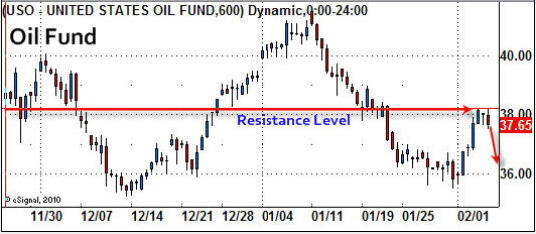
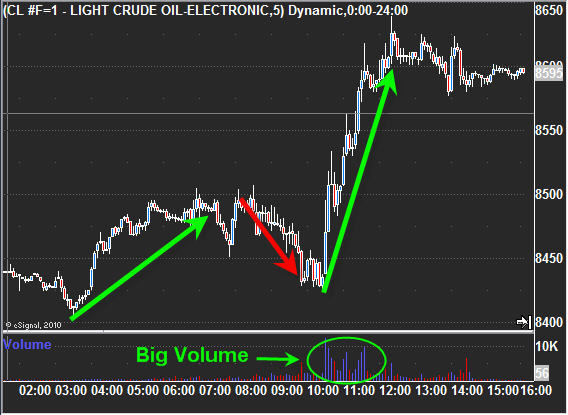
Crude Oil Futures – 120 minute chart of April 14, 2010
As the saying goes, buy on rumor (expectations) sell on the news. Well the price of oil moved up in the early morning anticipating the news (inventory numbers) at 10:30am ET would be in line with estimates. Then we saw profit taking started 2 hours before the number came out which is normal to see. But traders forecasted 1.4 million barrels as the number but the number came out at -2.2 million which was a big surprise for everyone. This sent oil sharply higher providing traders who caught the breaking news with an easy money trade. This type of action does not happen often so it’s a great little bonus for day traders.
Mid-Week Trading Conclusion:
In short, metals have had a nice run recently and the charts are pointing to a short breather before the next upward thrust.
Oil is holding up strong on the daily chart and with today’s extra boost in price, its looking like it may want to start a new leg higher if the momentum carries over for a few more days.
We saw the major indexes surge higher on rising volume indicating buyers are in a panic to buy in fear of missing more gains. There really is no reason to be buying at these prices other than trading off emotions in fear of missing more upside. The problem for these traders is that money is made by those who buy dips in the bull markets. Buying over extended rallies is a dangerous game, especially with the market as overbought as this one. The trend is our friend and if we do get a 1-2 day pullback in stocks we could take small position to buy on a dip.
If you would like to receive my ETF Trading Signals please visit my website: www.TheGoldAndOilGuy.com
Chris Vermeulen
Also,
With his free DAILY newsletter, he gives away commentary and insight that most people pay for. Look for this symbol on to sign up for the Daily NewsLetter.

I’d highly recommend you sign up for his free newsletter right now, and you’ll automatically get the report, “What Your Broker Doesn’t Want You to Know” part of his old broker training. S super fun entertaining read. His daily newsletter has a wealth of information.
Today’s Notes:
1. The Loonie
2. Colombia’s Llanos Basin
1. THE LOONIE
It is not only the Canadian currency we focus on this AM; not at all. In addition there is another big Chinese investment in Canada. Yesterday Sinopec and Conoco announced a big deal. COP is the third-largest integrated energy company in the United States, based on market capitalization, oil and natural gas reserves; the Texas based company has 2009 assets of $153 billion and revenues of $149 billion. The US oil company is trying to delver – reduce its debt load by $10 billion. So it sold its 9.03% stake in the Syncrude’s oil sands projects in Alberta’s Fort McMurray area for $4.65 billion. Conoco, not unlike the United States government, has been on a buying spree that had added so much debt to the balance sheet the company could no longer manage. So they are in the process of selling assets. The good news for Conoco is that the Chinese company stepped in a actually paid up for the 9% stake in Syncrude.
The Syncrude joint venture has, over the past 30 years, generated two billion barrels of oil. The Canadian Oil Sands Trust is the largest equity holder of Syncrude, with a 36.74% stake. Other stakeholders include Imperial Oil Resources (25%), Mocal Energy (5%), Murphy Oil (5%), Nexen Oil Sands Partnership (7.23%) and Suncor (12%). By the end of the decade, Syncrude expects to generate more than 425,000 barrels per day. The reserves are 4.9 billion barrels. The Sinopec transaction will require regulatory approval from the Canadian governmental authorities. This should not be a problem as the company is purchasing a minority position. The trends are clear. China is becoming a much larger player in the Canadian natural resource scene. There is growing global demand for Canada’s oil sands just as there is global demand for Canada’s nickel and uranium resources.
So this AM the Loonie has moved above par once again – as I write. This must irritate the solons in Ontario very much but it is the inevitable legacy of commodity countries such as Canada, Australia and Brazil. We have been long time proponents of the Canadian currency even in its fiat emanation. This is not the first crossing of the Rubicon for the Loonie. As you can see the Loonie soared to a premium in October 2007 and remained at or above par till Secretary Paulson caused the US short dollar covering. It is the legacy of de facto commodity backing that we are witnessing in a developed country with a high standard of life and a relatively small population.
The implications of this particular move by China are quite clear. The oil sands will be developed, if not with American capital then with American capital recycled by the Chinese and other emerging markets. Company’s like Oil Sands Quest (BQI AMEX) that I have followed for a long time will find interest in their Saskatchewan oil sands resources. American companies seem to be shying away at a time when global resource nationalism is picking up steam and Canada is one of the few really friendly and capable jurisdictions to the US.
….read pages 2 thru 5 HERE
Consequence of Error
Saturday’s tragic plane crash in Russia took the lives of many important military and government officials in Poland. And now the obvious questions are being asked: why were so many top officials on the same plane, whose fault was it, what can be done to prevent this type of national tragedy from happening again? We send our sympathy to our Polish friends.
But we also wonder about human nature. Is there some lesson we can glean from this event that will help us manage our own lives more prudently?
The key lesson from the Polish pilot’s now obvious mistake is to reassess our understanding of risk. What is risk? How can we realistically assess the risk in a situation before a tragedy? How can we avoid tragedy before it happens?
When I was a young officer in the Canadian Armed Forces, the pilot trainees were taught about the ‘consequence of error’: If I make a certain choice and that choice eventually proves to be an error, what will the consequences be? So if a pilot were advised to go to another airport because landing at this foggy airport was too acxdangerous, the consequence of using another airport would be that all his passengers would have to be bussed to the correct destination: they would all be late. And if he decided to try the landing in the fog, and that proved to be an error, the consequence would be a crash. Canada’s student pilots would have had no trouble making the decision to choose the alternative airport because of the huge difference between the two consequences of error.
In my book, Beyond the Bull, I discuss the use of the military mind in managing our investments. Let’s see if this applying the ‘consequence of error’ exercise can be used to help us improve our investment skills.
Financial planners and mutual funds salesmen tell us that we should buy good quality stocks and hold them indefinitely. The problem with this approach is that it hasn’t worked for ten years. Today, the Dow Jones Industrial Average is approximately the same as it was ten years ago. The Standard and Poor’s 500 Index is about 15% lower than it was ten years ago. Canadian investors did better: we made an average of about 2% per year for those same ten years. The investment industry’s choice ― buy and hold for the long term ― has turned out to be an error. And the consequence of making that error has been a sub-standard rate of return for ten years.
But what about the future? What would the possible consequences be if continuing to hold stocks for the long term proved to be an error? What if we simply sold our mutual funds and kept the money. What would be the consequence of that approach, if it proved to be an error?
Choice No. 1
If we continue to hold our equity mutual funds and that proves to be an error, we run the risk of losing our retirement nest egg. Twice in the past decade, the stock market dropped over 45%. It could happen again ― and if it does, the consequence of holding our stocks through that period is losing half of our retirement savings.
This problem applies not only to small investors. Big pension funds lost many billions of dollars of retirees’ money in the two monumental stock market declines of the past ten years. It’s not just about your RRSP; it’s huge. If the stock market drops again as it did in 2008-09 or 2001-02, it will seriously affect the retirement plans of almost all Canadians. This is the consequence of error of holding stocks when the stock market falls.
Choice No. 2
What if we sell out and that course of action proves to be an error? Selling out would be an error if the stock market went up and we were not invested because we had sold. The consequence of that error would be that we would earn only 2% or 3% on our cash instead of a much larger return if we had stayed in the stock market.
This ‘consequence of error’ exercise helps us develop judgement. In the case of the Polish airplane crash, there was an error in judgement that killed many people. In the case of stock market crashes, an error in strategy will affect the retirement plans of millions of Canadians. But the goal of the ‘consequence of error’ exercise is valid: to help us assess risk properly and to reduce the impact of the error in our lives.
Obviously we have more than just two choices in the investment world. I encourage investors to take advantage of the errors of other investors and to limit the effect of our own errors. Try to do what the mutual funds industry tells us can’t be done. Try to invest in securities that are rising in price and not in securities that are falling in price. Then we should plan the type of errors we want to make.
And what type of errors do we plan to make? Obviously, we are trying to not make investment errors. But, when we do make an error, we’d like it to be the type of error illustrated in Choice No. 2 above: an error where we earn a lower rate of return than we could have. And what type of errors do we plan not to make? The error shown in Choice No. 1: holding investments in down trends and losing our capital.
In a perfect world, we wouldn’t make errors. But we live in this world. And in the investment world, we spend a lot of time flying in the fog. So we need to plan our actions in full awareness of the consequences of possible errors ― and then be prepared to live with those consequences.
To order your copy of Beyond the Bull and the Five Levels of Investor Consciousness CD, or to sign up for Ken’s free monthly webinar, visit www.gobeyondthebull.com (Bullmanship Code = SS32).
This article and others by Ken are available at http://kennorquay.blogspot.com.
Contact Ken directly at ken@castlemoore.com.
-
I know Mike is a very solid investor and respect his opinions very much. So if he says pay attention to this or that - I will.
~ Dale G.
-
I've started managing my own investments so view Michael's site as a one-stop shop from which to get information and perspectives.
~ Dave E.
-
Michael offers easy reading, honest, common sense information that anyone can use in a practical manner.
~ der_al.
-
A sane voice in a scrambled investment world.
~ Ed R.
Inside Edge Pro Contributors

Greg Weldon

Josef Schachter

Tyler Bollhorn

Ryan Irvine

Paul Beattie

Martin Straith

Patrick Ceresna

Mark Leibovit

James Thorne

Victor Adair