
Daily Updates
Three Things I Think I Think
- The impact of the current downturn could be shaping up to have some interesting long-term ramifications. This is now the second market crash in less than two years and could be shaping up to be the third time small investors have been seriously burned in a decade. You have to wonder how comfortable the small investor is in this market now. The game must appear entirely rigged to an unsophisticated investor and the accusations of a system error during yesterday’s trade has to make some people wonder why they are putting their hard earned cash at risk of a massive computer glitch. Investors were just beginning to feel comfortable about the economic recovery and then whoosh! -1,000 points in one day. I don’t know exactly how this will impact prices in the long-term, but my guess is that the small investor is growing increasingly frustrated with the equity markets. This can’t be good for the long-term performance of stocks.
…read two and three HERE
Gold ‘Decouples’ on International Debt Crisis Concerns – Gold Forecast to Reach $3,000 Per Ounce
The sharp sell off on Wall Street and with equities internationally saw gold decouple and surge in all currencies yesterday. Oil, commodities and bonds also fell sharply in incredibly volatile trading.
Gold was up by more than 2% in dollar terms and by more than 3.5% in euros and pounds as the euro and pound fell sharply on contagion fears, hung parliament and economic concerns respectively. Gold reached new record nominal highs in sterling, euros and Swiss francs and 27 year highs in Japanese yen, also reaching a five-month high in dollars. Given the scale of the international debt crisis, the December record (nominal) high of $1,226 per ounce (interday) could be reached in the coming days and respected analysts are now forecasting gold to rise to $3,000 per ounce (see News).
…..read more and view charts HERE.
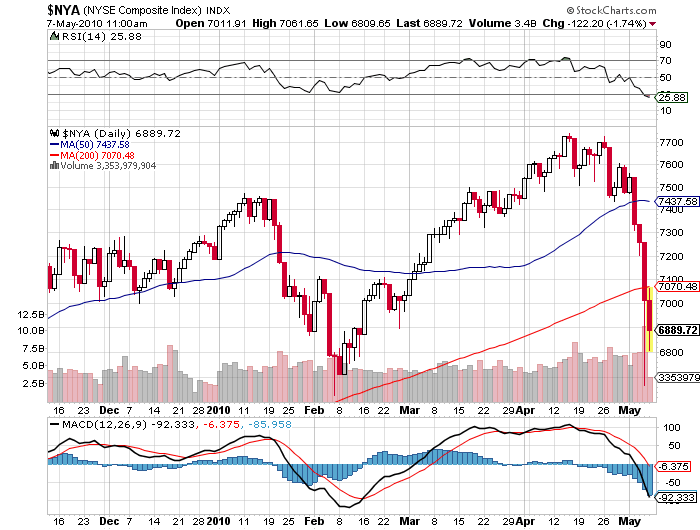
Richard Russell Comment: Any damage done? The chart below is a daily of the NYSE Composite, which includes ALL the stocks on the NYSE. The chart looks like a “head” that is chopped off at the neck. It’s a nasty looking piece of work. Should we blame it on all Greece? I’m doubtful – I think something else is wrong. This distribution top began back in late-March, before the world started wringing its hands about Greece.
The Day The Market Almost Died (Courtesy Of High Frequency Trading) via ZeroHedge.com
A year ago, before anyone aside from a hundred or so people had ever heard the words High Frequency Trading, Flash orders, Predatory algorithms, Sigma X, Sonar, Market topology, Liquidity providers, Supplementary Liquidity Providers, and many variations on these, Zero Hedge embarked upon a path to warn and hopefully prevent a full-blown market meltdown. On April 10, 2009, in a piece titled “The Incredibly Shrinking Market Liquidity, Or The Black Swan Of Black Swans” we cautioned “what happens in a world where the very core of the capital markets system is gradually deleveraging to a point where maintaining a liquid and orderly market becomes impossible: large swings on low volume, massive bid-offer spreads, huge trading costs, inability to clear and numerous failed trades. When the quant deleveraging finally catches up with the market, the consequences will likely be unprecedented, with dramatic dislocations leading the market both higher and lower on record volatility.”
…..read more HERE
ED Note: Greg Weldon’s May 5th ETF Playbook nailed the yesterday’s big selloff. Its not wonder Michael Campbell calls Greg Weldon – “The One Analyst other Analysts can’t Wait to Read.”
May 5th/2010
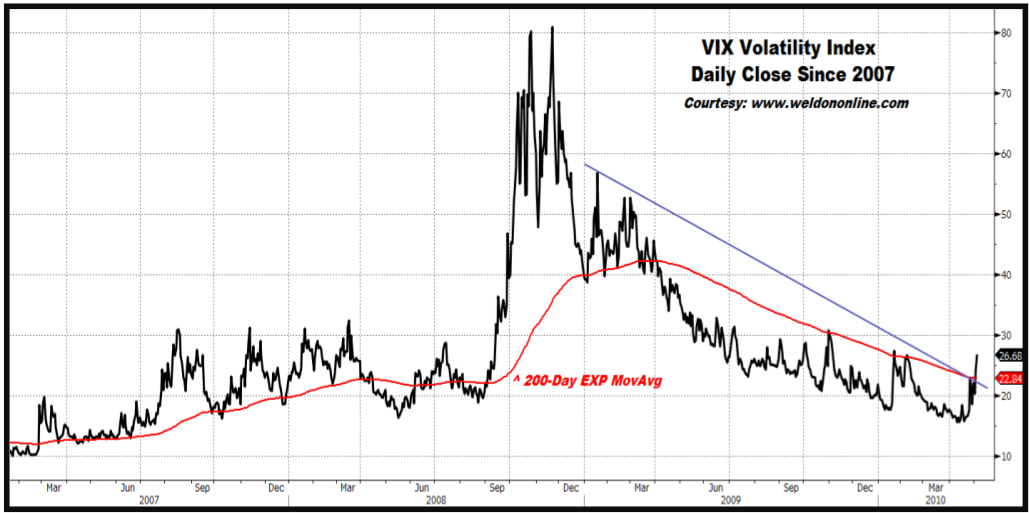
Of course we must highlight the upside breakout taking place in the CBOE Volatility Index, as noted in the chart below … with an upside violation of both the long-term 200-Day EXP-MA and the downtrend line in place since 2008. The VIX appears headed for a serious test of KEY overhead resistance defined by the Jan-10 high at $27.31 and the Oct-09 high at $30.69 (ED Note: The VIX hit a high of 40.71 and settled at 32.80 yesterday)
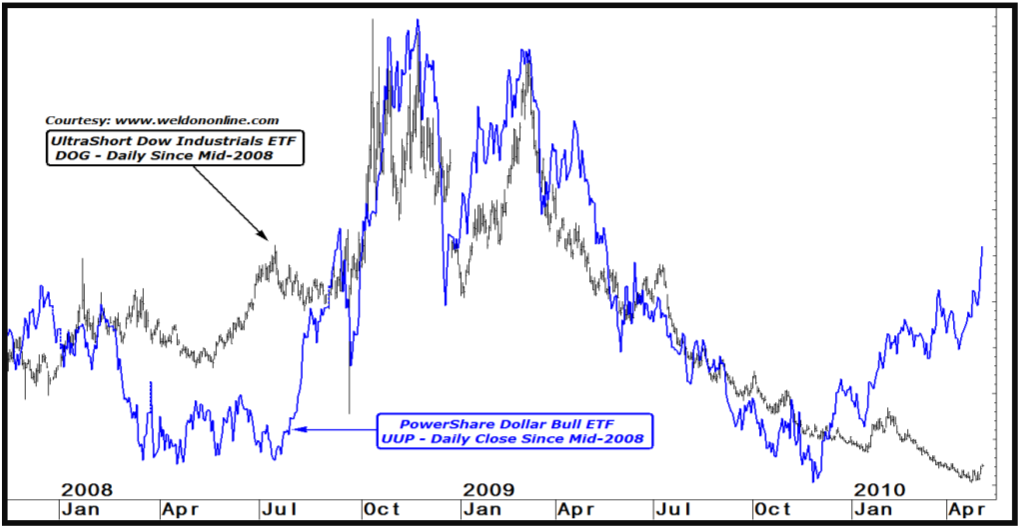
In line with the attempted breakout in the VIX … we find the overlay chart on display below to be of interest, as we observe the interplay between the Dow Industrials UltraShort DOG (black bars) and the US Dollar Bull ETF (UUP, blue line) … revealing a complete BREAK from the normal, historically tight positive correlation, suggesting that, either … the stock market is HIGHLY vulnerable here, or, there has been a secular decoupling.
We believe that the odds favor the former, and thus a ‘reconciliation’ of the positive correlation via an ‘adjustment’ in the stock market.
We have been bearish on the Eurocurrency for MANY MOONS, since last fall, on the premise that the current debt-deficit-debacle is SECULAR in nature, and is such so that it will NOT be easily ‘papered over’, monetarily.
In Money Monitor after Money Monitor, we have repeatedly screamed that the EU crisis will INTENSIFY, and, moreover, will likely take YEARS to ‘resolve’ … years of fiscal austerity, and PAIN.
Note Tuesday’s extension to the bull market in the UltraShort Euro ETF.
Weldon’s Money Monitor offers a FREE 30 Day Trial Subscription. For subscription information contact Eileen @Weldononline.com or Visit www.Weldononline.com for a FREE Trial.
A FREE 30 Day Trial Subscription is defined as a single Trial that is limited to a one-time Signup. Signing up for multiple trials under different names, Fraudulent contact information is illegal. Weldon’s Money Monitor takes this seriously..
Rogers, Faber Advise Paring Investments as U.S. Stocks Slump
Investors should consider paring their holdings after a plunge in U.S. stocks yesterday, according to Jim Rogers and Marc Faber.
Equities had a “normal correction” and were “overdue for a sell-off” after rallying from last year’s low, Rogers, Singapore-based chairman of Rogers Holdings, told Bloomberg Television today. “The market was overbought, ahead of itself and due for a correction,” Faber, publisher of the Gloom, Boom & Doom report, said in a separate interview yesterday.
U.S. shares tumbled as waves of computerized trading exacerbated a selloff triggered by Europe’s debt crisis. While the rout briefly erased more than $1 trillion in U.S. market value…..
…..read more HERE
-
I know Mike is a very solid investor and respect his opinions very much. So if he says pay attention to this or that - I will.
~ Dale G.
-
I've started managing my own investments so view Michael's site as a one-stop shop from which to get information and perspectives.
~ Dave E.
-
Michael offers easy reading, honest, common sense information that anyone can use in a practical manner.
~ der_al.
-
A sane voice in a scrambled investment world.
~ Ed R.
Inside Edge Pro Contributors

Greg Weldon

Josef Schachter

Tyler Bollhorn

Ryan Irvine

Paul Beattie

Martin Straith

Patrick Ceresna

Mark Leibovit

James Thorne

Victor Adair