
Daily Updates
After months of deriding U.S. Treasury bonds, Bill Gross and his fund managers at Pacific Investment Management Co. have switched sides.
Pimco had been the biggest and most vocal of a large group of Treasury bears, predicting that Treasury prices would fall, and yields rise, as the U.S. economy strengthens and the government borrowing binge continued.
In the opposing camp was Pimco’s chief rival, BlackRock Inc., which said in March that it was buying up Treasurys.
So far, BlackRock’s view has proven to be the winning bet. The debt crisis in Europe sparked a global flight to safe-haven assets.
Pimco on Wednesday shifted its views on Treasurys to be more in line with BlackRock’s. The capitulation by Mr. Gross and Pimco, which has some $1 trillion in assets under management, is significant because it is among the most influential players in the market. Pimco has enough money to move the market and investors follow its opinions closely. Mr. Gross and his Pimco colleagues regularly appear on television and release monthly newsletters espousing their views.
June 9 (Bloomberg) — Investor Marc Faber said cash and bonds will be “very dangerous” in the next 10 years as governments increase money supply to cover fiscal deficits.
“There’s no other way out but to print money,” Faber, the publisher of the Gloom, Boom & Doom report, said at a forum in Seoul today. “In the long run, all paper money will go exactly to its intrinsic value, which is zero.” Faber advised investors to protect themselves with assets such gold and silver.
….read more HERE
A monumental event is taking place in Europe, of a scope that makes the credit crisis in the US of the past almost three years, look small by comparison.
Those in the financial community do not understand the ongoing detrimental effect it will have on the entire world economy. It certainly will make European goods and services from the euro zone at least 12% cheaper for export than they have in the past. The flipside of that is imported goods, particularly energy, will be more expensive and that means higher European inflation. We see Iran and China making announcements that they will use dollars rather than euros in trade in the future. We guess they forgot the euro members may have lots of problems, but the euro still has about 7% gold backing, something the US dollar and all other currencies do not possess. This is not an excuse to own euros, but it has fallen from $1.50 to $1.19 and that is a sizeable correction. Those who are short the euro and have been since last October, and long the dollar, will want to take some profits. It is also in the best interest of all that the euro doesn’t fall any further at least at this time. The same holds true for Greek bonds, as well as those of Ireland, Spain, Portugal and Italy.
…..read more HERE
Time-Tested Indicator Predicts Big Gains for Gold Stocks
The increase in gold prices over the last five years has outperformed virtually every other asset class. From the low $400 range in 2005, gold has soared almost 300% to over $1200 per ounce.

Although many gold stocks have seen substantial gains since 2005, the overall price gains of gold stocks has underperformed the price appreciation of the metal as can be seen by viewing the PHLX Gold&Silver Index, comprised of 16 major gold and silver producers. While the price of gold has appreciated almost 200%, the XAU has lagged considerably with a gain of 96%.
…..read more and view 5 Charts HERE
Quotable
“So far, markets have given the U.S. a longer leash. The danger is that we’ll hang ourselves on it.” —Mark Whitehouse, The Wall Street Journal
Ok, we all know the story (even though it’s been thrown on the backburner with the ongoing implosion of Europe): the US dollar is doomed because of the growing deficits and debt in the United States.
Even though the euro is making the front page of every newspaper and online editorial website, the story that’s been following the dollar around like a dark cloud has certainly not disappeared; it’s just waiting to strike again when its time.
When is it time?
The mainstream financial newsletter industry will probably be first to jump back on that bandwagon (assuming they ever really got off of it.) And when things around the world simmer down a bit, the regular financial news publications will probably become littered with the US dollar bear market story yet again.
Let’s revisit.
This chart shows a big gap forming – government outlays are handily outpacing government receipts. Click HERE to view larger Chart
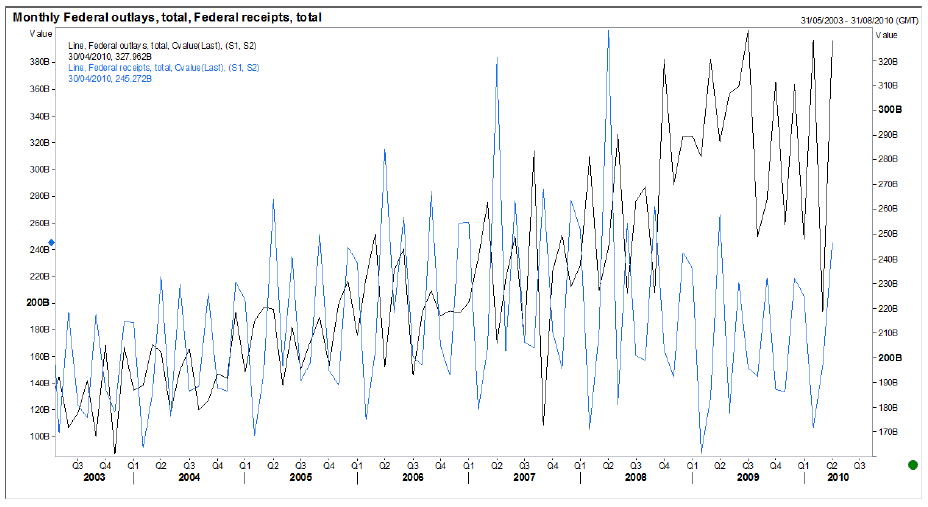
Looking at www.census.gov, their latest estimate for the federal budget (receipts minus outlays) is a deficit of 12.9% of GDP. Their estimate for gross federal budget debt is 90.4%. Other estimates put this number at 88%. Either way, gross is right.
The 90% figure also represents what’s believed to be a critical threshold for debt-to-GDP; it may have a significant impact on growth once it surges above 90%. And as The Wall Street Journal puts it:
You can argue that bail outs have gone to other unworthy candidates in addition to irresponsible consumers. And you can argue that there is a whole lot of other unnecessary spending on the books besides social security and Medicare, though those are two of the biggies.
Two things:
1) As to the “surprising faith,” perhaps that’s what I’m taking into this whole argument.
It appears Americans are waking up to the pace at which President Barack Obama’s administration brought on increasingly large amounts of debt, to the dangers posed by the recent US and global recession, and the turmoil that’s shaken up Europe and exposed the problems with out-of-control budgets there as well.
Either way, Americans are realizing the US may be at a tipping point. This growing awareness is in fact a good thing. Despite current warts, and attack by recent government policies, the US economy is still the most dynamic economic system in history and has proven its resiliency time and time again. It can be turned around. Maybe the mid-term US elections will be a good start.
2) As to the “borrowing rates unusually low,” Bob Prechter, of Elliott Wave fame, recently gave an interview to The Daily Crux, where he argued for deflation to hit the US before inflation. Here’s something he said that’s no secret anymore:
Over the past eight years, the Fed’s lending rates have twice fallen to zero, meaning that credit is free. The Fed has created $1.5 trillion of new money. Central banks around the world have offered unlimited, cost-free credit. The government is spending money like mad. And the Fed and the Treasury have bailed out or guaranteed another trillion or two of bad debt and promise to do even more. Oh, and the Chairman of the Fed swore eight years ago that he would drop money from helicopters.
My point in bringing this up: consumer and businesses are at a point where they’re still deleveraging and/or shoring up their finances. They recognize that a change needs to be made; they recognize that there is a limit to spending and mal-investment at some point. They’re no longer diving into the temptation of unusually low interest rates, etc. This I think represents a secular change in sentiment toward debt.
Taxpayers are beginning to recognize this in their own way. It is only these taxpayers who can make government recognize this sentiment shift and act accordingly. And they’re working about as hard as possible to make that happen now.
John Ross Crooks III
Black Swan Capital
www.blackswantrading.com
Get Black Swan’s Free Currency Currents Morning Commentary HERE
-
I know Mike is a very solid investor and respect his opinions very much. So if he says pay attention to this or that - I will.
~ Dale G.
-
I've started managing my own investments so view Michael's site as a one-stop shop from which to get information and perspectives.
~ Dave E.
-
Michael offers easy reading, honest, common sense information that anyone can use in a practical manner.
~ der_al.
-
A sane voice in a scrambled investment world.
~ Ed R.
Inside Edge Pro Contributors

Greg Weldon

Josef Schachter

Tyler Bollhorn

Ryan Irvine

Paul Beattie

Martin Straith

Patrick Ceresna

Mark Leibovit

James Thorne

Victor Adair