
Daily Updates
Technical Tips
Source: Ian Gordon, Longwave Group 06/13/2010
We wrote the following a couple of weeks ago, while we were taking a break in Scottsdale. But we thought that what we wrote then might still be of interest at this time.
May 24, 2010: Stock Markets around the world are in a precarious position. Many appear to be setting up for a crash in prices. This is true of US markets, despite the efforts of the ‘Plunge Protection Team’, which has been very active in trying to hold back the deluge. “S & P Demand Power fell 10 points to 380, while supply pressure rose 22 points to 465, telling us the decline was powerful, with deep pockets intervention buying markets with all ten fingers and toes working hard to prevent an all out crash.” – Robert McHugh, Daily Market Newsletter, Thursday May 29th, 2010.
There was an equivalent of the Plunge Protection Team around during the 1929 October stock market crash. It was formed by the big banks under the leadership of JP Morgan. On one of the crash days this syndicate purchased large amounts of key stocks at prices well above well above the offering price in an effort to halt the collapse. And they were successful, at least on that day. But the crash resumed the following day and the bankers stepped aside, realizing that they were simply throwing good money after bad. The ‘Plunge Protection Team’ of today is much more powerful than its banking counterparts of the late 1920s, because it comprises the Federal Reserve, the SEC and the US Treasury. This entity has the wherewithal to throw huge amounts of money into the market. But the stock markets are governed by natural law and under the circumstances no amount of money can turn a bear into a bull.
This bear market is a parallel to the 1929 to 1932 bear market and likely bigger in magnitude than that experienced between 1929 and 1932, when the Dow lost 90% of its value. Why? Well, for one very good reason the 1982 2000 autumn stock bull market was 2 ½ times bigger than its predecessor autumn stock bull market of 1921 1929 and a bear market is always a virtual mirror image of the bull market that it follows, as in the old rugby adage ‘the bigger they are the harder they fall’.
The Dow Jones Industrial Average
Richard Russell, the venerable writer of Dow Theory Letters recently wrote that if the DJIA closed below 10,388 and the Transports closed below 4,298, each average would confirm the resumption of the bear market. Both these averages are below the numbers specified by Mr. Russell, which confirms the resumption of the bear market.
…..read more HERE
“The Bloomie is reporting this morning that Russia is “discussing” the possibility of adding Aussie and Canadian dollars to their reserves… Frankly, I’m surprised they haven’t already done so! It doesn’t take a rocket scientist to see the potential that these two currencies have! Right now, the U.S. dollar accounts for 47% of Russia’s currency reserves, euros are 41%, British pounds are 10%, and yen is 2%… ” – from today’s Pfennig below:
In This Issue..
* Strong euro rally fizzles out overnight…
* Russia to add C$ and A$’s?
* IMF sides with U.S. on Chinese currency policy..
* Aussie housing starts are strong
A Return To Debit Crisis Trading…
Good day… And a Wonderful Wednesday… Man! Did we have some torrential downpours yesterday! The creek that my yard backs to was “a risen”! I can’t imagine all the rainouts of ballgames this spring… It’s one of the things that drove me crazy, when I was a baseball manager…
OK… The rain was coming down hard on the dollar yesterday too… But, this morning, when I turn on the screens, it looks like that dollar selling that went on all day yesterday, has had the brakes applied. I would say slammed on, but it all happened while I was sleeping, so I don’t really know for sure!
Yesterday… The currency rally was led by the euro, which climbed all the way past 1.23, and to 1.2360 on the day. This was the first “real rally” and not “mini-rally” that we’ve seen in the single unit in what feels like a month of Sundays! There was not “real” news, in fact, I told you yesterday that German Investor Confidence plummeted, which should have sent the euro reeling… But, instead, in out world of “opposites” bad data equals currency strength… Hey! We’ve seen it for months with the dollar, so why not the euro?
There was a story that passed by on the screens yesterday about how the “fear of owning euros” was ebbing… This morning, that “ebbing” must be reversing, for the euro just fell back below 1.23! And then back above… So, it’s going to be one of “those days” UGH!
The Bloomie is reporting this morning that Russia is “discussing” the possibility of adding Aussie and Canadian dollars to their reserves… Frankly, I’m surprised they haven’t already done so! It doesn’t take a rocket scientist to see the potential that these two currencies have! Right now, the U.S. dollar accounts for 47% of Russia’s currency reserves, euros are 41%, British pounds are 10%, and yen is 2%…
Russia has reduced their dollar holdings from 50% in 2006, and for those of you at home keeping score, we’re not talking about peanuts here… Russia has the third largest currency reserves in the world at $458.2 Billion! With my amazing ability to work a calculator, the move from 50% to 47% since 2006, was worth almost $14 Billion dollars, less in their treasure chest of reserves…
So… One has to wonder, what currency are they going to sell to get them the funds to buy Aussie and Canadian dollars? Will it be dollars? Or euros? And how much? These and many more questions will be answered if Russia does what is being discussed… So stay tuned… Same bat time… Same bat channel!
OK… There was news yesterday that the Fed had their first auction of term deposits (CD’s)… One reader sent me a note and asked me to explain what this was all about… So, here you go!
This is just a way for the Fed to drain the billions of dollars that are sitting in the banks right now, as reserves… The Fed is scared to death that the banks will eventually get back to loaning money, and if they do it with the cadre of cash that they currently have, the velocity of money would go through the roof, and right behind it would be inflation…
These CD’s are attractive to the banks because they know it will get paid back, as opposed to loaning anyone money right now, and, they get paid interest on the money! Of course, I have to chuckle, because, unless there’s a new law that requires banks to buy these term deposits from the Fed, it will become a useless tool to drain reserves, once banks feel that it’s OK to dip their toes back into the lending waters, for they will make more lending the money, than they will with the interest paid on the term deposits!
So… That’s the lesson for today, HA!
So… We’ve had this back and forth with the U.S. and China over the Chinese currency policy… Now it looks like the IMF is siding with the U.S. (of course they would! The IMF’s funding is heavily weighted with U.S. funds) The IMF’s Chief Economist commented on the issue of renminbi revaluation stating that… “I don’t know when and by how much the renminbi will be revalued, but I believe it is in their (China’s) interests. For the rest of the world it is important that it happens as soon as possible.”
I now wait for the Chinese response to the IMF… This ought to be good!
In Australia overnight… Australian Housing Starts increased 4.3% in the first quarter, from the previous quarter and brought the total to a six-year high! There are reports there that the increase was fueled by Gov’t stimulus… So, I’m not too impressed with the figure knowing that! It’s still data that will require the Central Bank to address, which means raise rates… Again, I’m calling, and have called for the next rate hike in Australia to come in August, during the dog days of summer…
And in Canada… The “separation” with the U.S. dollar / economy / Fed rate policy, continues to be the “story”… And with the Oil price continuing to rise, the loonie continues to be well bid. Oil this morning is up again trading over $76… And Gold was up yesterday too, so it was all good for the loonie!
Oh… I see the thing that slammed the brakes on the euro’s rise overnight now… We all know that the debt crisis in the Eurozone wasn’t over… But the markets seem to act as if they did think it was over, and now they’re surprised to see the problem come back to haunt them, as it was reported overnight that the U.S. Treasury and the IMF are putting together a credit line of as much as $307 Billion (250 Billion euros) for Spain…
I would expect now to see the euro head back down South, for the debt crisis news is back on the front page…
And India is tearing a page out of Australia’s book on how to stop a currency rally in its tracks… India is proposing a capital gains tax on all stock transactions by Indians and overseas funds…
Yes, this would help close the gap in the Budget, but come on! Isn’t there something else that can be done? Taxes… On investors… That’s just wrong in my book! The currency rally the rupee had enjoyed in recent days will be wiped out in a heart beat, on this news… So… Maybe, that’s what the Indian Gov’t wanted in the first place?
Today, the data cupboard here in the U.S. will yield, PPI… (wholesale inflation) which is expected to show an increase of nearly 5% in May… But, something happens to that number when it is converted to Consumer inflation (CPI)… And that “something” are the hedonic adjustments the Gov’t makes to CPI… UGH!
We’ll also see my fave, Capacity Utilization… And Industrial Production for May.
To recap… The strong currency rally led by the euro yesterday had the brakes slammed on it by a return to focusing on the debt crisis in the Eurozone, when a report said the U.S. and IMF are preparing a line of credit for Spain. Russia is reportedly discussing buying Aussie and Canadian dollars and adding them to their currency reserves. And India proposes a capital gains tax on investors…
Currencies today 6/16/10: American Style: A$ .8645, kiwi .6970, C$ .9730, euro 1.2295, sterling 1.4830, Swiss .8845, … European Style: rand 7.6320, krone 6.4040, SEK 7.80, forint 228.05, zloty 3.3210, koruna 20.9050, RUB 31.20, yen 91.50, sing 1.3940, HKD 7.79, INR 46.52, China 6.8323, pesos 12.60, BRL 1.7870, dollar index 86.26, Oil $76.60, 10-year 3.30%, Silver $18.55, and Gold… $1,234.15
That’s it for today… Whew! Did it ever rain hard here yesterday! Glad it was a work day! And not the weekend! The Big news yesterday, was that it looks like the Big 12 will live on, and not dissolve… That’s good news for my beloved Missouri Tigers… Bad news is that now they’ll have to play Oklahoma and Texas every year! UGH! Cardinals win again last night, they sure are a different team at home, than on the road! My little buddy Alex had his first of several swim meets last night… He swam IM, Free, Free relay and Medley relay… Another one is on tap for Thursday night! The World Cup just came on, can you believe that not all of the teams have played yet? I think that ends today… And with that, I thank you again for reading the Pfennig, and hope you have a Wonderful Wednesday!
Chuck Butler
President
EverBank World Markets
1-800-926-4922
1-314-647-3837
Subscribe
“A Pfennig for your Thoughts” is a free, quick-reading daily e-letter on world currencies, economic trends, and the occasional baseball score. Subscribe HERE
Chuck Butler is the President of EverBank World Markets, which offers currency-denominated currency deposit accounts, single currency CDs, and index CDs. The opinions and viewpoints expressed in The Daily Pfennig are those solely of the editor, and in no way reflect those of EverBank.
Cramer Calls Market “Stupid, Rapacious, Arbitrary, Capricious And Downright Ridiculous”, Tells Viewers To Stay Out
After catching a few soundbites of Cramer’s spiel today, we were stunned: for once theStreeter did not lose his marbles over an engineered, 20 handle, 200DMA breakout rally. Quite the opposite. In what is likely a first, the Mad Money host actually told his viewers it is time to get out of the market: “I am calling this a bad rally. This market has now become more depressing than Ethan Frome. Even the good days are now bad days. It’s almost as if the whole market is caught between 1st base and 2nd base. So we get an endless rotating short squeeze in oil, in the banks, in tech, in discretionary…. But once the shorts are done getting picked off, we’ve got no more reason to run. It is a rally that stops that a blast of future selling comes in. It is a rally that stops the moment the buyers just walk away. We used to have fundamentally based rallies – that’s not how this market works.” The 10 minute rant against the market by the legendary permabull is simply shocking: he actually describes all the different dimensions in which the stock market is completely busted and discredited in a way that makes us jealous: “This market is stupid. And it is hated for a very good reason. The market seems rapacious, arbitrary, capricious and downright ridiculous. It is a tale told by an idiot, full of sound and fury, signifying nothing.” – Cramer’s comment made June 15th @ 5pm ET
Gold was in the headlines last week when it traded at an all time high in U.S. and Canadian Dollars. On the other hand, gold stocks on both sides of the border strengthened, but failed to approach all time highs. Where do gold equities and related Exchange Traded Funds go from here?
One of the reasons for failure of gold equities to move to new highs is a lack of favourable seasonal influences. The period of seasonal strength is approaching, but is not there yet. According to Thackray’s 2010 Investor’s Guide, the sweet spot for gold equities is from July 27th to September 25th. The trade based on the Philadelphia Gold and Silver Index has been profitable in 16 of the past 25 periods. Average gain per period was 6.8 percent versus a loss of 0.6 percent for the S&P 500 Index. Gold benefits from greater demand by refiners that use the gold to make jewelry for the Christmas and Indian Diwali wedding season in late October or early November. This year Diwali occurs on November 5th. India is by far the largest purchaser of gold jewelry in the world.
Chances of a seasonal trade in gold and gold stocks this year are better than average. India’s economy is booming. It currently is one of the fastest growing economies in the world. Demand for gold jewelry is expected to be exceptional this fall despite the high price of gold.
Supply and demand factors are expected to influence gold and gold stocks favourably this summer and fall. Upside potential for gold currently is capped by gold held by the International Monetary Fund. Last summer the IMF received international approval to sell 400 tonnes of gold. Last fall it sold 200 tonnes to India and has announced intentions to sell its remaining 200 tonnes. Funds from the sales are needed to finance the financial bailout of Greece as well as to provide support for emerging nations that were damaged by the recent recession. The IMF has been slowly liquidating its remaining 200 tonnes under the Bretton Woods agreement reached by central bankers last summer. The effect of this action will remove important overhead resistance levels for gold and gold stocks.
Currency fluctuations also are expected to influence gold and gold stocks this summer and fall. Historically, gold and gold stock prices have moved inversely with the U.S. Dollar. The accelerated printing of U.S. Dollars during the past 10 years has triggered a flight to value. Since 2001 the price of gold in U.S. Dollars has more than quadrupled. That relationship disappeared temporarily in December 2009 when the Euro’s financial crisis first became apparent. Since then, the U.S. Dollar has strengthened relative to the Euro and gold and gold stocks have moved sideways. However, the historic inverse relationship between gold and U.S. Dollar is expected to return when the Euro eventually stabilizes. Unlike European nations that have announced in recent weeks plans to reduce government spending and deficits, the U.S. government is intent on increasing government spending and deficits. Ultimately, accelerated printing of U.S. Dollars to finance the federal government’s deficit will lead to a return to weakness in the U.S. Dollar and strength in gold and gold equity prices.
On the charts, gold equity indices have become more interesting in recent weeks. The Philadelphia Gold and Silver Index (Symbol: XAU), AMEX Gold Bug Index (Symbol: HUI) and the S&P/TSX Global Gold Index have strengthened with gold prices during the past two months. However, gold equity indices have been underperforming the commodity itself. In addition, the short term momentum indicators currently are overbought suggesting limited short term upside potential.
Preferred strategy is to place gold equities and related Exchange Traded Funds on the radar screen for a possible seasonal trade this summer. Please be patient, do your homework before choosing an investment in the sector and watch the charts for an opportune time to enter as July approaches.
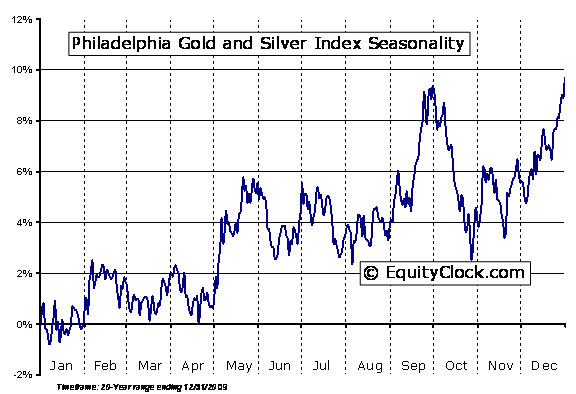
Equity Clock is a division of the Tech Talk Financial Network, a market analysis company that provides technical, fundamental and seasonality analysis on a daily basis via TimingTheMarkets.com and EquityClock.com. Equity Clock’s mission is to identify periods of reoccurring strength among individual equities in the market using methodologies presented by some of the top analysts in the industry, including that of Don Vialoux, author of TimingTheMarkets.com.
Feel free to use any of the content or seasonality studies (charts, timelines, or otherwise) presented as long as a link-back to this site at EquityClock.com is provided.
For further information on indicators used in reports presented on this site, please visit our reference page.
Bill Murphy and Jim Sinclair have done more to keep me on the right side of gold since just above $300. I truly can’t do without either one’s commentaries.
This is from Bill’s daily letter today: Just Click HERE
-
I know Mike is a very solid investor and respect his opinions very much. So if he says pay attention to this or that - I will.
~ Dale G.
-
I've started managing my own investments so view Michael's site as a one-stop shop from which to get information and perspectives.
~ Dave E.
-
Michael offers easy reading, honest, common sense information that anyone can use in a practical manner.
~ der_al.
-
A sane voice in a scrambled investment world.
~ Ed R.
Inside Edge Pro Contributors

Greg Weldon

Josef Schachter

Tyler Bollhorn

Ryan Irvine

Paul Beattie

Martin Straith

Patrick Ceresna

Mark Leibovit

James Thorne

Victor Adair