
Daily Updates
Stocks, gold, energy and other commodities soared Tuesday after the Bank of Japan announced plans to dramatically expand its quantitative easing program. The BOJ’s action spurred expecations for similar efforts by other central banks, Bloomberg reports, which helped the Dow climb 1.8% to within reach of 11,000. Meanwhile, gold hit another new record above $1,340 an ounce, silver reached a 30-year high and tin jumped to a record near $26,000 a metric ton.
But don’t confuse strength in such “risk” assets with an improving economy, says Jim Rogers, chairman of Rogers Holdings.
Byron King: Opportunities Across the Energy Spectrum
When it comes to energy, Newsletter Editor Byron King likes to keep his fingers in a lot of pies. He doesn’t limit his coverage to U.S. or even North American companies. He literally travels the world to find unique investment opportunities for his loyal subscribers. In this exclusive interview with The Energy Report, Byron discusses his recent trip to Serbia and some his favorite uranium plays.
Stocks in the “Anti-Greece” Are Beating the U.S. Market 7 to 1 — and the Gap is Widening
This small country, with fewer people than Florida, has been the world’s most consistent market winner of the past decade. We call it the “anti-Greece” because it runs its finances right: it’s a fiscally conservative free-market model to the world — with low spending and a balanced budget.
It has been growing 5%-7% for the entire past decade, blowing by Brazil, and now boasts the highest per capita income in Latin America. One investment is poised to profit more than any other from this remarkable story — and we’ll tell you about it below.
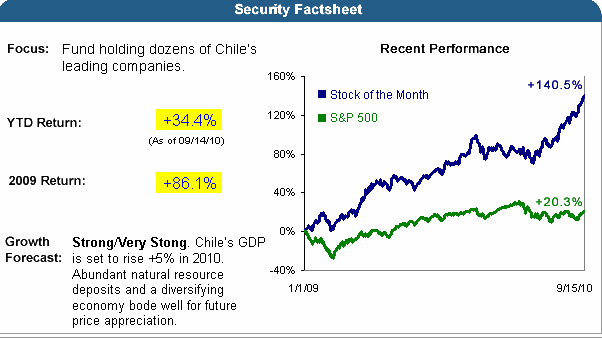

Click HERE to tell me the name of this fund!
The Man Selling the Fed’s Secrets
Believe it or not, there is a former Federal Reserve Governor selling the inside dealings of the Federal Reserve to rich investors for $75,000 each… and it’s all legal. In this week’s issue, I’ll show you two high-yield ways to fight back.
I’d be surprised if you’ve heard of Larry Meyer, but in the past few days, he’s created quite a buzz.
Larry Meyer is a former Federal Reserve Governor. He holds a B.A. from Yale; a Ph.D. from MIT. His pedigree is top-notch. So are his connections.
Meyer is still buddies with the folks on the Federal Open Market Committee, the policy-making body of the U.S. Federal Reserve. And his friends tell him what goes on at their meetings weeks before the general public gets to read about it.
You would think sharing that information with anyone outside the current Fed members would be illegal. You would also think the fact that Meyer charges well-heeled clients $75,000 each for access to what he has heard — well ahead of the investing public — would be unlawful. Amazingly, neither action is illegal, according to a Reuters investigation.
One of the Federal Reserve’s main tools is setting target interest rates, and profits can be made or lost based on what the Fed says at its meetings. It makes me mad (and likely you too) that some have inside access. But there is a way to fight back.
I think we’ll be much better off finding a few good income investments that are simply less sensitive to interest rates.
Why Interest Rates Matter to Income Investors
When interest rates rise, the price of some fixed-income securities, like bonds, tend to fall. For an extreme example, you wouldn’t want to hold a risky corporate bond paying a 7% yield if you could get a safer 10-year Treasury bond paying 7%.
So when the interest rates of Treasuries rise, investors tend to shed their riskier assets. This causes the price to drop — and the yields to rise — ultimately making riskier fixed-income securities more competitive when compared with safer investments.
It’s the number one reason why income investors are obsessed with what the U.S. Federal Reserve is likely to do with interest rates. And why some pay $75,000 for Larry Meyer’s analysis.
The two primary reasons the Federal Reserve raises target rates is to slow the economy and/or to prevent out-of-control inflation. But last I looked, the economy wasn’t overheating. In fact, the U.S. economic recovery is plodding along.
The U.S. economy grew by only +1.7% in the second quarter of this year. Economists are forecasting a possible +2.1% growth rate for the remainder of the year. Unemployment continues to remain high. And until people are back to work, personal consumption — a primary engine of the U.S. economy — will be constrained.
Meanwhile, inflation is running below +1.2% — well below the level where the Federal Reserve starts breaking a sweat.
But this will eventually change. Interest rates are at historically low levels and in all practicality can’t go much lower. When the economy finds more solid footing, you can rest assure that the Fed will be moving rates north.
You don’t have to pay someone $75,000 to figure this out.
Two Interest Rate-Friendly Strategies with Above-Average Yields
Knowing that rates will eventually rise, I am picking up income investments for my “Daily Paycheck” Portfolio that provide more protection in a rising rate environment. And I’m not sacrificing yield to do it.
Here are a couple of spots I’m looking:
Bonds with the Potential for Credit Upgrades: In my bond selection, I’ve tried to pick issues that have a good chance of achieving a rating upgrade. When the credit rating (and thus the perceived safety) of a bond improves, its price rises — while its yield drops in line with other similarly safe bonds. This will give these investments more of a price buffer when interest rates rise.
For instance, in April I bought shares of Ford Motor Credit 7.60% Notes (NYSE: FCJ) in my real-money portfolio. In the worst of the financial crisis, the credit rating on this issue was an ugly “Caa1.” When I purchased the notes, they had already been upgraded to “B1” — still highly speculative. They have subsequently been upgraded to “Ba3.” Based on Ford’s current numbers, I think future upgrades are likely.
Floating Interest Rate Securities: When it starts looking as if a rise in interest rates is imminent, I plan to rotate out of some of my more interest rate sensitive investments into investments with more appreciation potential. Floating-rate preferred stocks and bonds automatically pay higher distribution rates when interest rates rise. While it’s hard to purchase individual floating-rate securities, there are a number of closed-end funds that specialize in these stocks and bonds.
In my October issue of The Daily Paycheck, I even picked a floating-rate bond fund as my “Security of the Month.” The fund currently has a yield of 7.6% and pays monthly distributions. I’m adding 335 shares to my $200,000 portfolio. (Sorry, in fairness to Daily Paycheck subscribers, I can’t give its name. But if you’d like to join me, you can read all the details in this month’s issue. Click here for more information.)
So you can go ahead and pay $75,000 to Larry Meyers. Or you could invest your money in two income strategies that are less sensitive to rising interest rates. I know which I’ll be doing.
Always searching for your next paycheck,
Amy Calistri
Chief Investment Strategist — The Daily Paycheck (Subscribe to The Daily Paycheck and Save 50%
… PLUS receive up to four research reports!)
Related reading from Dividend Opportunities…
If you want to know more about Amy Calistri’s “Daily Paycheck” strategy, you’ll enjoy her free course. See how one man even earned $4,030.81 in dividends during June alone. Read: 51 Dividend Checks a Month
OCTOBER CROSS CURRENTS
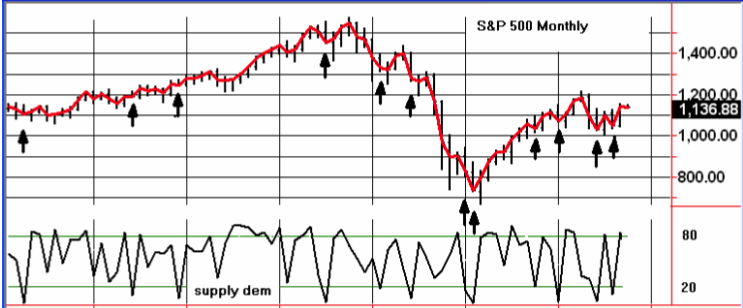
In the August newsletter, we introduced a new indicator. We said that if the S&P 500 closed in the bottom 20% of the range for a particular month, that the market should be higher over the next two months.
This situation happened at the end of August and we suggested that the market would be higher at the end of October.
Since that signal, the S&P 500 is up over 9%. This means that October could actually fall back by less and the signal would still be correct. However, most of the signals do give us two months on the upside and in the chart shown below, the second month has been up in 8 of 11 previous instances.
Also, in the chart below, the total profits from the signals shown have been 424 S&P 500 points while the S&P 500 itself was up only 30 points.
In spite of this tendency, this is October and there have been some pretty sharp declines in this month over the years and we shouldn’t be too surprised if it happens again.
For instance, in 2009, the S&P 500 dropped 4.7% at one point in the month of October. In 2008, it lost 20%. In 2007, 4%. In 2006, there was no appreciable loss, but in ‘05 and ’04 the S&P 500 lost 4% and 3% respectively. In 2004 and 2003, there was no significant loss, but September had sharp drops. So in this time frame, we have seen a number of reactions.
However, there is a silver lining. Except for 2008, these declines were excellent buying opportunities so if we do get a substantial loss this month, it may well present some profit potential.
Before the end of August, we took note that a number of analysts on CNBC were telling us that September was a poor month from a historical standpoint. This was in spite of the fact that 5 of the last 6 have been higher. It was against the backdrop of a very poor August. So now, with the best September since 1939, behind us, no one is warning us about the potential ravages of October.
We’ll see if this anecdotal evidence has any relevance.
STRONG INTERNALS
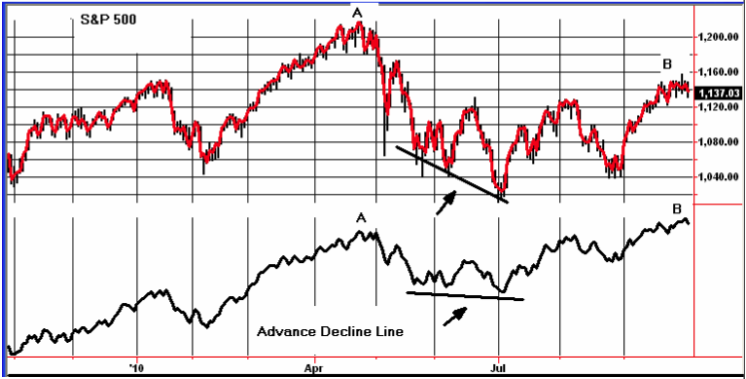
We continue to be impressed by the strong internals. Look at the chart below. Note that on the S&P 500, point B is considerably below point A. However, on the advance decline line directly below, point B is higher than point A.
In other words, the A-D line has already made up the loss from late April while the S&P 500 and
most other indices still have a considerable distance to go.
The advance decline line frequently gives you clues about market strength. Note in the middle of the charts that the down slant of the lows for the S&P is much steeper that the lows for the A-D line (arrows).
This is one reason that near term drops aside, we look for higher prices into the end of the year, perhaps considerably higher.
Adding to the bullish evidence was the action in September. According to a study shown on CNBC, since 1950, if September is higher, there is a 74% chance that the fourth quarter will also be higher. We haven’t checked this assertion, but it seems reasonable. We suspect that it is correct.
For the US Dollar, Bonds Gold, News & the Market, the London Market, High Yield Investments, Intermediate Term, Trading Short Term, Short Term Indicators…….
Subscribe to the Todd Market Forecast online HERE or Contact HERE
Stephen Todd RANKED # 1 BY TIMER DIGEST
A Short Biography
Since 1984, the editor and publisher of the Todd Market Forecast, a monthly newsletter with emphasis on the stock market, but also with sections about gold, oil, currencies and bonds.
Steve spent a number of years as an engineer in a steel mill before becoming a stock broker with a number of Firms, including E.F. Hutton, Bache and Paine Webber.
He has published articles on the economy and the stock market in the following publications: Barron’s, Stock Market Magazine, Futures Magazine, The National Educator and others.
His stock market commentary is heard on CNBC, Bloomberg, Associated Press Radio, Business Radio Network, CKNW in Vancouver, British Columbia, KFWB, Los Angeles and ROBTV in Toronto, Ontario.
-
I know Mike is a very solid investor and respect his opinions very much. So if he says pay attention to this or that - I will.
~ Dale G.
-
I've started managing my own investments so view Michael's site as a one-stop shop from which to get information and perspectives.
~ Dave E.
-
Michael offers easy reading, honest, common sense information that anyone can use in a practical manner.
~ der_al.
-
A sane voice in a scrambled investment world.
~ Ed R.
Inside Edge Pro Contributors

Greg Weldon

Josef Schachter

Tyler Bollhorn

Ryan Irvine

Paul Beattie

Martin Straith

Patrick Ceresna

Mark Leibovit

James Thorne

Victor Adair