
Daily Updates
Why Traders Fail
Stockscores.com Perspectives for the week ending October 1, 2010
In this week’s issue:
Weekly Commentary
Strategy of the Week
Stocks That Meet The Featured Strategy

Trading is simple, but not easy. Despite its simplicity, most people who try to trade have a hard time finding consistent profitability. Trading well is as much about doing certain things right as it is about avoiding the common mistakes. Here is a list of the common causes of trader failure.
1. Lack of Knowledge
Trading does not have to be complex or involve a sophisticated understanding of capital markets. In one day, I can teach a person the skills that I use as a trader. However, like riding a bicycle, being good at applying those skills takes practice and usually involves some painful mistakes through the learning process. You probably were pretty wobbly the first time you pedaled a bicycle but, with time, you found your balance and got good at it. Trading is no different.
However, unlike riding a bike, there are thousands of ways to trade. You have a choice in what you trade, the hold period for your trades and the strategies you apply.
There are many options for people looking to learn trading. You can take classes, study online, read books or try to figure it out on your own. Each approach to learning has a cost; don’t underestimate the price for how you intend to learn.
With so many approaches to acquiring the knowledge you need to trade, there is not necessarily just right and wrong ways to learn. It becomes a question of what is right for you, what best fits your learning style. What is most important is that you get educated before you risk a penny of your money in the market. Most people can’t beat the market because they don’t know what they are doing. Don’t let a lack of knowledge ensure your failure.
2. Poor Risk Management
The focuses for most aspiring traders are the decisions to enter and exit the trade. They spend a lot of time trying to find the right stock to buy and then try to make a good decision on when to enter. They miss out on the most important component of the trading process.
Risk management is that often forgotten piece of the trading puzzle. Without capital to trade with, you have nothing to do. Protect your capital first and never try to get rich overnight. Some might get lucky in the short term but those who fail to manage risk over the longer term will go broke. That is guaranteed.
For every trade, you need to know your downside. Being wrong is part of trading so you must have a plan for what to do when you are wrong.
3. Insufficient Capital
Since being wrong is part of a profitable trading strategy, you need to allow for drawdowns of your capital base. There will be times when market conditions will not be great for the strategies you are applying.
When planning your trading business, you must allow for this potential deterioration of capital. You may make five steps backward before you start to go forward, make sure you have the capital to ride out these losing periods.
4. Trading Without Proven Strategies
I have seen a lot of people trade without a strategy that they have tested. They think that they can beat the market by doing things that make sense. This is often the biggest problem with people who are successful in other areas of life.
It is a bad idea to think that you can beat the market by being smart. The markets rarely do what makes sense, at least in the context of the information that we have. This is because the market often moves on information that most of us just don’t have.
For that reason, it is smart to have a set of trading rules that you first test exhaustively before you trade. Your testing must determine whether the rules yield a positive expected value. Over a large number of trades, your rules should make a profit. What happens on any individual trade really does not matter.
5. Failure to Follow Rules
The rules you define and test are only effective if you follow them. While this is easy for all of us to understand, it is a very hard thing to actually do. We break rules because we are afraid of losing money. Emotion is a hard thing to overcome.
To minimize the impact of emotion requires a comfort with the risk you are taking. Most traders find that paper trading, simulated trading without using real money, is not too hard. It is only when they have their capital at risk that they start to make mistakes.
The solution to this problem is to not take more risk than you are comfortable with. The best traders are those who don’t care about the money. The more you can do to take out emotion, the better your chances will be to follow the trading rules.
(continued below)
- Get the StockSchool Pro Free

Open and Fund a brokerage account with DisnatDirect and receive the StockSchool Pro home study course free, including special Pro level access through the DisnatDirect client website. Offer only available to Canadian residents. For information, click HERE
2.6. Lack of Determination
Doing anything well requires the determination to learn and gain expertise. This is very much the case for trading because it is such an emotional pursuit. There will be times when the novice trader will feel overwhelmed with emotion and ready to give up.
I don’t think trading is something that can be done well by someone who does not like it. Having a passion for trading is what will get you through the hard times and ensure that you stick with it when your heart may tell you otherwise.
7. Poor Focus
The shorter the time frame you trade, the more focused you need to be. Position trading (hold period measured in weeks or months) is not that demanding mentally because you have a lot of time to make your trading decisions. Swing trading (hold period measured in days) requires you make quicker decisions but is not as demanding as day trading. The day trader (hold periods measured in hours or minutes) has to make decisions in only seconds and work hard to not miss out on good trading opportunities.
It is hard to trade if you have a lot of distractions while you are trading. You have to do what is necessary to avoid letting outside factors have an effect on your trading decisions.
8. Inability to Adapt
The market is constantly changing and you need to be able to adapt with it. That means applying trading strategies that are appropriate for the present conditions; you may not want to apply a buying strategy in a market with strong downward momentum.
Avoiding chasing the market with your rules is a challenge that many traders have trouble with. You should have a set of trading principles that do not change over time, these based on source of opportunity that you are pursuing. Do not constantly change the rules of your tested and proven strategies.
However, how and when you apply your strategies will change as the market evolves. I keep a stable of trading strategies that I apply as conditions warrant.

Here are a couple of stocks that I found today using one of the strategies available with the Stockscores Market Scan. In general, I scan for stocks that are behaving abnormally and breaking out from a predictable chart pattern. The most important part of this process is inspection of the chart and assessment of the reward for risk component of the trade.
Both of these stocks were featured to the subscribers of my daily newsletter during the trading day today. Daily newsletter subscribers get an email or cell phone text message when I find these stocks and are able to get in earlier in the day.

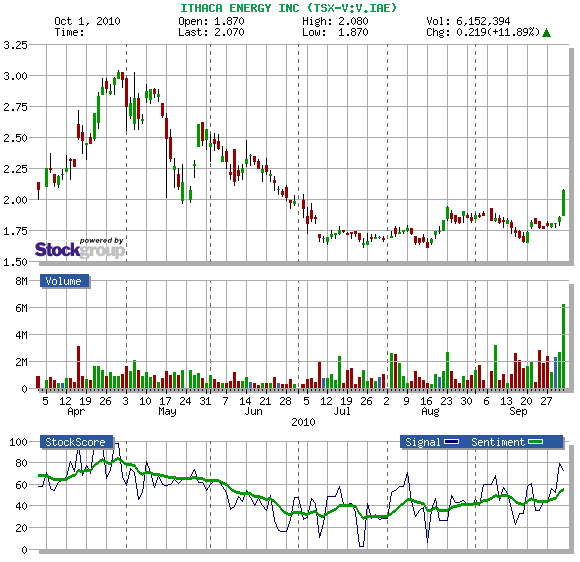
1. V.IAE
V.IAE traded very abnormal volume today as it broke out from a rising bottom period of sideways trading. The Energy sector is strong and this stock looks to have good potential provided it can hold above support at $1.79.
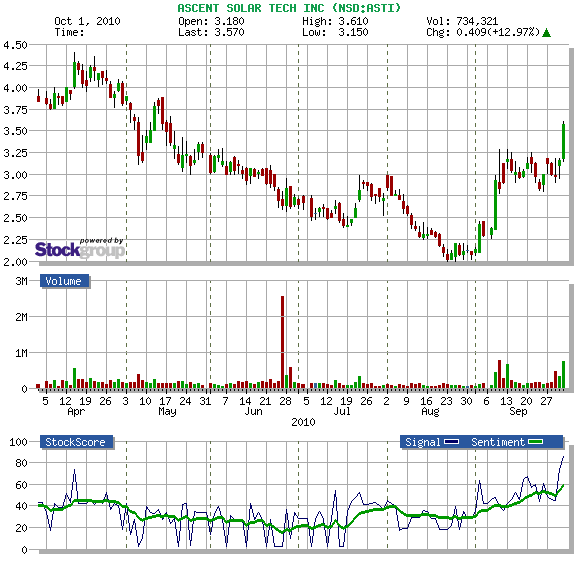
2. ASTI
ASTI has a similar chart pattern set up to V.IAE as it breaks from a short, rising bottom consolidation. Support at $2.95.
References
Get the Stockscore on any of over 20,000 North American stocks.
Background on the theories used by Stockscores.
Strategies that can help you find new opportunities.
Scan the market using extensive filter criteria.
Build a portfolio of stocks and view a slide show of their charts.
See which sectors are leading the market, and their components.
Click HERE for the Speaker Lineup and to Purchase the video if you want to learn from some of the worlds best traders including Tyler Bollhorn.

Tyler Bollhorn started trading the stock market with $3,000 in capital, some borrowed from his credit card, when he was just 19 years old. As he worked through the Business program at the University of Calgary, he constantly followed the market and traded stocks. Upon graduation, he could not shake his addiction to the market, and so he continued to trade and study the market by day, while working as a DJ at night. From his 600 square foot basement suite that he shared with his brother, Mr. Bollhorn pursued his dream of making his living buying and selling stocks.
Slowly, he began to learn how the market works, and more importantly, how to consistently make money from it. He realized that the stock market is not fair, and that a small group of people make most of the money while the general public suffers. Eventually, he found some of the key ingredients to success, and turned $30,000 in to half a million dollars in only 3 months. His career as a stock trader had finally flourished.
Much of Mr Bollhorn’s work was pioneering, so he had to create his own tools to identify opportunities. With a vision of making the research process simpler and more effective, he created the Stockscores Approach to trading, and partnered with Stockgroup in the creation of the Stockscores.com web site. He found that he enjoyed teaching others how the market works almost as much as trading it, and he has since taught hundreds of traders how to apply the Stockscores Approach to the market.
Disclaimer
This is not an investment advisory, and should not be used to make investment decisions. Information in Stockscores Perspectives is often opinionated and should be considered for information purposes only. No stock exchange anywhere has approved or disapproved of the information contained herein. There is no express or implied solicitation to buy or sell securities. The writers and editors of Perspectives may have positions in the stocks discussed above and may trade in the stocks mentioned. Don’t consider buying or selling any stock without conducting your own due diligence.
Market Buzz – Cash Rich Zungui Beats 2010 Earnings Expectations
The U.S. dollar weakness theme continued this Friday despite an initial drop in the Canadian dollar vs. the Greenback after a report showing that Canada’s economy unexpectedly shed 6,600 jobs in
September. The initial weakness subsided and U.S. dollar weakness mounted as investors digested a report that U.S. employers cut 95,000 jobs during the month.
The U.S. losses, which compared with expectations that payrolls would remain unchanged, spurred speculation that the U.S. Federal Reserve would turn to quantitative easing to stimulate the economy, which would further reduce the yield on U.S. debt.
On Friday, strength in fertilizer and gold propelled the S&P TSX Composite up 1.4 per cent on the week. Toronto’s benchmark index is now up over 13 per cent from the early July lows, in a rally that has caught investors off guard heading into what looked to be a dicey fall season.
Switching gears to our Canadian Small-Cap Coverage Universe (www.keystocks.com), we take a brief look at the strong results from Zungui Haixi Corp. (ZUN:TSX-V) issued this past week. Zungui is principally engaged in the manufacture and sale of athletic footwear, apparel/accessories (Sportswear Product Line), and casual leather footwear (Casual Product Line). Both product lines are marketed in the Peoples Republic of China (PRC) under the well-recognized ZUNGUI brand.
For the year ended June 30, 2010, total revenue increased 18 per cent to $163.9 million from $138.7 million in 2009. In RMB (Chinese currency), revenue increased 30 per cent to RMB 1,061.3 million for the year compared to RMB 815.6 million last year. Net income increased 17 per cent to $27.0 million, or $0.43 per share fully diluted.
We were very impressed with Zungui’s quarterly and year-end results, which beat expectations. In particular, cash flow surged to $30.3 million, or $0.49 per share, compared to $17.4 million for the prior year. The company now has $85.9 million, or $1.38 per share, in cash in the bank with no debt.
Looniversity – What Is a Company Worth?
A common misconception amongst novice investors is to equate the value of a company directly to its stock price. This might sound counter-intuitive, but it’s incorrect to think that a company trading at $50 is worth less than another trading at $100.
What a company is actually worth (its value) is its market capitalization. Market cap (as it is commonly referred to) is the stock price multiplied by the number of shares outstanding (the total number of shares a company has). For example, a company that trades at $100 per share and has 1,000,000 shares outstanding has a lesser value than a company that trades at $50 but has 5,000,000 shares outstanding ($100 x 1,000,000 = $100,000,000 while $50 x 5,000,000 = $250,000,000). Market capitalization changes every day when the price of a stock moves up and down. It will also change if a company issues new shares or buys back shares from the public.
Let’s take a look at an example from reality. The current price of Microsoft’s stock is $29.38 and its market cap is $273.62 billion; IBM’s stock price is currently trading substantially higher at $124.29, but the company is worth less overall since its market cap is $170.70 billion. This means that even though IBM’s stock is higher, investors feel that the value of Microsoft, as a whole, is about 60 per cent greater than the value of IBM.
The bottom line is – don’t equate a company’s value with the stock price
Put it to Us?
Q. Although I have yet to invest in the markets, watching stocks over the past three years has left me with an uneasy feeling. Is it finally a good time to start investing in stocks?
– E. Richard; Edmonton, Alberta.
A. Timing the market or trying to find the perfect entry point is often a fool’s game. In fact, in your case, we suggest you begin by first evaluating whether or not purchasing individual stocks is the right decision for you.
Empirical studies have shown that over the long term (ten years or greater), equities or common stock vastly outperformed all other investment tools including bonds, term deposits, and preferred shares. As a result, for the majority of the investing public, long-term exposure to common stocks through individual companies, mutual funds, or index-based investments is usually a good idea.
Having said this, your decision must take into account your individual risk profile and ultimately allow you to sleep soundly at night. If, even after you are told that investing is a long-term practice, you find that you cannot put aside the daily fluctuations, then maybe common stocks are not for you.
KeyStone’s Latest Reports Section
- Quick Service Restaurant Franchiser Posts Solid First Nine-Months, Holds Strong Cash Position – Near-Term Rating Shifted (Flash Update)
- Rare Earth & Magnetic Powder Manufacturer Share Price Surge Provides Excellent Profit Taking Opportunity – Near-Term SELL (Flash Update)
- Pure Play Chinese Construction Company, Reports Strong 2010 Result, Solid Backlog, PE of under 5, Yet Shares Drop? – SPEC BUY (Flash Update)
- China-Based Athletic Apparel Manufacturer Posts Excellent 2010 Results, Strong Cash Flow, $85.9 Million or $1.38 Per Share in Cash, No Debt – Reiterate BUY (Focus BUY) (Flash Update)
- Cash Rich Base Metal Producer with Low Relative Multiples , Benefitting from Gold & Silver By-product Price Surge – New Focus BUY (New Buy Report)
China’s Currency War:
Enemy #1 for Global Economy
When Brazil’s finance minister said the world was in a currency war, it came as big news to many people — a surprising “new” economic threat. But there’s nothing new about a currency war. China has been waging a war — an economic war — with its currency for a long time.
Over the last 14 years, China’s economy has grown four times as fast as the U.S. economy, and it has quickly soared to become the world’s second-largest. The key to China’s success has been a weak yuan — it’s method of manipulating a sustained advantage over its competitors in global trade.
This strategy of manufacturing an artificially weak currency to corner the world’s export market has led to a massive imbalance in global trade. It was a key contributor to the current economic crisis, and it’s proving to be a key barrier to a sustainable global economic recovery.
Put simply, these global trade imbalances have proven a recipe for more frequent boom and bust cycles.
That’s why the G-20, the IMF, the OECD — all of the major institutions and central banks of the world have been harping on the importance of repairing global imbalances. And all along they’ve been speaking directly to China.
Yet after all of the negotiations, threats from U.S. Congress and concessions China is said to have made, it has managed to gain an even bigger trade advantage through the three years of global economic crisis!
Consequently, we’re seeing the rise in currency market interventions from some of China’s key trade competitors as a way to combat their damaging currency disadvantage.
This is a clear sign the team effort pledged by G-20 members to combat the economic crisis is falling apart …
Last March, when the G20 assembled during the depths of the worst economic crisis, they broke camp with a vow to fight the battle together — to act in coordination.
Central bankers slashed interest rates. Governments rolled out fiscal stimulus packages, and the world economy started producing what many thought was an impressive recovery.
But it turned out to be nothing more than a stimulus-induced flop.
Now leaders around the world are seeing the writing on the wall — a long period of deleveraging, littered with more economic pain and shocks. And the vow of coordination is giving way to every man for himself.
Growing Division
Japan stepped in last month to weaken the yen with its biggest daily intervention on record, buying more than $23 billion in the open market. Historically intervention in a major currency is a coordinated event, supported by other major central banks. But this time Japan went in alone.
South Korea, Thailand and Singapore have been consistently intervening to stem the tide of strength in their currencies in recent months.
And Brazil has been doing the same, plus tacking on additional taxes on foreign capital to deter the influx of hot money flooding through its borders — i.e. currency controls.
Take a look at the chart below and you’ll understand why …
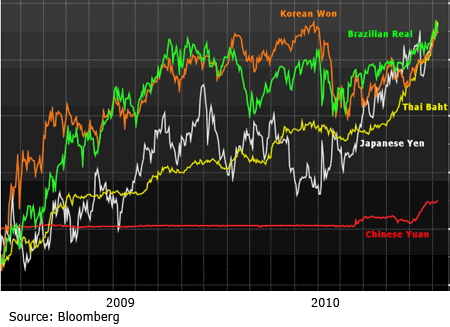
You can see the strong rise in Asian currencies over the past year — with one exception, the Chinese yuan. China’s manipulation of the yuan has consistently allowed it to corner the lion’s share of global exports.
But now its trade competitors are fighting back through currency manipulation of their own. Consider these growing responses to the weak yuan the early warning signs of a spreading …
Threat of Protectionism
I’ve said in past Money and Markets columns that ultimately, the rest of the world will have to choose action over diplomacy in dealing with China. And now we’re starting to see it.
The next steps will likely be imposing sanctions on China and trade restrictions on Chinese goods — an effort that is already progressing through Congress.
But the problem with protectionist activity is that it tends to bring about retaliation, and it becomes contagious. That’s exactly what happened in the Great Depression. And it’s what brought global trade to a standstill.
Today, with unemployment sustaining high levels, the political support to act is there. Many would think that “standing up to China, is standing up for us.”
Of course, when jobs are tight the perception by most workers towards globalization becomes more negative. And studies show that during these times, the number of people who favor the idea of higher tariffs on imported goods rises considerably.
As it becomes increasingly evident that China will not play ball on allowing its currency to appreciate to a fair value, geopolitical tensions are bound to elevate, and protectionism will likely follow.
And given the sovereign debt crisis that’s already underway, protectionism is yet another risk to the global economy that increases the probability of another bout with recession.
In fact, protectionism has historically put fragile economies in a deeper and more prolonged crisis …
Take a look at this chart of the S&P 500 from the Great Depression years. It gives you a clear understanding of why protectionism is so dangerous.
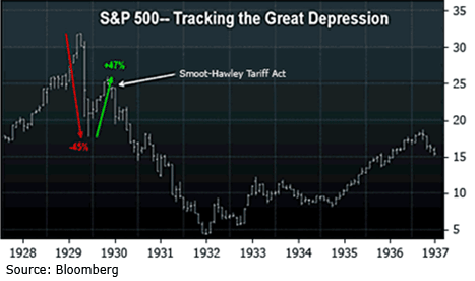
You can see that the stock market topped in 1929 and fell 45 percent in just three months. Then, it had a sharp correction, recovering 47 percent from the November ‘29 low.
In June 1930, two U.S. Congressmen, Smoot and Hawley, championed a bill to slap a tariff on virtually every foreign good. And that was the catalyst for the second leg down … a massive plunge in the stock market and arguably the catalyst for the Great Depression.
As an investor, it’s always important that you anticipate plausible scenarios. If a China conflict scenario plays out, you can expect the outcome to be bad for global growth and bad for global financial markets.
Regards,
Bryan
P.S. I’ve been showing my World Currency Alert subscribers how to use exchange traded funds to profit from rising and falling currencies, like the Japanese yen, the Chinese yuan and the U.S. dollar. Click here to discover more.
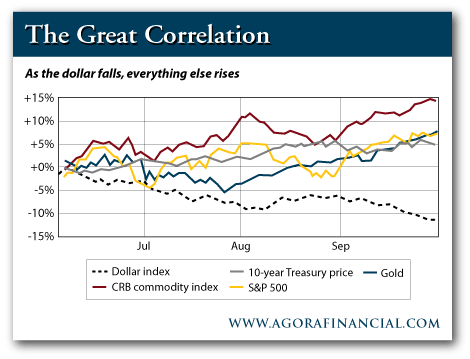
Paper is out; stuff is in. That’s what the markets are telling us right now. The dollar, that esoteric, floating abstraction upon which the financial world erects its sandcastle economies, plumbed a new seasonal low this week, with the dollar index flirting dangerously with its support level of 77. “Stuff,” as measured by the CRB Commodity Index, meanwhile, soared to within reach of the psychological 300-point milestone.
Indeed, everywhere we look, stuff is on the march.
Gold opened to another record above $1,365 on Thursday, then retraced a bit to around $1,345 as of this writing. Oil shot through $84 a barrel this week and copper busted the $3.75 mark, reaching ever closer to the 2008 high of $4.08. Not to be outdone, silver climbed to a fresh 30- year high, topping $23 per ounce by Friday morning.
The message from Mr. Market, in anticipation of the Fed’s QEII program (second round of quantitative easing – fancy jargon for “money printing”) is clear: Increasingly, investors are coming to prefer the sober, welcoming embrace of physical materials to the unrelenting, drunken currency abuse perpetrated by the world’s central bankers.
In actual fact, there’s not a whole lot that hasn’t been rallying in dollar terms lately…except, of course, the reputation of those responsible for destroying its credibility.
While the dollar index plummeted 12.4% from early June to the end of September – even as headlines persisted about a shaky euro – everything else has benefited. Our mates over at The 5 sketched up this neat little chart, which really puts the story in perspective:
One particularly notable – and worrying – component of the skyward global commodity trend can be found in the agricultural sector. The story here is part weak dollar and part supply-demand dynamic. Unlike metals or energy, however, the agricultural component of the commodity complex is not typically a “dollar diversification” tool for the emerging market’s growing middle classes, or for the 1.2 billion (according to UN data) hungry souls around the world. For them, food is a necessity, not an investment strategy. The demand for dietary staples, therefore, does not enjoy the same price elasticity as does, say, an iPod or a spiffy new electric can opener. And, as the global population swells to 9 billion by mid-century, you can bet this is a trend with marathon legs.
Partly due to this reality, farm commodities – or “ags” – have staged a remarkable rally this year.
Wheat, for its part, is climbing back toward its 2008 crises levels. Prices have risen some 75% since June as the Black Sea region suffers through the most severe heat wave in nearly half a century. The affected area ordinarily produces roughly one quarter of the entire global output. Consequently, experts forecast Russia’s harvest will come in around 60 million tonnes this year, well shy of the 75 million tonnes consumed domestically. Moscow has since implemented a ban on grain exports until late 2011.
Chris Weafer, chief economist at Uralsib Financial, recently told The Financial Times that, even allowing for the country’s emergency stockpile of 9.5 million tonnes, “We think Russia faces shortfall of 17 million tonnes and will have to import next year.”
Of course, supply shocks have been around as long as Mother Nature herself. Extreme weather patterns probably spawned the Biblical concept of the “seven fat years followed by seven lean years.” Droughts in Australia, floods in Pakistan, heat waves around the Black Sea and cold snaps across the south all collude to hinder global production, and have done, in one form or another, for millennia. But now, more than ever, global population growth and the emergence of the middle classes in developing markets are trimming that critical margin for error.
As Javier Blas reports in the FT, “…the most important underlying trend is the rise of emerging markets, where there are not only a growing number of mouths to feed, but where people with rising incomes want to eat higher-quality food – notably chicken, pork and beef. That in turn increases global demand for grain for animal feed.”
Corn, for example, is up more than 40% since June as global stock levels, with a “stock to usage ratio” of a paltry 12%, dipped to their lowest levels in almost four decades. Unfavorable weather patterns in the US kicked the rally off, but it was the revelation that China, feeding the fastest growing middle class on the planet, imported a record 432,000 tonnes in August that really kicked it into overdrive. This trend is all the more alarming, at least from a geopolitical perspective, when one considers that the US diverts a little over one third of its entire crop production to ethanol for fuel, a boondoggle that led one wry commentator to declare the program a blatant act of “unsustainable, government-sponsored food burning.”
To be sure, the hand of the state is always a dead weight on production, but when it comes to food, the matter quickly transforms from one of mere-to-moderate inconvenience to one of severe-to- apocalyptic life and death.
Moreover, if analysts like John Clemmow of UBS are correct, what’s on tap in the months to come could dwarf even the epic food crises of ’08.
“Clemmow maintains that despite riots and rationing at the time, there was no rice shortage in 2008,” relayed The 5 earlier this week. “The shortage two years ago was the result of governments panicking over supplies.”
But “Unlike in 2008,” says Clemmow, “there is now a possibility that with export bans in place, production problems in Pakistan and the strong suspicion that China and the Philippines will be importing in large quantities, we could be in for a fundamental squeeze.”
“Rice is the new iron ore,” Clemmow concludes, “and corn the new gold.”
As the food crises of 2008 illustrated all-too-clearly, the world’s dietary consumption habits seems to be approaching an important inflexion point, where a hungry emerging population literally eats into the market’s ability to absorb supply shocks. It would be foolish, and immoral, to blame the hungry for demanding their daily bread…and equally blind to assume they’ll ever be satisfied without it.
Regards,
Joel Bowman
For The Daily Reckoning
P.S. Traders looking to cash in on the run up in commodities are well advised to check out our Resource Trader Alert. Editor Alan Knuckman is on a “nine for nine” winning streak right now, including a gold play his readers cashed out of just this past Monday for a tidy gain of 221% in a little over five months.
Until Wednesday, his Resource Trader Alert is going out the door for half price. Details Here.
— Mayer’s Special Situations Resource Report —
American experts call this unconventional new natural gas recovery program…
“The Biggest Resource Breakthrough Since the ‘Beaumont Miracle’ of 1901”
But only one of these cutting-edge companies offers you the “secret wealth advantage” I reveal right here. (Click to Cont. Reading)
The just-released Labor Department report on the U.S. job market in September is a shocker! It’s telling us, with no punches pulled and no ambiguities, that the once-great American jobs machine is breaking down like a rusty old clunker, and all the Fed funny money in the world can’t get it fired up again!
Just look at the job numbers …
- The U.S. economy shed 95,000 jobs in September, up from 57,000 in August and the worst performance since June.
- The “official” unemployment rate held at 9.6 percent. But if you include discouraged and underemployed workers, you get an all-in number of 17.1 percent! Think about that: Almost 1 in 5 Americans can’t find solid, gainful employment … or have basically given up looking!
- Construction lost another 21,000 jobs. Manufacturing shed another 6,000 jobs. IT employment slumped for the second month in a row. While the financial sector shed workers for the FIFTH consecutive month. And the government? A nasty loss of 159,000 jobs, with state, local, and federal governments ALL letting workers go!
- What about wages? No good news there, either! Average hourly earnings flatlined. Companies simply have no reason to pay people more when applicants are a dime a dozen!
Here’s the problem: The Fed seems to think it can just throw money out of helicopters and solve all the economy’s woes. But it’s tried that TWICE before — and BOTH times it just inflated new asset bubbles, first in dot-coms and second in housing. Meanwhile, those free-money binges failed to ignite the real economy.
Albert Einstein famously said the definition of insanity is doing the same thing more than once and expecting a different result. Well now, despite the dismal failure of “QE1,” the Fed is about to roll out QE2. It won’t do a shred of good for the labor market, retail sales, housing, or industrial production — just like QE1 didn’t. But it IS “accomplishing” ONE thing —driving the price of certain assets like gold and silver or wheat and soybeans through the roof … and CRUSHING the value of the U.S. dollar.
Unemployment Explodes into Election Campaigns
Now, suddenly, with today’s shocking report from the Labor Department, unemployment is going to literally EXPLODE in the midst of scores of mid-term election races and overwhelm almost every other issue.
Best wishes,
Mike
This investment news is brought to you by Money and Markets. Money and Markets is a free daily investment newsletter from Martin D. Weiss and Weiss Research analysts offering the latest investing news and financial insights for the stock market, including tips and advice on investing in gold, energy and oil. Dr. Weiss is a leader in the fields of investing, interest rates, financial safety and economic forecasting. To view archives or subscribe, visit http://www.moneyandmarkets.com.
-
I know Mike is a very solid investor and respect his opinions very much. So if he says pay attention to this or that - I will.
~ Dale G.
-
I've started managing my own investments so view Michael's site as a one-stop shop from which to get information and perspectives.
~ Dave E.
-
Michael offers easy reading, honest, common sense information that anyone can use in a practical manner.
~ der_al.
-
A sane voice in a scrambled investment world.
~ Ed R.
Inside Edge Pro Contributors

Greg Weldon

Josef Schachter

Tyler Bollhorn

Ryan Irvine

Paul Beattie

Martin Straith

Patrick Ceresna

Mark Leibovit

James Thorne

Victor Adair